Winning Retail Store Transformation Approaches Using AI

AI helps with retail store transformation when stores adopt new technology and establish clear goals. They also need to monitor their results. Many store leaders witness positive outcomes after implementing AI. For instance:
69% of stores increase their profits each year.
72% reduce their operational costs.
85% of leaders have already integrated AI into their retail store transformation efforts.
Metric Type | |
|---|---|
Customer Experience | Conversion rate, average order value |
Operational Applications | Inventory turnover, labor efficiency |
Stores can evaluate their readiness for retail store transformation. They should also strategize the steps necessary to ensure successful changes.
Key Takeaways
AI helps stores do better by making shopping personal for each customer. Stores that use AI for this see sales go up by 10-15%.
Smart inventory management with AI helps stores avoid running out of items or having too many. This saves stores up to 25% in costs and makes sales go up by 15%.
AI lets stores change prices quickly. This helps stores make 25% more profit and can make sales go up by 5-10%.
Using AI to automate work makes stores run smoother. Stores save money and make fewer mistakes. Workers can spend time on important jobs.
Stores need to check if they are ready to use AI. They need clear goals and good data management to make AI work well.
AI Strategies for Retail Store Transformation

Personalization and Customer Experience
Retailers use AI to make shopping special for each customer. Recommendation engines suggest products based on what you bought before. Chatbots answer questions fast and give advice just for you. Sephora’s chatbot shares beauty tips. Domino’s Pizza’s chatbot helps you order food. AI watches how customers act online. Stores use this to give better deals and offers. These ideas help stores keep customers coming back and boost sales.
Tip: Stores using AI for personalization get more repeat buyers and higher sales.
Evidence Type | Statistic/Fact |
|---|---|
Consumer Preference | 70% of consumers prefer personalized search results |
Sales Increase from Personalization | 10-15% increase in sales for companies using AI |
Customer Expectation | 71% of consumers expect personalized experiences |
Return Likelihood | 76% of consumers are more likely to return to retailers offering personalization |
Many shoppers like chatbots and support agents. About 40% of people prefer these tools. Almost 80% are more likely to buy when stores offer personalized experiences. Most shoppers want deals that help them save money.
Some big retailers use AI to grow sales. Sephora saw sales go up by 25% after adding chatbots. Amazon uses AI to suggest products. This helps customers find things they want and buy more.
Smart Inventory Management
AI helps stores keep track of inventory better. Algorithms check stock levels and compare them to sales. This lowers mistakes and keeps shelves full. AI guesses what customers will want by looking at old sales and things like holidays or weather. Stores don’t run out of popular items or have too much extra stock.
AI inventory management fixes problems from changing demand and supply chain issues.
Real-time data helps stores guess demand and buy smarter.
Stores can lower both overstocks and stockouts with AI.
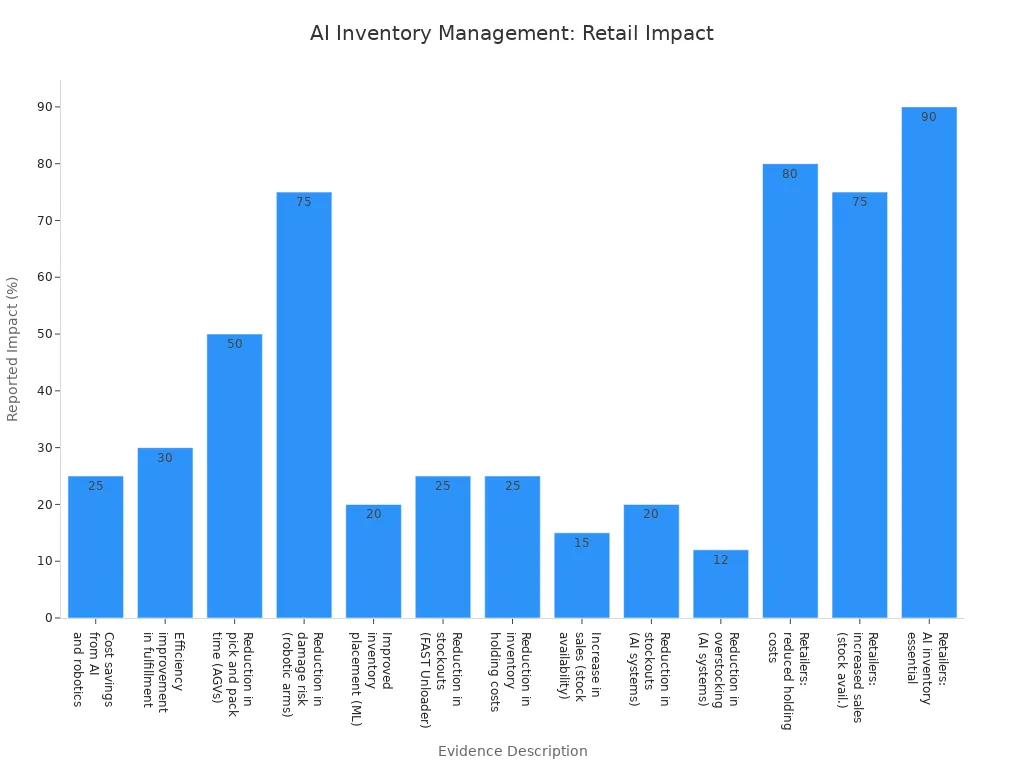
Evidence Description | Reported Impact |
|---|---|
Cost savings from AI and robotics in inventory management | Up to 25% |
Efficiency improvement in fulfillment centers | Up to 30% |
Reduction in time to pick and pack items using AGVs | Up to 50% |
Reduction in risk of damage to items using robotic arms | Up to 75% |
Improvement in inventory placement using machine learning | Up to 20% |
Reduction in stockouts due to FAST Unloader | 25% |
Reduction in inventory holding costs due to AI | 25% |
Increase in sales due to better stock | 15% |
Reduction in stockouts from AI systems | 20% |
Reduction in overstocking from AI systems | 12% |
Retailers reporting lower inventory costs | 80% |
Retailers seeing more sales from better stock | 75% |
Retailers saying AI inventory management is essential | 90% |
A coffee shop uses AI to watch inventory and learn what customers like. This helps the shop keep favorite items in stock and make customers happy.
Dynamic Pricing and Promotions
AI lets stores change prices and deals quickly. Algorithms look at demand, inventory, and how customers shop. Stores can give special deals when demand is low. They can raise prices when items are popular. This helps stores compete and make more money.
Capability | Description |
|---|---|
Real-Time Data & Performance Tracking | Lets stores change prices and deals right away. |
Personalization & Segmentation | Gives special prices and deals to each person. |
Advanced Analytics | Turns lots of data into ideas for pricing and deals. |
Dynamic Pricing Engine | Changes prices fast using demand, inventory, and customer actions. |
Omnichannel Integration | Makes sure online and store prices match. |
Automation of Pricing & Promotions | Helps teams manage prices and deals with easy rules. |
Stores using smart pricing see better sales and loyal customers. Amazon’s pricing system changes prices every ten minutes to match demand and competitors. AI pricing can raise profit margins by 25%. Many stores report profit increases of 5% to 10% after using AI pricing tools. These tools also make pricing faster, with up to 90% better results than old ways.
AI pricing uses real-time data to change prices and deals.
Stores can make more money and manage inventory better.
Dynamic pricing helps stores react fast to market changes.
Automated Operations
AI automates many jobs in stores. Algorithms study transactions to spot fraud. AI security systems watch for trouble and keep stores safe. Chatbots and virtual helpers answer questions and help with shopping. Smart shelves let customers scan barcodes for product ideas.
Automated customer service helps with questions and builds good relationships.
AI keeps track of stock and cuts down on mistakes.
Supply chain optimization uses real-time data to make deliveries faster.
Fraud detection keeps shopping safe.
Benefit | Description |
|---|---|
Supply Chain Optimization | AI finds the best delivery routes by looking at real-time and old data, including weather and traffic, making logistics better. |
Customer Satisfaction | AI gives customers special offers, making shopping more fun and quick with chatbots. |
Error Reduction | AI collects data automatically, lowering mistakes in sales and demand guesses, so stores don’t miss sales. |
Cost Reduction | AI helps stores guess demand, lowers inventory and labor costs, and helps stores get better deals with suppliers, cutting costs. |
Store transformation gets easier when stores automate jobs. Workers can focus on important tasks while AI does routine work. Stores save money, make fewer mistakes, and keep customers happy.
Note: Automation helps stores work better and keeps customers satisfied.
AI Success Stories in Retail
Leading Retailers’ Transformations
Many big retailers use AI and see great results.
Amazon uses AI for shopping, pricing, and stores without cashiers.
Walmart uses AI to guess what people will buy and manage stock.
Alibaba Group studies how customers act and uses smart retailing.
Target uses AI to move stock and guess demand.
H&M makes better clothes and wastes less with AI.
The Home Depot uses AI for online shopping and supply chain work.
These companies show that AI helps stores grow and work better.
In-Store AI Applications
Stores use AI to help customers and make work easier. Walmart uses AI to find empty shelves and spot popular items fast. Zalando has virtual fitting rooms. Customers make 3D avatars to try on clothes. This helps lower returns.
Application Name | Description |
|---|---|
Bodega’s AI-driven essentials | The store uses computer vision and AI to pick and refill items based on where it is. |
DeepMagic’s future store formats | The store works without staff but still gives a good experience. |
Macy’s On Call app | The AI shopping helper finds products and checks stock, making shopping better. |
Amazon Go | The store lets you pay without a cashier and tracks products with AI, changing how you shop. |
AI with cameras and sensors helps stores see where people walk. It helps stores find items that don’t sell much and make special deals.
Key Lessons Learned
Stores learned important things from using AI.
They need clear plans for AI, so leaders set rules.
Only a few workers need new skills, but training is still needed.
Leaders focus on guessing demand, helping workers, and IT support for AI.
Stores spend more money on AI, both in IT and other areas.
Rules help keep data safe and protect privacy.
AI changed how people work. Most leaders see workers use AI tools a lot. Many workers want to learn about AI, and some would change jobs to learn more. Stores get better customer service, smarter choices, faster work, lower costs, and stronger business.
Implementation Best Practices
Enable: Assess and Prepare
Retailers start by checking if they are ready for AI. They make clear goals for retail store transformation. They look at market trends to learn what is new. They spend money to keep data correct and easy to use. Teams hire AI experts and pick tools after looking at what they need. Security and rules keep data safe from harm. Retailers test AI with small programs before using it everywhere. They use AI to help customers and make work easier. Leaders want teams to use data for choices and keep learning.
Retailers who get ready well have a strong base for AI success.
Make a plan for AI with business goals.
Spend on good data management.
Hire AI experts.
Check tools and partners.
Keep data safe with security.
Try AI before using it fully.
Use AI for better customer service.
Make work faster and easier.
Build a team that uses data.
Keep learning and changing.
Embed: Integrate AI Solutions
Retailers put AI into daily work by using best steps. They keep data safe and talk to everyone early. Teams find out what they need and pick tech that fits their goals. Workers learn how to use new tools. Clear talks help everyone know what is new.
Description | |
|---|---|
Data Security | Use strong security and follow privacy rules. |
Stakeholder Involvement | Include users and leaders from the start. |
Communication and Support | Offer help and gather feedback. |
Assess Needs | Find out what the store needs most. |
Select the Right Technology | Pick AI tools that work with current systems. |
Train Employees | Teach staff how to use AI. |
Transparent Communication | Explain benefits and changes clearly. |
Evolve: Scale and Optimize
Retailers grow by using more AI and making it better. They set a clear plan for AI that matches business goals. Teams build skills and get better step by step. Regular checks and updates keep AI working well. Retailers share news with customers to build trust.
Strategy | Description |
|---|---|
Strategic Framework | Make a plan for AI that fits business needs. |
Phased Approach | Use more AI little by little. |
Continuous Optimization | Check and fix AI often. |
Clear Communication | Tell customers about AI changes. |
General Mills uses many models each month. They make lots of predictions and save money by wasting less.
Building Data Infrastructure
Retailers need strong data systems for AI. They manage both types of data. Good systems help stores use their own business data in AI tools. This gives better answers and solves problems. Without good data, AI only gives simple answers. Stores that focus on data plans do better in merchandising and work. A solid data plan helps stores grow and win in retail store transformation.
New data systems help stores give better service and work faster.
Team Training and Change Management
Retailers teach teams to use AI. Store workers learn to use new devices for inventory. Managers study data to make better plans and schedules. Office teams use AI for planning and forecasting. Stores start with a check to see if they are ready for AI. Leaders make a plan to keep everyone updated. Training matches each job.
Role | Training Focus |
|---|---|
Store Associates | Use AI tools for inventory counts. |
Store Managers | Read data and use AI for schedules and forecasts. |
Corporate Teams | Use advanced AI for planning and forecasting. |
Check current skills and ways of working.
Plan talks to keep things clear.
Make training for each job.
Overcoming Challenges in AI Adoption
Data Privacy and Security
Retailers face many risks with AI. Data breaches can happen if vendors do not protect information. AI systems use lots of data, so cyber-attacks are more likely. Retailers must follow strict data protection laws in each country. They use k-anonymity and differential privacy to keep customer data safe. Advanced encryption protects data when stored and sent. Regular audits and real-time checks help find problems early and keep systems safe.
Tip: Retailers should make strong data rules, use encryption, and check systems often to keep customer trust.
Change Management
Many retailers have trouble with change when using AI. Some workers are afraid of new technology. Others worry about not getting enough return on investment. Bad data can slow down progress. If leaders do not support new ideas, teams may not want to change. New data privacy laws may limit how stores use customer information.
Challenge Type | Description |
|---|---|
Workers feel nervous about new AI tools and processes. | |
Not enough ROI | Leaders worry about not getting enough value from AI investments. |
Debilitated by data | Bad or missing data makes AI less effective. |
Culture wars | Teams may not support new ideas if leaders do not encourage innovation. |
New data laws | Changing rules can make it hard to use customer data. |
Technology Integration
Adding AI to retail stores is not always easy. Connecting AI to old systems takes time and money. Retailers must manage data access and follow privacy rules. Some AI tools use only company data, but others need to protect customer information. Technical problems can happen when picking the right AI solutions. Computer vision systems may not work well in bad lighting or may mix up similar products. Adding new AI to old technology often needs big changes.
Avoiding Common Pitfalls
Retailers often run into problems when using AI. Many projects fail because they do not have clear goals. Poor data quality causes most AI projects to fail. Not enough skilled workers can slow things down. Security and privacy risks stay high, and leaders worry about breaches. To avoid these problems, retailers should set clear goals, treat data as important, train workers, and build security into every step of the AI process.
Making clear plans and investing in people and data helps retailers do well with AI.
Measuring Impact and ROI
Defining Success Metrics
Retailers must use clear metrics to see how AI helps their stores. These metrics show if their spending on AI is worth it. Good metrics show how both customers and the business benefit. For example, stores check how much stock sells at full price. They also see how often favorite items are gone. Stores look at how much shoppers spend and how often they come back.
Metric | Description |
|---|---|
Shows what percent of stock sells at full price. This tells if AI matches what people want. | |
Inventory holding costs | Stores save money by not keeping too much extra stock. This lowers storage and insurance bills. |
Stockout rate | Popular items are out of stock less often, so stores sell more. |
Conversion rate | More people who visit the store end up buying something. |
Average order value (AOV) | Shoppers spend more each time because AI suggests good products. |
Customer lifetime value (CLV) | Customers spend more over time if they like the store and keep coming back. |
Labor cost reduction | AI does jobs that workers did before, so stores save money. |
Time to market | Stores put new products on shelves faster and start selling sooner. |
Tracking Performance
Retailers watch important numbers to see how they are doing. They check if shoppers buy more or join loyalty clubs. They also see how fast they fill orders and how often things run out. Marketing teams look at how well ads work and how much it costs to get new shoppers. Money teams check if sales go up and if each shopper spends more.
Customer experience: If shoppers buy again or join loyalty clubs, AI is helping.
Operational efficiency: Fewer empty shelves and faster orders mean better inventory work.
Marketing performance: Good ads and low costs to get new shoppers show marketing is working.
Financial impact: More money per shopper and higher sales mean AI is worth it.
Tip: Checking these numbers often helps stores find problems and fix them fast.
Adapting Strategies
Retailers use what they learn to make AI work better. They build strong data systems at checkout to guess what people will buy. AI helps stores move products and deliver them faster. It also helps guess what will sell in the future.
Use checkout data to guess what people will buy next.
Let AI help move products and make deliveries faster.
Use AI to spot sales trends and plan better.
Method | Description |
|---|---|
Continuous monitoring and optimization | AI checks how things are going and changes plans if needed. |
Leveraging point-of-sale data | Checkout data helps stores know what to order and sell. |
Automation for data integration | Automated tools put all the data together fast, so stores can change plans quickly. |
AI agents check new products and give ideas to help stores sell more. They help stores react fast to changes and keep getting better results.
Future Trends in Retail AI

Emerging Technologies
Retail stores keep changing as new AI tools come out. Many stores use dynamic pricing to change prices fast. Kohl’s changes prices when stock or demand goes up or down. This helps customers trust the store more. Sephora uses AI kiosks to suggest products for each shopper. This makes people happier and helps the store sell more. Walmart uses robots with AI to check inventory. This makes counting items more correct and helps workers do better. Walgreens looks at customer data to make better store layouts. More people visit and buy things because of this. Lowe’s has the LoweBot, an AI helper that shows customers where products are.
Retailers also try augmented reality for virtual try-ons. Shoppers can see how clothes or makeup look before they buy. Stores use smart IoT devices to track products and help workers. These new tools make shopping easier and more fun.
Next-Gen Store Transformation
New AI solutions help stores work smarter. Chatbots answer questions and suggest products. This keeps shoppers interested. Virtual try-on features let people see and use products in new ways. Brands use AI to guess what customers will want next. This helps stores plan better and make good choices.
Machine learning, natural language processing, and computer vision are important. These systems learn from data, understand what people say, and see pictures. Stores use these tools to help customers and make work faster. AI helps manage inventory and make special marketing plans. Retailers get faster work and better results.
Retailers get good results when they use AI in stores. Some important ways are making shopping feel special, using smart tools for inventory, and letting AI do daily jobs. Teams that begin early do better than others. Learning all the time helps stores stay up-to-date with new AI ideas.
Check if your store is ready for AI.
Start changing your store now.
AI helps stores grow faster and give better service. It is a great time to start.
FAQ
What is AI in retail store transformation?
AI uses smart computer systems to help stores work better. These systems do jobs like stocking shelves and setting prices. They also help customers when they shop. Stores use AI to make shopping easier and more personal for everyone.
How does AI help with inventory management?
AI looks at sales data and guesses what people will buy. Stores use this to keep popular items in stock. They also avoid having too much extra stuff. This saves money and makes customers happy.
Are AI-powered chatbots safe for customer data?
Most stores use strong security for AI chatbots. They keep customer information safe with encryption. Stores follow privacy laws and check their systems often. Customers can ask about how stores protect their data.
Can small stores use AI, or is it only for big companies?
Small stores can use AI tools too. Many companies make easy AI solutions for all sizes. These tools help small stores sell more and manage stock. They also help give better service to customers.
See Also
The Future of Retail Lies in AI-Driven Stores
Transforming Online Retail Management with AI E-Commerce Tools
Essential Insights for Retailers on AI-Enhanced Corner Stores
Launching a Budget-Friendly AI-Driven Corner Store Successfully
