Using AI-powered dashboards for decision-making in Convenience store chains & small-format grocery.


You see big changes in convenience stores and small-format grocery chains because of AI-powered dashboards. You need real-time data and automation to keep up with busy shoppers and shifting products. Many stores face inventory gaps, waste, and slow actions. With ai, shelf monitoring happens automatically, so you get fast updates on what is missing. Staff can then focus on customers instead of checking shelves by hand. The table below shows how ai helps you solve common challenges and supports enhanced decision-making.
Operational Challenge | AI Solution |
|---|---|
Inventory Management | ai-powered dashboards improve inventory accuracy and real-time adjustments to operations. |
Demand Forecasting | ai-driven forecasting models identify deviations early, surfacing them before they disrupt operations. |
Responsiveness to Market Changes | ai enhances decision-making processes, reducing decision latency and enabling quicker actions. |
Agility in Operations | ai facilitates coordinated responsiveness, allowing teams to act based on real-time data. |
Handling Unpredictable Demand | Real-time inventory systems provide visibility and responsiveness to manage volatility confidently. |
Key Takeaways
AI-powered dashboards provide real-time inventory tracking, helping you spot errors quickly and improve accuracy.
Use actionable analytics from AI dashboards to make informed decisions about sales and store performance.
Analyze customer movement patterns to optimize store layouts and enhance the shopping experience.
AI integration streamlines data management, allowing for better inventory control and reduced waste.
Invest in staff training to maximize the benefits of AI dashboards and improve overall store efficiency.
AI-powered dashboards: Smarter decisions for convenience stores
Real-time inventory tracking
You can see the power of ai-powered dashboards when you track inventory in real time. These dashboards give you live visibility into inventory levels at every store location. You spot errors quickly and improve accuracy. You do not need to wait for manual counts or guess what is missing. The system updates instantly, so you always know what is on the shelf. You use real-time data to identify sales trends and adjust your product mix. This helps you make better decisions and increase profits.
You monitor inventory across multiple stores at once.
You reduce mistakes in inventory management.
You respond faster to changes in demand.
You keep shelves stocked and avoid lost sales.
You can see the difference in numbers after you use ai-powered dashboards. The table below shows how inventory accuracy improves:
Metric | Before AI Implementation | After AI Implementation | Improvement |
|---|---|---|---|
Inventory Accuracy | 63% | +32% | |
Fulfillment Accuracy | N/A | 99.5% | N/A |
You also notice fewer errors in inventory balance. Traditional systems often miss problems, but ai-powered dashboards cut these errors by 27%. You achieve up to 75% of your potential accuracy in just five months. This means you spend less time fixing mistakes and more time helping customers.
Actionable sales and performance analytics
You use ai-powered dashboards to get actionable analytics about sales and store performance. These dashboards show you real-time data, so you make decisions quickly. You do not need to search through piles of data. The dashboard puts important information right in front of you. You see which products sell best and which need more attention. You get alerts when something changes, so you act before problems grow.
Here is how these features help you:
Feature | Benefit |
|---|---|
Real-time data | Enables informed decisions in time-sensitive situations. |
Quick decision-making | Facilitates accurate data usage and fast responses to market changes. |
Enhanced operations | Revolutionizes operations and provides deep insights into performance. |
Customer interaction | Fine-tunes customer interactions, leading to improved experiences. |
Customized dashboards | Provides actionable analytics at the manager's fingertips. |
Information accessibility | Eliminates the need to sift through extensive data, streamlining decision-making. |
Optimization guidance | Directly tells managers what actions to take to enhance store performance. |
AI-powered task prioritization | Helps employees work more efficiently and complete critical operations faster. |
Instant alerts | Allows for proactive problem resolution before impacting customer experience. |
You use these insights to improve your store every day. You know what works and what needs to change. You guide your team to focus on tasks that matter most. You solve problems before they affect your customers.
Store layout and customer movement insights
You can use ai-powered dashboards to study how customers move through your store. The system tracks each shopper’s journey. You see which aisles get the most traffic and which products attract attention. You do not rely only on general data. You get real-time data about actual customer behavior.
You analyze customer movement patterns to optimize store layouts.
You position products where shoppers are most likely to see them.
You learn how customers navigate your store and adjust layouts for better flow.
You use these insights to boost sales and improve the shopping experience.
You make changes based on what you see, not just what you think. You place popular items in high-traffic areas. You rearrange shelves to make shopping easier. You use ai to create a store that works for your customers and your business.
How AI works in small-format grocery chains

AI integration with retail data
You use ai to connect all your grocery store inventory management systems. Ai technologies help you collect data from sensors, sales, and customer actions. You see everything in one place. Ai automates data management, so you do not worry about errors. You track inventory and sales with advanced analytics. You get real-time notifications for Buy Online, Pickup In-Store orders. Ai also helps you plan delivery routes, saving up to 30% on delivery costs. You make better decisions because ai gives you clear insights.
Tip: Ai systems let you manage different fulfillment methods from a single dashboard. You save time and avoid confusion.
Here is a table showing the core ai technologies that power these dashboards:
Technology Type | Description |
|---|---|
Data Platform | Uses a lakehouse approach for batch and streaming data, giving you real-time dashboards. |
Sensors and Edge | Collects data with sensors, filtering noise before sending to the cloud for faster decisions. |
Robotics and Automation | Uses cobots for shelf replenishment, improving speed and customer experience. |
APIs and Integration | API-first systems connect inventory and pricing, making it easy to reach business goals. |
Security and Governance | Sets rules for data access and retention, keeping your data safe and compliant. |
AI-powered automation for inventory and stock accuracy
Ai makes automated inventory management simple. You get alerts when stock runs low or products age. Ai tracks inventory in real time, so you always know what is on the shelf. You use handheld devices for instant stock checks and transfers. Ai analytics forecast demand and spot trends, helping you avoid stockouts and waste. You access mobile dashboards to make decisions anywhere in the store.
Feature | Description |
|---|---|
Automated Replenishment Alerts | Ai sets smart reorder points and alerts for low stock, stockouts, and aging inventory. |
Real-time Inventory Tracking | You check stock instantly and transfer items with handheld devices. |
Advanced Analytics for Forecasting | Ai uses analytics to predict demand and identify fast or slow-moving products. |
Mobile Accessibility | You use mobile dashboards for quick decisions on the go. |
User-friendly dashboard features
Ai-powered dashboards make grocery store inventory management easy for everyone. You see real-time data analytics that help you act fast. Ai creates personalized customer experiences, boosting satisfaction and loyalty. You automate tasks and integrate data, so staff spend less time on manual work. Ai streamlines operations and increases productivity.
Feature | Description |
|---|---|
Real-time data analytics | You get quick insights for better decisions and efficient operations. |
Personalized customer engagement | Ai tailors experiences for each customer, improving loyalty. |
Streamlined operations | Ai automates processes and connects data, making work easier for staff. |
You use ai to make grocery store inventory management smarter and faster. Ai technologies help you see data clearly, automate inventory, and use analytics to improve every part of your store.
Key benefits and challenges of AI-powered automation
Reducing waste and improving profitability
You can use ai-powered automation to make better stocking decisions and reduce waste in your store. When you track product engagement, you see which items sell fast and which ones sit on the shelf. This helps you keep popular products available and avoid over-ordering slow-moving items. You quickly spot best-sellers and dead stock, so you can adjust your inventory and boost sales. You also use ai to analyze promotions and see which ones work best. This lets you plan future promotions that drive more sales and improve store performance metrics.
You use item insights to optimize inventory and minimize waste.
You track promotion results and understand customer redemption trends.
You discover market basket patterns to place products together and increase sales.
You identify high-traffic zones and move high-margin items to these areas for better sales.
You analyze customer journeys to improve store layout and navigation.
Preventing waste is crucial for profitability. Over-ordering leads to spoilage and lost resources. Ai-powered automation helps you avoid these costly mistakes.
You see real results when you use ai in your store. Stores that use ai to track products and predict customer purchases reduce stockouts and excess inventory. You make 50% fewer mistakes in ordering, which leads to better stock management. Ai-driven demand forecasting improves accuracy in inventory decisions and minimizes waste.
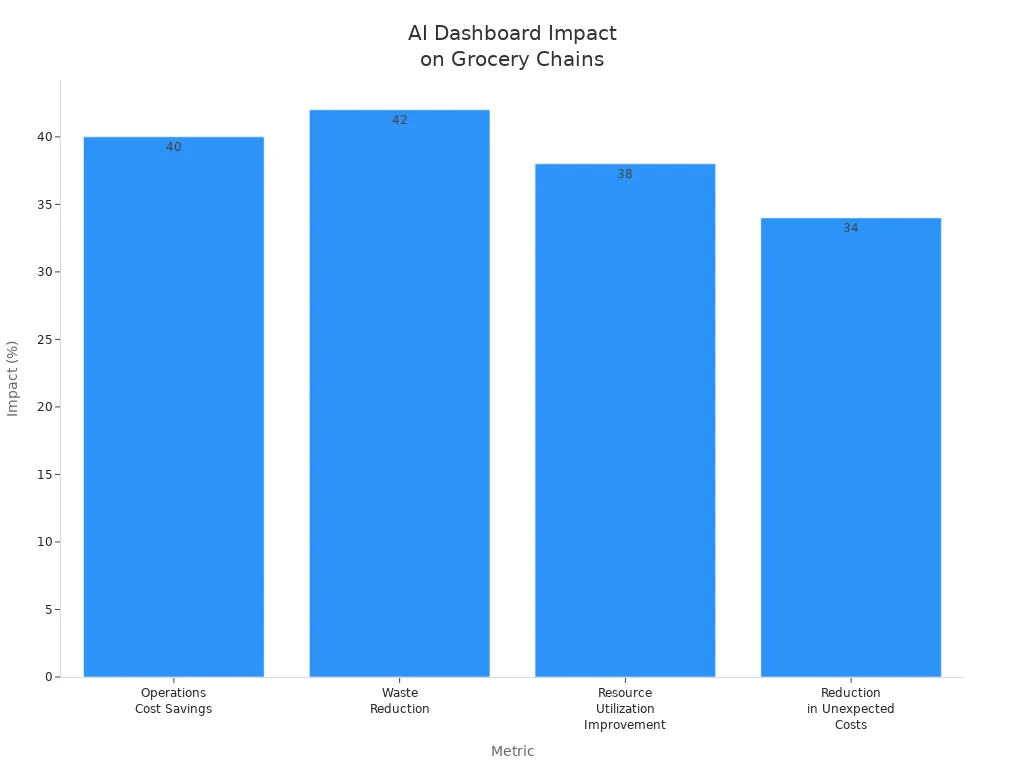
Here is a table showing the impact of ai-powered automation on cost savings and profitability:
Metric | Impact |
|---|---|
Operations Cost Savings | Up to 40% |
Waste Reduction | 42% |
Resource Utilization Improvement | 38% better |
Reduction in Unexpected Costs | 34% |
Enhancing operational efficiency
Ai-powered automation transforms how you manage daily tasks and store performance metrics. You automate routine processes, which saves time and lets your staff focus on customer service. Ai gives you real-time insights, so you can make proactive decisions and respond quickly to issues. You improve communication among your team, which leads to better teamwork and higher performance.
Feature | Benefit |
|---|---|
Automates daily tasks | Reduces time spent on manual processes, allowing staff to focus on customer service. |
Provides real-time insights | Enables proactive decision-making and quick responses to operational issues. |
Enhances communication | Improves coordination among staff, leading to better teamwork and efficiency. |
Monitors performance metrics | Allows managers to track progress and identify areas for improvement. |
Role-specific dashboards | Tailors information to specific user needs, improving usability and effectiveness. |
Automated reporting | Saves time on data compilation and helps in quick analysis of store performance. |
Proactive ops management | Identifies potential issues before they escalate, ensuring smoother operations. |
You see efficiency and productivity gains soon after you start using ai-powered automation. Retailers report faster, smarter decisions that benefit teams, customers, and the bottom line. Ai-driven scheduling systems reduce administrative time by 66%. You also see a 10% drop in compliance-related costs. Many stores save up to 20% in operational overhead and improve overall efficiency. Ai reduces bottlenecks, mis-picks, and late shipments, which improves supply chain performance.
Evidence Description | Impact |
|---|---|
Retailers see efficiency and productivity gains as early benefits. | Faster, smarter decisions that benefit teams, customers, and bottom lines. |
AI-driven scheduling systems reduce administrative time by 66%. | Decreased compliance-related costs by 10%. |
Retailers report savings of up to 20% in operational overhead. | Enhanced overall efficiency. |
AI reduces bottlenecks, mis-picks, and late shipments. | Improved supply chain efficiency. |
You can see real-world examples of ai-powered automation in action. Shucking Good Hospitality achieved a 94% task completion rate by digitizing workflows. Temp Stop rolled out digital checklists across 11 stores in just 14 days. Bacari completed over 150 work orders in 30 days after streamlining operations with ai.
Overcoming integration and training hurdles
You may face challenges when you bring ai-powered automation into your store. Data quality issues can lead to incorrect conclusions and predictions. You need to invest in good data practices to get the best results. High data volumes can create technical challenges, especially when you need real-time insights for automated checkout and store performance metrics. You may also find that different systems use different metrics, which can make integration harder.
Challenge | Description |
|---|---|
Data quality issues | Low-quality data leads to incorrect conclusions and predictions, necessitating investment in data quality practices. |
Real-time processing needs | High data volumes create technical challenges in orchestrating AI models without performance bottlenecks, which are essential for real-time insights. |
Lack of universal metrics | Inconsistencies in data formats and metrics create integration roadblocks, requiring customizations for specific business cases. |
Complexity of syncing omnichannel data | Fragmented data from multiple channels complicates the synchronization process, which is crucial for deriving reliable insights from AI and analytics systems. |
You also need to train your staff to use new systems. Ai-powered automation works best when everyone understands how to use the dashboards and automated checkout features. You can help your team by providing clear training and support. Start with simple tasks and build up to more advanced features. When your staff feels confident, you see better performance and smoother operations.
Tip: Focus on building a strong foundation with good data and clear training. This helps you get the most from ai-powered automation and automated checkout.
You may need to invest time and resources at the start, but the long-term benefits for sales, performance, and efficiency make it worthwhile. Ai helps you track store performance metrics, automate checkout, and improve every part of your store. You see higher sales, better customer experiences, and a stronger business.
Steps to adopt AI dashboards in convenience stores
Assessing needs and setting goals
You start your ai journey by understanding what your grocery business needs. Clear goals help you measure success. Use these steps to guide your process:
Identify key objectives. Decide if you want to improve inventory, boost personalization, or get better real-time updates.
Select a pilot project. Choose one area, like ai-driven demand planning, to test first.
Check your data quality. Good data makes ai work better.
Engage stakeholders. Bring in team members who will use the ai dashboards.
Train employees. Make sure everyone knows how to use new tools.
Tip: When you set clear goals, you make it easier to track progress and see results.
Choosing and implementing the right solution
You need to pick an ai dashboard that fits your grocery store’s needs. Look for a solution that connects with your current systems and handles real-time updates. Make sure the dashboard supports hyper-personalization and can grow with your business. Test the dashboard with your pilot project. Watch how it manages data and supports your team. If it works well, roll it out to more stores. Keep your focus on solutions that make daily tasks easier and help you use ai for better decision-making.
Choose a dashboard that offers strong data integration.
Make sure it supports both personalization and hyper-personalization.
Test with a small group before a full launch.
Training staff and measuring results
You help your team learn the new ai dashboard by offering hands-on training. Show them how to use real-time updates and personalization features. Encourage questions and give support. After training, measure how the ai dashboard improves your grocery operations. Use these metrics to track progress:
Measurable Outcome | Description |
|---|---|
Higher accuracy leads to better planning and fewer sales losses. | |
Inventory turnover | Faster turnover frees up cash and reduces waste. |
Stockout rate | Lower rates mean fewer lost sales opportunities. |
Gross margin return on inventory (GMROI) | Measures how much profit your inventory generates. |
Customer satisfaction and market share | Direct results of keeping the right products in stock. |
You also see benefits like enhanced decision-making, improved marketing efficiency, and optimized customer experiences. Ai helps you make smarter choices, respond to trends, and deliver better service. When you use ai dashboards, you turn data into action and keep your grocery business ahead.
You see how ai in retail changes the way you make decisions. You use ai to monitor every part of your store, from inventory to cashierless shopping. You get real-time insights that help you understand customer behavior and improve your enhanced customer experience.
AI-powered dashboards give you faster, smarter decisions.
You use ai to monitor trends and respond to customer needs.
You see how ai in retail helps you boost sales and manage costs.
"Automated retail is no longer a trend—it’s the new expectation. With solutions ranging from AI-powered kiosks to RFID-backed inventory systems, automation is improving speed, flexibility, and personalization across every touchpoint."
You can follow these steps to start:
Build your business case for ai in retail.
Assess your data and train your team.
Choose the right ai to monitor your store.
Plan your rollout and measure results.
You see that ai in retail will keep growing. You use ai to monitor customer behavior and make better decisions every day. Start now to lead your market.
FAQ
What are AI-powered dashboards in convenience stores?
You use AI-powered dashboards to see real-time data about your store. These dashboards help you track sales, inventory, and customer movement. You make better decisions because you see everything in one place.
How do AI dashboards help reduce waste in convenience stores?
You use AI dashboards to monitor product sales and shelf life. The system alerts you when items do not sell. You adjust orders and reduce waste. This helps you save money and keep your convenience stores profitable.
Can small teams in convenience stores use AI dashboards easily?
You do not need a large team to use AI dashboards. The dashboards have simple interfaces. You get clear instructions and quick training. Your staff learns fast and starts using the system right away.
What data do AI dashboards use in convenience stores?
You see data from sales, inventory, and customer actions. The dashboard collects information from sensors and checkout systems. You get a full view of your convenience stores. This helps you spot trends and solve problems quickly.
Are AI dashboards secure for convenience stores?
You keep your data safe with built-in security features. The system controls who can see or change information. You follow privacy rules and protect your convenience stores from data risks.
See Also
Understanding AI-Driven Convenience Stores: Essential Insights for Retailers
The Future of Retail: Embracing AI-Driven Store Innovations
Comparing Micromarkets and Smart Stores: Global Trends in Automation
Launching an AI-Enhanced Corner Store on a Budget
Revolutionizing Online Retail: The Impact of AI Tools on Management
