How AI-powered stores improve staff productivity in convenience store chains and small-format grocery.

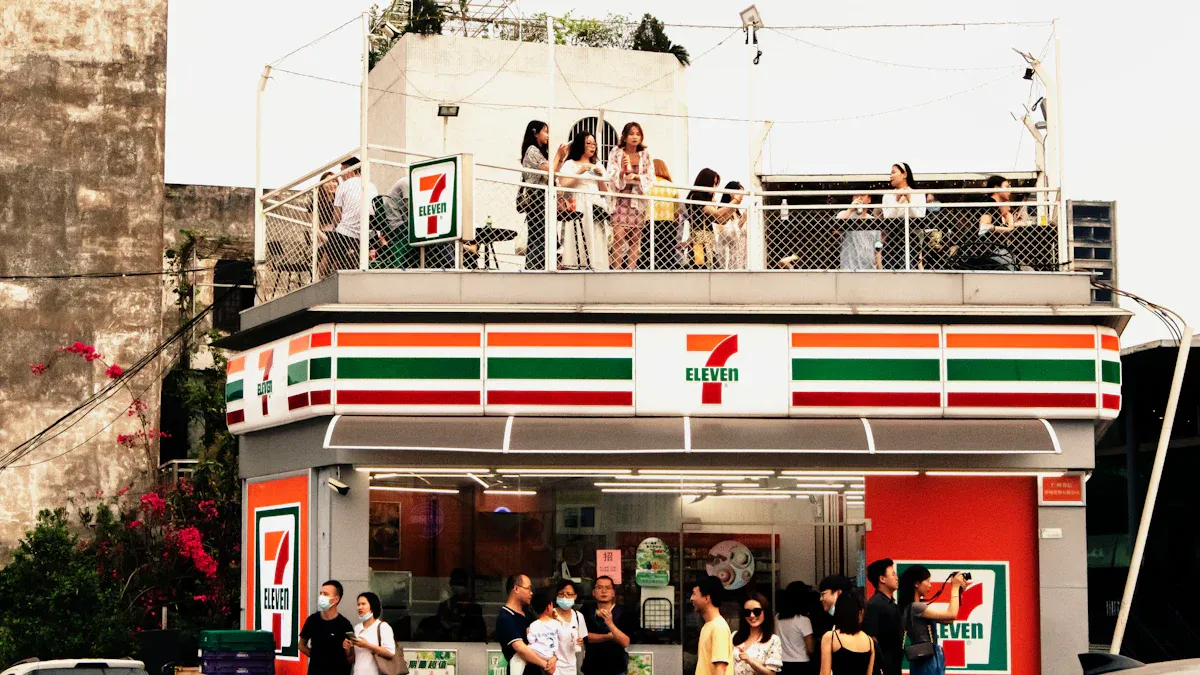
AI-powered stores help you work smarter and faster. You see less time spent on checkout, which lets you focus on stocking shelves, cleaning, and preparing food. Customers get more attention from you, and positive checkout experiences boost satisfaction.
Benefit | Description |
|---|---|
Enhanced Customer Experience | Customers wait less, leading to increased satisfaction and repeat visits. |
Operational Efficiency | Stores can serve more customers with fewer employees, reducing mistakes and improving organization. |
Cost Savings | Significant savings on labor, training, and error correction. |
You notice up to 40% savings on operations and a 42% drop in waste. These changes give you clear results and help store managers make better decisions.
Key Takeaways
AI-powered stores enhance customer experience by reducing wait times, leading to happier shoppers and increased repeat visits.
Automation of daily tasks, like self-checkout and inventory management, allows staff to focus on customer service and store upkeep, improving overall efficiency.
Predictive analytics help maintain optimal inventory levels, reducing waste and stockouts, which boosts sales and customer satisfaction.
AI-driven scheduling tools create fairer work shifts, improving employee satisfaction and reducing turnover rates.
Voice analytics provide valuable feedback for staff training, helping employees improve their skills and enhance customer interactions.
AI-powered stores: Automating Daily Tasks
AI-powered stores help you finish daily tasks faster and with less effort. Automation lets you focus on helping customers and keeping the store clean. You see fewer mistakes and less stress during busy hours. These technologies change how you work and make your job easier.
Self-checkout & Payment Automation
Self-checkout systems let customers scan and pay for items on their own. You do not need to stand at the register all day. This change helps you spend more time stocking shelves and helping shoppers. Self-checkout kiosks work all night, so you do not have to cover late shifts. Automation also lowers errors, especially when you feel tired.
Self-checkout systems reduce the need for staff during late-night hours.
Automation cuts down on manual mistakes, especially during slow periods.
AI-powered kiosks help stores save money and run smoothly 24/7.
You notice that transaction speed improves and staff can focus on other important jobs. The table below shows how self-checkout systems help you and your store:
Benefit | Description |
|---|---|
Enhanced Transaction Speed | Customers can complete transactions at their own pace, reducing wait times and improving efficiency. |
Improved Staff Allocation | Reduces the need for cashiers during peak times, allowing staff to focus on critical tasks. |
Space Optimization | Self-checkout systems do not require dedicated checkout areas, allowing for better store layout. |
AI-driven Stock Replenishment
AI-powered stores use smart systems to track inventory and predict what products you need to restock. You do not have to count items by hand or guess what will sell next. These systems help you keep shelves full and avoid running out of popular products.
FLO dropped out-of-stock items from 15% to 3%, which helped sales go up.
Walmart used AI to keep shelves stocked during busy times and cut inventory costs by 15%.
Levi Strauss improved efficiency and reduced stockouts with real-time demand forecasting.
You see better inventory turnover rates because AI helps you order just the right amount. This means less waste and more sales. Here is how AI-driven stock replenishment helps your store:
Benefit | Impact on Inventory Turnover Rates |
|---|---|
Increases turnover by reducing excess stock | |
Reduced excess stock | Enhances cash flow and profitability |
Minimized stockouts | Improves customer satisfaction and sales efficiency |
AI forecasting lowers spoilage and helps you spend less time on manual inventory checks. You can focus on keeping the store neat and helping customers.
Digital Shelf & Price Management
Digital shelf management lets you update prices and product information with just a few clicks. You do not need to change paper tags by hand. Electronic shelf labels (ESLs) show accurate prices and last for years without needing new batteries.
You can update 5,000 prices in 10 minutes, which is 70% faster than doing it by hand.
A chain with 100 stores saves 6,000 tons of paper each year, which helps the environment.
Real-time price changes let you adjust prices based on demand and keep customers happy.
The table below shows how digital shelf and price management systems help you work smarter:
Outcome | Details |
|---|---|
ROI | Ranges from 2–3 years, with labor savings offsetting upfront expenses. |
Efficiency | Update 5,000 prices in 10 minutes—70% faster than manual updates. |
Labor Savings | Significant time savings and improved accuracy through automation. |
Cost Savings | A 100-store chain saves 6,000 tons of paper annually—equivalent to 100,000 trees. |
Digital shelf labels let you focus on helping customers and restocking shelves. You do not have to worry about price mistakes. The system makes quick updates across all stores, saving you time and reducing errors.
AI-powered stores use these technologies to make your job easier and help you serve customers better. You spend less time on manual tasks and more time on what matters most.
Inventory & Supply Chain Optimization
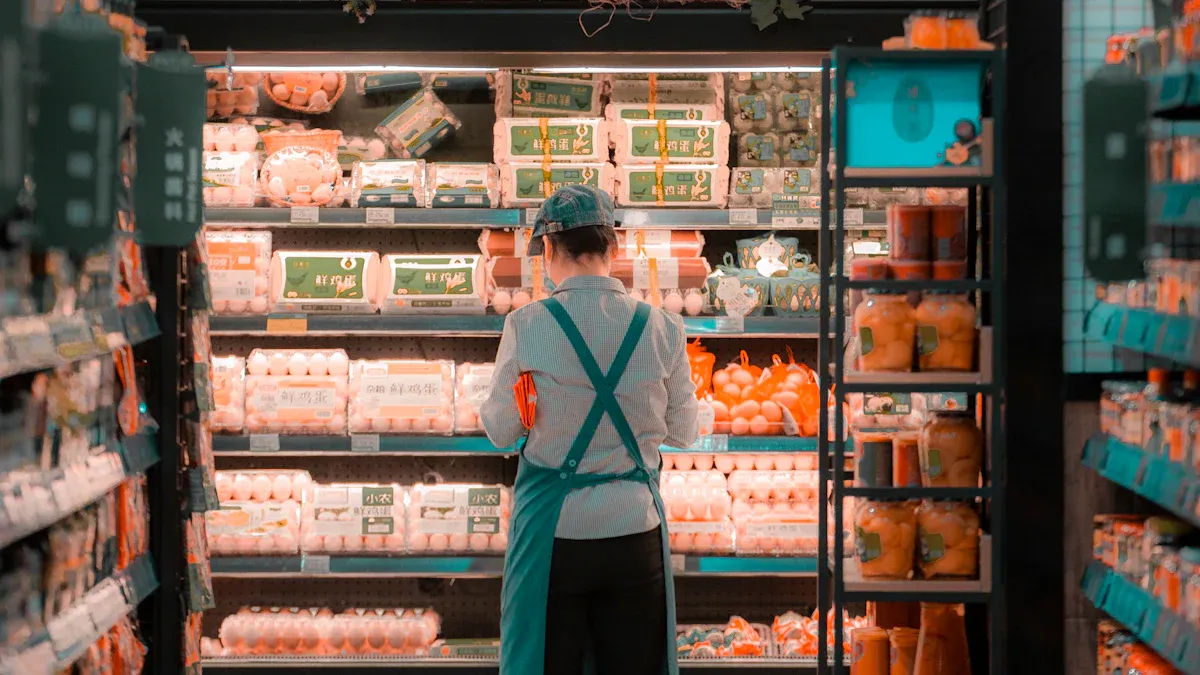
Predictive Inventory Analytics
You can use predictive inventory analytics to make your store run smoother. This technology looks at past sales and outside factors, like weather or local events, to guess what customers will buy next. You do not have to guess or count by hand. You get more accurate demand forecasts, which means you keep the right products on your shelves.
Benefit | Description |
|---|---|
Accurate Demand Forecasting | Predicts future demand using sales data and outside factors. |
Optimized Inventories | Helps you reduce extra stock and keep popular items available. |
Enhanced Supply Chain Efficiency | Spots supply risks early so you can act before problems happen. |
Companies using predictive analytics are 2.3 times more likely to see better supply chain visibility and efficiency.
You get better ordering and replenishment, which means fewer stockouts and less waste.
Consistent stocking leads to happier customers and more repeat visits.
Modern POS systems and inventory software give you real-time sales data. You set reorder points with confidence and avoid overstocking. This helps your store stay profitable.
Automated Ordering Systems
Automated ordering systems make your job easier. You do not need to enter data by hand, which often leads to mistakes. Human error rates for basic spreadsheet entry can reach up to 40%. Automation fixes this problem.
Automated systems track stock levels and order new items when needed.
AI-powered tools check and validate information in real time, so you get accurate orders.
You see faster turnaround times and a more reliable supply chain.
The 1-10-100 rule shows how costly mistakes can be: $1 to check data, $10 to fix errors, and $100 if you miss them. Automation saves money and lets you focus on helping customers. Advanced inventory solutions can cut labor for repetitive tasks by 70%. You spend more time on important jobs, like assisting shoppers and managing inventory.
Reducing Stockouts & Waste
AI-powered stores help you keep shelves full and cut down on waste. These systems watch shelves in real time and spot empty spaces quickly. You can restock before customers notice.
AI improves demand forecasting by looking at many signals, such as weather and local events.
Stores using AI see an 80% drop in stockouts and a 25% reduction in shrink.
Better replenishment can boost sales by 4% and save $30,000 weekly from less waste.
A regional grocer used AI markdowns and cut waste by 15% in six months. One online retailer reduced waste by 49% with AI. Experts say that reducing waste is now a key business strategy, not just a way to follow rules. You help your store save money and protect the environment at the same time.
Smarter Scheduling & Labor Management
AI-driven Staff Scheduling
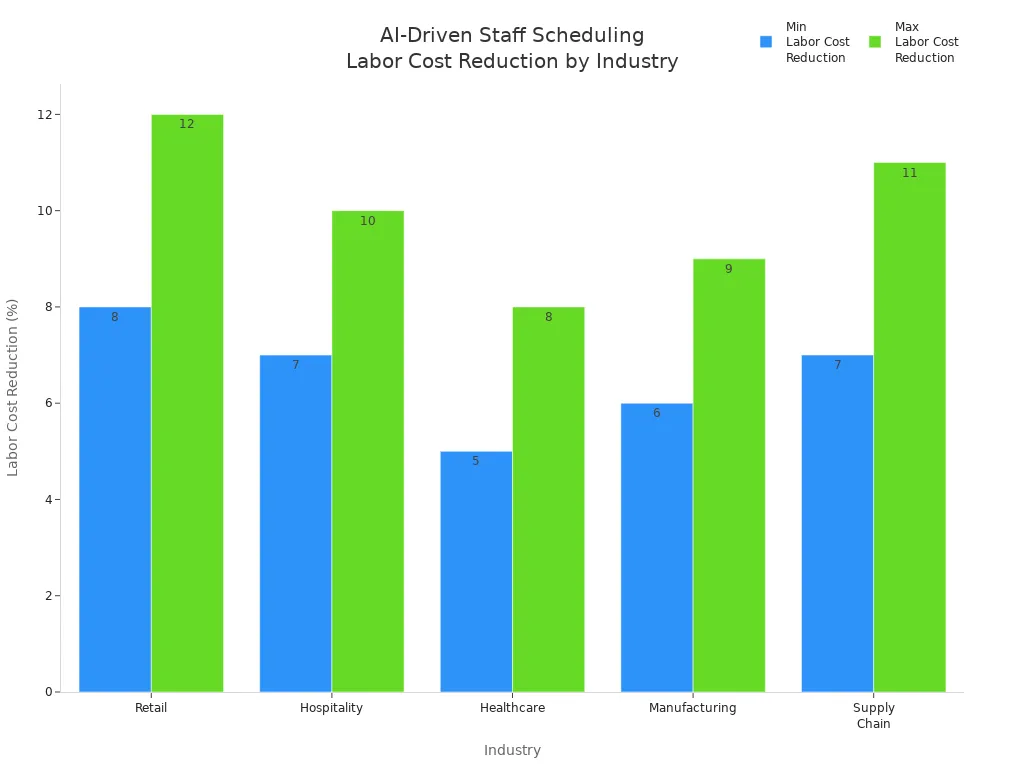
You can use AI-driven scheduling tools to match staff shifts with busy times in your store. These systems study foot traffic and sales patterns, so you always have enough help when you need it most. You get fairer schedules and fewer last-minute changes. AI-powered stores help you save money and keep your team happy.
Industry | Description | |
|---|---|---|
Retail | 8-12% | AI correlates staffing with foot traffic patterns and seasonal fluctuations. |
Hospitality | 7-10% | AI optimizes staff distribution based on occupancy and event schedules. |
Healthcare | 5-8% | AI balances credential requirements and patient acuity while maintaining care quality. |
Manufacturing | 6-9% | AI aligns staffing with production schedules and skill requirements. |
Supply Chain | 7-11% | AI coordinates staff across logistics functions based on inventory flow. |
Tip: AI scheduling systems let you set your shift preferences, swap shifts easily, and get your schedule in advance. This flexibility helps you plan your life and reduces stress.
Dynamic Task Assignment
AI can assign tasks based on your skills and store needs. You get clear goals and regular feedback, which helps you improve. Managers can see which jobs need more attention and give you the right tools to succeed.
Study Focus | Methodology | Key Findings |
|---|---|---|
Dynamic assignment of a multi-skilled workforce | Approximate Dynamic Programming (ADP) | Achieved a 15% improvement in productivity by optimizing technician assignments based on skill sets and availability. |
You get tasks that match your strengths, which makes work more enjoyable.
Managers reward good performance and help you overcome obstacles.
Teams with clear goals and enough resources finish tasks faster and better.
Note: AI-powered stores use dynamic assignment to handle labor shortages and changing customer needs. This approach boosts productivity and keeps your team engaged.
Voice Analytics for Performance
Voice analytics tools listen to cashier-customer interactions and give feedback. You learn what works well and where you can improve. Stores like Cubby's and Mach 1 use these systems to motivate staff and raise service quality.
Store Name | Voice Analytics Implementation | Reported Outcomes |
|---|---|---|
Cubby's & Mach 1 Stores | Tool listens to interactions between cashiers and customers. | Enhanced employee motivation and improved customer service. |
Voice analytics also help with training. You get personalized coaching based on real conversations. The system tracks progress and builds a library of best practices. This makes training faster and more effective.
Tip: Regular feedback from voice analytics helps you grow your skills and feel more confident at work.
Customer Service & Store Efficiency
AI Chatbots & Virtual Assistants
You can rely on AI chatbots and virtual assistants to answer common questions from shoppers. These tools help customers find products, learn about store promotions, and get information about loyalty programs. You do not have to stop what you are doing to answer every question. This frees you up to focus on tasks that need your attention, like restocking shelves or helping with special requests.
They provide product information and store locations.
They offer personalized recommendations and help with loyalty programs.
Most customers prefer using these self-service options. In fact, 69% of shoppers choose AI-powered help when available. By 2025, experts expect 95% of customer interactions to use AI. Stores like Vodafone and Zendesk have seen faster response times and higher satisfaction after using chatbots. You notice fewer complaints and happier customers.
Tip: When chatbots handle routine questions, you can spend more time helping customers with complex needs.
Personalized Recommendations
You see customers enjoy shopping more when they get suggestions that match their interests. AI-powered stores use customer data to recommend products, which makes shoppers feel valued. This leads to more sales and loyal customers.
96% of shoppers are likely to buy when they receive personalized messages.
Amazon gets over a third of its sales from recommendations.
82% of people say personalized experiences influence their buying choices.
Personalized recommendations help you focus on customer service. You can use insights from AI to suggest products and build stronger relationships. This makes your job easier and helps customers find what they want quickly.
Note: Personalized systems let you spend less time guessing what customers need and more time giving great service.
AI-driven HVAC & Lighting Systems
You work in a store that uses smart systems to control heating, cooling, and lighting. These AI-driven tools save energy and keep the store comfortable. Smart HVAC systems can lower energy use by up to 35%. Lighting uses less power, which helps the store save money.
Tesco cut electricity for refrigeration by 20% after switching to AI. Stores also see fewer maintenance problems and save $5,000 to $9,000 each year. You notice fewer after-hours callouts, which means less stress for you and your team.
Impact Area | Result |
|---|---|
Refrigerant leak rate reduction | |
Average annual savings per store | $5K–$9K from avoided maintenance and energy costs |
Reduction in after-hours callouts | Up to 40% reduction |
AI-powered stores use these systems to improve efficiency. You work in a safer, more comfortable environment and help the store run smoothly.
Staff Benefits & Implementation Challenges
Reduced Workload & Stress
You notice that AI-powered stores help you work smarter and feel less stressed. Smart scheduling systems match your shifts with busy times and your preferences. You get more control over your schedule, which helps you balance work and personal life. Stores see fewer last-minute absences and better attendance. Flexible scheduling also makes you happier at work and helps you stay longer with your team.
Benefit | Description |
|---|---|
Enhanced Productivity | AI optimizes shift assignments based on employee performance, leading to better efficiency. |
Reduced Labor Costs | Intelligent scheduling reduces overstaffing, optimizing wage expenditure while maintaining service. |
Decreased Absenteeism | Aligning schedules with employee preferences results in higher attendance and fewer last-minute absences. |
Improved Employee Retention | Flexible scheduling is a key factor in job satisfaction, significantly impacting retention rates. |
Better Work-Life Balance | Employees gain control over their schedules, improving their ability to manage personal and work commitments. |
Organizations using AI scheduling assistants report strong results. One retail chain saw a 15% drop in turnover rates among hourly staff. Another group reduced overtime costs by 12% in just three months.
Better Decision-making
You make better choices at work when you have clear information. AI-powered stores give you real-time data about sales, inventory, and customer needs. You see which products sell best and which tasks need your attention. This helps you avoid mistakes and focus on what matters most. You feel more confident and make decisions faster.
Job Satisfaction & Training
You feel more satisfied with your job when you get regular feedback and training. AI tools help managers spot your strengths and areas for growth. You receive coaching based on real interactions, which helps you improve quickly. Training becomes easier and more effective. You learn new skills and feel ready to handle new technology.
Store owners face some challenges when bringing in AI systems:
Many teams use data that is inconsistent or scattered, which can cause problems with AI results.
Some managers think their staff must be experts in data science before starting, but outside experts can help set up systems.
Teams may expect instant results from AI tools, but real change needs workflow redesign and staff involvement.
Employees sometimes worry about how AI will affect their jobs. Involving you early in the process helps reduce fear.
Good data quality is important. Stores often start with a data check to make sure AI works well.
Tip: You can help your store succeed by learning about new AI tools and sharing your feedback with managers.
You see how AI-powered stores change your work for the better. Automation helps you finish tasks faster and focus on customers. You enjoy less stress and more job satisfaction. Store owners can start by testing smart scheduling and inventory tools. The future looks bright. Autonomous stores give you real-time insights and help you place products for higher profits.
Metric Category | Description |
|---|---|
Reduced manual tasks, improved asset use | |
Engagement Quality | More time spent shopping, higher conversion rates |
Revenue Acceleration | Shorter sales cycles, bigger deals, better win rates |
Automation cuts routine labor.
Autonomous stores reach profitability quickly.
Real-time insights boost your store’s success.
FAQ
How does AI help you finish tasks faster in your store?
AI automates routine jobs like checkout and inventory tracking. You spend less time on manual work. You can focus on helping customers and keeping shelves stocked.
Will you need special training to use AI-powered systems?
Most stores offer easy training for new AI tools. You learn by doing simple tasks. Managers give you support and feedback. You do not need to be a tech expert.
Does AI make your job less secure?
Concern | Reality |
|---|---|
Job loss | AI shifts your focus to customer service and store upkeep. |
Job growth | You gain new skills and more chances for advancement. |
What if you have trouble with new technology?
You can ask for help from managers or trainers. Stores often provide guides and videos. You learn at your own pace. Support is always available.
See Also
The Future of Retail: Embracing AI-Driven Stores
Modern Retail's Advantages: AI-Enhanced Combo Vending Machines
AI-Driven Corner Stores: Essential Insights for Retailers
Transforming Online Retail: The Impact of AI Tools
Global Insights: Micromarkets Compared to Smart Retail Stores
