AI trends making brick and mortar stores smarter every day

You can see AI trends changing how stores work every day. Physical stores still make up about 80% of all retail sales in the US. Many retailers use AI for better personalization. They also use it for inventory control and customer service. AI helps stores run smoother. It also makes security stronger. The market for AI in retail could reach $14.49 billion in 2025. It may grow to $40.74 billion by 2030. This means a 23% growth rate each year.
Some stores have problems when using AI. Here are some examples:
Challenge Type | Description |
|---|---|
Implementation Complexity | Setting up and using AI tools can be hard. This is true for small and midsize retailers. |
Data Privacy Concerns | Collecting and using customer data brings up safety issues. It also raises privacy concerns. |
Investment Requirements | Hardware, software, and training cost a lot. This makes it hard, especially in developing areas. |
Key Takeaways
AI helps stores make shopping special for each person. It makes the experience more fun and different for everyone.
AI changes prices and deals fast to match what people want. This helps stores sell more and waste less.
AI helps stores know what items people will buy. It also checks stock by itself. This means shelves are not empty as much. Customers are happier.
AI tools help customers shop faster and easier. They give quick help and suggest things you might like. This makes shopping better for everyone.
AI cameras and systems make stores safer. They stop stealing and cheating. Shoppers feel safer in the store.
AI trends in personalization

Personalization is one of the most interesting AI trends in stores. Generative AI and machine learning help stores know what you like. These tools look at what you do and suggest things you may want. This makes shopping feel special for each person. Stores that use these tools see happier customers. They also see people come back more often. As AI gets better, stores can make shopping even more personal. This makes each visit better and easier.
In-store recommendations
When you go into a new store, you might see digital screens or smart shelves. These use AI to show you products based on what you bought before. They also look at what you check out in the store. This helps you find things you may like, even if you did not plan to buy them. Stores use machine learning and predictive analytics to guess what you want. This makes shopping simple and fun. You might also get deals that fit your likes, which can save you money.
AI-powered suggestions help more people buy things than old marketing.
Some stores see 25% more sales when they use AI to target shoppers.
Personal shopping experiences make you want to come back again.
Dynamic promotions and pricing
AI trends also change how stores set prices and make deals. With AI, stores can change prices fast based on what people want, what is in stock, and what other stores do. If something is not selling, the system can lower the price or start a deal to sell it. This helps stores waste less and keep new things on the shelves.
AI models check stock and start deals when fewer people buy, which helps stores sell more.
One store sold 20% more during a big sale by using dynamic pricing. AI can also look at old sales to see which deals work best for different shoppers. This means you get deals you care about, and stores can make more money too.
Benefit | Description |
|---|---|
Real-time Pricing | Changes prices fast to match what people want and what other stores do. |
Targeted Promotions | Gives you deals that match what you like and buy. |
Improved Inventory Turnover | Sells products faster, wastes less, and keeps shelves full of new things. |
As AI trends keep growing, you will see even more personal deals and smarter prices in your favorite stores.
Inventory management with AI
AI trends are changing how stores handle inventory. Smart systems help track products and guess what people will buy. They also help keep shelves full. These tools stop empty shelves and wasted products. Stores can run better and save money with these systems.
Automated stock monitoring
AI can watch your stock all the time. Smart cameras and sensors check what is on shelves. The system tells you when items are low or gone. This helps you fix problems fast and keep shoppers happy.
Companies using AI for stock checks have fewer empty shelves, almost 96% less.
Stores lose $1.1 trillion each year from empty shelves.
AI helps manage stock better, so you waste less and sell more.
Automated systems save time and lower labor costs by doing hard inventory work.
Tip: AI gives you clear reports, so you know what to order and when.
Demand forecasting
AI tools help guess what shoppers will want next. These systems look at sales, weather, holidays, and local events. You can use this to plan for busy or slow times.
AI forecasting is better than old ways.
Automated restocking makes fewer mistakes and costs less.
You can react faster when people want new things.
AI shows you what people want, so you keep the right items in stock.
Description | |
|---|---|
Higher Forecast Accuracy | AI finds demand patterns people often miss. |
Reduced Costs | Better planning means less waste and fewer markdowns. |
Real-time Visibility | You see what happens in your supply chain right away. |
Faster Replenishment | Automated systems keep shelves full and stop lost sales. |
Better Customer Satisfaction | Shoppers find what they want, so they come back. |
Maximized Profitability | You match stock to real demand and keep profits strong. |
AI trends in inventory management help with busy seasons too. The system checks sales, loyalty programs, and things like weather. You can send products to the right stores and avoid too much or too little stock. This keeps your business running well and your customers happy.
Customer experience enhancements
AI-driven service
You can see how AI-driven service changes your shopping trip. Many stores use smart systems to help you find what you want. For example, companies like Target and Carrefour use AI to study what you buy and how you shop. This helps them keep shelves full and offer you better choices.
Amazon and Sephora use AI to give you product suggestions that match your style.
Virtual assistants in stores answer your questions right away. You get help fast, which makes shopping easier.
Some stores use facial recognition and mood analysis. These tools help staff know how you feel and what you might need.
Augmented reality lets you try on makeup or see how furniture looks in your home before you buy.
AI trends also improve Point-Of-Sale systems. You get special deals based on your shopping habits. These smart tools make your visit smooth and personal.
Tip: If you ever need help, look for a digital assistant or a smart kiosk. These tools use AI to guide you.
Frictionless checkout
You do not have to wait in long lines anymore. Frictionless checkout uses AI to speed up your payment. Smart cameras and sensors track what you pick up. You can pay by walking out or using your phone.
These systems cut down on queues and make shopping faster.
You get more payment options, like one-click checkout or mobile pay.
Stores save money because they need fewer cashiers.
In North America and Europe, about 9.2% of stores use frictionless checkout. People like these systems because they make paying quick and easy. When you spend less time waiting, you feel happier with your visit. AI trends in checkout help stores serve you better and keep you coming back.
Note: Fast payment means you leave the store with a smile. Stores also spend less on running checkouts.
Operations optimization
Staff scheduling
AI helps you manage staff schedules in a smarter way. You can use AI tools to match the number of workers to the number of shoppers. This means you do not have too many or too few people working at once. Here are some ways AI improves staff scheduling:
You can cut overstaffing by 5-10%. This can save your store a lot of money each year.
AI avoids 65% of common mistakes in scheduling. This helps your store run better and keeps costs down.
You can lower employee turnover by 10-15%. When workers stay longer, you spend less on hiring and training.
AI also makes work fairer for your team. You can give everyone a fair chance at good shifts. Workers get their schedules early, so they can plan their lives. This helps your team feel happier and more balanced. When your staff feels good, they give better service to shoppers.
Tip: Happy workers help your store succeed. AI scheduling gives everyone a fair shot at the best shifts.
Resource management
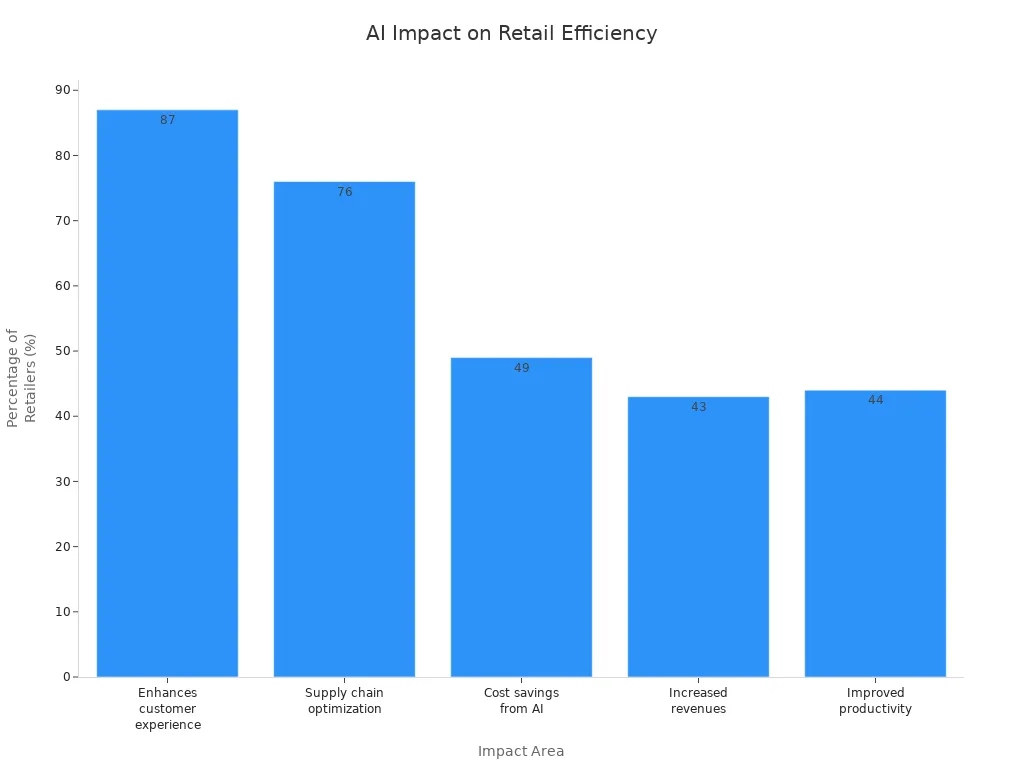
AI makes it easier for you to use your store’s resources well. Many retailers see big improvements after using AI. You can see the impact in the table below:
Impact Area | Percentage |
|---|---|
Retailers acknowledging AI enhances customer experience | |
Retailers reporting AI's role in supply chain optimization | 76% |
Retailers experiencing cost savings from AI integration | 49% |
Retailers reporting increased revenues due to AI | 43% |
Retailers witnessing improved productivity | 44% |
You can use AI to track inventory, manage supplies, and plan for busy times. AI gives you real-time updates, so you always know what is happening in your store. This helps you avoid waste and keep shelves full. You can also spot problems before they get big.
AI streamlines your daily tasks.
You use resources better and save money.
You see what you need, when you need it.
Some stores face challenges when starting with AI. High setup costs and system changes can make things hard at first. Over time, you see that AI helps your store run smoother and keeps customers happy.
Security and loss prevention
AI surveillance
More stores now use AI surveillance to keep things safe. AI-powered cameras and sensors watch for odd actions, like fidgeting or acting nervous. These systems warn security before someone steals. AxxonSoft’s smart video surveillance uses live data and advanced analytics. This helps stop theft and fraud. It also makes store layouts and shopping better.
Shoplifting in the US went up by 24% in 2024. Because of this, many stores made their security stronger. AI video surveillance upgrades old CCTV systems. You get alerts about threats right away, not just videos after something happens. AI lets you watch in real time and use smart analytics. You can spot risky situations and act fast.
Here are some facts about store losses:
Outside theft caused 32.8% of all losses.
Over half of retailers saw more losses than before.
The average shrink rate rose to 1.6%, or $112.1 billion.
Theft from inside and outside made up 65% of shrink.
AI surveillance works well with your current security. You can make your system more accurate and get fewer false alarms. AI uses predictive analytics to help you plan staff and where to put products.
Evidence Description | Key Points |
|---|---|
AI can seamlessly integrate with current CCTV and security infrastructure to improve accuracy and reduce false alarms. | |
Proactive threat detection | AI-powered solutions can help retailers detect potential threats before they escalate using video and audio analytics. |
Predictive analytics for loss prevention | AI analyzes historical data to identify trends, helping retailers optimize staffing and product placement to prevent theft. |
Fraud detection
AI helps you stop fraud in many ways. You can use AI to watch sales and find strange patterns. These systems check returns and spot fake claims. AI also looks for employee theft by watching sales data.
AI-powered systems use predictive analytics to find threats early. You get better security and stop more losses. Stores use facial recognition to spot known shoplifters. AI-driven training teaches staff how to stop losses.
AI Application | Outcome |
|---|---|
AI-Powered Surveillance | Detects suspicious behaviors in real-time, reducing theft. |
Facial Recognition | Identifies known shoplifters, enabling preemptive actions. |
AI Monitoring Systems | Identifies patterns of employee theft through transaction monitoring. |
AI in Return Processing | Analyzes return patterns to detect fraud. |
Automated Inventory Management | Reduces administrative errors in stock management. |
AI-Enhanced Auditing | Identifies inconsistencies in vendor transactions. |
Predictive Analytics | Anticipates operational issues, allowing proactive management. |
AI-Driven Training Programs | Tailors training to address weaknesses in loss prevention. |
Fraud Detection Algorithms | Analyzes transactions to identify fraudulent activities. |
Dynamic Pricing | Optimizes pricing to minimize losses from mispricing. |
Predictive Analytics for Stock Levels | Reduces losses from overstocking or stockouts. |
You can see that AI makes stores safer and saves money. With smarter surveillance and fraud checks, you protect your business and customers every day.
You can see AI trends making stores smarter and faster. Stores focus more on what you need. Today, you get better service and accurate stock. You also get quick checkouts. In the future, stores will use new tools like augmented reality and automated checkout. By 2026, most stores will use AI to make shopping better. The table below shows how AI helps you and store owners:
Benefit Type | Description |
|---|---|
Operational Efficiency | AI makes store work easier, lowers costs, and helps workers do more. |
Demand Forecasting | AI guesses what people will buy and helps stores keep the right items. |
Customer Service Automation | AI lets stores answer your questions faster and gives better help. |
Enhanced Customer Experience | AI-driven AR tools let you try products virtually, so you feel sure before buying. |
Shopping will get easier and more fun as these changes keep happening.
FAQ
How does AI protect your privacy in stores?
Stores use AI to keep your data safe. They follow strict rules and use encryption. You can ask how your information gets used. Many stores let you choose what data you share.
Will AI take away jobs in retail?
AI changes some jobs, but it also creates new ones. You may see more tech support and customer service roles. Workers learn new skills to help stores use AI tools.
Is AI expensive for small stores?
AI can cost a lot at first. Many small stores start with simple AI tools. You can find affordable options that help with tasks like scheduling or inventory.
What is the future of AI in shopping?
You will see smarter stores. AI will help you find products faster and get better deals. Shopping will feel more personal and easy. New tools like virtual try-ons will become common.
See Also
The Future of Retail Lies in AI-Driven Stores
Understanding the Growth of AI-Enhanced Convenience Stores
Comparing Micromarkets and Smart Stores in Global Retail
Transforming Online Retail Management with AI E-Commerce Solutions
Revolutionizing Retail: The Impact of Smart Electronics Vending Machines
