How to evaluate ROI for autonomous retail in convenience store chains and small-format grocery

You need to evaluate ROI for autonomous retail to make smart choices in your convenience stores or small-format grocery. Today, over 69.3% of global retailers use at least one automation technology, and digital self-checkout kiosks appear in 41.7% of stores worldwide. Retail professionals now rely on advanced ROI tools that use machine learning to study customer behavior. These tools help you see the true value of digital upgrades, not just in sales but also in customer experience.
Key Takeaways
Evaluate ROI to understand the true value of autonomous retail technology. This includes faster returns, improved customer experiences, and reduced losses.
Calculate ROI by comparing total benefits to total costs. Use the formula: ROI = (Total Benefits - Total Costs) / Total Costs × 100%.
Track key metrics like payback period, cost savings, and sales uplift to measure the effectiveness of your autonomous retail investment.
Focus on both tangible and intangible benefits. Higher customer satisfaction and better brand perception can significantly impact your store's success.
Avoid common pitfalls by setting clear goals, ensuring data accuracy, and providing ongoing training for your staff.
What Does ROI Mean in Autonomous Retail
ROI for Convenience Stores and Small-Format Grocery
Return on investment, or ROI, shows you how much value you gain from your spending on autonomous retail technology. In convenience stores and small-format grocery, ROI goes beyond just money. It covers faster returns, better shopping experiences, and lower losses. You can see the main benefits in the table below:
Benefit | Description |
|---|---|
Rapid ROI | Implementing autonomous retail can lead to a quick return on investment. |
No Queues, More Sales | A seamless shopping experience increases customer throughput and basket size. |
Eliminate Shrink | Automatic tracking ensures all items are accounted for, reducing losses. |
Operate 24/7 with Less Labor | Unmanned stores reduce labor costs while providing extended access to customers. |
You usually calculate ROI by comparing what you spend with what you gain. Here is a simple way to do it:
Add up your cost savings and any extra revenue from the new system. Subtract the total cost of setting up autonomous retail.
Divide this net benefit by your total investment cost.
Multiply by 100 to get the ROI percentage.
For example, if you invest $100,000 and gain $100,000 in benefits in the first year, your ROI is 0%. In the second year, with no new costs, your ROI jumps to 100%.
Why ROI Evaluation Matters
You need to evaluate ROI to make smart choices about technology in your stores. Checking ROI from your current autonomous outlets helps you see if your investment pays off. You also learn how well your store runs with less staff and more automation. This information helps you decide if you should open more autonomous stores or expand your current ones. Data from ROI evaluations guides your plans and helps you grow in the right direction.
Tip: When you evaluate ROI, you gain insights that help you plan, save money, and improve your store’s future.
Key Costs and Benefits to Evaluate ROI
Main Cost Factors
You need to look at both the money you spend at the start and the money you spend to keep things running. Autonomous retail often costs more to set up, but it saves you money over time. The table below shows how these costs compare to traditional stores:
Retail Model | Initial Setup Costs | Ongoing Operational Expenses | ROI Impact |
|---|---|---|---|
Autonomous Retail | High | Low (reduces over time) | Scales quickly with volume, favorable ROI |
Attended Retail | Lower | High (volatile labor costs) | Less cost-effective in high-volume, low-margin environments |
You pay more at first for autonomous technology, but your ongoing costs drop. This means your investment pays off faster as your store gets busier.
Core Benefits: Savings, Sales, Experience
Autonomous retail brings many benefits that help you save money and boost sales. Here are some of the main financial gains:
You minimize human error.
You improve operational efficiency.
Retailers who invest heavily in automation see cost reductions of up to 22%, while others see only 8%. You can also make your store more efficient. By 2025, you may automate up to 70% of routine tasks, cutting unit costs by as much as 20%. This leads to bigger profit margins.
Retail automation reduces operational costs and prevents financial losses through intelligent solutions.
You also improve the shopping experience. Stores using autonomous technology have cut transaction and waiting times by half. This change led to a 170% jump in revenue per customer. When you make shopping faster and easier, people buy more.
Beyond Money: Brand and Employee Impact
The value of autonomous retail goes beyond dollars. Frictionless shopping and advanced analytics help you create a better brand image and keep customers coming back.
Retail customers have come to expect shopping experiences to be personalized to their unique needs and preferences, order fulfillment and returns that are hassle-free, and responsive customer service available via multiple channels.
Retailers who integrate IoT devices throughout stores gain access to a treasure trove of real-time data analytics, personalized shopping preferences and more efficient inventory management.
With checkout-free stores, a huge repository of data will be available for retailers to create excellent customer experiences. This will help them promote brand loyalty and improve footfalls in the long-term.
You also help your employees. With less time spent on routine tasks, your staff can focus on helping customers and growing your business. This can improve employee satisfaction and retention, which saves you money in the long run.
How to Evaluate ROI: Step-by-Step
Identify and Quantify Costs
To evaluate ROI for autonomous retail, you first need to understand all the costs involved. These costs go beyond the price tag of new technology. You must look at both direct and indirect expenses. Here are the main areas to consider:
Licenses and Software Fees: These are the costs for the software that runs your autonomous systems.
Infrastructure: This includes cameras, sensors, and network upgrades.
Development and Implementation: You may need to pay for custom features or integration with your current systems.
Maintenance and Support: Ongoing service keeps your system running smoothly.
Training: Your staff will need to learn how to use the new technology.
Tip: Analyzing the total cost of ownership (TCO) helps you avoid surprise expenses. TCO covers everything from setup to ongoing support. Some solutions, like Emporix, offer transparent pricing that adjusts to your store’s needs and includes maintenance, which helps you plan your budget.
You should list all these costs before you move to the next step. This will give you a clear picture of what you are investing.
Identify and Quantify Benefits
Next, you need to measure the benefits your store gains from autonomous retail. These benefits can be both tangible and intangible.
Tangible benefits include:
Increased sales from faster checkouts and higher customer throughput.
Lower labor costs because you need fewer staff for routine tasks.
Reduced losses from theft or errors, thanks to automated tracking.
Improved efficiency, which means you can serve more customers with the same resources.
Intangible benefits include:
Higher customer satisfaction. You can measure this with customer satisfaction scores or Net Promoter Scores (NPS).
Better brand perception. Positive experiences make customers more likely to return and recommend your store.
Improved employee satisfaction. Staff can focus on helping customers instead of repetitive tasks.
Note: A complete cost-benefit analysis should balance these tangible outcomes with the intangible ones. Measuring customer loyalty, satisfaction, and brand perception is just as important as tracking sales and savings.
You can use surveys, feedback forms, and analytics tools to track these benefits over time.
Simple ROI Formula
Once you have your costs and benefits, you can calculate ROI using a simple formula. This formula helps you see if your investment is paying off.
ROI = (Total Benefits - Total Costs) / Total Costs × 100%
You add up all your financial gains, cost savings, and any risk avoidance. Then, subtract your total investment. Divide the result by your total costs and multiply by 100 to get a percentage.
Here is a table with real-world examples:
Scenario | Total Impact | Investment | ROI | Payback Period |
|---|---|---|---|---|
Smart Logistics and Route Optimization | ≈ $81,300/month | ~$27,000 | ≈ 3.0× | < 1 month |
Warehouse Process Automation | ≈ $103,000/month | ~$25,000 | ≈ 4.2× | ~1.2 months |
Personalization in E-commerce | N/A | N/A | ≈ 15× | < 2 weeks |
You can use this formula to evaluate ROI for your own store. Track your process automation rate, cost per transaction, and customer lifetime value to see the full impact.
By following these steps, you can make smart decisions about autonomous retail. You will know exactly where your money goes and what you get in return.
Metrics to Track and Interpret
Key Metrics: Payback, Savings, Sales Uplift
You need to track the right metrics to see if your autonomous retail investment works. These numbers help you measure how quickly you get your money back and how much you save. They also show if your sales go up after you add new technology.
Payback Period tells you how fast your investment starts making money. A shorter payback period means you see cash flow growth sooner.
Cost Savings show how much you save on labor, shrinkage, and other expenses after switching to autonomous retail.
Sales Uplift measures the increase in sales after you upgrade your store. You can compare weekly or monthly sales before and after the change.
Customer Acquisition Cost (CAC) Payback Period helps you compare your results to industry averages. This metric shows how quickly you recover the money spent to attract new customers.
You can use data analytics to monitor these metrics over time. The table below shows how analytics help you evaluate ROI and improve your store:
Application of Data Analytics | Description |
|---|---|
Sales Data Analysis | Helps identify slow-moving products and adjust inventory to minimize costs and maximize profits, particularly for perishable goods. |
Checkout Process Evaluation | Determines optimal number of checkout lanes and identifies areas for cashier training to improve efficiency. |
Trend Identification | Analyzes sales data across stores to spot emerging trends and customer preferences, guiding product launches and inventory changes. |
Staffing Optimization | Allocates cashiers effectively to reduce checkout times based on data insights. |
Supply Chain Visibility | Provides insights into inventory levels and demand trends, helping to reduce costs and improve delivery speed. |
Interpreting Results and Overcoming Challenges
You may face challenges when you interpret ROI results for autonomous retail. Many retailers struggle to prove ROI, connect new systems with old ones, and train staff. The table below shows common challenges and solutions:
Challenge | Percentage of Retailers Facing This Challenge | Solution |
|---|---|---|
Proving ROI | Establish baseline performance metrics to quantify the impact of implementation. | |
Integrating with existing technology | 75% | Integrate operational data systems to connect analytics with existing platforms. |
Training staff and employee adoption | 51% (training), 33% (adoption), 22% (support) | Provide adequate training and support, and engage employees to ensure successful adoption. |
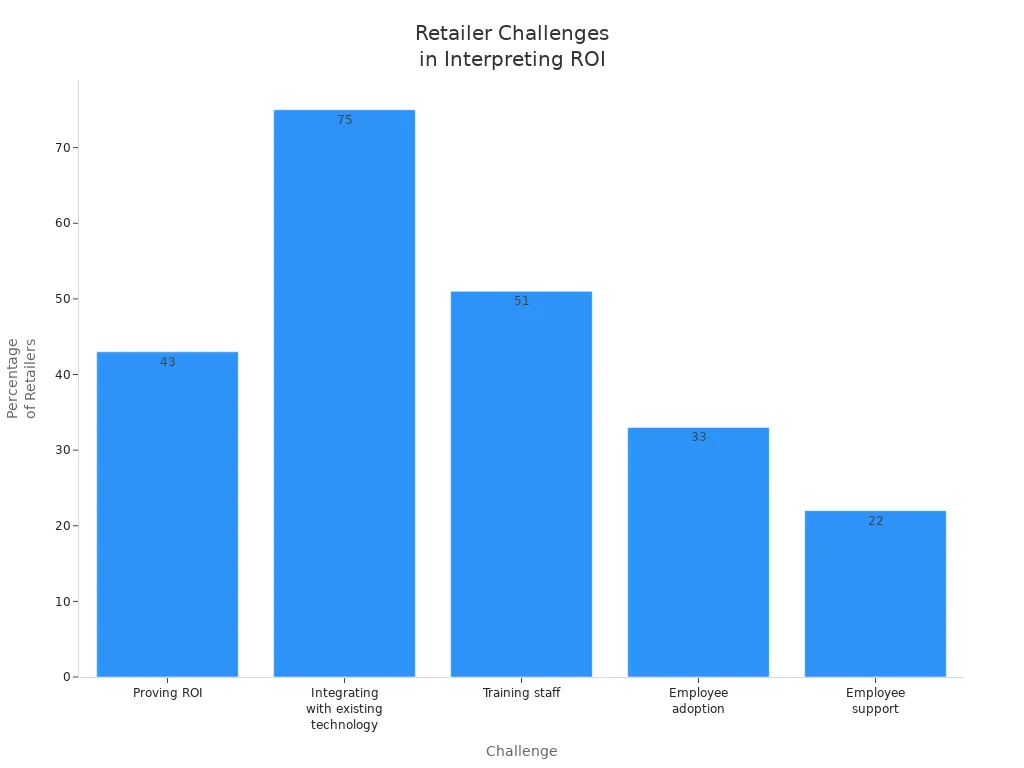
You can overcome these challenges by setting clear goals and using baseline metrics. For example, some stores saw sales jump by over 250% after switching to smart technology. You should track analytics, customer interaction, and employee retention as part of your ROI metrics. These steps help you evaluate ROI and make better decisions for your store.
Maximizing ROI and Avoiding Pitfalls
Practical Tips for Value
You can get the most out of autonomous retail by using smart strategies and the right technology. Here are some ways to boost value in your convenience store or small-format grocery:
Use AI to make your store run better. AI helps you manage inventory, predict demand, and personalize shopping for each customer.
Rethink your store’s location and layout. Adding drive-thrus or mobile ordering can make shopping easier for your customers.
Focus on customer experience. Advanced checkout options and self-service kiosks help shoppers save time and enjoy their visit.
Try hybrid prepared foods ordering. Offer online ordering and in-store kiosks for ready-to-eat meals.
Use smart carts and scan-and-go technology. These tools let customers check out quickly and easily.
Install smart video cameras. These cameras track customer flow and help you manage staff and inventory.
Technology Type | Description |
|---|---|
Counter service automation | Kiosks for deli and bakery items improve speed and service. |
Kiosk advertising | In-store kiosks can promote deals and seasonal items. |
Smart carts | Customers scan and pay at the cart for a fast checkout. |
Tip: Regularly check your store’s performance. Review key numbers each month, share results with your team, and keep your technology up to date.
Common Mistakes to Avoid
Many retailers make mistakes that hurt their results. You can avoid these pitfalls by staying alert and planning ahead.
Do not overestimate what AI can do. Set realistic goals for your technology.
Always set clear business objectives. If you skip this step, your project may not deliver results.
Make sure your data is accurate and well managed. Poor data leads to bad decisions.
Do not ignore risks. Use a risk management plan to spot and fix problems early.
Keep your team trained. Ongoing training helps your staff use new tools well.
Note: When you evaluate ROI, align your technology with your business goals. Run pilot projects, set clear metrics, and keep improving your systems to stay ahead.
A structured process helps you evaluate ROI and make smart choices for your store. Use the steps and metrics in this guide to support your decisions. Start with these actions:
Focus on solutions that show measurable value.
Pilot AI and automation for quick wins, like stock reordering.
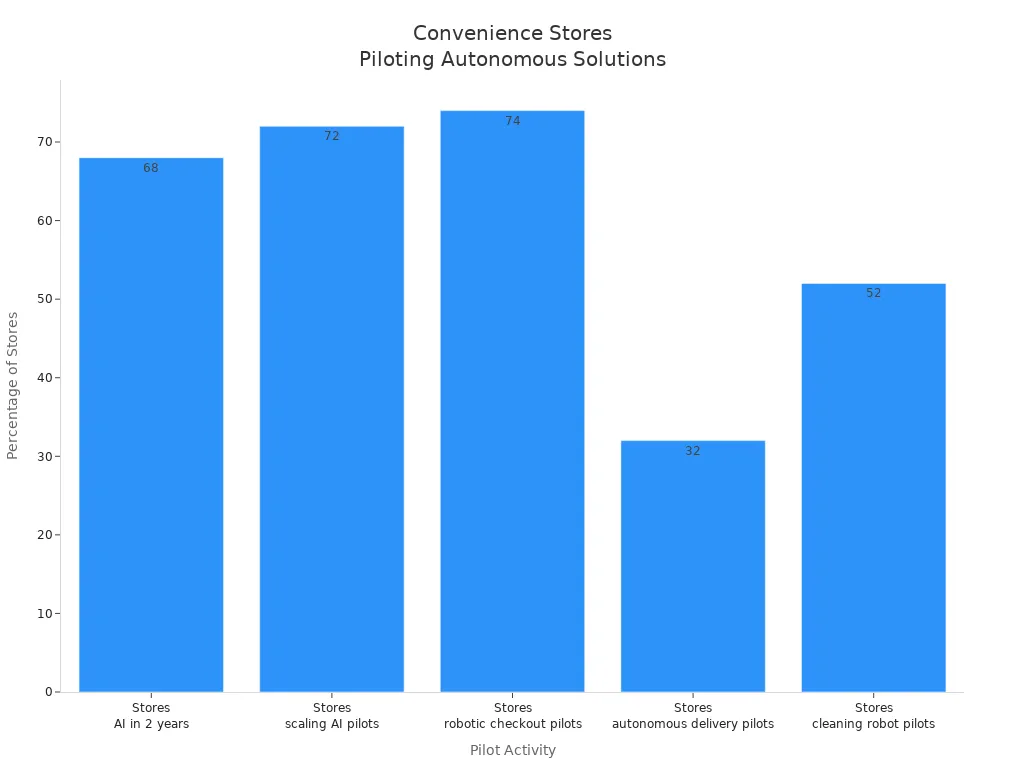
Statistic | Value |
|---|---|
Convenience stores looking to implement AI solutions within 2 years | 68% |
Stores in AI pilot projects planning to scale | 72% |
Engaged in AI robotic checkout pilot projects | 74% |
Piloting AI-driven autonomous delivery vehicles | 32% |
Piloting AI-enabled autonomous cleaning robots | 52% |
Keep tracking your results and adjust your approach. This helps you build long-term success with autonomous retail.
FAQ
What is autonomous retail?
Autonomous retail uses technology to run stores with little or no staff. You see self-checkout kiosks, smart shelves, and AI-powered systems. These tools help you shop faster and make store operations smoother.
How do you measure ROI for autonomous retail?
You add up your cost savings and extra sales. You subtract your total investment. You divide the result by your costs. You multiply by 100 to get your ROI percentage.
What are the biggest benefits of autonomous retail?
You save money on labor. You reduce theft and errors. You give customers a faster, easier shopping experience. You also collect better data for your business.
Can small stores afford autonomous retail?
You can start small with basic automation like self-checkout. Many solutions scale to fit your budget. You may see quick returns as your store gets busier.
See Also
Comparing Micromarkets And Smart Stores In Global Retail
Understanding The Growth Of AI-Driven Corner Shops
Launching An AI-Enhanced Corner Store On A Budget
