How to Future-Proof Retail AI Platforms with Advanced API Design


Advanced API design helps decide how retail AI will grow. Many retailers use AI for custom suggestions, finding trends, and managing stock.
Statistic Description | Percentage |
|---|---|
Retailers currently using AI | 42% |
Retailers piloting or evaluating AI solutions | 34% |
Retailers planning to adopt AI technologies next year | 60% |
Adoption priority for better customer journey | 59% |
Adoption priority for higher performance | 49% |
Adoption priority for cost efficiency or ROI | 44% |
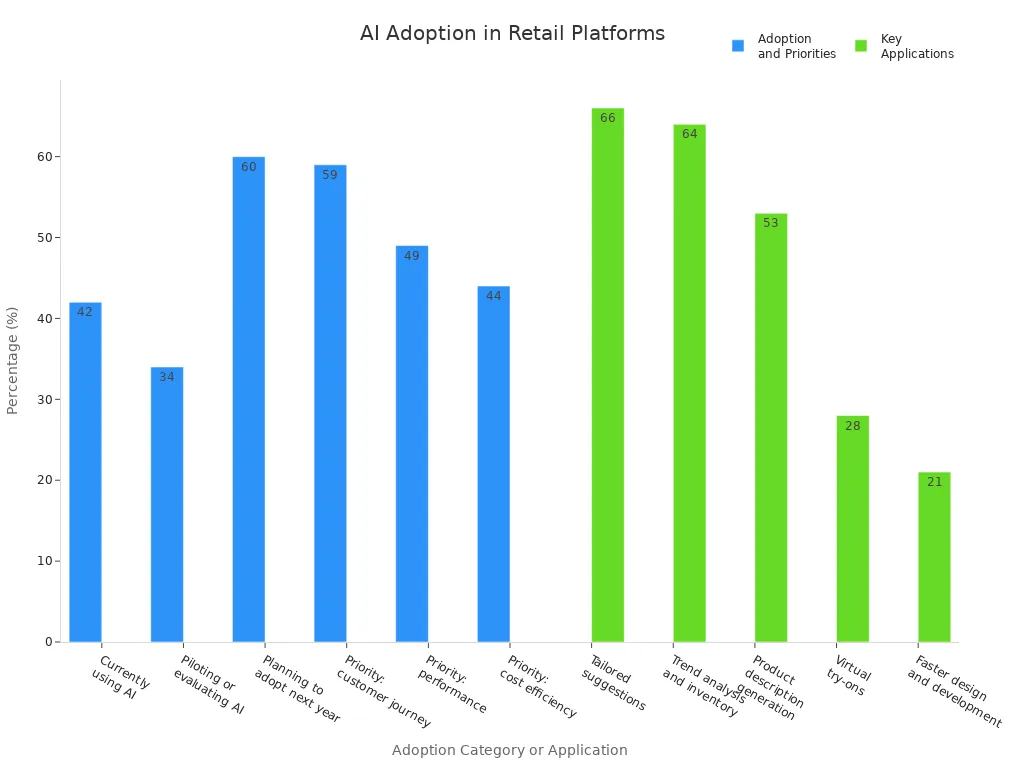
API-first strategies help launch new technology 45% faster. They also make systems 30% easier to grow. With the right plan, you get flexibility, strength, and safety.
Key Takeaways
Advanced API design helps retail AI platforms change fast. This makes it easy to update prices and inventory on time.
Scalable API setups let retailers grow without problems. They can add more resources when they need them.
Strong security in API design keeps customer data safe. It also helps follow rules and builds trust with users.
Modular API design makes fixing and upgrading easier. Teams can work on different parts at the same time. This does not hurt the whole system.
Watching and improving APIs all the time finds problems early. This keeps things working well and fair for everyone.
API Design for Retail AI Resilience
Adaptability to Change
Retail changes often. New trends and technology appear all the time. API design lets you react fast. APIs can handle inputs right away. Your retail AI platform can change as soon as the market does. You can update prices, inventory, or recommendations quickly.
Tip: Make APIs that respond fast. This helps you beat competitors and serve customers sooner.
Evidence Description | Explanation |
|---|---|
APIs process and react in real time | Retail AI systems can change fast when the market shifts. This makes them more adaptable. |
AI-driven insights help self-regulation | APIs can keep improving themselves. This is important for changing customer needs. |
AI allows quick system integration | Businesses can change their plans fast. This keeps them competitive when the market changes. |
You may face problems like bad data, privacy worries, and ethics. Good data and clear rules help you avoid mistakes and earn trust.
Real-time data keeps inventory, customer info, and orders updated everywhere.
Less complex integration means new features launch faster with less downtime.
Fast testing and changes help you improve your AI strategies.
Scalability for Growth
When your business grows, you need to handle more customers and products. API design helps you grow by letting you scale parts of your system alone. You can add resources where needed without stopping everything.
Principle | Description |
|---|---|
Scalability | Use horizontal scaling, load balancing, and caching for busy times. |
Flexibility | Modular design lets you update parts without breaking the system. |
Extensibility | Add new features easily with plugins. |
Standardization | Clear interfaces help teams work together. |
Error handling | Good APIs keep working even if something fails. |
Metric | Value |
|---|---|
Latency | |
Error Rate | Below 0.1% |
Availability | Over 99.9% uptime |
Retailers with scalable API setups now have 16% of the AI API market in retail and e-commerce. You get fast launches, better customer experience, and stand out from others. Recommendation engines, demand forecasting, and dynamic pricing use strong APIs to work well at scale.
Security and Compliance
You need to keep customer data safe and follow rules. API design helps with security and compliance. Use encryption for stored and moving data. Logging and audits help you watch API actions and spot problems.
Note: Follow rules like SOC 2, GDPR, and HIPAA. These rules need clear data limits, safe handling, and regular checks.
SOC 2 says you must set data limits and log API actions.
GDPR needs encryption and strict data rules.
HIPAA requires safe handling of sensitive data.
By focusing on these things, you earn customer trust and avoid fines. Strong API design keeps your retail AI platform safe, even when threats and rules change.
Principles of Advanced API Design
Modularity
You need modularity to make retail AI platforms strong. Modularity means you split your system into smaller parts. Each part does one job. This makes your API design simple and clear. Autonomous AI agents do better when they use high-level endpoints. These endpoints group business logic together. This helps avoid confusion and makes things work faster.
Modular API design gives AI agents better context.
You cut down on fragmentation, so agents act quicker.
High-level endpoints mean agents make fewer calls.
It is also easier to fix and upgrade things. Teams can work on different parts at the same time. One part can be fixed or changed without hurting the rest. Testing is easier because you can test each part alone. You can use the same modules in many products, which saves time.
Modularity lets teams work alone on their parts.
Maintenance is safer and simpler.
Testing each part is easy and saves debugging time.
Reusing modules helps start new projects faster.
Tip: Begin with modular API design for quick changes and good teamwork.
Versioning
Versioning keeps your retail AI platform steady as it grows. You need to change things without breaking what works for users. Good versioning helps you add features and fix bugs while keeping APIs strong.
Description | Advantages/Trade-offs | |
|---|---|---|
URI versioning | Adds a version number to the URI for each resource. | Simple but can become unwieldy with many versions; complicates HATEOAS implementation. |
Query string versioning | Uses a parameter in the query string to specify the version. | Same URI for the resource; requires parsing of the query string; complicates HATEOAS. |
Header versioning | Implements a custom header to indicate the version of the resource. | Requires client to add header; can use default version if omitted; complicates HATEOAS. |
Media type versioning | Uses the Accept header to specify the content format and version. | Allows clients to specify response format; can define custom media types for versioning. |
You build trust by not breaking old features. Users know their systems will keep working after updates. You can use versioned endpoints and feature flags to keep things smooth. Keeping APIs the same is important, especially when customers pay as they go.
Backward compatibility keeps users happy and cuts support costs.
Versioned endpoints and feature flags stop service breaks.
Consistent updates make users trust your platform.
Note: Plan versioning early to avoid big changes later.
Interoperability
Interoperability lets your retail AI platform link with other systems. You need to follow standards so your APIs work with other tools and partners. This makes connecting faster and more reliable.
Description | |
|---|---|
STAR Automotive Retail Domain Model | A coordinated effort to standardize operational data structures for dealership and OEM systems. |
JSON/OpenAPI Practices | Aligns domains with modern API development standards, enhancing interoperability. |
Unified Data Definitions | Provides consistent data structures across platforms for core processes. |
AI integration platforms help your systems and third-party services talk in real time. You get better data flow and more automation. This means faster choices and smoother work in your retail business.
Tip: Use open standards and clear data rules to make your API design ready for the future.
AI-Driven API Strategies

API Lifecycle Management
You need to manage APIs from start to finish. AI tools help you make APIs faster. These tools write simple code for endpoints and plans. This saves you time. AI can give you ideas that fit your business. Reasoning-ready APIs let AI agents answer in a personal way. This makes shopping better for customers.
Component | Description |
|---|---|
Scalability | Use horizontal scaling, load balancing, and caching to handle high traffic. |
Flexibility | Modular design allows updates without breaking the whole system. |
Extensibility | Add new features easily with plugin systems. |
Standardization | Clear interfaces make it easy for teams to work together. |
Error handling | Good APIs keep working even if something goes wrong. |
AI helps you watch how your APIs work. It can guess where problems might happen. Smart traffic routing sends requests to the best place. Adaptive rate limiting keeps your system safe and lets more people use it.
Automated Testing
Automated testing helps you find mistakes and makes things work better. AI makes testing smarter by guessing what might break. Continuous integration and delivery catch bugs early. Automated regression testing checks if old features still work.
Functional tests check if endpoints give the right data.
Edge case testing finds rare problems.
Security vulnerability testing looks for common risks.
Evidence | Explanation |
|---|---|
Self-healing API testing | Adapts to changes in endpoints, reducing maintenance and ensuring reliability. |
Continuous testing | Catches errors early, improving software quality and reliability. |
Shift-left API automation | Finds most defects during development, reducing costs and speeding delivery. |
Performance Optimization
You need to check and improve how fast your APIs are. Response time shows how quickly your system answers. Throughput tells you how many things you can do at once. Error rate shows how often things go wrong. Compute usage checks how well you use your resources. System uptime shows how often your service is online. Scalability shows how well you handle more users.
Pagination and caching make responses faster and save resources.
Asynchronous logging and connection pooling stop overloads.
Payload compression and connection pooling make responses quicker and cheaper.
Great teams use AI models that match their goals. MLOps pipelines help watch and improve APIs all the time. Value tracking helps you know where to spend for better results. Good API design helps with all these things and keeps your retail AI platform ready for the future.
Challenges and Ethics in API Design
AI Limitations
You will face challenges when you use AI for API design in retail. AI tools do not always give the same results. The code they generate can change each time you run them. This makes your development process harder. AI also does not understand your business or the code around it. You may get suggestions that do not fit your needs. Sometimes, AI creates modules that do not match your requirements. Debugging becomes difficult when you see these inconsistencies. You will also notice that there is no standard way for AI to describe what it does. This leads to unpredictable outputs.
AI tools show non-determinism. The code changes with each use.
AI lacks business context. Suggestions may not match your goals.
Consistency issues appear. Not all modules follow your rules.
No standard description language exists. Outputs can surprise you.
Tip: Always review AI-generated code. Test it before you use it in production.
Human Oversight
You must keep humans in the loop when you design APIs with AI. People can catch mistakes that AI misses. You need experts to check if the API meets your business needs. Human review helps you spot errors, security risks, and bias. You should set up clear steps for code review and approval. This keeps your platform safe and reliable.
Assign team members to review AI-generated code.
Use checklists to make sure APIs meet your standards.
Schedule regular audits to find and fix problems.
Human oversight builds trust. It ensures your retail AI platform works as you expect.
Ethical Data Use
You must use data in a fair and responsible way. Your APIs should treat all users equally. Fairness means you do not favor one group over another. You need to tell people how you use AI in your platform. Transparency helps users understand your decisions. You should give customers a way to ask questions or challenge AI-driven choices. Accountability means you listen and respond to their concerns.
Transparency: Explain how you use AI and data.
Accountability: Provide ways for users to question or review decisions.
Note: Ethical data use protects your brand and builds customer loyalty.
Actionable Steps for Future-Proofing

Building for Change
You should make your retail AI APIs ready for new needs. Start by using an API-led connectivity approach. This way, you build your system with small parts you can reuse. You can change or upgrade these parts as your business grows. Use domain-driven design to group your APIs by your main business needs. This keeps your system flexible and simple to manage. Always use API versioning. This lets you add new features or fix bugs without breaking things that already work. Strong API governance makes sure your APIs stay the same and safe. Zero trust architecture keeps your data and apps safe, even when you add new AI tools.
API-led connectivity helps you build with reusable parts.
Domain-driven design matches APIs to your business goals.
API versioning helps you make changes without problems.
API governance keeps everything safe and the same.
Zero trust architecture protects your platform.
Tip: Always plan for change. This helps you stay ahead in a fast market.
Continuous Improvement
You need to keep making your retail AI platform better to win. Set up continuous monitoring to check if your APIs follow rules and work well. Regular checks help you find problems early, like bias or slow speed. Real-time feedback loops let you fix things fast. Use logging and audits to see what happens in your system. Plan reviews after you update your platform to make sure it still meets your goals and follows the rules.
Watch APIs to make sure they are fair and work well.
Check performance often to find problems early.
Use real-time feedback to fix things quickly.
Log and audit actions to keep track of everything.
Review your platform after updates to stay on track.
Making things better all the time keeps your platform strong and trusted.
Collaboration
You need good teamwork to keep your retail AI APIs ready for the future. Work with experts from different areas to design safe and useful APIs. AI can help you find security risks by looking at how things work and checking for problems. This way, you can stop many frauds before they happen. Customers want offers made just for them, so you must use AI and automation to give them what they want. True interoperability lets your systems talk to each other. This turns AI into a smart tool for making choices. Building strong connections and a good setup makes a retail system that can change and grow.
Working together with teams and technology helps your retail AI platform do its best.
You can keep your retail AI platform ready for the future by using advanced API design and smart AI strategies. These methods help your system change, grow, and stay safe. Real examples show that AI-driven APIs make things safer, work better, and are easier for developers. They also help with changing prices and making the supply chain work well.
Key Takeaway | Description |
|---|---|
Enhanced Security | Finds threats fast and fixes weak spots automatically. |
Performance Optimization | AI guesses how people will use the system and spots slow parts. |
Improved Developer Experience | AI makes building and testing easier. |
To get better, you should:
Make a strong data model and use the same words for everything.
Draw a map of your system and write down business rules.
Think about how users will use your system and plan every part.
Keep learning and changing your plans as your data changes.
When your AI agents keep learning, they get smarter and more helpful. This makes your platform more correct and useful. Always check your API design to make sure your retail business is ready for what comes next.
FAQ
What makes an API design "future-proof" for retail AI?
You make a future-proof API by using modularity, versioning, and interoperability. These things help you change fast, grow easily, and link with new tools as your business gets bigger.
How does AI improve API testing and maintenance?
AI helps by testing and finding mistakes quickly. You get feedback right away and tests that fix themselves. This makes your APIs work well and means you do not have to do as much by hand.
Why should you use versioning in your retail API?
Versioning lets you add new things without breaking old ones. Your platform stays steady and users can trust it. You can safely update parts of your system.
How do you ensure API security and compliance?
You keep data safe by using encryption, logging, and checking often. You follow rules like GDPR and SOC 2. These steps protect customer data and help you not get fined.
Can you connect your retail AI platform with other systems?
Yes, you use open standards and clear data rules. This helps your APIs work with partners, other tools, and new tech. You get better automation and data sharing.
See Also
The Future of Retail Lies in AI-Driven Stores
Understanding the Growth of AI-Enhanced Corner Retail Shops
Transforming Online Retail Management with AI E-Commerce Solutions
Modern Retail Benefits from AI-Enhanced Combo Vending Machines
