Key technology requirements changing the retail game today

You must pay attention to key technology requirements to do well in autonomous retail. Data integration helps you provide the same customer service at every store. Real-time visibility allows you to see transaction data immediately, enabling you to manage inventory quickly. A unified customer experience connects loyalty programs and POS systems across all stores. AI agents and automation now assist in increasing sales and enhancing customer relationships. In 2024, 78% of companies utilize AI, and brands experience four times more purchases when customers interact with chatbots.
Key Takeaways
Buy advanced POS systems to make sales and inventory easier at every store. Use AI and automation to help make better choices, stop running out of stock, and make customers happier. Add contactless payment to make buying faster and help customers feel good. Use cloud-based management so you can see data right away, which helps control inventory and talk to customers better. Make data security and compliance important to keep customer info safe and help people trust your brand.
Key technology requirements for autonomous retail
You need to know the main technology needs for autonomous retail. These needs help you run many stores, make customers happy, and work better. Multi-location retailers have problems like systems that do not connect, different experiences, and hard rules. The right technology can fix these problems.
Advanced POS and self-checkout
You use advanced POS and self-checkout to make work easier. These tools help you sell items fast and track inventory right away. They also help your customers wait less. Many retailers say these tools help them work better and make shopping nicer. But you should think about the price and problems before you change things.
Tip: Pick POS systems that work in all your stores. This stops data from getting stuck and gives customers the same experience.
Here is a quick look at the main benefits and challenges:
Benefits | Challenges |
|---|---|
High initial costs | |
Enhanced customer experience | Customer adoption issues |
Better inventory management | Technical glitches |
Privacy concerns |
You might pay a lot at first and have tech problems. Customers may need time to get used to new tools. You also need to keep customer data safe and think about privacy. Even with these problems, advanced POS and self-checkout are still very important for franchise and multi-location retailers.
Contactless and cashierless payments
You can make shopping faster and easier with contactless and cashierless payments. These tools let customers pay fast, sometimes in just seconds. You will see shorter lines and happier shoppers. Many fast-food places use these tools to cut down wait times. People want things to be easy, so they like quick payments.
Contactless payment systems make checkout faster and customers happier.
In fast-food places, these tools let people pay in seconds.
People want things to be easy, so more stores use contactless payments.
You also need to think about the cost of new payment tools. You must buy hardware, software, and pay for support. These are important technology needs to stay ahead in autonomous retail.
You should remember that stores with many locations need one system to run everything and keep the brand the same. Each store should fit local needs but still feel like the same brand. Standard technology helps you stop broken systems and different service.
By focusing on these main technology needs, you can work better, make customers happy, and get your business ready for the future of retail.
AI agents and automation
AI-driven decision making
AI agents help you make better choices in your stores. These systems look at lots of data and find things people might not see. AI can guess what customers want and when they want it. This helps you keep the right products in stock and waste less. You also get answers faster and more correctly when you need to decide about sales or inventory.
Some ways AI-driven decision making helps you:
Looks at data to find trends and patterns.
Makes choices fast with less help from people.
Can guess market changes right away.
Helps you choose faster and more correctly.
Cuts down on manual work and makes forecasts better.
In 2022, stores spent 16% of their AI money on planning for demand. This shows that AI is very important for guessing sales. When you use AI, you can have 65% fewer stockouts, keep 20–30% less inventory, and fill orders 5–8% more.
Improvement Type | Statistic |
|---|---|
Stockouts Reduced | 65% fewer stockouts |
Leaner Inventories | 20–30% leaner inventories |
Higher Fill Rates | 5–8% higher fill rates |
Automated in-store processes
Automation helps your stores run better. Automated systems check inventory, refill shelves, and help customers with little human help. You can use smart assistants, cashierless checkouts, and AI-powered customer service to save time and money.
Here are some results you might see:
Better distribution and following rules.
Self-checks that use photos and lists.
More people join promos with reminders.
AI chatbots give help all the time.
Campaigns and reports start faster.
Stores have seen big changes after using automation. For example, you can have 30% fewer stockouts, 20% less extra inventory, and 15% lower logistics costs. Automation also helps you cut labor problems by up to 18%.
Outcome | Description |
|---|---|
Reduction in stockouts | 30% fewer stockouts with AI-driven supply chain optimization |
Decrease in excess inventory | 20% less extra inventory |
Lower logistics costs | 15% lower logistics costs |
Reduction in labor inefficiencies | 12–18% less labor problems |
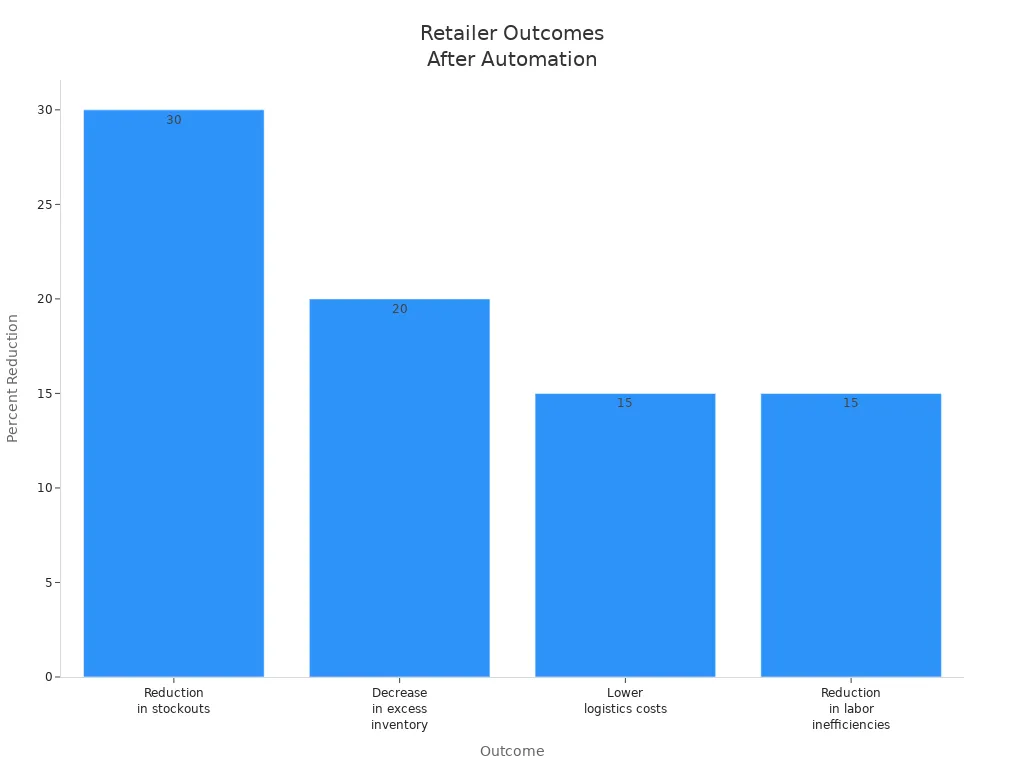
You can see that AI agents and automation are important technology needs for running modern, smooth, and customer-friendly stores.
Sensory and machine vision technology
IoT sensors and RFID tracking
You can use IoT sensors and RFID tracking to make your store smarter. These tools help you watch products and equipment right away. IoT sensors send information about things like temperature and movement. They also tell you how full your shelves are. RFID tags let you follow items as they move in the store. You always know where each product is and how many you have. This helps you stop running out of things and wasting products.
You can set up alerts when shelves are almost empty. You refill items before customers notice they are gone. RFID tracking also helps you find lost things and stop stealing. You save money and keep your store working well. Many stores use these systems to make inventory more correct and restock faster.
Note: IoT sensors and RFID tracking are important technology needs for autonomous retail. They help you control inventory and keep your store safe.
Machine vision for customer tracking
Machine vision gives you new ways to learn about your customers and protect your store. Cameras and computer vision systems watch how people move and look at products. You see which aisles are busy and which items get attention. Object detection lets you spot customers and items on shelves. Object classification helps you tell shoppers from workers and track what gets picked up.
Object tracking follows customers as they shop and shows how they use the store.
Behavior analysis tells you where people spend time and what paths they take.
Computer vision systems also help you keep your store safe. They find strange actions, like bags left alone or odd movements. You can act fast if there is a problem. Retail shrinkage costs stores in the U.S. over $112 billion each year. Vision AI can cut shrinkage by up to 60% in grocery stores. You fix problems faster when you use computer vision for fraud.
Benefit | Description |
|---|---|
Improved security | |
Better shopping data | Tracks customer paths and time spent |
Less shrinkage | Cuts theft and fraud losses |
You use machine vision to make your store safer and learn more about your customers. This technology helps you give shoppers a better experience and protect your business.
Centralized data and analytics
Cloud-based management
Cloud-based management helps your stores stay connected and work well. Cloud systems put all your store data in one spot. You can check sales, inventory, and what customers do from anywhere. Many retailers use cloud-based POS systems for all their stores. These systems help you run loyalty programs and track inventory without paper or waiting.
You get lots of good things from cloud-based management:
You see sales and inventory numbers right away for every store.
You can send digital receipts and connect loyalty programs everywhere.
You make better choices because you have the newest information.
You can find and fix problems fast.
Cloud-based management helps with omnichannel shopping. Customers get the same experience online and in the store. You also manage inventory better because you know what sells and where. Cloud systems help your business grow and keep your brand strong.
AI analytics for personalization
AI analytics help you learn about your customers and give them what they want. You can use AI to look at buying habits and send special deals to the right people. Personalized marketing makes customers feel important and want to come back. You see big changes when you use AI analytics for personalization.
Key ROI Metric | Data |
|---|---|
Revenue Lift | 6%–10% revenue jump from personalization; leaders see 40% more revenue. |
Conversion Rate | Up to 1.7x higher conversion rates; up to 25% lift with chatbots. |
Marketing ROI | 25% average increase in marketing ROI. |
Customer Retention | 28% reduction in customer churn rates. |
Cost Savings | Up to 50% lower customer acquisition costs; 37% lower marketing costs. |
You can get 40% more customer engagement with digital receipts and loyalty programs. Real-time data helps you run campaigns that bring shoppers back. You also have 25% fewer stockouts and 15% more revenue with better supply chain management. These are key technology requirements for franchise and multi-location retailers who want to stay ahead.
Integration and scalability
API architecture for multi-location
You need strong integration to link all your stores. API architecture helps your tools work together. APIs let your systems share data right away. You do not have to type the same data twice. This saves time and stops errors.
APIs make it simple to add new tools or services. You can connect payment systems, inventory tools, or loyalty programs. You can also use third-party services easily. With APIs, you get updates faster and make better choices. Your stores act like one team.
Tip: Pick platforms with open APIs. This lets you grow and change your tech as your business gets bigger.
You might face some problems when you add tech to many stores. Here is a quick look:
Challenge | Implication |
|---|---|
Unified vision | Needed for smooth technology integration |
Security concerns | Grow with more locations |
Real-time inventory management | Key for running stores well |
Personalized customer experiences | Important for happy, loyal customers |
You need to plan for these problems. Make sure your API setup is safe and simple to use.
Franchise customization
You want each store to feel local but still match your brand. Customization lets you do this. You can set up different menus, prices, or deals for each store. You can also use data analytics to see what works best in each place.
Franchise operators like these customization features:
Customization Capability | Description |
|---|---|
Automation of Processes | Makes work faster and cuts down on manual tasks |
Data Analytics | Gives you insights to make smart choices and predict what customers want |
Enhancing Customer Experience | Makes shopping easier and more personal, so customers come back |
You can use automation to save time and money. Data analytics helps you find trends and make stores better. When you focus on customer experience, you build loyalty and grow your business.
Note: Integration and customization are key technology needs for franchise and multi-location retailers. They help you grow, stay flexible, and keep your customers happy.
Security and compliance
Data privacy and cybersecurity
You need to keep your store and customers safe from cyber attacks. Autonomous retail uses lots of connected devices and systems. This means hackers have more ways to get in. You should learn about the biggest risks so you can stop them early.
Threat Type | Description |
|---|---|
Phishing | Trick emails or messages that try to steal private information. |
Ransomware | Malware that locks your files and asks for money to unlock them. |
Insider Threats | Employees or partners who misuse their access to data. |
Unpatched Software Vulnerabilities | Old software that has not been updated and can be attacked. |
Data Leakage | Sensitive data leaving your store by mistake or on purpose. |
Weak Passwords | Easy-to-guess passwords that let hackers in. |
SQL Injection | Hackers use bad code to break into your database. |
DDoS Attacks | Too much traffic sent to your system to make it crash. |
Third-Party Vendor Risks | Outside companies with weak security can put your data at risk. |
You can make these risks smaller by using strong passwords. Update your software often and teach your workers about safety. You should also check if your vendors have good security. Keeping customer data safe helps people trust your store and keeps your business strong.
Regulatory and ADA compliance
You have to follow the law when you use new technology in your stores. This means you must protect customer privacy and make your store easy for everyone. The Americans with Disabilities Act (ADA) says you need to help people with disabilities shop in your stores.
Compliance Aspect | Description |
|---|---|
Accessibility for Individuals with Disabilities | Make sure all technology works for people with disabilities. |
Regular Updates to Policies | Change your rules often to match new laws. |
Central Document Management | Keep all compliance records in one place for all your stores. |
You should test your systems to see if everyone can use them. Change your rules often so you do not break the law. Keep all your records in one spot to stay organized. This helps you follow the rules in every store.
Tip: Good security and following the rules keep your business and customers safe. They also help you avoid fines and make your store look trustworthy.
Customer experience technology
In-store navigation and engagement
You can make shopping easier and more fun with new tools. These tools help customers find what they want. They also make shopping more enjoyable. Many stores use real-time navigation and geolocation. Wayfinding technology guides shoppers to products. It shows them special deals as they walk around.
Real-time personalization gives each customer a unique experience. Augmented Reality lets shoppers see how products look or work before buying. Smart shelves and electronic shelf labels show the right prices. They help you fix out-of-stock problems fast. Computer vision checks shelf inventory. It helps you keep products available. Self-checkout and scan-and-go options make shopping faster and easier.
You can use AI to study customer behavior. This helps you understand what people like. You learn where they spend time in your store. When you use these tools, you can send personalized offers. Offers are based on where shoppers are in the store. This encourages impulse buys and increases sales.
If you watch how long customers stay in certain areas, you can learn what works and what does not. Longer dwell time often means shoppers are interested. They may spend more money. If you see high dwell time but low sales, you might need to check prices or stock. These insights help you improve your store layout and marketing.
Loyalty and personalization platforms
You can keep customers coming back with strong loyalty and personalization platforms. A unified loyalty program lets shoppers earn and use points at any of your locations. This makes it easy for them. It helps you keep your brand the same everywhere. You can also offer special rewards that fit local tastes.
Feature | Description |
|---|---|
Centralized Management | Keeps your brand consistent and makes updates simple for all stores. |
Lets you give rewards that match what local shoppers want. | |
POS Integration | Connects loyalty programs with your checkout system for smooth shopping. |
Actionable Insights | Shows you what customers buy so you can improve your offers. |
Mobile Accessibility | Lets shoppers check and use rewards on their phones for more engagement. |
When you use advanced loyalty platforms, you see big results. Stores have seen up to 25% higher customer retention rates. Repeat purchase rates can improve by more than three times. Top programs can boost sales by 15–25% each year. VIP members often spend much more than other shoppers. These platforms help you grow your business and keep customers happy.
You should see customer experience technology as one of the key technology requirements for franchise and multi-location retailers. It helps you stand out and build lasting relationships with your shoppers.
You notice that technology is changing how stores work. Cloud-based solutions let you share data and work as a team. Advanced analytics help you make good decisions quickly. Mobile apps keep customers interested in your store. If you want to stay ahead, you should:
Spend money on technology that can grow with you.
Teach your team how to use new tools.
Make sure your data is safe and you follow the rules.
First, plan with the best vendors, set up your systems, and train your workers. These steps get your stores ready for the future of retail.
FAQ
What is the most important technology for autonomous retail?
You need a strong POS system that works in all your stores. This system helps you track sales, manage inventory, and connect with customers. It forms the base for other advanced tools.
How does AI help you in retail stores?
AI helps you predict what customers want. You can use AI to manage inventory, set prices, and send special offers. AI also helps you answer customer questions quickly.
Why do you need cloud-based management?
Benefit | Reason |
|---|---|
Real-time updates | You see data right away. |
Easy access | You check info from anywhere. |
Fast decisions | You act on new trends fast. |
How do you keep customer data safe?
You use strong passwords and update your software often. You teach your team about online safety. You also check your vendors for good security practices.
See Also
Transforming Retail: The Impact of Smart Vending Machines
Understanding AI-Driven Corner Stores: Essential Insights for Retailers
The Future of Retail: Embracing AI-Enhanced Stores
