How to unlock value through partnership models in retail AI ecosystems


You can get real value in retail AI by using partnership models. Technology partners and integrators help you work quicker and make it easier to use new solutions. AI-driven retail ecosystems do well when people work together and share goals. Each business has its own needs. You should look at which partnership models fit your goals and technology plans.
Key Takeaways
Partnership models in retail AI let businesses share things and ideas. This helps them solve problems like rules and high costs. Choosing the right partnership model helps you work with tech providers and data experts. This makes your AI project grow faster. Bilateral collaborations help you solve problems by working closely with a partner. You both have clear goals and share what you need. AI ecosystems and platforms help many partners work together. They can share tools and ideas to make customers happier. Service-oriented partnerships give you special skills from others. You can focus on your main business while experts do the hard tech work.
Understanding Partnership Models in Retail AI

Defining Partnership Models
Partnership models are ways companies work together for shared goals. In retail AI, these models help you connect with technology providers, data experts, and service companies. Each model is different. Some focus on sharing technology. Others are about exchanging data or building new services together. Companies may form alliances to create new AI tools. You might join a network that shares customer insights. These models give you choices. You can pick partners that fit your needs. This helps you grow your AI projects faster.
Tip: When you choose your partnership model, make sure you know what each partner does. Clear roles and goals help everyone do well.
Why They Matter in Retail AI
Partnership models help you use AI in retail. Many businesses face problems like following rules, high costs, and skill gaps. You do not have to fix these problems alone. Partners let you share resources and knowledge. This makes it easier to handle rules and manage data privacy risks.
Over half of businesses using AI say following rules is their biggest problem. Strong partnerships help you build plans to meet these rules.
Small and medium retailers often do not have enough resources. Partnerships let you get technology and support you might not have alone.
Competition and the need for customer personalization push you to use AI faster. Partners help you keep up with market changes.
You may also face other problems like data fragmentation, integration issues, and resistance to change. Good partnership models help you beat these barriers by combining strengths and sharing best practices. When you pick the right partners, you can unlock new value and grow your business with AI.
Types of Partnership Models
You can pick from different partnership models in retail AI. Each model has its own benefits. You should learn how each one works before you choose.
Bilateral Collaborations
Bilateral collaborations are when two companies work together. You and your partner set clear goals and share resources. This model is good for solving a problem or making a new AI tool. For example, a retailer can work with a technology company to build a demand forecasting system. You get direct help and focused results. You also keep control over your project.
Tip: Start with a small project in a bilateral collaboration. You can build trust and see how your partner works.
AI Ecosystems and Platforms
AI ecosystems and platforms bring many partners together. You join a network of retailers, technology providers, and data experts. This model helps you share ideas and tools. You can use ready-made AI solutions like predictive analytics, machine learning, and computer vision. These tools help with demand forecasting, inventory optimization, and customer service.
You can update your systems step by step. This keeps your business running while you add new features.
Hybrid architectures let old and new systems work together.
Automated deployment pipelines make your AI tools more reliable.
APIs help you connect different tools and move to advanced AI platforms.
Infrastructure-as-code and observability tools help you manage and monitor your systems.
You can use AI to personalize customer engagement, set dynamic prices, and automate fulfillment. These platforms help you work with others and try new ideas faster. You can fix problems like data fragmentation and old systems by using unified data governance and modular services.
Note: AI ecosystems and platforms make it easier to connect with others and try new ideas. You do not have to build everything yourself.
Service-Oriented Partnerships
Service-oriented partnerships let you use outside experts for certain tasks. You might hire a company to manage your AI infrastructure or analyze your data. This model gives you skills you do not have in-house. You can focus on your main business while your partner handles the technical work. Service partners often help with machine learning, natural language processing, and customer service platforms. You get flexible help that fits your needs.
You can grow your AI projects as needed.
You save time and money by using expert services.
You can respond quickly to changes in the market.
Research and Data Networks
Research and data networks connect you with other retailers, suppliers, and technology companies. You share data and insights to solve common problems. For example, you might join a network that shares demand forecasts and inventory levels. This helps everyone plan better and avoid shortages.
Data-sharing platforms help you work closely with suppliers.
Cloud-based AI platforms bring data from many partners into one place.
You build trust by sharing information safely.
AI governance makes sure you use data responsibly and follow the rules.
Tip: Research and data networks help you try new ideas while staying ethical. You can innovate without losing trust.
By learning about these partnership models, you can pick the best way to grow your retail AI projects. Ecosystem and platform approaches help you connect, share, and try new things. You can beat problems like data fragmentation and old systems. You can also build strong relationships that help your business succeed for a long time.
Best Practices for Partnerships
Building strong partnerships in retail AI needs careful planning. You can use a simple guide to make and manage these relationships. The table below shows some helpful frameworks you can try:
Framework/Methodology | Description |
|---|---|
U.S.I.D.O. Framework | Steps for AI product management: Understand, Specify, Implement, Deploy, Optimize. |
Build / Buy / Bake Strategy | Helps you choose to build, buy, or co-develop AI solutions. |
Customer-Centric Approach | Focuses on user feedback and experience. |
AI Technology Integration | Guides you in managing data and connecting AI tools. |
Growth Strategy Framework | Uses AI insights for pricing and customer retention. |
Ethical Governance Framework | Makes sure you follow ethical rules and write down decisions. |
Strategic Alignment
You need to make sure your goals match your partner’s goals. Begin with small projects and test your ideas. Show how your work brings value. Train your team to use new AI tools. Bring in outside experts if you need more skills. Keep checking your progress and make changes when needed.
Focus on return on investment (ROI).
Teach employees to use AI.
Use outside experts if needed.
Watch and improve your systems.
Tip: Match your business model, customer needs, and technology from the start. This helps you avoid mistakes like unclear goals or bad data quality.
Structuring Agreements
When you set up agreements, you must protect your business. Make sure you cover these points:
Data privacy and security rules, like GDPR and CCPA.
Clear ownership of AI content and tools.
Contract terms for liability and performance.
Service Level Agreements (SLAs) for uptime and support.
Data protection language that matches buyer standards.
Note: In risky areas, set clear limits on liability to manage risks.
Data Sharing and Security
You must handle data with care. Use strong data governance to keep information safe and correct. Make sure you only share data with trusted partners. Set clear rules for how data is used and stored. Good data quality leads to better AI results.
Measuring Success
You should track your progress with clear metrics:
Customer engagement shows if your partnership connects with shoppers.
Operational excellence measures how well your systems work.
Performance analytics help you see what works and what needs fixing.
Alert: Avoid mistakes like unclear strategies, bad data, or not linking AI to business goals. Good partnership models help you stay on track and deliver real value.
Real-World Success Stories

Retailer & Integrator Collaboration
You can see big changes when stores and technology integrators team up. Many stores now use electronic shelf labels, self-checkout, and RFID. These tools make shopping easier for everyone. They help stores save time and money. The table below shows how many stores use these tools and what they hope to get:
Evidence Type | Description |
|---|---|
Technology Adoption | Almost 60% of stores use electronic shelf labels. 55% have self-checkout. 44% use RFID. 33% offer scan-and-go. |
Expected Financial Impact | 44% of stores think technology will raise profits by more than 1.5 percentage points. |
Investment Plans | 60% of store leaders want to spend 5% to 20% more on upgrades in the next five years. |
AI Utilization | 73% of stores plan to use AI for better customer insights and local shopping. |
In-Store Fulfillment | 30% of stores now use in-store fulfillment at scale. |
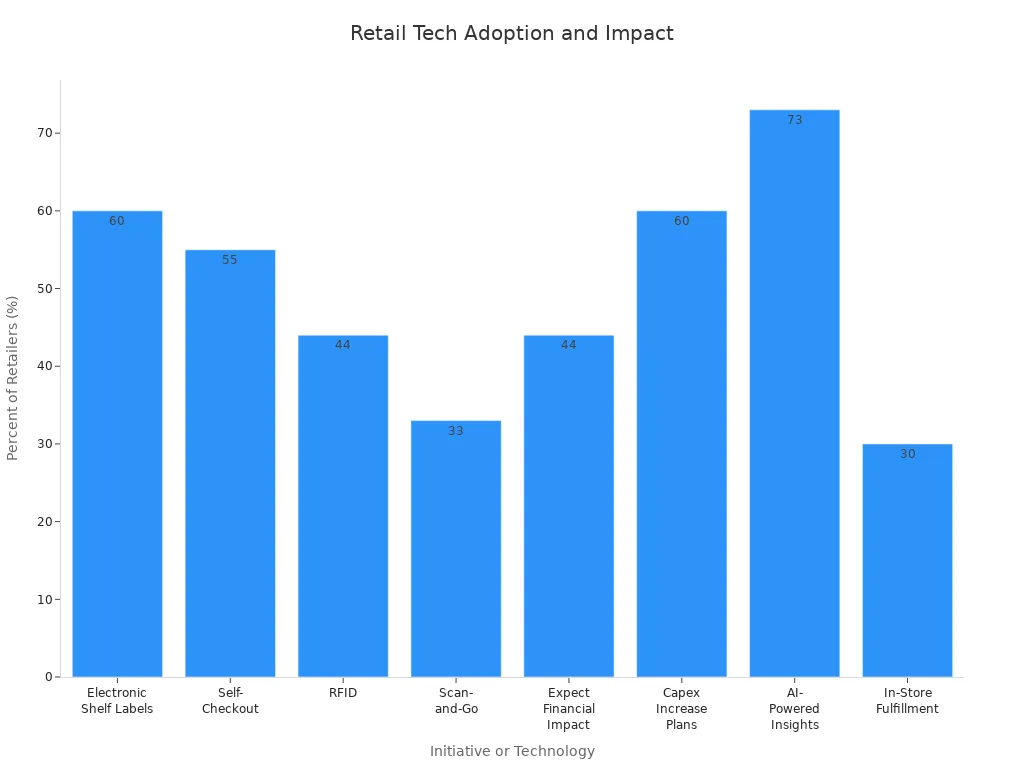
These partnerships help stores use new technology faster. They also help stores do better and improve performance.
Multi-Partner AI Ecosystem
When you join a multi-partner AI ecosystem, you get more than just technology. You work with experts who know your industry well. You use AI to make smarter choices. Partners care about the planet and follow rules for good business. The table below shows what makes these ecosystems strong:
Key Factor | Description |
|---|---|
Industry Specialization | Partners focus on your industry, so you get solutions that fit your needs. |
AI-Driven Optimization | AI helps you make smart decisions and work better with others. |
Commitment to Sustainability | Partners care about the planet and follow rules for responsible business. |
You can use these ecosystems to fix problems, share ideas, and grow your business responsibly.
Industry Lessons
You can learn a lot from big retail partnerships. Companies like Amazon use strong technology and friendly rules to help sellers and shoppers. They focus on what customers want and let many types of businesses work together. Here are some important lessons:
Key Success Factors | Description |
|---|---|
Technology Platform | A strong tech base and logistics help everyone in the ecosystem. |
Seller-Friendly Policies | Supportive rules encourage more partners to join and grow. |
Customer-Centric Approach | Focusing on shoppers leads to new ideas and better service. |
Diverse Ecosystem Structure | Many business models can work together and succeed. |
You can expect 30-45% better efficiency.
You may see 25-40% faster development cycles.
You can get 35-50% more new ideas and products.
You gain an edge by responding quickly to market changes.
“Small businesses use focused tools, test them fast, and improve them with customer feedback. This helps them balance efficiency and personal service.”
You should remember that knowing different company cultures helps you work better with partners. Big stores use AI to grow worldwide. Midsized stores try to work smarter. Small shops use AI to connect with local shoppers. Each group finds its own way to win with partnerships.
You get more value from retail AI when you work with partners. Working together helps you fix problems and reach your goals faster. Look at what you do now and see how you can do better. To get the best results from your partners, follow these steps:
Get to know your customers better by watching how they interact.
Use technology to make your work better every day.
Check your results with analytics to see if your actions help your business.
FAQ
What is a partnership model in retail AI?
A partnership model lets you work with other companies to use AI in retail. You share tools, data, or services. This helps you solve problems and grow your business faster.
How do I choose the right partnership model?
You should look at your goals and needs. Ask what skills or technology you need. Pick partners who match your plans and help you reach your targets.
Is data sharing safe in retail AI partnerships?
You must use strong data rules and clear agreements. Trusted partners follow privacy laws like GDPR. Good data governance keeps your information safe.
What are the main benefits of retail AI partnerships?
You get new technology faster.
You save money and time.
You learn from experts.
You can serve your customers better.
See Also
Exploring AI-Driven Vending Machines: Advantages for Today's Retail
The Future of Retail: Embracing AI-Driven Stores
Understanding AI-Enhanced Corner Stores: Essential Insights for Retailers
Launching an AI-Enhanced Corner Store on a Budget
Comparing Micromarkets and Smart Stores: Global Automated Retail Insights
