Reducing labor dependency in Convenience store chains & small-format grocery with AI-powered stores

You see labor shortages everywhere in retail. In convenience stores, 60% of operators report a significant impact from not having enough staff. Many grocery stores have raised starting pay by 15-25% in the last three years.
Retailers now turn to AI and automation for reducing labor dependency. Automated systems help you keep stores running, cut costs, and improve efficiency, even as turnover rates soar above 60% each year.
Key Takeaways
AI-powered automation can significantly reduce labor dependency in retail, helping stores operate efficiently even during staff shortages.
Self-service technologies, like automated checkouts, speed up transactions and enhance customer satisfaction by minimizing wait times.
Real-time inventory management through AI ensures shelves are stocked and reduces waste, leading to better customer experiences and increased sales.
Automated labor management systems optimize staffing based on real-time data, improving employee satisfaction and reducing turnover.
Investing in AI solutions can lead to substantial cost savings and higher profits, making your store more competitive in the evolving retail landscape.
Reducing labor dependency with AI
Automating routine store tasks
You can see how ai-powered autonomous retail changes daily work in convenience store chains. Many routine tasks no longer need constant human attention. Self-service technology lets you focus on more important jobs while automation handles the rest.
Here are some of the most common store tasks that ai-powered autonomous retail can automate:
Description | |
|---|---|
Real-time inventory tracking | Monitor inventory and shipments instantly to avoid stockouts. |
Demand forecasting | Use machine learning to predict shopper preferences for optimal ordering. |
Automated stock replenishment | Ensure timely restocking to keep shelves full. |
Enhanced supply chain visibility | Gain insights into the entire supply chain to minimize waste and overstock. |
Self-service checkout systems now let customers skip lines and pay automatically. Most shoppers finish their payment in under 15 seconds. These systems make checkout three times faster than traditional lanes. You can also use ai-powered autonomous retail to detect theft and fraud. Smart cameras and sensors spot suspicious activity and alert you right away.
Tip: Retail Dive predicts that 70% of routine store tasks will be automated by 2025, including checkout and inventory tracking. This means you can expect even more time savings and fewer staffing headaches soon.
Retailers have started using cashier-less stores and smart shelves. These tools help you reduce waiting times and keep shelves stocked. When you use ai-powered autonomous retail, you see fewer empty aisles and lower transport costs. Machine learning models help you forecast demand, which can reduce lost sales by up to 12%.
Streamlining operations with AI
You can streamline your store operations with ai-powered autonomous retail. Self-service tools and automation work together to make your business run smoothly.
Evidence Type | Description |
|---|---|
Faster Checkouts | AI enables customers to scan all items at once, significantly reducing wait times at checkout. |
Real-time Inventory Tracking | AI systems monitor inventory levels continuously, helping to avoid stockouts and overstocking. |
Automated Stock Replenishment | Machine learning predicts customer demand, ensuring timely restocking of popular items. |
Enhanced Security | Smart security systems utilize AI cameras to detect suspicious behavior and alert staff quickly. |
Personalized Shopping | AI analyzes data from various sources to tailor shopping experiences to individual customer needs. |
Self-service checkout and smart shelves help you keep track of products in real time. You can restock popular items before they run out. AI-powered autonomous retail also improves security. Cameras and sensors watch for theft and alert you if something looks wrong.
You can also use ai-powered autonomous retail to personalize the shopping experience. AI looks at customer data and suggests products that match their needs. This makes shopping easier and more enjoyable for your customers.
A specialty food retailer reduced spoilage by 38% after using ai-powered autonomous retail for ordering perishable items.
An apparel chain increased email campaign ROI by 56% with AI-driven customer segmentation.
An electronics retailer improved margins by 4.2% using dynamic pricing algorithms.
Most importantly, you see real business results. After adopting ai-powered autonomous retail, 69% of retailers reported higher annual revenue. About 72% saw lower operating costs. McKinsey forecasts an extra $310 billion in revenue for the retail sector through better digital customer interactions.
You can use ai-powered autonomous retail to reduce labor dependency, cut costs, and improve your store’s performance. Self-service and automation help you stay ahead in the fast-changing world of convenience store chains and small-format grocery.
Automated labor management in retail
Optimizing staffing with real-time data
You can use automated labor management to make staffing easier and smarter. Real-time data helps you see what is happening in your store every minute. This means you can adjust schedules quickly and avoid having too many or too few workers. Many stores now use automated labor management systems that connect workforce and inventory data. These systems help you match staff levels to customer demand and product availability.
Here is a table showing key features of automated labor management systems and how they help you:
Feature | Description |
|---|---|
AI-Powered Scheduling | Analyzes past data to forecast labor needs and optimize shift plans, reducing overstaffing and understaffing. |
Integrated Workforce Management | Connects workforce and inventory systems to adjust staffing based on real-time inventory changes. |
Real-Time Analytics | Continuously analyzes operations to spot inefficiencies and allows for quick adjustments. |
Predictive Labor Forecasting | Uses historical data to predict staffing needs, minimizing idle time and improving labor allocation. |
You can see results quickly. For example, a national petro-convenience store chain used real-time data to cut schedule creation time by 66%. You can also use external factors like weather and local events to make sure your store is staffed right during busy times and not overstaffed when things are slow. Real-time inventory management lets you restock shelves fast, so you meet customer demand without delay.
Case studies show how automated labor management works in real stores:
Example | Description |
|---|---|
Trax | AI-powered inventory management ensures product availability and optimizes shelf placement. |
InStore.ai | Voice analytics for cashier performance, boosting employee motivation and customer experience. |
Casey's General Stores | Automation of call-in orders using conversational AI, improving efficiency and satisfaction. |
Addressing turnover and labor shortages
Automated labor management helps you tackle labor shortage and high turnover. Many retail jobs have problems like fluctuating pay, tough working conditions, and job instability. These issues make it hard to keep good workers. Here are some common causes:
Contributing Factors | Description |
|---|---|
Fluctuating Compensation | Variability in pay can lead to dissatisfaction and turnover among employees. |
Challenging Working Conditions | Difficult work environments can deter potential employees from joining. |
Job Instability | Uncertainty in job security can push workers to seek more stable employment. |
Other reasons include poor onboarding, lack of training, low pay, long hours, toxic management, and inconsistent schedules.
Automated labor management can help by creating fair schedules and respecting employee preferences. You can use AI to optimize staff scheduling based on customer demand, which improves service and employee satisfaction. When you automate routine tasks, your team can focus on helping customers and building relationships. This reduces burnout and helps you keep your best workers.
AI-driven workforce management solutions give you data-driven insights and predictive analytics.
Major retail chains report lower payroll costs and better workforce use.
AI-powered demand forecasting helps you optimize staffing levels.
Predictive workforce analytics minimize labor shortage and excess staffing costs.
Investing in better scheduling and digital tools improves profit margins and lowers operating costs.
Retailers using these technologies see faster increases in customer satisfaction.
A store manager shared, "Our team used to dread unpredictable schedules. Now, the system accounts for their preferences, and they’re more engaged. That translates to better customer service." Automated labor management supports you in reducing labor dependency and overcoming labor shortage challenges.
AI-powered autonomous retail technologies
Self-service checkout systems
You see self-service checkouts everywhere now. These systems let you scan and pay for items without waiting in line. Checkout-free systems like Scan & Go and Grabango make shopping faster and easier. Many stores use automated checkout solutions to reduce labor dependency and improve customer satisfaction. Eataly added self-checkout to cut queues and boost sales. Circle K retrofits stores with self-service checkouts and loyalty programs. An independent grocery store in Pennsylvania installed self-checkout during the pandemic, showing how quickly stores can adapt.
Factor | Impact on Customer Satisfaction |
|---|---|
Speed of Service | Quick and seamless transactions lead to positive customer experiences and greater satisfaction. |
Queue Management | Reduced queue times enhance customer experience, making self-checkout appealing compared to traditional lines. |
Technology Functionality | Well-functioning technology contributes to a seamless shopping experience, increasing customer loyalty. |
Overall Customer Experience | A user-friendly interface is crucial for ensuring customer satisfaction with self-checkout systems. |
You get faster service and fewer lines. Checkout-free systems also help stores run 24/7, making shopping more convenient for everyone.
Smart shelves and inventory automation
Smart shelves and inventory automation change how you manage products. These ai-powered autonomous retail tools track stock levels and alert staff when shelves need refilling. You do not need manual stock checks. Smart inventory management updates records in real time, reducing errors and saving time. Stores like FamilyMart use AI for demand planning and layout changes. Smart shelves cut waste, especially with perishable goods, and help increase profits.
Smart shelves automate inventory management and alert staff when products run low.
Real-time tracking reduces out-of-stock situations and improves customer satisfaction.
Automated systems save labor costs and let staff focus on customer service.
IoT technology triggers replenishment, reducing lost sales and improving efficiency.
Smart shelves help you keep products available and customers happy. The global market for smart shelves grows because stores want accurate, real-time stock visibility.
AI-driven customer engagement
AI-driven customer engagement makes shopping personal and efficient. These ai-powered autonomous retail systems analyze customer data and predict what shoppers want. You get personalized recommendations and instant support from AI chatbots. Checkout-free systems and virtual assistants help you find products and check out without human help.
AI personalizes interactions and anticipates customer needs.
Chatbots handle support requests instantly, providing 24/7 assistance.
AI gathers and analyzes customer data, identifying patterns and preferences.
Automated systems let staff focus on complex issues and customer service.
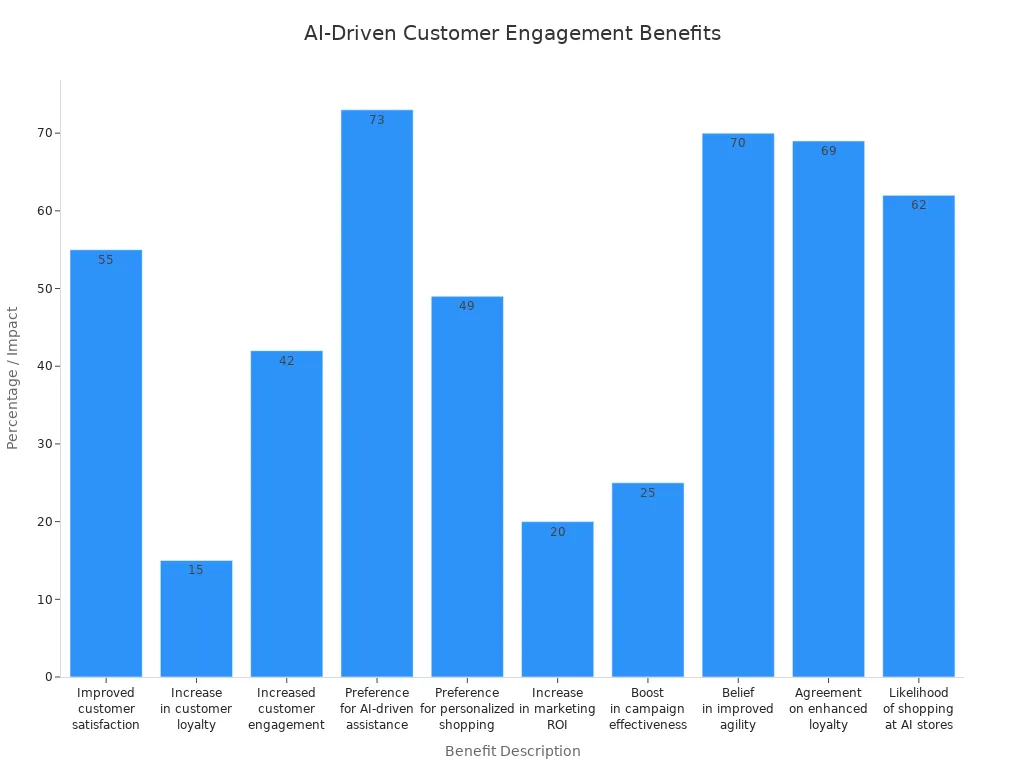
Benefit Description | Percentage/Impact |
|---|---|
55% | |
Increase in customer loyalty | 15% |
Increased customer engagement due to AI displays | 42% |
Preference for AI-driven assistance | 73% |
Preference for personalized shopping experiences | 49% |
Increase in marketing ROI from targeted advertising | 20% |
Boost in campaign effectiveness | 25% |
Belief in improved operational agility | 70% |
Agreement on enhanced customer loyalty | 69% |
Likelihood of shopping at AI-enhanced stores | 62% |
You see ai-powered autonomous retail technologies reducing labor dependency, improving efficiency, and making shopping better for everyone.
Benefits of AI and self-service
Cost savings and profitability
You can see big savings when you use ai-powered autonomous retail and self-service in grocery stores. Many retailers report lower costs and higher profits after switching to ai-based solutions.
General Mills saved over $20 million by using AI to improve supply chain logistics.
Ralph Lauren increased operating profit by 24% in one year with AI demand forecasting.
DSW cut $1.5 million in support costs by adding an AI virtual agent.
Retailers often achieve 15–30% cost savings with self-service and ai-powered autonomous retail. You reduce labor costs, waste, and speed up checkouts. When you use ai-based solutions, you also improve inventory management and gain better customer insights. These changes help you boost profitability and stay competitive in grocery stores and online grocery shopping.
Operational efficiency gains
You can make your store run smoother with ai-powered autonomous retail and self-service. Many grocery stores use ai-based solutions to improve efficiency and keep shelves stocked.
Statistic/Forecast | Description |
|---|---|
AI Adoption Rate | 28% of retail businesses use AI, but only 4% integrate it into daily operations. |
Future AI Application | 68% of retailers plan to use AI for inventory and supply chain by 2025. |
Economic Impact | AI could add $13 trillion to the global economy by 2030. |
Market Growth | AI in retail will grow from $9.85 billion to $40.49 billion by 2029. |
Chatbot Spending | Retail spending through chatbots will rise from $12 billion in 2023 to $72 billion by 2028. |
You can use self-service and ai-based solutions to make online grocery shopping easier and faster. These tools help you restock products, answer questions, and keep customers happy. |
Enhanced shopping experience
You give shoppers a personalized shopping experience with ai-powered autonomous retail and self-service. Self-service checkouts make shopping quick and easy. You can design store layouts that guide customers and encourage impulse buys.
Long checkout lines often cause customers to leave without buying. You can avoid this problem by using self-service and ai-based solutions. These tools help you create a personalized shopping experience in grocery stores and online grocery shopping.
Tip: Self-service systems let you offer 24/7 shopping and instant support, making every visit smooth and enjoyable.
You can use ai-powered autonomous retail to learn what customers want and give them a personalized shopping experience every time they shop online or in-store.
Challenges and considerations
Implementation costs and ROI
You may wonder about the costs of bringing AI into your store. AI-powered solutions can require a big investment at first, but you often see strong returns. Here is a quick look at what you might expect:
Store Size | Expected ROI | |
|---|---|---|
Small Grocery Stores | $20,000 – $100,000 | |
Mid-sized Supermarkets | $100,000 – $500,000 | Enhanced sales through personalization |
Large Chains | $1 million+ | Reduced labor and waste |
You can also see benefits like faster checkouts, better stock levels, and improved customer satisfaction. Many stores break even in 18–24 months, especially when labor savings and bigger basket sizes add up.
Staff adaptation and training
Switching to AI and self-service tools can feel overwhelming for your team. Some workers worry about job security or privacy. Others find it hard to change how they work. You need to help your staff adjust and learn new skills. Common challenges include:
Overcoming fears about job loss and privacy.
Learning new ways to work with AI.
Understanding the benefits and changes AI brings.
You can support your team by:
Offering ongoing training in digital skills and AI basics.
Using AI-powered training tools that match each person’s learning style.
Providing short, focused lessons that fit into daily routines.
Automating repetitive tasks so staff can focus on helping customers.
Giving training in customer service and digital tools.
Data privacy and security
AI systems collect and use a lot of data. Even simple details like age or zip code can identify someone. This raises privacy concerns for your customers. You need to protect their information and follow the law. Key steps include:
Setting clear rules for data use and protection.
Following privacy laws and regulations.
Using encryption and access controls to keep data safe.
Being open about how you use data and getting customer consent.
Teaching customers about their data rights.
Note: Building trust with your customers starts with strong privacy practices and clear communication.
Future of AI in convenience and grocery
Emerging trends in autonomous retail
You see new trends shaping the future of autonomous convenience stores and small-format grocery. Many stores now use autonomous systems to boost labor efficiency. Automation helps you run stores with fewer staff, even during labor shortages and wage increases. You can keep your store open 24/7 with autonomous technology. Customers expect stores to always be stocked and ready. Real-time analytics give you precise control over inventory, so you waste less and keep shelves full.
Here is a table showing the top trends in autonomous retail:
Trend | Description |
|---|---|
Automation reduces dependency on staffing during labor shortages and inflationary wage cycles. | |
24/7 Accessibility | Always open, always stocked — ideal for today’s on-demand culture. |
Precision Data & Inventory Control | Real-time analytics eliminate waste and improve product availability. |
Speed of Deployment | VenHub’s Union Station store was delivered and operational in days, not months — a new industry benchmark. |
Consumer Trust in Technology | Mobile payments, facial recognition, and QR access are now everyday behaviors. Consumers are ready. |
You notice more personalized shopping experiences in autonomous stores. Small-format stores use autonomous systems to target specific customer groups. You see sustainability initiatives, like energy-efficient lighting and fresh produce, becoming common in autonomous stores. Lower operating costs make autonomous stores attractive for owners who want to maximize profits. The rise of small-format autonomous stores matches consumer demand for convenience and efficiency.
Tip: Autonomous stores let you respond quickly to market changes and customer needs. You can deploy new locations in days, not months.
Long-term impact on labor and business models
Autonomous technology will change how you manage labor and run your business. You will use autonomous systems to personalize shopping and streamline operations. AI helps you understand what customers want and anticipate their needs. Autonomous agents give recommendations and make decisions, changing the way you interact with shoppers.
You will see more cashier-less autonomous stores and inventory robots. These autonomous solutions address labor shortages and improve efficiency. Your employees will focus on creative tasks and customer service, while autonomous systems handle routine work. Autonomous technology will help you reduce turnover and foster a better work environment.
Here are some predictions for the future of autonomous retail:
You will use autonomous systems to enhance personalization and create new shopping experiences.
Autonomous technology will help you understand consumer behavior and improve loyalty.
Autonomous agents will streamline decision-making and change the retail landscape.
Cashier-less autonomous stores and inventory robots will become common.
Autonomous solutions will improve employee experience and reduce turnover.
You will see autonomous technology reshape business models. You can run stores with fewer staff, lower costs, and better customer service. Autonomous systems will help you stay competitive and meet changing consumer expectations.
You see grocery stores with ai changing how you manage labor and serve customers. The digital transformation of grocery shopping brings new tools that help you save money and work faster. Grocery stores with ai use smart carts, service kiosks, and autonomous checkout to make shopping easier. You notice grocery stores with ai improve scheduling and task management, letting you focus on customer service. The digital transformation of grocery shopping means retraining staff and creating new skilled jobs. Grocery stores with ai help you rethink your business and treat data as a key asset.
Grocery stores with ai boost efficiency and customer satisfaction.
Grocery stores with ai streamline checkout and inventory.
Grocery stores with ai create new opportunities for skilled workers.
The future of grocery stores with ai depends on blending automation with a personal touch. You should experiment, learn, and use clean data to stay ahead.
FAQ
What is the main benefit of using AI for scheduling in a small-format retailer?
You gain better labor optimization. AI helps you match staff to busy times. This means you avoid overstaffing and understaffing. You save money and improve service. Scheduling becomes easier and more accurate for your team.
How does contactless technology improve the shopping experience?
You enjoy a contactless payment experience. You tap or scan to pay. This makes shopping safer and faster. Contactless systems also support faster checkout. You spend less time waiting in line.
Can automated systems help with back-of-house automation and labor scheduling?
You use automated systems for back-of-house automation. These tools handle inventory and labor scheduling. You get real-time updates. This reduces errors and saves time. Your staff can focus on helping customers.
Why is scheduling important for labor optimization in convenience stores?
You need good scheduling for labor optimization. It helps you plan shifts and meet customer demand. Scheduling also reduces costs. You keep your store running smoothly. Labor scheduling supports better service and happier staff.
How does contactless checkout support a safer store environment?
You use contactless checkout to limit touchpoints. This reduces the spread of germs. You protect both staff and shoppers. Contactless options make your store safer and more modern.
Tip: Contactless solutions also speed up transactions and improve customer satisfaction.
Feature | Benefit |
|---|---|
Contactless checkout | Safer, faster service |
Automated scheduling | Fewer errors, less stress |
See Also
Understanding AI-Driven Convenience Stores: Essential Insights for Retailers
The Future of Retail: Embracing AI-Enabled Store Innovations
Comparing Micromarkets and Smart Stores in Global Retail Automation
Launching an AI-Driven Corner Store on a Budget
Modern Retail Advantages: Exploring AI-Enhanced Combo Vending Machines
