The Future of Retail Labor Cost Reduction with AI

You can see big changes in stores today because of AI. Retailers use AI to help set up interviews, which is a significant step in reducing retail labor costs. This technology almost eliminates scheduling expenses, allowing teams to focus on more important tasks. A grocery store in the Northeast saved about $45,000 each year by using AI for inventory and labor planning. In the UK, some businesses operate 30% more efficiently in the back office. These examples demonstrate that AI not only helps stores save money on labor but also effectively contributes to reducing retail labor costs. The results can be measured.
Key Takeaways
AI does simple jobs like making schedules and tracking inventory. This saves time and cuts labor costs. Using AI to plan work helps stores have the right number of workers. This stops having too many or too few staff. AI tools help people make better choices. This gives better service and makes customers happier. Using AI can save a lot of money. Some stores say they spend up to 30% less on workers. Teaching workers how to use AI tools is very important. This helps stores get the most out of AI and work better.
AI’s Role in Reducing Retail Labor Costs

Automating Routine Operations
AI can do many simple jobs in stores. This saves both time and money. For example, AI helps with making schedules, keeping track of inventory, and giving out tasks. The table below shows how AI copilots help in different store jobs:
Operational Area | Common Labor Cost Issue | AI Copilot Intervention | Expected Business Effect |
|---|---|---|---|
Store scheduling | Overstaffing or understaffing from static forecasts | Predictive analytics align labor plans with traffic and demand | Lower overtime, better labor use, improved service |
Inventory management | Manual handling of stockouts and overstocks | Automates replenishment and investigation workflows | Less rework, fewer emergencies, reduced lost sales |
Task management | Managers spend time on routine coordination | AI assigns and tracks tasks by urgency and impact | More productive managers, faster issue resolution |
Walmart used AI to help with inventory. Stockouts went down from 5.5% to 3%. Extra stock dropped by 15%. Inventory turnover went up from 8 to 10.5 times a year. These changes made supply chain costs 20% lower. You can see that using AI for simple jobs really helps stores save money.
AI Copilot for Workforce Allocation
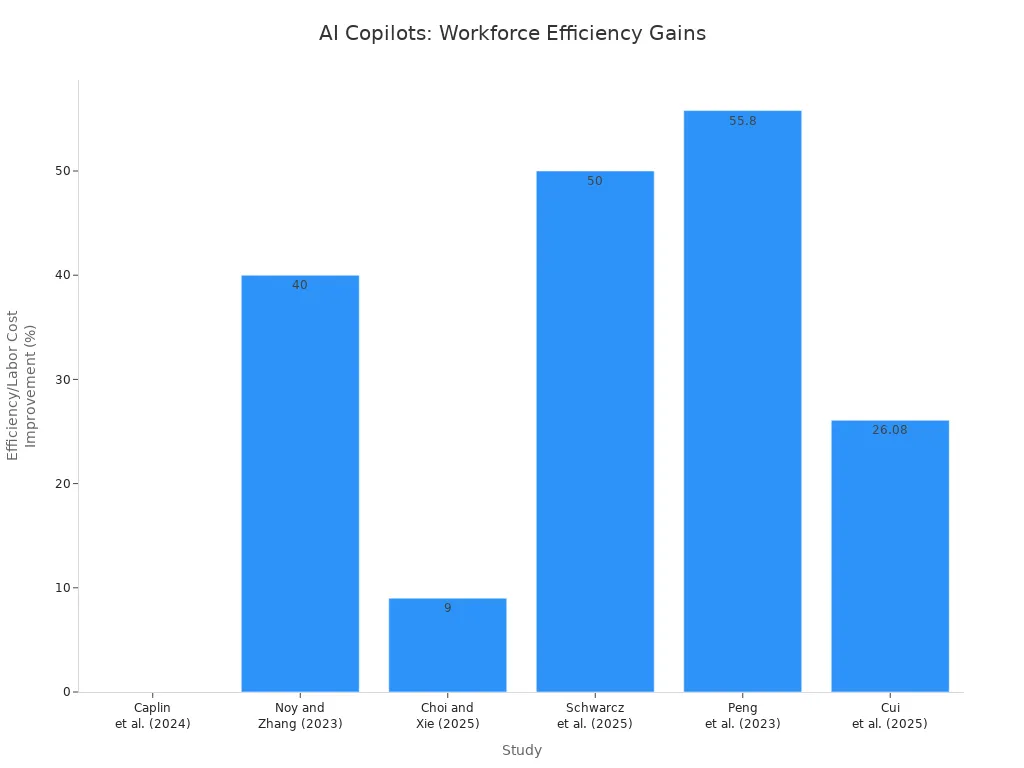
AI copilots help stores put the right number of workers on each job. They use data to guess when stores will be busy and suggest new shifts. This helps stores not have too many or too few workers. Managers still decide, but AI gives better choices. Studies show AI copilots make workers faster and save money. For example, ChatGPT users finish jobs 40% faster and do 18% better work. The chart below shows how studies found big improvements in worker planning and saving money:
Improving Decision Quality
AI helps managers make better choices about workers. It looks at sales, how many people come in, loyalty programs, and old schedules. For example, a pizza chain saw a 90% jump in orders during the Super Bowl with AI. This helped them stop long waits and lost sales. AI also finds loss patterns and helps stop shrinkage.
"The future of retail lies in unified commerce experiences that seamlessly blend digital and physical touchpoints," notes Michelle Grant, showing how AI supports better labor planning for all types of stores.
By using AI like this, stores can save money and give better service.
Challenges in Retail Labor Management
Overstaffing and Scheduling Inefficiencies
It is hard to make good worker schedules in retail. Many stores use old numbers to pick how many people work. Schedules often stay the same, even if the store gets busy or slow. This can mean too many workers when it is quiet. It can also mean not enough workers when it is busy. If there are not enough workers during busy times, profits can fall by 7%. Having too many workers only lowers profits by about 1.1%. Some studies say better planning can raise profits by 10% in a year. It is also tough to manage big teams without good tools. Shopping habits change a lot, which makes planning harder.
Tip: If you use real-time data, you can make better schedules and avoid these problems.
High Turnover and Training Expenses
High turnover is a big problem for stores. You have to hire new people and teach them. This takes a lot of time and money. The table below shows how much it costs to replace a worker:
Cost Type | Percentage of Annual Salary |
|---|---|
Minimum Replacement Cost | 50% |
Average Replacement Cost | 100% |
Maximum Replacement Cost | 200% |
When more workers leave, customer scores go down. New workers need almost two months to learn and work well. This means you get eight weeks of lower service and lost sales. High turnover also means you spend more on hiring and training. This takes away money and time from other important jobs.
Operational Waste
Operational waste can hurt your profits. In grocery stores, food waste can cost twice as much as your profit. Waste management can use up 4-10% of your company’s money. Common causes of waste are:
Bad inventory management
Store layout that does not work well
Not enough staff
Poor teamwork in the supply chain
You also lose money from products you do not sell, throwing things away, and time spent on spoiled goods. Having too much stock uses up your money. Moving extra stock costs more in transport. If you work on lowering labor costs, you can fix many waste problems and make more profit.
AI Solutions for Reducing Retail Labor Costs
AI-Driven Scheduling and Optimization
AI-driven scheduling tools help stores use workers better. These tools check sales, how many people come in, and what shifts workers like. They make schedules that fit what the store really needs. Walmart uses AI to plan when people work. This stops having too many or too few workers. Orquest has a system that looks at how well workers do and what shifts they want. This makes workers happier and helps them do a better job.
Many stores have seen good results with these tools:
Walmart uses AI to put the right number of workers on the floor when it is busy.
A small hardware store in the Midwest used AI to cut extra work hours by 15%. They matched worker hours to what the store needed and saved money.
Rapid Innovation’s AI changes worker schedules fast if the store gets busy or slow.
AI scheduling can save $10,500 to $15,000 each year in a store with 50 people by lowering turnover by 10%. When fewer workers quit, you spend less on hiring and training new people.
Tip: Using AI for schedules can help you get more done and spend less money.
Automated Store Operations
AI can run many store jobs by itself. This saves time and money. Stores use digital workers, robots, and smart tools to do jobs people used to do. These tools help keep shelves full, track inventory, and give out jobs to workers.
Here is how AI automation helps in different jobs:
Area of Operation | Contribution to Labor Cost Reduction |
|---|---|
Autonomous Shelf Management | Digital workers watch stock and guess when you will run out, so you need fewer people to check shelves. |
Real-time Workforce Scheduling | AI changes worker hours as needed, so you always have the right number of people. |
Task Management | Digital workers give out jobs based on what is most important, so there is less wasted time and your team works better. |
You can see real results from companies using these tools:
Coca-Cola uses AI vending machines. They sold 15% more and needed 18% fewer trips to restock.
Danone uses smart warehouses. They fill orders faster and spend less on workers.
Kellogg’s uses AI to watch shelves. This helps them have fewer empty spots and sell more.
Stores also use robots to fill shelves and IoT tools to track stock all the time. These tools help you make better choices and keep the store running well.
Digital Workers and Chatbots
Digital workers and chatbots can do many jobs people used to do. Chatbots can answer customer questions right away. This means you do not need as many people for customer service. Chatbots can cut support costs by up to 30%. They can talk to thousands of customers at once, which lowers the work for your team by 60-70%. Each chatbot chat costs about $0.50, but a person costs $6 or more.
A big retail chain used AI for schedules and saw labor costs drop by 10% in just three months. At the same time, customers were happier. The AI looked at years of sales to make sure there were enough workers when it was busy and fewer when it was slow.
The retail AI copilot links your store’s systems. It runs jobs by itself and helps you put the right number of workers on the floor. This means less wasted work and better service while saving money.
Note: When you use digital workers and chatbots, you can help more customers and spend less money at the same time.
Benefits of AI Adoption in Retail
Profitability and Cost Savings
When you use AI in your store, you can really save money. AI helps you do jobs faster and with less effort. This means you do not need to spend as much on workers. You also lose less money from mistakes. AI makes it possible to help more customers every hour. This means you can make more money. AI helps you keep track of inventory, so you throw away less food. You also save money because you do not have to get rid of expired items. Some stores have used AI to cut food waste by almost 15%. AI energy systems can help you pay about 28% less for electricity. JD.com made 92% more profit in one quarter after using AI in their supply chain. Amazon used over 750,000 robots and cut order costs by 25%. These examples show that AI is a great way to save money and make more profit.
AI helps your store run better and lowers worker costs.
You can help more customers each hour and earn more money.
Smarter inventory planning means less waste and more savings.
Smart energy tools help you spend less on electricity.
Big companies like JD.com and Amazon made a lot more profit with AI.
Enhanced Customer Experience
AI changes how you help your customers. It lets you give faster and more personal service. The table below shows how AI makes customers happier:
Benefit | Evidence |
|---|---|
Customer satisfaction and loyalty | 73% of shoppers say AI assistants make service faster. |
Personalization and engagement | Personalized suggestions make up 31% of sales. |
Impulse purchases | About 49% of people buy things after AI suggestions. |
You can use conversational AI to answer questions right away and give updates. This makes customers feel good and want to come back. When you give personal suggestions, shoppers feel special and buy more.
Employee Engagement
AI helps your team feel happier at work. When AI does boring jobs, workers can focus on important tasks. This makes them get more done and feel proud of their work. AI tools can also help workers learn new things and grow in their jobs. Your team feels important and happy, so they want to stay.
Tip: When workers feel good about their jobs, they do better work and stay longer. AI can help you build a stronger team.
Steps to Implement AI for Labor Cost Reduction
Assess Current Labor Challenges
Start by looking at your store’s biggest labor problems. Ask yourself where you lose the most time or money. You might see issues with scheduling, high turnover, or wasted hours on simple tasks. Make a list of these challenges. Use data from your sales, inventory, and staff schedules to spot patterns. This helps you see where AI can make the biggest difference in reducing retail labor costs.
Tip: Talk to your team. They know which jobs take too long or cause stress.
Select AI Solutions
Choose AI tools that fit your store’s needs. Look for solutions that solve your main problems and work well with your current systems. Use the table below to compare options:
Criteria | Description |
|---|---|
Technical Capabilities and Feature Completeness | Does the tool solve your problem better than others? Check speed, accuracy, and features. |
Implementation Timeline and Complexity | How long will it take to set up? Will it disrupt your store? |
Cultural and Organizational Fit | Does the vendor understand your business? Are they easy to work with? |
Long-term Viability and Product Roadmap | Will the company support you in the future? Are they growing and improving their product? |
Reference Quality and Responsiveness | What do other stores say about this vendor? Are they helpful and quick to respond? |
AI can automate routine tasks and use data to make your store run better. Pick a solution that matches your goals and budget.
Train Staff and Monitor Results
Teach your team how to use the new AI tools. Focus on real tasks, like using AI for scheduling or checking inventory. Companies that train staff with hands-on lessons see big improvements. For example, Toyota saved over 10,000 man-hours each year by training workers to use AI. Learning Management Systems can help track progress and give role-specific lessons. Aim for at least five hours of training and offer in-person help when needed.
After you launch AI, keep checking how it works. Use these metrics to measure success:
Metric | Description |
|---|---|
Forecast Error Rate | How accurate are your sales and staffing predictions? |
Stockout Frequency | How often do you run out of items? |
Inventory Carrying Cost | Are you spending less to store products? |
Shrinkage Rate | Are you losing fewer items to theft or mistakes? |
Labor Cost per Store | Are your labor expenses going down? |
SLA Compliance with Suppliers | Are you meeting agreements with your suppliers? |
Note: Results may take time. Keep tracking your progress and adjust your approach for the best results.
You can see clear changes when you use AI in your store. AI-powered workforce management, predictive analytics, and employee tracking help you spend less money and give better service.
AI Application | Impact on Labor Costs |
|---|---|
AI-Powered Workforce Management | Lower overtime costs and better staffing |
Predictive Analytics | Finds problems and guesses what you will need |
Employee Performance Tracking | Makes schedules that fit workers’ strengths |
To start lowering retail labor costs, do these things: 1. Get your data ready and make sure it is correct. 2. Teach your team how to use AI tools. 3. Try small projects first and listen to what people say.
AI helps you make more money and have happier workers. Try AI solutions now to do well for a long time.
FAQ
How does AI help you reduce labor costs in retail?
AI automates tasks like scheduling and inventory tracking. You spend less time on routine jobs. You save money by using fewer workers for simple tasks. AI helps you match staff to store needs.
Can you use AI in small retail stores?
You can use AI in stores of any size. Many tools work for small shops. You start with simple solutions like AI scheduling or chatbots. You see results quickly.
Will AI replace your workers?
AI does not replace all workers. You use AI to handle boring tasks. Your team can focus on helping customers and solving problems. AI makes your staff more productive.
How much money can you save with AI?
You can save thousands each year. Stores report up to 30% lower labor costs. You spend less on overtime, hiring, and training. AI helps you avoid waste and mistakes.
Is it hard to train your team to use AI?
You can train your team with simple lessons. Many AI tools are easy to use. You give hands-on practice. Your staff learns quickly and feels confident.
See Also
The Future of Retail: Embracing AI-Driven Stores
Understanding the Growth of AI-Enhanced Convenience Stores
Transforming Online Retail: The Impact of AI Tools
Launching a Low-Cost AI-Driven Corner Store Successfully
Modern Retail Solutions: Advantages of AI-Enhanced Vending Machines
