How to scale autonomous retail from one site to many in convenience store chains & small-format grocery


You can scale autonomous retail by following a phased approach. Start with a proof of concept, move to controlled deployment, and then expand to a full-scale rollout. Align technology, operations, and customer experience management to achieve success in convenience store chains and small-format grocery. AI and edge computing help you improve automation in autonomous stores and enhance customer experience. Strategic site selection is vital for growth.
The table below shows how many stores use autonomous solutions:
Description | Percentage |
|---|---|
Convenience stores looking to implement AI solutions within 2 years | 68% |
Stores in AI pilot projects planning to scale | 72% |
Engaged in AI robotic checkout pilot projects | 74% |
Piloting AI-driven autonomous delivery vehicles | 32% |
Piloting AI-enabled autonomous cleaning robots | 52% |
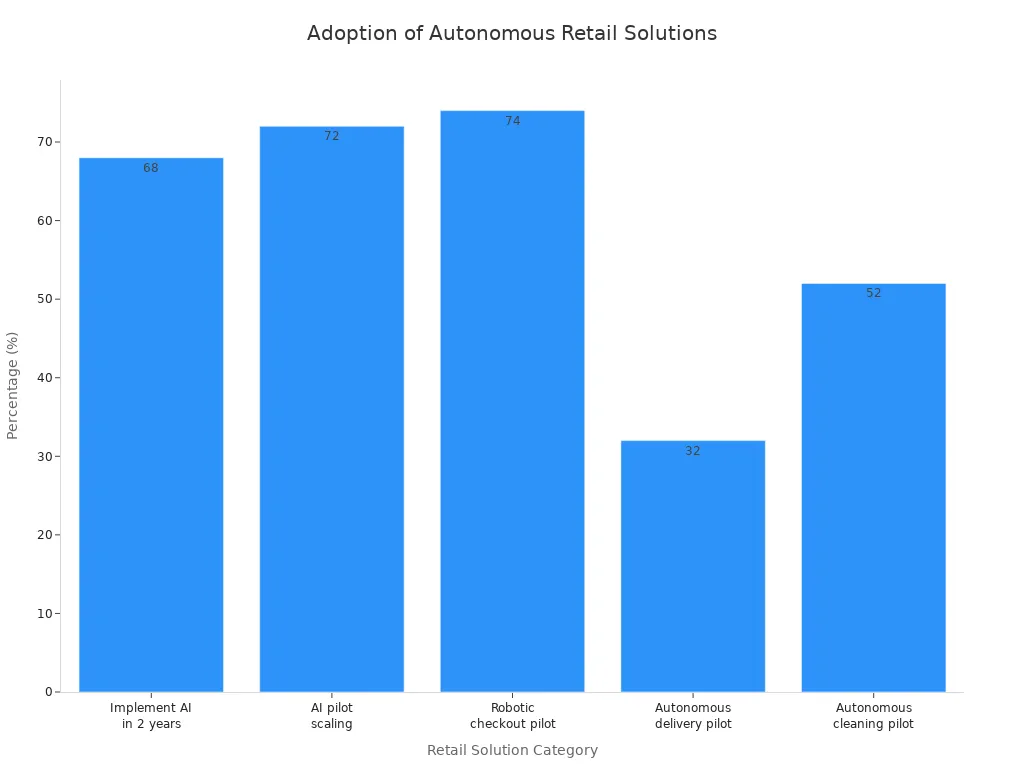
Common challenges include technology integration, automation acceptance, user experience, compliance, market demand, competition, and inventory management. You need to address these challenges to succeed in retail automation.
Key Takeaways
Start scaling autonomous retail with a proof of concept. Choose high-traffic locations to test technology and set clear goals for expansion.
Use a controlled deployment strategy to minimize risks. Roll out automated systems in phases and continuously update them based on customer feedback.
Standardize technology solutions across stores. This helps avoid integration issues and ensures smooth operations as you expand.
Leverage AI and edge computing to enhance customer experience. These technologies improve checkout speed and inventory management.
Focus on staff training and change management. Empower employees with the right skills to adapt to automation, boosting productivity and customer satisfaction.
Planning to Scale Autonomous Retail
Proof of Concept and Pilot Sites
You need to start your journey to scale autonomous retail with a strong proof of concept. Select high footfall locations for your pilot sites. These sites help you test cashier-less technology and automated checkout software in real-world conditions. You should set clear expansion goals before you begin. Use these goals to measure your progress and decide when to move forward.
You can evaluate pilot site performance using key metrics. These metrics show you if your autonomous stores are ready for more locations. The table below lists important indicators:
Category | Key Metrics |
|---|---|
Business Value | Time saved per employee, cost reduction per resolved ticket, uplift in sales from agent-assisted interactions. |
User Value | Satisfaction scores (CSAT), user retention, drop-off rates, time saved on manual tasks. |
Technical Performance | Uptime, intent recognition accuracy, fallback rates, tool execution success. |
You should involve all stakeholders early. This includes store managers, IT teams, and finance leaders. Everyone needs to understand the benefits of ai powered automated self checkout and automated checkout software. You must plan your resources carefully. Make sure you have enough staff to support the pilot and enough budget for technology upgrades.
You also need to watch how automation affects customer patronage. Some shoppers may love cashier-less checkout and self-checkout. Others may need help with new systems. Track user satisfaction and retention to see if your autonomous solution meets customer needs.
Controlled Deployment Strategy
After you finish your pilot, you can move to a controlled deployment. This step helps you scale autonomous retail without big risks. You should use a location strategy that targets high footfall locations and areas with strong demand for convenience.
Here are some effective strategies for controlled deployment:
Assess your current retail environment and business needs.
Roll out automated checkout software and ai powered automated self checkout in phases.
Test your systems in a few stores before expanding further.
Update your ai and automated systems often to keep up with customer needs.
You must also manage risks during deployment. Protect sensitive data collected by autonomous systems. Follow data protection rules to avoid legal problems. Use strong cybersecurity measures to keep your automated checkout software and ai powered automated self checkout safe from attacks. Test your ai decision-making in controlled settings before you launch in more stores.
Tip: Keep your deployment team ready to respond to any issues. Rapid deployment works best when you can fix problems quickly.
Full-Scale Rollout in Convenience Store Chains
When your controlled deployment succeeds, you can plan a full-scale rollout. Set clear expansion goals for your autonomous stores. Use your location strategy to pick the best sites for new cashier-less and automated stores. Focus on scalability so you can add more locations without losing quality.
Full-scale rollout can change how customers shop. Smart carts and ai powered automated self checkout can increase basket size by up to 30%. Customers enjoy faster shopping and no lines at the register. Automated checkout software and self-checkout reduce labor costs and improve convenience.
Impact on Sales | Description |
|---|---|
Increase in Basket Size | Smart carts can increase consumer basket sizes by up to 30% through personalized recommendations and promotions. |
Enhanced Convenience | Smart carts eliminate the need for traditional checkout, improving the shopping experience and potentially increasing patronage. |
Cost Reduction | By processing payments without a checkout register, smart carts can help reduce labor costs associated with traditional checkout methods. |
You should keep tracking customer satisfaction and sales as you scale autonomous retail. Use data from your automated checkout software and ai powered automated self checkout to improve your stores. This helps you meet your expansion goals and build a strong network of cashier-less, autonomous stores.
Technology Integration for Autonomous Stores
Standardizing Solutions for Small-Format Grocery
You need to choose scalable solutions when you scale autonomous retail across multiple stores. Standardizing technology helps you avoid costly integration problems and makes it easier to manage autonomous stores. The table below shows some of the most scalable technology solutions for convenience and small-format grocery stores:
Technology Solution | Key Features | Scalability |
|---|---|---|
Standard Cognition | Light-touch installation, no shelf sensors, privacy protection | High |
Wheelys 247 | App-based entry, no employees, automated payment | Moderate |
Żabka Nano | AI and computer vision, QR code entry, automatic payment | High |
AiFi | 100% camera-based, AI algorithms, no shelf sensors | High |
Trigo Vision | Ceiling-mounted cameras, automatic billing, theft prevention | High |
VenHub | Fully autonomous drive-thru, robotics for fulfillment | High |
Juxta Nomad | Portable, cashier-free, AI and shelf sensors | High |
You should follow clear standards for integration. These include strong data privacy, reliable product recognition, and seamless user experience. You must design systems that scale for different store sizes and customer traffic. Use open APIs and make your self-checkout accessible to everyone.
Tip: Standardizing your automated systems helps you expand faster and keeps your operations consistent.
Leveraging AI and Edge Computing
AI powers many features in autonomous stores. You can use ai-powered self-checkout to personalize promotions and streamline checkout. AI automated self checkout uses computer vision for automated checkout and product recognition to speed up shopping. Retailers like FamilyMart use ai for demand planning, which reduces waste and keeps bestsellers in stock. AI-based video analytics can cut shrinkage by 35%, helping you prevent theft and improve incident response.
Edge computing supports automation by processing data locally. This means your stores can keep running even if the network goes down. Edge computing reduces latency and saves bandwidth, which leads to faster self-checkout and better inventory management. You can use edge computing to deliver localized promotions and smarter in-store interactions.
AI robotic chefs automate food preparation during busy hours.
Agentic ai helps you manage customer interactions and supply chains without manual effort.
Ensuring Cost Efficiency and ROI
You need to select technology that delivers strong ROI when you scale autonomous retail. Unsuitable technologies can slow down integration and increase costs. Scalable solutions like cloud-based platforms let you add new stores easily and support your business as it grows. Automated checkout and ai-powered self-checkout reduce labor costs and improve operational efficiency.
Key Point | Description |
|---|---|
Choosing the wrong technologies can hinder scaling and complicate integration with existing systems, leading to increased costs and time. | |
Leveraging scalable technological platforms | Utilizing cloud-based platforms like Microsoft Azure or AWS allows for flexible scaling, supporting businesses of all sizes with necessary technical support. |
You should track your automated systems and self-checkout performance to make sure you meet your goals. Use data from your autonomous stores to improve product recognition and computer vision for automated checkout. This helps you optimize your automation and keep your convenience stores profitable.
Operations, Data, and Infrastructure
Centralized Data Management
You need strong centralized data management to scale autonomous retail across many stores. This approach helps you keep your automated systems running smoothly and supports better decision-making. Follow these best practices:
Ensure data quality by using validation and regular checks.
Unify and centralize data to remove silos between departments.
Use advanced analytics tools to make sense of your retail data.
Set up strict security and governance policies to protect customer information.
Focus on real-time insights so you can react quickly to changes in consumer behavior.
Centralized management boosts operational efficiency. The table below shows how it helps your convenience stores:
Benefit | Explanation |
|---|---|
Improved Coordination | Enhances collaboration across business functions, leading to more efficient operations. |
Seamless Management | Streamlines supply chain, customer relationships, and sales channels for better efficiency. |
Real-Time Access | Provides immediate data access, improving decision-making processes at all levels. |
Improved Data Accuracy | Reduces errors and outdated information, ensuring consistency across stores and departments. |
Enhanced Inventory Management | Offers a comprehensive view of stock levels, helping to avoid stockouts and overstocking. |
Streamlined CRM | Facilitates better management of customer interactions, enhancing marketing and support efforts. |
Efficient Multi-Channel Management | Allows for unified data management across various sales channels, ensuring a seamless customer experience. |
Enables tracking of sales performance and customer behavior, leading to informed decision-making. |
Reliable Connectivity and Store Layouts
You must keep your automated retail systems connected and stable. Many stores face challenges with network stability and processing power. Disruptions can hurt real-time tracking and cause operational bottlenecks. To avoid these problems:
Use reliable networking equipment.
Monitor your systems for connectivity issues.
Plan for backup solutions to keep automation running.
Store layout also matters. Open layouts with clear lines of sight help ai sensors and automated checkout systems work better. You should design your retail space to support automation and make sure your technology can monitor inventory accurately.
Tip: Test your store layout before launching new automated systems to ensure optimal performance.
Centralized Monitoring and Support
Centralized monitoring helps you keep your autonomous retail operations running smoothly. You get real-time visibility into the health of your automated devices, which allows for quick remote diagnostics. This proactive approach catches failures early and keeps uptime high. Predictive analytics and continuous monitoring can lower maintenance costs by up to 25%.
System Type | Benefits |
|---|---|
AI Applications | Elevate customer experience and improve operational efficiency. |
Edge AI Capabilities | Enable real-time processing with ultra-low latency and maintain uptime in unstable environments. |
High-Availability Infrastructure | Ensures uninterrupted automated processes with intelligent failover and data protection. |
Scalable Solutions | Allows for seamless expansion and integration of new systems as organizational needs evolve. |
Note: Centralized oversight helps you maintain consistent service levels across all your stores and supports your goal to scale autonomous retail.
Overcoming Challenges in Autonomous Retail
Inventory Control and Theft Prevention
You must keep your inventory safe and accurate when you scale autonomous retail. Technologies like RFID and LiDAR help you track products and prevent theft. RFID lets you monitor inventory in real time, making audits faster and stopping losses before they happen. LiDAR creates 3D maps and detects movement, so you can spot suspicious activity quickly.
Technology | Functionality | Benefits |
|---|---|---|
RFID | Real-time tracking and monitoring of inventory | Enhances visibility, reduces theft, automates inventory audits |
LiDAR | Creates detailed 3D maps and detects movement | Improves surveillance, differentiates normal behavior from suspicious activities |
Retailers using ai and automation, such as Walmart, have seen inventory loss drop by 15%. You should use these tools to keep your stores secure and your data accurate.
Staff Training and Change Management
Your team needs the right skills to work in autonomous stores. Training programs that focus on communication, problem-solving, product knowledge, empathy, and technology help staff adapt to automation. When you empower employees, they feel more confident and productive. Organizations with autonomous work cultures report lower turnover rates and save money on hiring and training. Workers who control their schedules can boost productivity by up to 40%. Engaged staff provide better service, which increases customer satisfaction in convenience retail.
Tip: Offer regular technology training and encourage proactive engagement to help your team succeed in automated environments.
Privacy, Security, and Compliance
You must protect customer data and follow privacy laws when you scale autonomous retail. Regulations like the FTC, CCPA, and GDPR set strict rules for data collection and use. Payment systems in autonomous stores must meet financial standards and screen transactions in real time. You should give customers access to their personal information and allow corrections or deletions. Create clear privacy policies and appoint a Data Protection Officer if needed.
Regulation | Description |
|---|---|
Federal Trade Commission (FTC) | Governs data privacy at the federal level. |
California Consumer Privacy Act (CCPA) | Enhances privacy rights and consumer protection. |
GDPR | Sets rules for data protection in the EU. |
Compliance with cybersecurity and privacy laws builds trust. Customers feel safe when you use strong security protocols and keep their data private. Trust grows when you follow legal standards and use advanced ai strategies to protect information.
Note: Maintaining customer trust and satisfaction is essential for the success of autonomous retail.
You can scale autonomous retail by following best practices and using data at every step. Start with predictive analytics and smart inventory tracking. Use ai-driven automation to improve efficiency in autonomous stores. Personalize the shopping experience for every convenience customer.
Best Practice | Description |
|---|---|
Predictive Analytics | Forecasts demand based on shopping trends, ensuring shelves are always stocked. |
Smart Inventory Tracking | Alerts stores about low stock, avoiding out-of-stock situations. |
AI-Driven Automation | Reduces operational costs and improves efficiency through automated processes. |
Personalized Shopping Experience | Offers tailored recommendations based on consumer preferences, enhancing customer satisfaction. |
Stay proactive by using data to solve problems before they grow. The future will bring more mobile commerce, better inventory management with ai, and cashier-less checkout. Automation will make operations smoother while keeping service strong.
Mobile commerce will grow fast.
AI will improve inventory and reduce waste.
Cashier-less checkout will boost convenience.
Automation will streamline store operations.
You can build a strong network of autonomous stores by focusing on data, technology, and customer needs.
FAQ
What is autonomous retail?
Autonomous retail uses technology like AI and sensors to run stores with little or no staff. You shop, pay, and leave without waiting in line.
Tip: Look for stores with smart carts or self-checkout kiosks.
How do you choose the right technology for scaling?
You should compare solutions for ease of integration, scalability, and cost.
Solution | Scalability | Cost Efficiency |
|---|---|---|
AI Checkout | High | Good |
RFID | Medium | Moderate |
Edge Computing | High | Good |
How does automation affect store staff?
Automation changes staff roles. You train employees to manage technology and help customers.
Staff monitor systems
Staff guide shoppers
Staff solve tech issues
What steps help prevent theft in autonomous stores?
You use tools like RFID tags and AI cameras to track products and spot suspicious actions.
Note: Regular audits and real-time alerts keep your inventory safe.
See Also
Comparing Micromarkets And Smart Stores In Global Retail
Launching A Low-Cost AI-Driven Corner Store Successfully
Understanding The Growth Of AI-Enhanced Corner Stores Today
Grocery Vending Machines Transforming Access To Retail Services
Examining Walgreens Self-Checkout: Benefits And Retail Hurdles
