Is Your Retail Business AI-Ready? A Checklist


AI readiness means your retail business has the people, data, systems, and policies ready to adopt AI without guesswork. You can measure this state, and you can improve it.
This post gives you an AI readiness checklist for your own business. You will work through objectives, data, systems, team, governance, security, culture, and budget. Each category has clear rules, so your AI readiness assessment rests on facts rather than feelings. AtScale treats these elements as a connected network, because no single part works alone.
Run the checklist honestly. A structured review today makes your first retail AI deployment checklist – scenario 12 pilot much smoother tomorrow.
Key Takeaways
AI readiness means your retail business has the right people, data, systems, and rules to adopt AI successfully.
Use a checklist to check eight key areas: goals, data, systems, team, rules, security, culture, and budget.
Give each area a score from 1 to 5 to see your strengths and weaknesses, then work on the weakest area first.
Use a 90-day plan to fix the gaps: get leaders on the same page, run a small test, and get ready to roll it out fully.
Begin with strong data basics, because clean, clearly defined data matters most for AI success.
What AI Readiness Means for Retail
A Plain Definition
AI readiness is your ability to take an AI project from development into a live retail setting and keep it working. Straive says readiness is a condition you keep up, not a certificate you earn. That difference matters. A store can buy a forecasting tool in a week. Keeping that tool accurate through a holiday season takes clean data, trained staff, and clear rules.
Amperity's 2025 State of AI in Retail surveyed 1,000 U.S. retail leaders. It found that 45% used AI weekly or more, while only 11% said their organization was ready to scale. The gap between daily use and confident scale shows why an ai readiness assessment belongs before your next purchase, not after it.
A practical framework from Amperity breaks readiness into six steps:
Define the decision and outcome — name the user, action, decision window, and success measure.
Map the required context — list the customer, transaction, product, inventory, consent, and operational fields the decision needs.
Resolve identity and meaning — connect records to a person, household, account, or device, and standardize fields.
Set governance and human controls — define allowed data, access, retention, approval, and override processes.
Connect the workflow — decide where the recommendation appears and who reviews it.
Test, measure, and monitor — track accuracy, drift, data freshness, complaints, and business impact.
Start With the "Why"
Clarifying your business goal is the first and most important step. Name the business problem before you name the tool. Retailers often adopt AI to forecast demand, personalize offers, manage inventory, improve supply chain logistics, and upgrade CRM, according to Edge Delta. Edge Delta also reports that 40% of retailers have adopted AI to improve in-person experiences and support real-time pricing and customer research.
Your goal should state how ai ties into business goals in numbers your team already tracks. A vague goal like "use AI" gives you no way to judge success. A clear goal like "cut stockouts on top sellers" gives you a target and an owner.
Test customer and market fit at the same time. Review your internal readiness factors honestly, because strong data cannot save a project that solves a problem your shoppers do not have. Readiness starts with a defined business goal, then moves to the systems that serve it.
The AI Readiness Checklist

This AI readiness checklist puts your assessment into clear groups. Each group has short rules you can mark as met, partial, or missing.
Data, Systems, and Platforms
Start with data quality. Clarkston Consulting says models need data that is consistent, well-defined, and timely. Small quality problems that are fine in static reports can really hurt model performance. Your core datasets need clear owners, written definitions, and clear quality expectations. DQLabs suggests data profiling to find missing values and inconsistent formats. Then cleanse, standardize, and keep monitoring. Build this into your data infrastructure before any pilot.
Audit these data criteria:
Core datasets have named owners and written definitions.
Data is granular, timely, and trustworthy for each use case.
Automated quality checks run when data comes in.
Records match across storefronts, feeds, and AI-search surfaces.
Systems come next. Your commerce platform and product feeds must show stable product and variant IDs, typed product attributes, strong variant modeling, and fresh availability. CoreDNA sums up the principle well: one commercial model, many channel mappings. Change the mapping, not the product. A table helps you judge platform fit.
Capability | Readiness test |
|---|---|
Stable product and variant IDs | Same product matches across feeds and AI surfaces |
Typed product attributes | Machines read explicit facts, not inferred copy |
Store and local inventory | Supports "where can I get it?" queries |
Incremental updates | Volatile pricing and stock stay close to reality |
Ryze AI notes that most platforms offer guided setup for initial configuration.
Team, Governance, and Security
Assess team capability honestly. WAIR reports that employees worry they lack the technical skills to work with new AI tools. A LinkedIn survey of retail marketing leaders found 87 out of 100 say their teams have meaningful skills gaps around AI. That gap now ranks ahead of legacy technology, budget, and executive alignment as the biggest barrier. TCS names workforce skills gaps as the second-biggest challenge, behind only financial pressures. Map gaps by role before you train.
Governance covers policy, compliance, and risk review. Alation recommends clear roles, a data governance framework, quality standards, classification schemes, and lifecycle management. Dataiku adds a full AI system inventory, risk classification, gate reviews, bias testing, and audit logs. Build a responsible AI policy that names allowed data, access rules, retention, and override paths. Address regulatory compliance through anchors such as the EU AI Act and NIST AI Risk Management Framework. Weigh ethical considerations, including fairness, transparency, accountability, and your duties under data privacy laws. Risk management and governance controls include explainability, bias testing, model risk classification, human-in-the-loop, and kill-switches.
Security deserves its own review. Orca Security advises finding and classifying sensitive data before it enters an AI pipeline. Enforce least-privilege access on every service identity, validate inputs and outputs, encrypt data at every stage, and watch model behavior continuously. Protect customer data with sensitivity tiers. Track shadow AI by keeping a visible inventory of every tool in use and clear data-sharing rules.
Culture closes the review. Prosci finds successful AI organizations show more data openness, widely shared AI knowledge, and high transparency in decision-making. Check whether employees feel safe to experiment and whether leadership models the behavior it expects. A culture assessment should also check whether leadership shares a consistent understanding of the initiative's objectives.
Readiness Evaluation Criteria
A Simple Scoring Method
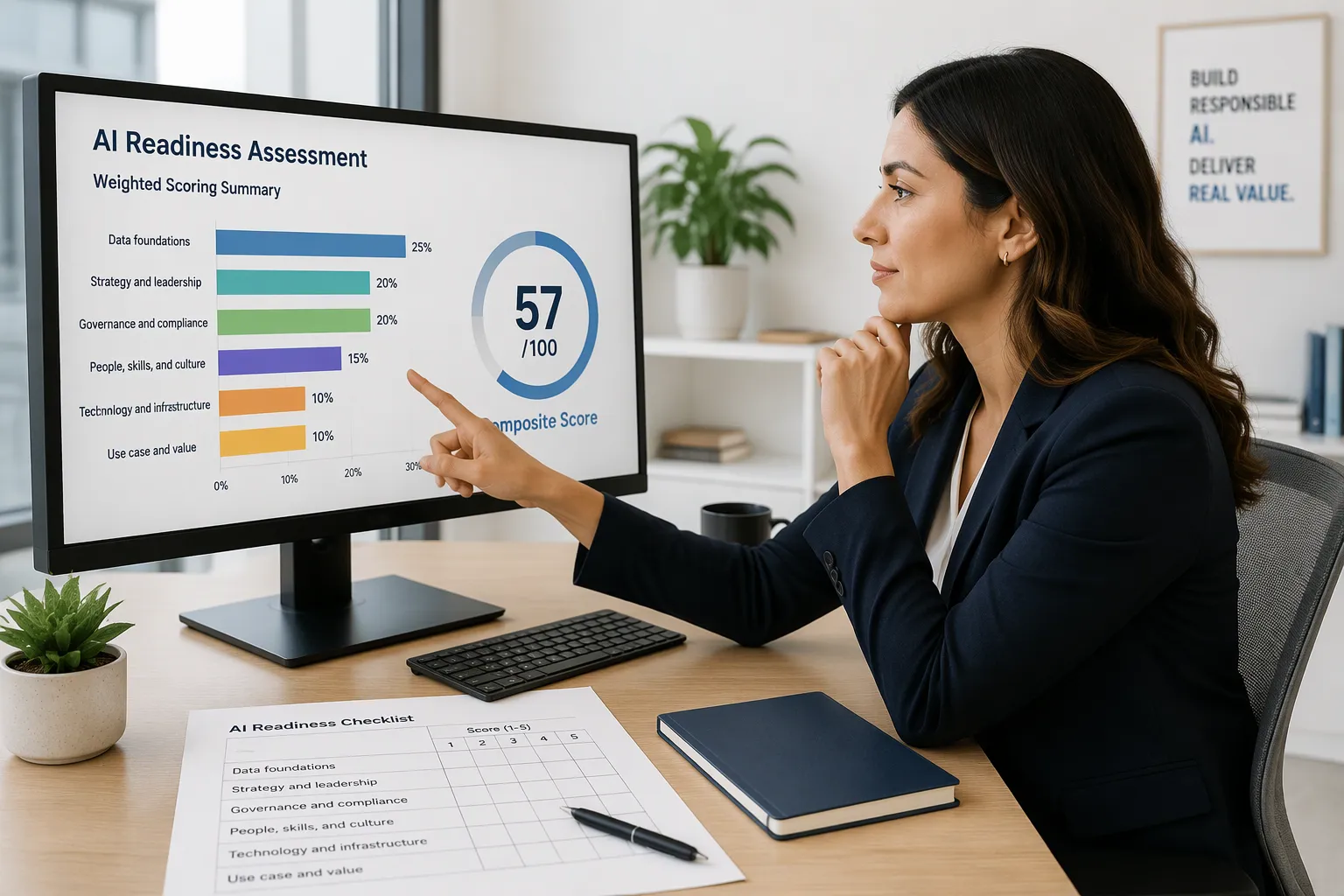
Give each category a score from 1 to 5. A 1 means it is missing, and a 5 means it is fully in place. Ovaledge has a weighted model that turns those scores into one number. Rate the six pillars, multiply each by its weight, add the results, then multiply by 20 to get a score from 0 to 100.
Pillar | Weight |
|---|---|
Data foundations | 25% |
Strategy and leadership | 20% |
20% | |
People, skills, and culture | 15% |
Technology and infrastructure | 10% |
Use case and value | 10% |
Ovaledge shows the same weights in a bar chart:
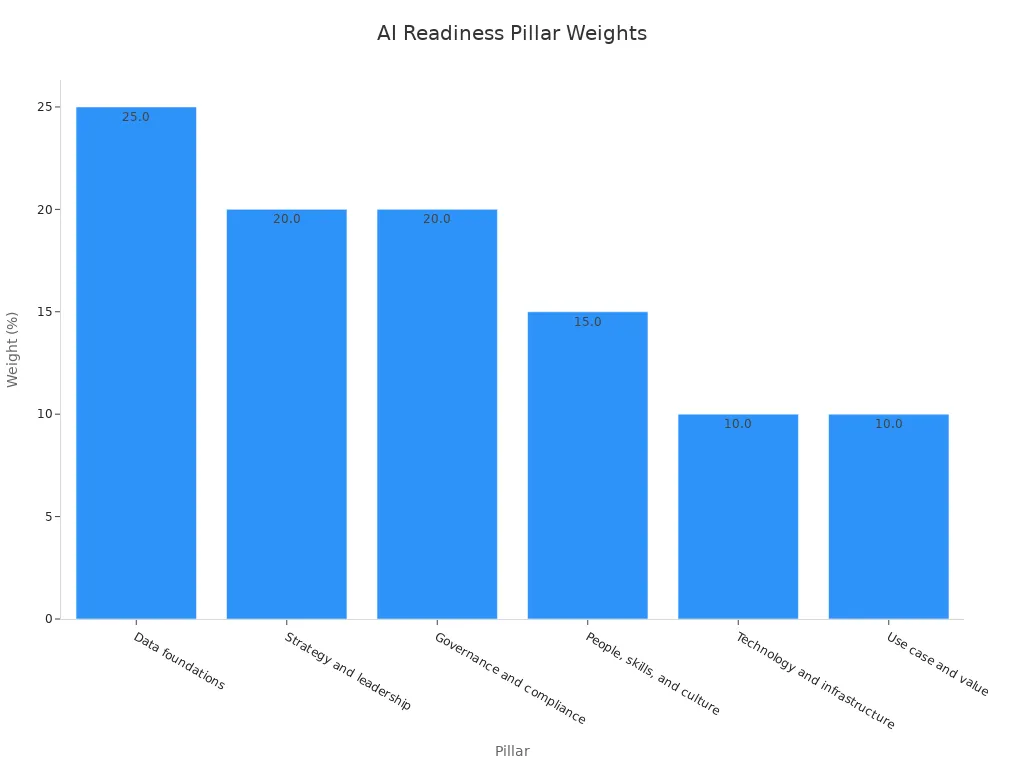
A worked example makes the math easier to see. Ovaledge describes a mid-size insurer that scored data 2, strategy 4, governance 2, people 3, technology 4, and use case 3. The weighted total is 2.85, and the composite is 57. A flat 3 across all six pillars gives 60. Use these readiness evaluation criteria to compare your own result with the maturity bands below.
Score | Maturity level | Where to start |
|---|---|---|
0-25 | Level 1: Unprepared | Start with a data inventory and executive education. |
26-45 | Level 2: Planning | Stand up a data catalog and a governance policy. |
46-65 | Level 3: Developing | Push data quality above 85% on critical datasets. |
66-85 | Level 4: Implemented | Industrialize with a center of excellence. |
86-100 | Level 5: Embedded | Expand into products and push the frontier. |
Link each score back to your business goals. A high technology score cannot make up for weak data foundations, because the weights already show that fact.
Common Gaps and Ready Signs
Poor data quality is the top gap. PwC reports that 65% of retail executives say data silos and fragmented systems are the main barrier to their AI goals. Nisum describes the symptoms: data spread across POS, web, app, and loyalty systems, formats that do not match, missing identifiers, and no single owner for quality. Forecasting suffers most, because models struggle with new SKUs and little history.
Unclear ownership comes right after. Columbus Consulting finds that business leaders often think their data is ready while IT teams deal with the mess. No AI policy is the third common gap. Without written rules on allowed data, access, and retention, pilots get stuck at review.
Microsoft lists the signs of a ready organization: clear business objectives for AI, trained employees, trusted and accessible data, governance and oversight processes, security controls, and supporting infrastructure. Add clean, accurate data in your product feeds and engaged leadership to that list. A strong ai readiness assessment also tracks success metrics for each pilot, not just launch dates.
Your digital maturity shapes how fast you close these gaps. A retailer with unified data moves quickly. A retailer with fragmented silos needs foundation work first. Run the checklist again after each fix and watch your score climb.
Steps to Close the Gaps
A 90-Day Retail AI Deployment Plan
You fix gaps in order, not all at once. RingCentral shares a plan with three phases. Days 1–30 get leaders on the same page and set the KPI scorecard. Days 31–60 run pilots and make integrations stronger. Days 61–90 get ready for full rollout and a scaling playbook.
Phase one begins with a steering group from IT, merchandising, and operations. Score your top two or three use cases on business impact, implementation complexity, and organizational risk. Give one owner to each effort, and set baseline measurements before you deploy. Techverx suggests measuring that baseline for two to four weeks.
Phase two runs a low-risk ai pilot in one category, three stores, or one support queue. Keep a human in the loop until you know the error rates. Write stop rules before launch, like stopping if the target metric has not moved by week eight. Phase three finishes monitoring, approval workflows, and frontline training, then moves one high-impact use case into production.
Quick Wins vs. Long-Term Fixes
Order matters. Dataiku describes an online fashion retailer whose small data science team built and deployed market basket analysis in two hours, a project that would otherwise have taken weeks. That is what a quick win looks like: measurable value in months, not years.
Category | What it delivers | Retail examples |
|---|---|---|
Quick wins | Measurable ROI in months; builds momentum | Dynamic pricing, support chatbots, demand forecasting |
Long-term fixes | New business models and autonomous operations | Transformational customer experiences |
Launch Consulting explains the split this way. Fund quick wins first, then put that momentum back into long-term fixes. Treat your retail ai deployment checklist – scenario 12 as the worked example: it puts a fast pilot ahead of foundation work, so you prove value before you scale.
Content readiness belongs in the same plan. FPT Software reports that Gemini draws 72% of its insights from brand-owned sources. Set up product pages with schema markup, FAQ formatting, and factual detail so AI systems find and rank your content correctly.
AI readiness is a spectrum, not a pass/fail test. Your score shows where you stand today and which gaps matter most. Run the checklist honestly, then pick one or two gaps to address first. Small, focused fixes build momentum for scaling ai across your stores.
Readiness today makes adoption smoother tomorrow. Start with your weakest category, assign an owner, and set a review date. Each fix raises your score and prepares your team for the next step.
FAQ
How long does it take to become AI-ready?
There is no set timeline. Your starting score decides how fast you go. A retailer with unified data can pilot in weeks. A retailer with fragmented silos needs foundation work first. The 90-day plan has three phases: alignment, pilot, and rollout preparation.
Which gap should I fix first?
Start with your lowest-weighted score, not your lowest raw score. Data foundations carry the heaviest weight at 25%, so weak data quality holds back every other category. Fix ownership and definitions before you buy tools. Clean product feeds make every later step easier.
Can a small retailer pass this checklist?
Yes. The checklist measures what you can do, not how big your company is. A small team can score well with clear objectives, one owned dataset, and a written AI policy. Skip the center of excellence until you reach Level 4. Focus on quick wins that show measurable value in months.
Do I need a formal AI policy before my first pilot?
You need written rules before customer data enters any tool. Name allowed data, access levels, retention, and override paths. Keep a visible list of every tool in use. A short policy beats a perfect one that never ships. Expand it after the pilot.
How often should I rescore my business?
Rescore after each fix, and set a review date for every open gap. Quarterly reviews work well for most retailers. Watch for drift in data quality and tool usage between reviews. A rising score shows your readiness assessment stays current, not just your launch date.
See Also
AI-Powered Corner Stores Are Rising: Essential Insights For Retailers Today
Launching An AI-Powered Corner Store With Very Low Initial Investment
AI-Powered E-Commerce Tools Are Transforming How Online Stores Are Managed
Why AI-Powered Retail Stores Represent The Future Of Shopping
Cloudpick Checkout Computers Boost Efficiency, Accessibility, And Overall Customer Experience
