How Edge Computing Outperforms Cloud for Retail AI Applications


Edge computing wins for retail artificial intelligence. It keeps data in your store and cuts latency to milliseconds. You get real-time decisions at the shelf, not seconds later.
Cloud computing centralizes processing and storage in distant data centers. That model works for many tasks. Retail does not fit that mold. Your stores need speed, low bandwidth use, and strong data privacy.
The choice between cloud vs edge computing comes down to five factors. Latency, bandwidth, privacy, scalability, and real use cases all favor the edge. Edge computing processes data locally. Cloud computing centralizes processing elsewhere. That difference changes everything for retail AI.
Key Takeaways
Edge computing makes decisions in milliseconds, so you can act right away when a shelf runs empty or a shopper needs help.
You save on data transfer costs because edge devices process data locally and only send alerts to the cloud, cutting expenses.
With edge computing, customer data stays in your store. This makes it easier to follow privacy laws and keep sensitive information safe.
Edge systems keep running even when the internet goes down, so your store work never stops.
You can start with one store and grow to thousands without network problems, making edge computing a smart choice for retail growth.
Low Latency: Edge vs. Cloud Computing for Real-Time Retail AI
Enabling Instant In-Store Decisions
When a shopper picks up a product or a shelf runs empty, you need answers in milliseconds. Edge computing gives you that speed. Processing at the edge keeps inference on site, so your systems act the moment data arrives. Edge AI gets response times as low as 1–10 ms, often 5–10 ms. That speed makes real-time responses possible for latency-sensitive applications like smart shelves and self-checkout.
Think about a smart shelf that watches for stock-outs. Cameras take pictures of the shelf, a model spots the gap, and an alert goes to staff. The whole loop runs locally in milliseconds. Here is how that pipeline works:
Shelf cameras take pictures
Product detection and classification run on the edge node
Shelf mapping and SKU recognition match items to planograms
Inventory availability analysis flags gaps
Out-of-stock alerts generate locally
Store staff get the notification
Replenishment happens before sales are lost
In-store inventory management is helped by edge computing, which can give real-time inventory monitoring and alerts when products are running low or out of stock, helping retailers restock efficiently and reduce lost sales from empty shelves.
Eliminating Cloud Round-Trip Delays
Cloud computing sends your data to a faraway data center and waits for the answer. That round trip adds latency you cannot remove. Cloud latency usually ranges from 30–60 ms, but it can reach 50–200+ ms in bad conditions. Sending video feeds to the cloud for real-time decisions is not possible because of this round-trip delay.
Checkout-free shopping shows the gap clearly. The engineering benchmark for virtual cart updates sits under 500 milliseconds from the moment a product is touched to cart registration. Any latency above that threshold creates reconciliation errors at scale. For Żabka's 24/7 autonomous stores, inference ran at the edge to keep checkout latency under 200 ms and avoid streaming raw video off-premises. Edge computing can cut latency by 2 to 10 times compared to centralized cloud models. That difference separates real-time responses from delayed ones. When you compare edge vs. cloud computing for latency-sensitive applications, computation closer to devices wins every time.
Bandwidth Costs: Cloud vs Edge Computing in Retail
Cutting Data Transfer Expenses
You pay for every bit of video that leaves your store. One 1080p camera sends 1–2 Mbps of upload all day long. Ten cameras need 10–20 Mbps of steady upload. A few dozen cameras can max out the upstream link your whole business shares. That strain often forces an internet upgrade of $50–200 per month on top of your subscription.
In the cloud model, every camera's video has to travel up your internet connection, continuously, because the recording lives in the data center. A single 1080p camera consumes roughly 1–2 Mbps of upload around the clock... ten cameras need 10–20 Mbps of sustained upload, and a few dozen cameras can saturate the upstream link that the rest of the business also depends on, sometimes forcing an internet upgrade of $50–200 a month on top of the subscription.
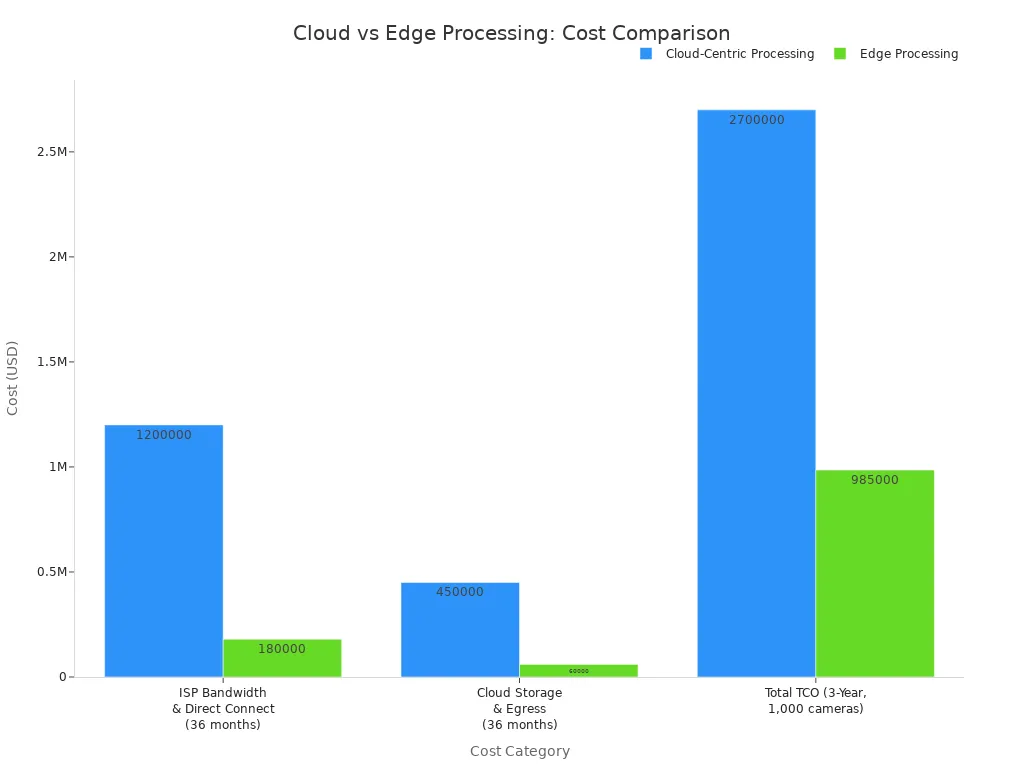
Cloud recording subscriptions add more. Short retention runs $10–30 per camera per month. Longer retention runs $30–60. Enterprise tiers with analytics reach $75–150 per camera per month. Edge computing flips this math. Your edge node analyzes footage on site and uploads only alerts and short clips. Cloud egress fees drop to almost nothing.
Metric | Cloud-Centric Processing | Edge Processing |
|---|---|---|
Continuous upstream bandwidth (500 cameras) | 1.5 Gbps (500 × 3 Mbps) | Less than 5 Mbps across entire fleet |
Monthly data ingress | ~486 TB | Only alerts and short clips uploaded |
Cloud egress fees | $24,000–$43,000/month | Minimal (metadata/clips only) |
Total Estimated TCO (3-Year, 1,000 cameras) | $2,700,000 | $985,000 |
Scaling AI Without Network Bottlenecks
Growth punishes a cloud-heavy design. Each new store adds cameras, sensors, and POS terminals. Each device streams raw data to a central data center. Bandwidth demand climbs with every location. Retailers often realize ROI on edge hardware in fewer than six months from network savings alone.
Edge computing breaks that link between store count and network load. A gateway function lets you choose which data goes to the cloud and which stays local. You train ai models in the cloud and push updates to the edge. Inference runs in the store, so only model updates cross the network. Your edge systems process data locally and stay centrally managed across thousands of sites. This hybrid split conserves bandwidth and keeps checkout, cameras, and inventory running at full speed.
Data Privacy: Edge Computing vs. Cloud Computing

Keeping Customer Data On-Site
Your store gathers very private data. Facial scans, purchase records, and customer info move through your systems daily. In a cloud-first design, data goes over public networks to servers you don't own. Each stop creates a new spot where a leak could happen. Cheap cameras and sensors can't run good security on their own. Many sit in open, unwatched areas on the sales floor.
Edge computing changes where data stays. Your edge machines handle personal data in the store. They send only what the higher level needs. You don't have to upload every raw frame to the cloud right away. This method gives you more control over private info. It also lowers risk at the start. A camera can scan a face, get an anonymous number, and delete the video. The personal data never leaves the store.
Simplifying Compliance with Local Processing
Privacy laws favor keeping less data. Rules like GDPR and CCPA tell you to gather less, store less, and send less. Local processing makes these tasks simpler. If data never leaves the store, you have less to protect, report, and check.
The key step is to handle and hide private data at the source. So the edge machine does real-time face analysis. It pulls only anonymized, total numbers... The raw video with personal info is never saved or sent to the cloud.
By handling personal data locally and removing it after use, edge computing makes it easier to follow strict rules like GDPR. The store keeps full control over the data... This local processing is a key idea of data minimization and purpose limitation. These are two main rules of data protection law (Microsoft, 2024).
This split also helps with data-sovereignty rules. A store in one country can keep customer data inside that country. No need to build a new cloud region. You still train ai models in the center and send updates out. Inference happens at the edge, so raw customer data stays. That design changes a compliance problem into a normal task.
Scalability and Reliability: Cloud Computing vs Edge Computing
Scaling with Store Expansion
Each store's edge node works on its own. You can add a new location without putting stress on the central cloud. No huge upgrades are needed. This pod-based setup lets you grow step by step. Start small. Scale fast once edge services show they are worth it.
The debate of cloud vs edge computing becomes clear here. A cloud-heavy design forces every new store to send raw data to a central hub. Bandwidth goes up. Storage grows. This model works for a few locations. It breaks across thousands.
Edge scale handles tens of thousands of small, often poorly connected locations. Cloud scale runs a handful of large data centers. You cannot use one for the other.
A unified orchestration layer controls deployment across distributed sites. Automation handles rollout and placement. You scale from a few edge sites to hundreds without manual work. AI model training happens in the cloud. The cloud pushes updates to the edge. Inference runs locally for instant responses. Each store works as a self-contained pod.
Maintaining Operations During Network Outages
Internet outages do not stop edge systems. Cloud-dependent retail fails when connectivity drops. Edge computing processes video closer to the store. It offers lower bandwidth and keeps running during disruptions.
The comparison of cloud computing vs edge computing shows a key difference. Cloud computing depends on continuous connectivity. Edge computing keeps running with local-first recording. Full-resolution video stays local. Only metadata syncs to the cloud. Your checkout systems work. Cameras keep recording. Inventory updates in real time.
Here is how each approach behaves during an internet outage:
Criterion | Cloud | Hybrid edge-to-cloud |
|---|---|---|
Recording location | Remote data centers | Local in each store |
Behavior during outage | Relies on connectivity | Local-first recording continues |
Real-time latency | Higher | Low |
Bandwidth burden | High | Low |
Cloud computing wins on remote access. Edge computing wins on local resilience. Most enterprises adopt a hybrid architecture. They keep ai processing local for real-time decisions. They send aggregated data to the cloud for analytics. This split gives you reliability without losing central control.
Practical Retail AI Use Cases for Edge and Cloud Computing
Real-Time Inventory Monitoring
Computer vision helps you watch shelves better. Cameras see products and find issues right away. A vision model runs on local machines to check if products are in the right place. It spots low stock, wrong items, or theft. Alerts come from the store itself, right away.
You need certain hardware and software for this. You need servers in the store, cameras with AI, and edge devices that use x86, ARM, or NVIDIA GPU chips. Software like Wallaroo.AI helps you put models into use. You also use pruning and quantization to make models run better on limited hardware. Your edge AI system talks to POS, inventory, and CRM systems for a full picture.
Retailers such as Zippin use ceiling cameras and shelf sensors to track each item. Standard AI can watch current security video without extra gear. VusionGroup connects small shelf cameras to your ERP to see what is on the shelf. These systems still work even if the internet goes down.
Personalized In-Store Promotions
Digital signs can see who is nearby and change right away. Screens with edge computing analyze age, gender, and mood as people look. The system changes what it shows immediately. A store using Aquaji signs shows quick breakfast items and coffee deals in the morning. Later, when families and students come, the screen shows family picks and student discounts.
All this processing happens on the device itself. Face detection and machine learning run locally, and data stays on the device. You get quick info without sending personal data to the cloud. The system still works if the network fails. You can try different messages and improve campaigns right there.
Using both edge and cloud works best here. Edge devices make instant choices at the shelf and screen. Cloud computing collects data for long-term study and training AI. This mix gives you speed in the store and knowledge across all stores. The cloud trains models. The edge runs them. Splitting data processing and analysis keeps delays low and costs low.
AI edge computing lets stores make faster decisions right there. This helps them quickly react to customer changes, demand shifts, and security issues.
Edge computing wins over cloud computing for retail AI. You get latency in milliseconds, lower bandwidth costs, stronger privacy, easier scaling, and real use cases that work in actual stores. These five benefits all come from one thing: edge processing is built for fast, private, always-on store operations.
The payoff is real. Retailers often realize ROI on edge hardware in fewer than six months solely from network savings. You also see lower bandwidth costs and better store efficiency.
Check your current cloud-heavy AI setup today. Try an edge deployment in one store. Measure the speed, cost, and privacy gains for yourself.
FAQ
Is edge computing safe enough for customer data?
Your data stays in the store on hardware you own. You decide what leaves the building. This lowers the number of weak spots and makes it easier to follow privacy laws.
How many cameras can one edge device handle?
The exact number depends on your hardware and how complex your model is. You can add more nodes as your store grows.
Do I have to get rid of my cloud setup to use edge computing?
No. Most retailers use a mix of both. The cloud handles training and long-term analytics. The edge makes real-time decisions in the store. You keep both systems working side by side.
Can edge computing keep working when the internet goes down?
Yes. Edge nodes process data on site and keep recording video. Only metadata syncs to the cloud once the connection comes back. Your store operations never stop.
How do I update models on edge devices?
Models train in the cloud and send updates to edge nodes over the network. Each store downloads the new AI model on its own. Inference runs locally without any pause.
See Also
How AI-Driven Convenience Stores Are Changing Retail Landscape Today
The Inevitable Future Of Retail Lies In Artificial Intelligence
Transforming Online Store Operations Through Artificial Intelligence E-Commerce Solutions
Comparing Amazon Go And Cloudpick In Automated Retail Technology
How Cloudpick Checkout Computers Improve Efficiency Access And Customer Experience
