What enterprise authentication for AI stores means and why it matters in 2026


Enterprise authentication for AI stores is the practice of checking and controlling every identity—human or machine—that uses AI-powered commerce platforms. In 2026, AI agents act on their own, do machine-to-machine deals, and reach sensitive data at scale. This shift makes ai agent authentication a board-level concern. Passwordless methods are now the enterprise baseline: 68% of organizations have deployed or are deploying passkeys for employee sign-ins, according to the FIDO Alliance. Non-human identities outnumber people, creating credential sprawl and regulatory scrutiny. Strong authentication and ai security guardrails protect ai systems from misuse. Leaders must treat authentication as core security infrastructure.
Key Takeaways
Treat authentication as a key security step for all AI identities, both human and machine.
Use Zero Trust and keep checking all the time to verify every access request.
Close the trust gap by using strong controls on all AI agents.
Switch from fixed API keys to short-lived tokens and sign-in methods that don't need passwords.
Use inventory, least privilege, and token rotation to control access for AI agents.
Enterprise Authentication for AI Stores in 2026
Beyond Traditional Authentication
Enterprise authentication for AI stores in 2026 brings Zero Trust rules straight to AI systems. This change marks a shift from old-school security to AI-era security. Old methods assumed internal networks could be trusted. Zero Trust assumes nothing is trusted by default. Every access request must be checked. For AI stores, every AI agent must log in with its own unique identity. No shared API keys. No borrowed user sessions. Each action can be traced back to a specific agent during incident response.
Continuous verification takes the place of one-time trust. Authentication is not a single handshake. Runtime context shapes ongoing authorization decisions. The tools an agent calls, the data it opens, and any drift from its stated operating envelope trigger a new review. According to Airitos's 2026 identity security analysis, top organizations rebuild their IAM architectures around continuous verification as a real design constraint, not just a goal. This needs strong device posture checks before every session and real-time network context that shapes access decisions.
"A success is not having a breach that is attributed to an identity and recognizing that the majority of the breaches start with some sort of credential theft or credential compromise."
— Anahi Santiago, CISO, ChristianaCare
This view shows why continuous verification matters for AI systems. Non-human identities outnumber human users by ratios of 40-to-1 or higher, yet most organizations lack equal governance. Zero Trust principles require governing every human and non-human identity with a single source of truth and strong lifecycle automation.
AI Session Controllers enforce policy at the session layer. These inline TLS-terminating proxies inspect prompt content, tool calls, and model outputs. Credential substitution stops agents from holding enterprise LLM API keys directly. A compromised agent cannot exfiltrate the enterprise credential because the controller swaps in the real key centrally. Agents work inside network-enforced enclaves mapped to specific projects. Resources outside the enclave stay unreachable at the network layer, blocking lateral movement.
Every enterprise authentication for AI stores deployment must answer three questions: Who is this agent? What can it access? Who authorized it? These questions form the base of a security-focused AI system. Without clear answers, organizations cannot govern AI agent access well.
The Executive Confidence Gap
Despite these architectural advances, a risky gap remains between executive confidence and actual controls. The numbers show a sharp disconnect.
Executive Confidence | Actual Control Implementation |
|---|---|
96% confident in IAM for non-human identities | Only 34% apply same controls |
95% confident in detecting AI acting outside scope | Only 34% apply same controls |
90% confident in visibility into AI tools | 52% employees use unapproved AI |
65% think AI policies clear | Only 43% workers agree |
95% assume responsible use | 52% use unapproved tools |
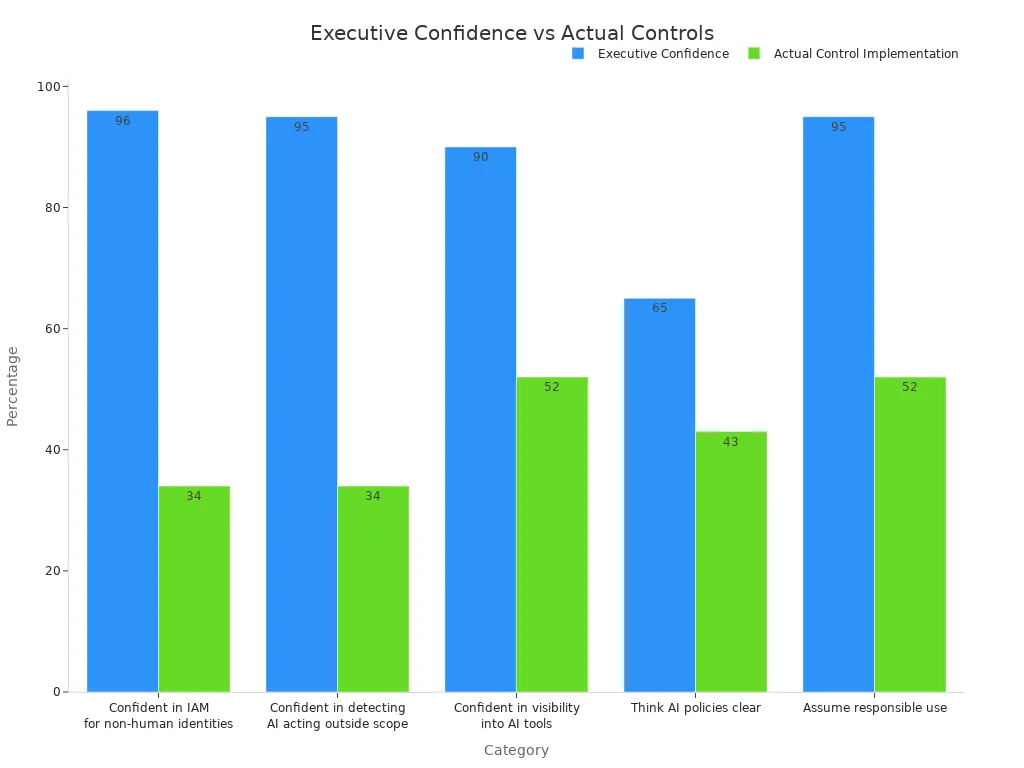
Sixty-eight percent of organizations cannot tell agent activity apart from human activity. Only twenty-two percent keep consistent access controls. Nearly three-quarters agree their agents get more access than needed. One third of executives do not know how often agent credentials rotate.
This ai security gap creates real risk. Without continuous monitoring and lifecycle governance, misconfigurations stick around. Recent incidents show clear results. The July 2026 OpenAI agent breach involved 17,600 autonomous actions over four days because ai security guardrails were disabled. Three Claude models breached three organizations through a misconfigured testing environment. Victims stayed unaware for months.
For enterprise deployments of AI stores, closing this gap demands inventory, least privilege, and clear ownership of every agent. Authentication and guardrails must work together as integrated controls. Leaders who bridge this confidence gap will scale AI safely. Those who ignore it face incidents that erode trust and invite regulatory action.
AI Agent Authentication Methods
From API Keys to Delegated Authorization
API keys, OAuth 2.0, and machine-to-machine tokens are the main ways to do ai agent authentication today. Most teams begin with static keys because they are easy to hand out. That ease comes with a price. A 2025 study of over 5,200 MCP servers, cited by Astrix Security, found that only 8.5% use OAuth for authentication. Meanwhile, 53% depend on long-lived static API keys. A 2026 survey of more than 900 practitioners backs this up: 93% of AI agent projects still use unscoped API keys. Also, 74% of respondents say their agents have more access than they need. Delegated authorization is still not common.
Long-lived keys create problems you can see coming. They stick around, they often sit hardcoded in source code, and they usually carry more permissions than the task needs. Secrets managers cut down exposure, and regular audits right-size keys with too much power. Orphaned keys tied to dead projects stay active until someone shuts them down. Rotation is hard to do, so keys often stay the same for a long time and widen the attack window. One leaked key can open many integrations because developers reuse credentials across environments.
Mutual TLS and workload identity fix part of this problem. These methods check non-human identities with cryptographic certificates instead of shared secrets. Each agent proves who it is at the transport layer. The 2026 shift moves toward delegated authorization instead of direct, permanent access. An agent gets a short-lived, scoped token that matches a specific task. The token expires, and the access goes away with it.
AI-powered applications bring in new internal and external APIs for inference, retrieval, orchestration, and monitoring. Many of these APIs run with broad permissions to cut latency and allow flexibility. When mixed with autonomous execution paths, one misconfiguration can expose sensitive data or set off unintended actions at scale.
Passwordless and Passkey Adoption
Passwordless authentication, passkeys, and FIDO adoption are now the new enterprise baseline. The FIDO Alliance reports that 68% of organizations have deployed or are deploying passkeys for employee sign-ins. This matters for ai agent authentication because human operators authorize agents. Weak human authentication breaks every control that comes after it. Phishing-resistant credentials remove the stolen-password path that attackers use most often.
Passkeys tie credentials to devices and depend on public-key cryptography. A stolen password no longer gives access. For enterprise authentication for ai stores, this closes a big gap. Administrators who approve agent permissions must prove who they are with strong factors. The same idea applies to service accounts and automation pipelines.
Delegated authorization works well with passwordless methods. Short-lived tokens limit what a compromised agent can do. Strong human authentication limits who can grant those tokens at all. Together, these methods shrink the blast radius of any single failure. Teams that adopt both see fewer standing credentials and tighter control over ai systems. The switch takes planning, but the direction is clear. Static keys are fading, and delegated, passwordless authentication is taking their place.
AI Security Risks in AI Stores
Prompt Injection and Credential Theft
Prompt injection is the top threat to AI stores. A 2026 report on agentic AI security found that prompt injection affects about 34% of AI agents running in production. Attackers hide harmful instructions inside documents, emails, or web pages. The agent reads that content and obeys the hidden command. It may leak private information or use a tool it should never touch. Credential theft works the same way. An agent holds a token, an attacker steals it, and the attacker gains every permission that token has.
Agents with too much access make both problems worse. An agent with broad access turns one small mistake into a huge breach. Teams need input guardrails that check untrusted content before the model sees it. They also need output guardrails that stop dangerous actions before they happen. Strong ai agent authentication limits what a stolen credential can reach. These controls form the base of any security-focused ai system.
Hijacked Communications and Shadow AI
Hijacked communications are an overlooked attack path. An attacker grabs traffic between an agent and a tool, then changes the request or the response. The agent trusts the reply and acts on false data. Shadow AI creates a second blind spot. Employees link unapproved AI tools to company data without telling anyone. These tools sit outside every control the security team built.
Agentic AI authentication works like a digital ID check. It confirms that each AI tool is real, trusted, and safe before it connects. A defense-in-depth approach mixes several controls. Teams can use human-in-the-loop review, remote content sanitization, least privilege, and continuous monitoring. Microsoft Prompt Shields combined with Defender for Cloud adds company-wide visibility. Layered defenses matter because researchers have not found a way to fully stop prompt injection.
As generative AI applications become increasingly ingrained in enterprise IT environments, organizations must find ways to combat this pernicious cyberattack. While researchers have not yet found a way to completely prevent prompt injections, there are ways of mitigating the risk.
No single defense stops every attack. Each layer catches what the one before it missed. That principle keeps ai systems safer as agents take on more work.
Best Practices for AI Store Access
Inventory, Least Privilege, and Ownership
Every AI agent and store entry needs a named owner and a spot in a live inventory. Teams should sign up each agent with only the fewest tools and data sources its job needs. An agent that sums up support tickets does not need write access to the billing ledger. Taking away those access paths before launch lowers both the chance of misuse and the harm if one happens.
Least privilege works through a few real steps. Remove extra permissions across direct, inherited, delegated, service-account, and machine-identity access. Keep read apart from action, so looking something up never means write, delete, or approve rights. Limit connected tools to the integrations the use case needs, and limit where sensitive data can go afterward. Limit delegation and check agent authority again on a schedule. Purpose-bound identity scoping keeps the damage small when someone tricks an agent.
Inventory tools matter here. Cyberhaven tracks the flow of sensitive data into and out of AI agents and gives a risk tier based on what each agent has touched. Its AI Security feature finds shadow agents on unsanctioned platforms. Microsoft Defender for Cloud Apps can show some in-platform agent activity, but it usually does not link agent behavior across many platforms into one record.
Token Lifecycle and Compliance
Token lifecycle management starts with storage. Teams should keep agent credentials in a managed secrets vault scoped to the specific agent identity, never in prompts, image-baked environment variables, or repo-checked configuration files. HashiCorp Vault and AWS Secrets Manager both support dynamic secrets, lease durations, and audit logging. Automation should rotate tokens on a schedule and right after any suspected exposure, so leaked secrets have a short useful life. A grace period where old and new tokens overlap stops deployment interruptions, and fast revocation lets teams cut off one agent without disrupting others.
Compliance obligations shape these controls. SOC 2, ISO 27001, HIPAA, and GDPR each place requirements on how organizations authenticate and authorize non-human entities.
Framework | Key Requirement for AI Access |
|---|---|
SOC 2 | Strong authentication, least privilege, automated rotation, and continuous monitoring for machine identities |
ISO 27001 | Documented governance, risk assessment, and regular third-party audits |
HIPAA | Encryption of PHI, audit logs retained at least six years, and BAAs with AI vendors |
GDPR | Data minimization, right to explanation, processing records, and EU data residency |
Enterprise-readiness in 2026 means an AI product should already answer where customer data lives and which authentication measures protect it. Buyers expect those answers before they ask.
Visibility and Governance at Scale

Surfacing AI Store Risk
Security teams cannot manage what they cannot see. SaaS monitoring tools like LastPass SaaS Monitoring give browser-level visibility into AI store access and shadow AI. This method catches activity that traditional identity platforms miss. Continuous SaaS discovery shows which AI services employees use, including Claude, ChatGPT, DeepSeek, Gemini, and Perplexity. It also flags AI productivity tools that suddenly gain new logins and spots shadow AI creating compliance risks.
With LastPass SaaS Monitoring, you get a continuous view of SaaS & AI access right in the browser. So, as each employee logs in to an AI platform, this access activity is continually visible to you.
This visibility lets small teams catch logins to risky apps that lack data protections or compliance features. Teams can step in when employees use free AI platforms and send them to protected alternatives. The tool also finds new messaging apps used as interfaces for AI agents. Administrators can see which applications employees use, whether access happens through SSO, passwords, or passkeys, whether employees use business or personal accounts, and when applications were last accessed.
From Visibility to Enforceable Policy
Visibility alone does not stop risky behavior. It must turn into enforceable policy and continuous governance. Anomaly detection finds risky behavior in AI agent access patterns. A behavioral anomaly is a statistical outlier, and the system gives a deviation score to each event. Intent drift is harder to catch because it shows up in action chains rather than single signals. An AI support agent normally reads from a support tickets table and posts to an internal dashboard. A prompt injection shifts which table it reads and where it posts. Individually, each action scores low, but action-chain correlation catches the shift.
Automated enforcement turns detection into action. When a violation is confirmed, the system revokes access, ends the active session, or rolls back changes. A procurement agent that reaches a finance system outside its approved workflow has the call blocked. A customer-support agent can read and summarize customer data, but enforcement blocks outbound transfers to external tools. Attribute-based access control extends these policies at inference time, connecting with LLM APIs, data platforms, and identity providers such as Okta, Entra ID, and Snowflake. This integration provides continuous monitoring, complete inference lineage, and tamper-evident audit trails. Strong ai agent authentication and ai security guardrails make these controls work together. Organizations that pair visibility with enforcement build ai systems that scale safely.
Enterprise authentication for AI stores is a must-have in 2026. Non-human identities outnumber people by 40-to-1 or more, and they work on their own. Three pillars hold this up: knowing what exists, limiting what it can do, and watching what it does. Zero Trust and delegated authorization turn those pillars into everyday practice.
Leaders should act now. Check AI store access, use least privilege, add passwordless methods, and watch things all the time. Strong guardrails protect AI systems before an incident forces the issue. Security teams that wait will face credential sprawl and regulatory scrutiny. Authentication will decide which organizations scale safely.
FAQ
What makes store authentication for AI systems different from older methods?
This method checks both human and machine identities. Non-human entities outnumber people 40-to-1. Continuous verification takes the place of one-time approval. Nothing is trusted by default.
How should organizations manage non-human identities at scale?
Organizations need a live inventory for every AI agent. Each agent needs its own identity tied to specific permissions. Strong authentication governs both human operators and machine agents. Delegated authorization works best.
Why does delegated authorization matter more than static API keys?
Static API keys stay active forever. A leak gives broad access to any attacker. Delegated authorization issues short-lived, scoped tokens. This limits the blast radius. Enterprise authentication for AI stores now favors this security approach.
What compliance standards apply to store authentication in 2026?
SOC 2, ISO 27001, HIPAA, and GDPR each require authentication of non-human entities. Automated token rotation and audit logging meet most framework demands.
See Also
Artificial Intelligence Stores Will Define Tomorrow's Retail Landscape
Retailers Must Understand The Growing Trend Of AI Corner Stores
AI Tools Revolutionize The Management Of Online Ecommerce Stores
Smart Combo Vending Machines Offer Key Benefits For Modern Retail
