Five Key Steps to a Digital Transformation Roadmap for Convenience Stores


Convenience stores that use digital signs see a 35-40% jump in the average sale per customer. Is your store still relying on outdated methods and legacy tools? Customers now expect faster, more personalized digital service, and with intense competition and rising expectations, they’ll quickly notice if you’re falling behind. A single broken device can remain unfixed for over 24 hours, quietly costing you thousands in lost sales. Meanwhile, turning raw data into actionable insights feels nearly impossible. Your customers need a digital experience that matches today’s standards—seamless, intuitive, and effortless. They have little patience for slow service or friction. That’s why building a clear digital transformation roadmap is essential. This five-step plan guides you from assessing your current state to continuously improving, so by the end, you’ll have a concrete, actionable strategy to move forward with confidence.
Key Takeaways
Check your store's digital maturity to find gaps and opportunities.
Focus on easy wins, such as managing your inventory, to improve cash flow quickly.
Pick technologies that make shopping better for customers, like self-checkout and mobile apps.
Connect your systems to make everything work smoothly for customers and staff.
Use data and customer feedback to keep making your digital plan better.
Step 1: Assess Your Digital Transformation Maturity
Before you build your digital transformation roadmap, you need a clear picture of where your store stands today. This assessment reveals gaps between your current operations and what customers now expect. You cannot fix what you do not measure.
Evaluate Existing Systems and Pain Points
Start by looking at how your store runs each day. Walk through your store and watch every customer interaction. Ask yourself these questions: Does your point-of-sale system process transactions quickly? Can you track inventory in real time? Do you offer contactless payment options?
Many convenience stores still use old hardware and software that is no longer supported. Some use manual cash registers and separate inventory programs that cannot connect to modern cloud-based systems. These outdated tools create problems. Slow checkout lines frustrate customers. Manual inventory management leads to inconsistent stock levels and tracking errors. Out-of-stock scenarios cause missed sales and erode customer confidence.
Your digital value chain connects every part of your business, from supplier deliveries to customer payments. When one link breaks, the entire chain suffers. Consider your loyalty program. If it cannot integrate with your ordering system, customers face confusion when they try to redeem rewards online. Your marketing efforts also suffer when customer data collection happens through disconnected platforms.
Benchmark Against Industry Standards
Once you identify your pain points, compare your operations against industry maturity models. These models describe how far stores have progressed in their digital transformation journey.
Stage | Description | Adoption Rate |
|---|---|---|
Inaction | Lacks digital capabilities for contactless payments, online ordering, loyalty, or personalization | ~50% of c-stores |
Initiation | Digital presence is functional but predictable; relies on templates and third-party delivery services | ~38% of c-stores |
Foundation | Custom platform providing unified customer view | ~5% of c-stores |
Acceleration | Invests in technology for individual customer insights and cross-channel marketing | ~5% of c-stores |
Innovation | Digital offerings are strategic differentiators; data-driven CRM and platform development | <1% of c-stores |
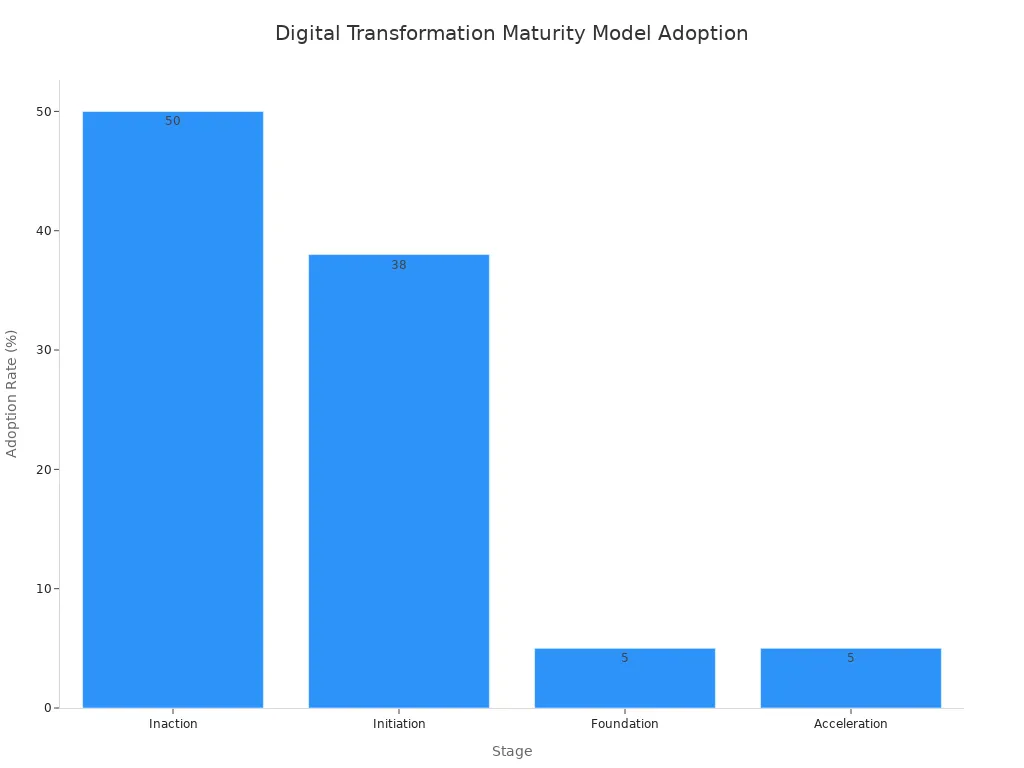
Most convenience stores remain stuck in the Inaction or Initiation stages. Only a small fraction reach Foundation or Acceleration. This gap represents your opportunity. By moving even one stage forward, you can outperform most competitors.
Your assessment should also examine automation opportunities. Where do manual processes slow you down? Which tasks could benefit from digital tools? Answering these questions honestly helps you prioritize your next steps. The goal is not perfection today. The goal is clarity about your starting point so you can build momentum toward meaningful transformation.
Step 2: Build a Digital Strategy for Convenience Stores
Your assessment gives you a starting point. Now you need a plan to turn those findings into action. A strong digital roadmap follows five key areas: customer experience, operational agility, workforce enablement, data-driven decisions, and technology integration. Your plan should be step-by-step, not overwhelming. Each step ties to clear results you can measure and adjust.
Prioritize Quick Wins That Drive Cash Flow
Start with changes that bring in money fast. Good inventory management software is a must. It tracks stock levels, sales numbers, and reorder points. This gives you useful data to cut overstocking and stockouts, which boosts sales and keeps customers happy. This one change can stop lost sales from empty shelves and reduce waste from expired items.
7-Eleven's digital plan reaches customers beyond the store and forecourt. Customer data drives engagement, communication, and loyalty. Smartphones allow push/pull messages, surveys, mobile-friendly emails, and geofencing. Mobile apps combine payments, loyalty, and targeted marketing.
You can use similar ideas without building everything at once. Focus on digital tools to bring in new customers:
Use mobile and location-based tools to reach customers when they plan routes
Show up on multi-category apps (fuel, food, groceries) to build habits and repeat visits
Track extra sales, new versus existing customer behavior, profit per promotion, and attribution that stops cannibalization, using test-versus-control methods
These quick wins build momentum. They prove to your team that digital changes deliver real results, not just ideas.
Set KPIs for Customer Experience and Efficiency
You cannot improve what you do not measure. Your digital customer experience needs clear numbers tied to both satisfaction and daily performance. The table below shows key KPIs for your loyalty and engagement programs.
KPI | Description |
|---|---|
Share of total sales made by loyalty members | |
Visit Frequency per Member | How often loyalty members come back |
Average Spend per Loyalty Member | Average purchase size for loyalty members |
Offer Redemption Rate | Share of offers used |
Share of loyalty members who stay active | |
Shows how likely customers are to recommend you | |
Shows how easy it is to do business with you |
These numbers link directly to your plan. Loyalty penetration shows adoption. Visit frequency reveals behavior shifts. NPS and CES capture the quality of your digital experience. Track them monthly, watch trends, and adjust when numbers stall. Your customers show you what works through their actions. Listen to that data.
Step 3: Choose Technologies to Enhance Customer Experience
Your digital transformation roadmap now needs the right tools. These technologies are essential for modern convenience stores. This step improves your digital customer experience. Your customers expect speed and convenience.
Modernize POS, Self-Checkout, and Inventory
Start with your point-of-sale system. A modern POS automates tasks like inventory tracking and sales reporting. Automation saves time. Real-time inventory tracking updates stock levels after each sale. This prevents stockouts and overstocking.
Add self-checkout kiosks. These self-service machines let customers scan and pay without waiting. A Bloomberg report shows 87% of customers prefer stores with touchless terminals. The ROI for a single store can reach $75K per year. This includes $29K in upsell revenue and $46K in labor savings. The payback period is 12 to 18 months. Throughput during peak hours can increase by 40%. Self-service options keep the main counter open for age-restricted items.
Contactless payments also matter. Over half of Americans regularly use digital wallets. Your POS should support credit, debit, and mobile wallets.
Automated ordering systems trigger purchase orders when stock hits minimum levels. Demand prediction uses historical data to forecast seasonal peaks. You stock the right items at the right time.
Launch a Mobile App and Loyalty Program
A mobile app extends your relationship beyond the store. Your customers spend only four minutes inside your store. An app keeps them engaged. Mobile ordering and delivery features let customers order ahead. Mobile ordering lets customers skip the line. You can offer online ordering through your app. This builds customer loyalty.
Your app should include digital loyalty programs. 84% of customers prefer brands with loyalty programs. 90% of US users belong to at least one. Parker's Kitchen redesigned its app to integrate rewards and self-checkout. This creates a loop between in-store purchases and mobile engagement.
Personalization makes your loyalty program effective. You can create personalized customer experiences. You can send personalized offers. The 'almost there' effect motivates customers to add items to reach a reward threshold. This increases revenue and visit frequency. Analytics give you real-time insights into bestsellers.
POS integration syncs inventory and sales data with the app. It automates order-taking and payment. Security features like biometric authentication protect customer information.
Your digital transformation continues with these tools. This transformation requires careful execution. You have chosen technologies that enhance the customer experience. Now you must integrate them to serve customers seamlessly.
Step 4: Integrate Systems to Serve Customers Seamlessly
Your digital transformation roadmap reaches a critical point when you connect your systems. Separate tools create friction. Integrated systems deliver the seamless customer experience your customers expect. This step transforms your technology investments into a unified operation.
Connect Back-Office with Front-End Touchpoints
Your back office functions as the central hub for all store data. It receives sales information from your POS system and inventory changes from scanning tools. This unified data flow enables real-time tracking, automated reconciliation, and loss prevention. You connect your front-end POS with your back-office inventory system through this architecture.
Real-time updates between inventory, POS, and loyalty apps prevent frustrating situations. A customer earns rewards points at the pump, then redeems them inside the store without complications. PAR Retail's integrated loyalty program guarantees a 50% increase in members and a 50% increase in transactions. Their system embeds loyalty into every interaction without requiring an app. AI-driven Offer Intelligence personalizes offers in real-time. This integration improves pump-to-store conversion and increases in-store spend.
Consider AI-powered inventory management tools. Image recognition and predictive analytics automate restocking, reduce waste, and ensure product availability. These systems connect directly to your POS and mobile ordering platforms. When a customer places an online ordering request, your inventory updates instantly. Your staff sees accurate stock levels. Your customers see available items.
Train Staff and Standardize New Workflows
Technology integration fails without proper staff adoption. Your team needs structured training that matches their daily work. Task-based checklists break training into simple, guided tasks. Role-based workflows map training to specific positions. Cashiers see only checkout content. Supervisors see inventory management modules.
Follow the five-stage adoption model: Awareness, Desire, Knowledge, Ability, and Reinforcement. Build understanding of why the new digital system matters. Motivate employees by addressing their fears. Provide targeted training. Offer practice opportunities. Sustain the change through continuous feedback and celebration.
Standardize workflows across all locations. Use a centralized price book to manage items, retails, and promotions from one place. Automate invoice capture and matching. Set variance thresholds to reduce manual errors. Establish clear till limits and shift reconciliation steps. Roll out standardization in phases: map current processes, pilot at a few locations, then expand. Turn on core modules before advanced controls. Use exception-based reporting to identify outliers and refine workflows. Your digital transformation succeeds when every store operates consistently.
Step 5: Use Data to Continuously Improve Digital Transformation
Your digital transformation journey never ends. Data makes your roadmap a living system that changes with customer needs. Every sale, click, or feedback form tells you what works and what needs fixing.
Analyze Data for Smarter Decision-Making
Begin with the data your systems already have. Fuel sales show buying patterns. Match those numbers with in-store buys to find cross-selling chances. Inventory reports show best-sellers and profit margins. Expense reports track costs like card fees. Sales and customer data help you plan staff shifts for expected foot traffic.
Walmart shows how to do this on a large scale. The retail giant uses sales data and customer likes to predict demand, cut overstock, and keep products in stock. You can use the same ideas at your store. Predictive models look at past sales, trends, and seasons to guess future demand. Better guesses mean fewer empty shelves and lower storage costs. You match stock to expected sales, plan with suppliers early, and keep fresh items from spoiling.
A mid-sized retail brand with falling online sales used data to study customer behavior and drop-off points. They found that mobile users left carts because pages loaded slowly. After making the mobile site faster and giving personalized product tips, sales went up 28% in three months. Your store can get similar results by finding where customers have trouble and fixing those problems.
Iterate Based on Customer Feedback and Trends
Customer feedback guides your next changes. Circle K launched a mobile app with 51,000 active users in North America. Customers scan QR codes in stores to take surveys. AI studies answers and creates tasks for store workers. If someone reports a spill, the system tells an employee right away. Good feedback goes to district managers who give credit to good workers. Circle K tracks Net Promoter Score and found that happy customers visit stores twice as often as unhappy ones.
Tesco's Clubcard program shows how data helps personalize offers. In 2024, four AI campaigns gave personal shopping goals to 10 million loyalty members. This led to their biggest Christmas sales ever. Sainsbury's Nectar program uses customer data for targeted ads, aiming for £100 million extra profit from 2024 to 2026.
The 7 C's of digital retailing—customer, customization, and others—remind you that personalization is key in modern retail. New trends like self-checkout and digital stores need constant updates. You must change how you set up stores, understand customer habits, and use new tech. Your data shows what customers want. Listen, change, and keep improving.
Your five-step roadmap moves you from assessment to action. You evaluated your current systems, built a strategy around quick wins, selected customer-focused technologies, integrated those tools, and committed to data-driven improvements. This journey never truly ends. Markets shift, customer expectations evolve, and new tools emerge.
Start with Step 1 today. Download our free digital maturity checklist to measure where your store stands. You can also book a consultation with our team for personalized guidance. The future of convenience is digital; let your roadmap lead the way.
FAQ
How long does a digital transformation take for a convenience store?
Most stores see real results in 6 to 12 months. Begin with quick wins like modern POS systems or contactless payments. These changes bring fast returns. Then build momentum with bigger projects like mobile apps and loyalty programs. Your timeline depends on where you start.
What is the biggest mistake stores make during digital transformation?
Stores often try to do everything at once. This overwhelms staff and causes confusion. Instead, follow a step-by-step plan. Finish one step before starting the next. Test changes at a few locations first. Then roll out what works. This lowers risk and builds confidence.
Do I need a mobile app to stay competitive?
A mobile app helps build customer relationships, but it is not your first move. Start with basic tools like inventory management and self-checkout. These upgrades boost efficiency right away. Add an app later to improve the customer experience. Your app should link with your loyalty program and ordering system.
How can I measure the success of my digital efforts?
Track key performance indicators every month. Watch loyalty penetration, visit frequency, and average spend per member. Keep an eye on your Net Promoter Score and Customer Effort Score. These numbers show what works. Use this data to adjust your plan. Ongoing improvement keeps your digital transformation on course.
Can small convenience stores afford these technologies?
Yes. Many options fit your budget. Start with low-cost choices like contactless payments and automated inventory alerts. These tools pay for themselves through less waste and faster checkouts. Self-checkout kiosks can bring in $75K per year. The payback period is 12 to 18 months. Focus on tools that boost cash flow quickly.
See Also
Understanding the Emergence of AI-Driven Convenience Stores for Retailers
Comparing Micromarkets and Smart Stores: Global Automated Retail Operations
Transforming Online Store Management with Artificial Intelligence E-Commerce Tools
