How AI-powered stores reduce labor dependency in hospitals and healthcare facilities

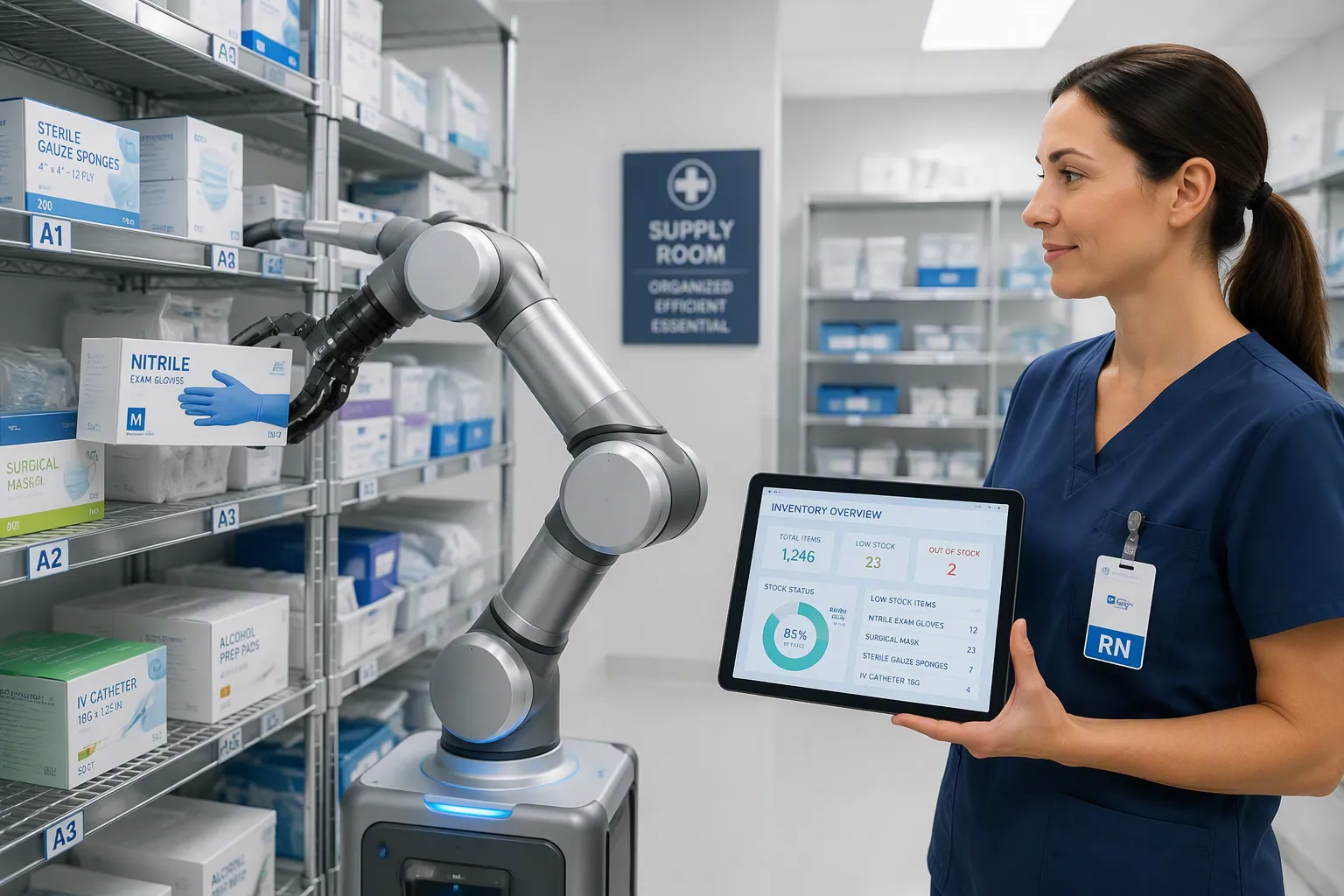
Healthcare systems face unprecedented staffing gaps. Supply chain and administrative positions remain critically underfilled across the nation. Manual inventory management, ordering, and validation consume thousands of staff hours annually. These routine tasks pull clinicians and supply chain professionals away from patient-centered work.
AI-powered stores offer a strategic solution. These systems function as labor optimization tools, not mere technology upgrades. They automate repetitive tasks that drain workforce capacity. Reducing labor dependency becomes possible through intelligent automation.
How exactly do these systems decrease workforce requirements? What operational changes should leaders anticipate? This article defines AI-powered stores, details their automation capabilities, and discusses governance frameworks for successful adoption. Understanding these elements helps administrators make informed decisions about implementation.
Key Takeaways
AI-powered stores automate supply tasks, cutting staff time by 65-75%.
Predictive systems forecast demand and auto-reorder supplies, reducing manual work.
Smart triage routes only high-risk issues to staff, so they focus on critical work.
Human oversight remains for complex decisions, ensuring safety and trust.
Pilot AI in one department to measure savings and build a case for expansion.
AI-Powered Stores vs. Legacy Systems
Defining AI-Powered Stores
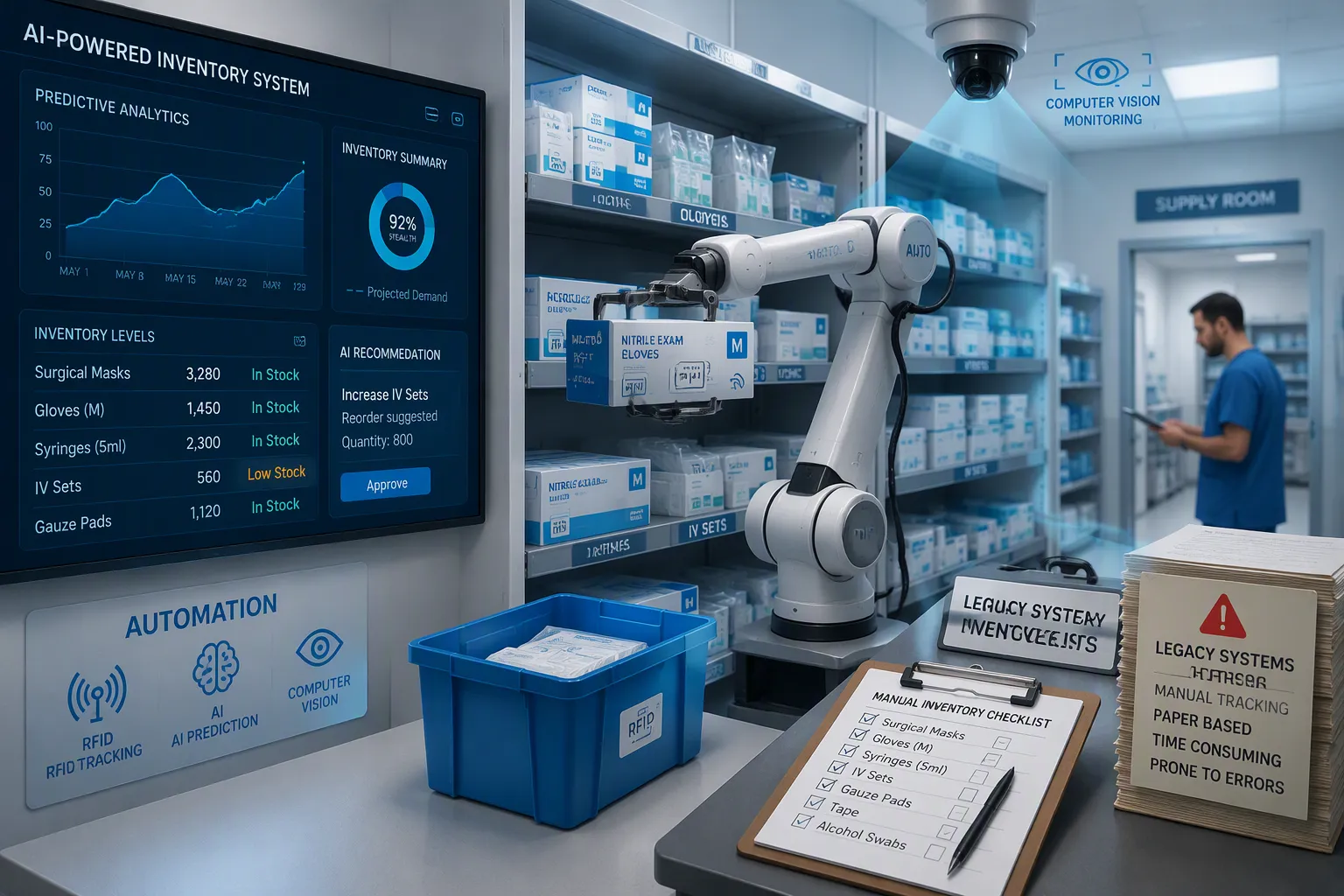
An AI-powered store functions as an automated supply room with intelligent inventory systems. Machine learning algorithms drive these systems. They predict demand, auto-replenish stock, and flag anomalies without human intervention. These systems learn from real-time data and adjust their behavior as conditions change.
Legacy systems rely on static minimum and maximum levels. Staff must manually check shelves and adjust orders when usage patterns shift. These rules-based approaches cannot adapt to sudden changes in patient volume or procedure schedules. A surge in orthopedic surgeries or an unexpected supply shortage leaves legacy systems blind until a human notices the problem.
AI-powered stores incorporate several defining components:
Predictive demand forecasting uses machine learning to analyze historical usage, patient volume trends, and supplier lead times.
Real-time inventory tracking automates reordering when stock reaches critical thresholds.
RFID technology enables location tracking of medical supplies and automated data collection.
Computer vision AI performs visual inspections, image recognition for counts, and expiration date tracking.
Natural language processing supports voice-activated inventory checks and automated supply requests.
These components work together continuously. The system learns from each transaction and refines its predictions over time. It distinguishes between routine consumption patterns and unusual spikes that require attention.
The Hidden Labor Costs of Manual Supply Management
Manual supply management consumes substantial staff hours across multiple activities. Cycle counts require workers to physically count every item in storage. Purchase order creation demands manual data entry for each product. Invoice verification forces staff to match paperwork against received goods. Discrepancy resolution sends workers searching for missing items or incorrect shipments.
Consider a typical hospital environment. Supply chain staff spend hours each week on these oversight tasks. They scan barcodes, count boxes, and reorder supplies by hand. Clinicians also lose time when they must locate supplies or request restocking. These minutes accumulate into full shifts of lost productivity.
Hospitals using autonomous AI for supply management report a 65-75% reduction in staff time spent on scanning, counting, or reordering supplies. This reduction translates directly into labor savings. A department that previously dedicated substantial time to manual oversight might reduce that commitment by 65-75%.
The freed hours allow supply chain professionals to focus on strategic work. They can negotiate better contracts, analyze usage patterns, and collaborate with clinical teams. Reducing manual oversight also decreases error rates. Automated systems track expiration dates and usage trends more reliably than handwritten logs. Staff members redirect their expertise toward problem-solving rather than repetitive data entry.
Automation Capabilities for Reducing Labor Dependency
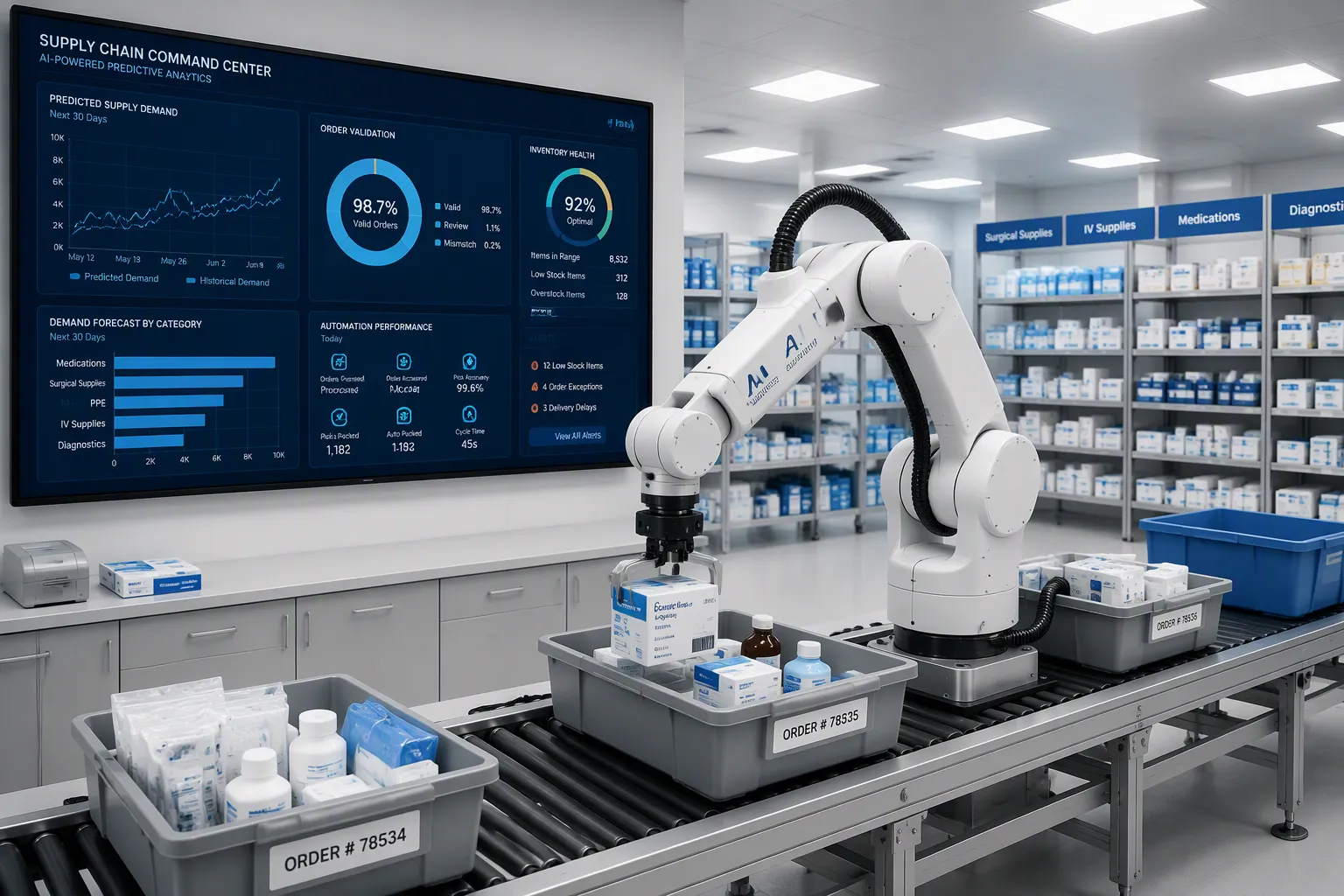
AI-powered stores reduce labor dependency through three core mechanisms. Predictive order validation ensures the correct supplies arrive at the right time without manual intervention. Intelligent exception triage routes only high-risk issues to staff. Operational workflow optimization uses robotics and layout changes to minimize physical labor. Together these mechanisms automate repetitive tasks that previously consumed thousands of staff hours.
Predictive Order Validation and Replenishment
This mechanism uses machine learning to forecast demand and generate purchase orders automatically. The system ingests data from surgical schedules. It examines procedure type, scheduled volume, facility location, and historical supply consumption per procedure. Traditional systems rely only on historical consumption. They miss upcoming demand changes. The predictive model links operational planning directly to inventory planning. When orthopedic procedure volume rises, the inventory adjusts forecasts accordingly. This eliminates the need for manual reordering and cycle counts.
The system also works within budget limits. It auto-generates purchase orders that respect financial constraints. Staff no longer need to create each order by hand. AI-driven inventory management reduces medical supply waste by 30–40% while maintaining 99% availability rates. These results demonstrate that AI handles routine tasks without manual oversight. Physical automation also supports labor reduction. AI-powered robots can sort, pack, and load supplies with strength and precision. An AI-powered crane identifies the most accessible slot for a high-demand item. It optimizes warehouse layout and reduces manual handling.
The impact on workforce requirements is measurable. One retailer reduced its planning workforce from 50–60 planners to 40–50 after implementing AI. Digital shelf labels save an estimated 200 labor hours per store per year. Frontline task automation delivers 9–15 hours of time savings per store per month. These savings translate into potential reductions in full-time equivalents. By 2026, 76% of chief supply chain officers predict that agents will improve process efficiency according to a survey. This shift toward intelligent automation reduces manual intervention substantially. Reducing labor dependency becomes a tangible outcome of predictive validation and replenishment.
Intelligent Exception Detection and Triage
Even with automation, exceptions still occur. AI-powered order automation helps detect, categorize, and prioritize exceptions based on impact. The system ranks each exception by urgency and impact. Staff focus on high-value issues first. They spend far less time chasing low-priority problems. Predictive order validation assesses the likelihood of successful order processing before issues arise. It surfaces risk earlier in the workflow instead of waiting for an exception to appear.
Reducing labor dependency means staff do not need to manually review every order or discrepancy. The system handles routine validations automatically. It only escalates high-risk exceptions for human review. For example, a large capital purchase or a recall response still requires staff attention. But routine supply orders, matched to predicted demand and within budget, pass through without any human touch. This triage approach dramatically cuts the hours spent on purchase order creation, invoice verification, and discrepancy resolution.
Staff redirect their expertise to patient care and strategic initiatives. The reduction in manual oversight also decreases error rates. Automated systems track expiration dates and usage trends more reliably than handwritten logs. Reducing labor dependency through exception triage also mitigates staff burnout. Research indicates that reducing administrative burden improves clinician satisfaction and retention. The combination of predictive validation and intelligent triage creates a supply chain that runs efficiently with minimal human effort. These capabilities transform the hospital supply chain into a self-managing system that frees talent for higher-value work.
Governance and Integration for Sustainable Adoption
Keeping Humans in the Loop
Hospital leaders often worry about AI operating without oversight. Human-in-the-loop models address this concern directly. The AI generates a numerical confidence score for each decision. High scores mean the system processes the case automatically. Low scores trigger immediate routing to a human reviewer.
Routine supply orders receive high confidence scores. The system validates them against predicted demand and budget limits. These orders flow through without staff involvement. Organizations using smart escalation rules report that less than 10% of decisions require human intervention.
Certain situations demand human judgment. Major financial impacts require staff approval. Protected categories in healthcare decisions need human review. Ethical judgment calls stay with people. Significant uncertainty in the AI's output escalates automatically. Potential reputational damage also triggers human oversight.
A patient in crisis presents a clear example. The AI detects a time-sensitive emergency. Its confidence score drops sharply. The system immediately escalates the case to clinicians for urgent intervention. This protects patient safety while preserving automation benefits.
Ensuring Explainability and Seamless Integration
Explainability builds trust in AI-powered stores. Every automated decision must leave an audit trail. Staff need to understand why the system made a particular choice. Compliance requirements demand this transparency. Healthcare facilities face strict regulatory oversight.
Integration with existing systems determines success. AI-powered stores must connect with electronic health records and procurement platforms. Seamless data flow prevents information silos. Supply data enriches clinical workflows. Patient schedules inform inventory predictions.
Reducing labor dependency through automation also addresses staff burnout. Research shows that administrative burden drives clinician dissatisfaction. Automating routine supply tasks removes a constant source of frustration. Staff members reclaim time for patient care and strategic thinking.
Implementation requires thoughtful change management. Leaders should pilot the system in one department first. They should measure labor hours saved and staff feedback. Governance structures must define escalation paths clearly. Staff need training on when to trust automation and when to intervene.
Predictive validation, exception triage, and workflow optimization form the backbone of AI-powered stores. These mechanisms work together to cut manual tasks dramatically. Reducing labor dependency allows hospitals to redirect scarce talent toward patient care and strategic planning. Staff burnout decreases when administrative burdens disappear.
Administrators should view these systems as scalable investments. Labor savings compound over time. Operational resilience strengthens. Underserved communities with tight staffing benefit most from this technology.
Leaders should assess current manual processes first. Then they should pilot an AI-powered store in one department. Measuring labor hours saved builds a compelling business case for full deployment. The path forward starts with a single, measurable step.
FAQ
How quickly can a hospital implement an AI-powered store?
Implementation timelines vary by facility size and existing infrastructure. Leaders should pilot the system in one department first. They measure labor hours saved and staff feedback. Successful pilots typically expand to additional departments within several months.
What labor savings can departments realistically expect?
Hospitals using autonomous AI for supply management report a 65–75% reduction in staff time spent on scanning, counting, or reordering supplies. A department that previously dedicated substantial time to manual oversight might reduce that commitment by 65-75%.
How do AI-powered stores handle unexpected supply shortages?
The system flags anomalies without human intervention. It ranks each exception by urgency and impact. Staff focus on high-value issues first. Routine validations pass through automatically. Only high-risk exceptions, such as recall responses, escalate for human review.
Will staff need extensive training to operate these systems?
Staff need training on when to trust automation and when to intervene. Governance structures must define escalation paths clearly. Most decisions require no human intervention. Organizations using smart escalation rules report that less than 10% of decisions require staff involvement.
Can AI-powered stores integrate with existing hospital software?
Yes. AI-powered stores must connect with electronic health records and procurement platforms. Seamless data flow prevents information silos. Supply data enriches clinical workflows. Patient schedules inform inventory predictions. Integration with existing systems determines overall success.
See Also
The Future of Retail Belongs to AI-Driven Stores
Revolutionizing Online Store Management with AI E-Commerce Tools
Modern Retail Benefits from AI-Enabled Combo Vending Machines
