How Retailers Can Compare Cashierless Store Proposals on a Like-for-Like Basis


Cashierless store proposals differ widely in technology, scope, and pricing. A headline price tag rarely reflects true value. One vendor may bundle installation and support; another may quote hardware alone. Marketing claims add more noise. Without a standard method, you cannot fairly compare cashierless store proposals, and mismatched scopes will distort every judgment you make.
You need a repeatable process. This framework gives you three tools: one uniform criteria set, a weighted scoring matrix, and verified vendor data. Apply them to every proposal, and each vendor competes on the same terms. You judge speed, fit, compliance, and total cost side by side, not claim by claim.
Key Takeaways
Set one clear list of criteria for every vendor. Cover performance, fit, compliance, and cost.
Score each proposal on a weighted matrix. Use the same scale and weights for all vendors.
Verify vendor data with pilots and reference checks. Do this before you make a final decision.
Compare total cost of ownership, not just the headline price. Include hidden costs like installation and support.
Apply the same process every time. This removes bias and helps you choose the best solution for your stores.
Set Uniform Criteria to Compare Cashierless Store Proposals

A fair comparison starts with one criteria set that applies to every vendor. Build this set before you read any proposal. Cover four areas: technical performance, application fit, regulatory compliance, and cost. Technical performance includes scan and recognition accuracy, transaction speed, scalability across store counts, computer vision and sensor fusion capability, and automated payment at exit. Application fit covers store size, product mix, and customer convenience segments. Regulatory compliance covers data privacy and accessibility. Cost covers upfront spend, operational spend, and hidden costs such as installation, maintenance, and connectivity.
Technical Performance and Fit
Map each vendor's offering to your customer priorities as a baseline criterion. Shoppers want speed, shorter lines, and reduced human contact. Score how well each proposal delivers these outcomes in your actual store format. A solution built for a small convenience footprint may not suit a large-format store with a broad product mix. A mobile smart store may fit an outdoor venue better than a fixed installation. A computer vision cool cabinet may serve a compact, high-traffic location well. Show where each solution type fits best, and let the criteria reveal the match.
Test accuracy and speed against your own scenarios. Ask how the system handles crowded aisles, similar-looking products, and high-volume exit periods. Check scalability: can the vendor replicate the deployment across multiple sites without redesign? Confirm the automated payment at exit works for your accepted payment methods. These questions keep the evaluation grounded in real operating conditions.
Compliance and Total Cost
Compliance belongs in the same criteria set, not in a separate review. Confirm the proposal addresses data privacy rules for your region and accessibility requirements for your customers. A solution that fails either area creates risk that no price advantage can offset.
Cost needs the same discipline. Separate upfront cost from operational cost, then hunt for hidden cost. Installation, training, connectivity, maintenance, and software updates often sit outside the headline figure. Ask every vendor to break cost into these categories. Then you can compare total cost of ownership rather than sticker price.
Use this uniform criteria set every time you compare cashierless store proposals. The same questions, the same categories, and the same definitions apply to every vendor. This discipline removes the advantage of a cleverly scoped quote. It also surfaces where each solution type genuinely fits your stores. A vendor with strong computer vision and sensor fusion may lead on accuracy. Another may lead on footprint flexibility. The criteria set lets both compete on equal terms, and it gives you a defensible record of why one proposal wins.
Score and Weight Proposals Evenly
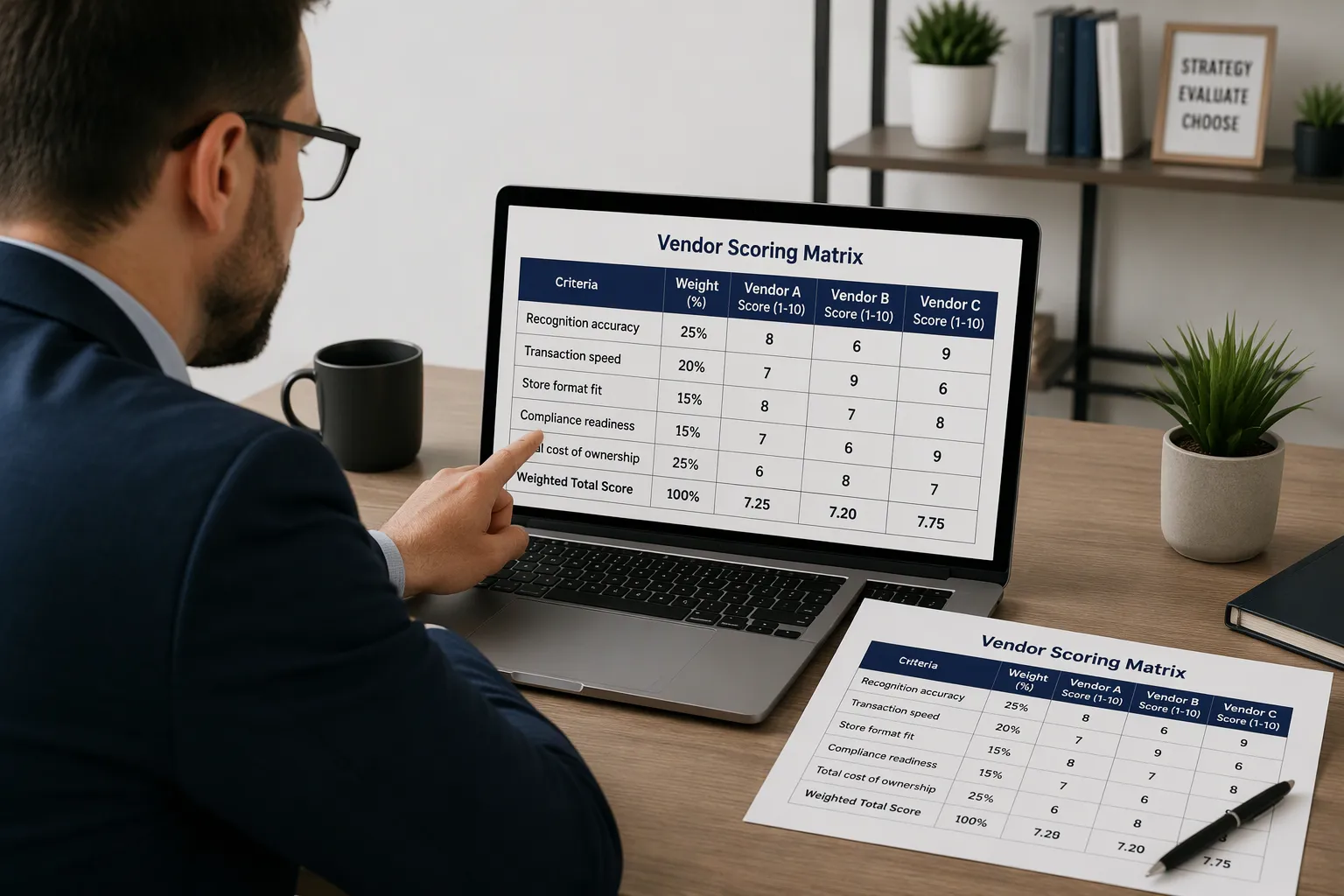
A criteria set gives you the raw material. A scoring matrix turns that material into a decision. The matrix converts every criterion into a common score scale, so a strong accuracy result and a strong cost result can sit in the same row and compete on equal footing.
Build the Scoring Matrix
Start with a simple scale. Score each criterion from 1 to 5, where 1 means the proposal falls well short of your requirement and 5 means it exceeds it. Define what each number means before you score anything. Write the definition down. A 3 for transaction speed should mean the same thing for every vendor you assess.
Normalize the data first. Vendors report performance in different units and formats. Convert each figure to your scale using your own thresholds. If your requirement is a fast exit transaction, set the threshold that earns a 3, then score above or below it. Do the same for accuracy, footprint, and cost. Cost needs a reverse scale: the lowest total cost of ownership earns the highest score.
Lay the matrix out as rows of criteria and columns of vendors. A worked example helps:
Criterion | Weight | Vendor A | Vendor B | Vendor C |
|---|---|---|---|---|
Recognition accuracy | 25% | 4 | 5 | 3 |
Transaction speed | 20% | 5 | 3 | 4 |
Store format fit | 20% | 3 | 4 | 5 |
Compliance readiness | 15% | 4 | 4 | 3 |
Total cost of ownership | 20% | 3 | 2 | 5 |
Multiply each score by its weight, then sum the weighted scores. Vendor A lands at 3.80, Vendor B at 3.65, and Vendor C at 3.95 in this example. The arithmetic is simple. The discipline behind it is what matters.
Weight by Retailer Priorities
Weights encode your strategy. A retailer chasing shorter lines may weight transaction speed at 25 percent and cost at 15 percent. A retailer expanding across many small sites may weight footprint and scalability higher. A cost-focused operator may push total cost of ownership to 30 percent. No single weighting suits every retailer, and that is the point.
Set weights before you see vendor scores. This order protects you from unconscious bias toward a favored proposal. Document the rationale for each weight. When your board or finance team reviews the decision, the reasoning stands on record.
Apply the same matrix identically to every vendor. Same criteria, same scale definitions, same weights, same arithmetic. This consistency is what lets you compare cashierless store proposals on a like-for-like basis. Change the weights midway and the comparison collapses into opinion. Hold the matrix steady, and the scores reveal true value across speed, fit, compliance, and cost.
Verify Vendor Data Before You Compare Cashierless Store Proposals
Scores only mean something when the underlying data is real. Vendors control the numbers they present, and polished decks can hide gaps. Verification turns vendor claims into evidence you can trust.
Request Standardized Data
Ask every vendor for the same data package in the same format. Standardize the request before proposals arrive, so no vendor gains an edge through selective disclosure. Request four categories:
Performance metrics: recognition accuracy, transaction speed, and uptime, measured under defined conditions.
Deployment references: live sites of similar size and format, with contact details.
Cost breakdowns: upfront, operational, and hidden cost lines, itemized separately.
Compliance documentation: data privacy and accessibility evidence for your region.
Set the measurement conditions in your request. Ask for accuracy figures from stores with your product mix and traffic patterns. A vendor's best-case demo result tells you little about your crowded Saturday aisle. Cloudpick, for example, has deployed 200+ smart stores across 13 countries, and that footprint gives you real sites to examine. Request the same evidence from every vendor, and the data packages line up for direct comparison.
Validate Claims Early
Validation happens before final scoring, not after. Run a pilot in one of your stores and test the scenarios that matter: similar-looking products, peak exit traffic, and your accepted payment methods. Record the results against the same thresholds in your scoring matrix.
Check references with direct questions. Ask each reference site about actual uptime, support response, and total cost after go-live. Independent verification adds a third layer. A site visit or a third-party audit confirms what the vendor reported. When claims survive a pilot, reference checks, and independent review, you can compare cashierless store proposals with confidence. Verified data is the foundation of a credible, apples-to-apples decision.
You now have a three-step framework. First, set uniform criteria for performance, fit, compliance, and cost. Second, score every proposal on a weighted matrix. Third, verify vendor data through pilots and reference checks. This method shields your decision from marketing influence. It also reveals true total cost and genuine fit for your stores.
Put the framework to work on your next set of vendor proposals. Score them side by side before you decide. When you compare cashierless store proposals this way, every vendor competes on equal terms, and your choice rests on evidence rather than a polished pitch.
FAQ
How many vendors should you score at once?
Score every vendor that meets your baseline criteria. A matrix with three to five proposals stays manageable and still reveals real differences. Add more vendors only when each one brings a distinct solution type worth testing against your store formats.
What if a vendor refuses to share performance data?
Treat missing data as a failed criterion. Score the gap at the low end of your scale and note it in the matrix. A vendor that will not supply standardized metrics or reference sites gives you no basis for a fair comparison.
Should you weight cost higher for a small pilot?
Yes, if budget discipline drives the pilot. Raise the total cost of ownership weight and lower the performance weights. Document the change before scoring. Keep the same weights for every vendor in that round, then reset them for the full rollout.
How do you compare vendors with different deployment scales?
Normalize by site, not by total. Ask each vendor for per-store cost and per-store performance metrics. A vendor with a large global footprint, such as Cloudpick's 200+ stores across 13 countries, still competes on the same per-site rows as a smaller provider.
When should you rerun the scoring matrix?
Rerun it whenever your priorities shift, such as a new store format or a tighter budget. Also rerun it after each pilot. Fresh verified data and updated weights keep the comparison honest, and the matrix stays a living decision tool rather than a one-time exercise.
See Also
Comparing Micro Markets And Smart Stores In Global Automated Retail
Cloudpick Delivers Cashierless Shopping Convenience Directly To Your Retail Store
A Detailed Comparison Of Amazon Go Versus Cloudpick Systems
Examining Walgreens Self Checkout Benefits And Challenges In Retail
