Data Privacy in Retail Analytics A Roadmap for Workplace Compliance

You collect a lot of customer data to power your retail analytics. But your customers and employees want more control over their personal information. Fines from regulators, harm to your reputation, and loss of trust are real dangers. Doing nothing costs more than just penalties. It hurts customer loyalty and employee morale. This roadmap helps you handle the mix of what customers expect, what retailers want, and what rules require. Compliance is not a burden. It is a smart edge that builds trust that lasts in your workplace. Privacy worries at work are growing, but you can fix them without losing business value. This guide gives clear, simple steps to reach data privacy and data protection. You will learn to balance strong insights with respect for people's rights.
Key Takeaways
Learn privacy rules such as GDPR and CCPA. Use them in your shop.
Check all customer and employee data. Keep private details safe.
Build privacy into systems from the beginning. Use tools such as differential privacy.
Create a team with legal, IT, and HR roles. Enforce clear policies.
Prepare a breach response plan. Tell the authorities and people on time.
Understanding the Data Protection Landscape
You cannot build a compliant retail analytics program without first understanding the rules that govern personal information. The regulatory environment has grown complex, with the General Data Protection Regulation (GDPR) in Europe, the California Consumer Privacy Act (CCPA), and new state-level privacy laws emerging across the United States. Each regulation carries distinct requirements, yet they share a common thread: they place individuals in control of their personal data. Your workplace must navigate these overlapping obligations carefully, since failing to comply triggers steep penalties and erodes the trust you work hard to build.
Key Regulations for Retail Analytics
The GDPR and CCPA are the two biggest privacy rules for retail analytics today. They take very different approaches, so you need to know both to work well.
Aspect | GDPR | CCPA |
|---|---|---|
Consent Model | Must get clear permission before handling most personal data | No permission needed by default; only for sensitive data or data from children |
Breach Notification | Tell authorities within 72 hours; tell people if high risk | Tell California residents without waiting too long |
Penalties | Up to €20 million or 4% of global yearly income | Up to $7,500 for each violation |
Consumer Rights | People can move or delete their data | People can see or delete their data; moving data is less direct |
Other states like Colorado and Florida have their own privacy laws too. Each one adds more rules to follow. You must keep watching these changes, because staying legal means knowing every place where you do business.
Mapping Rules to Retail Scenarios
Think about a typical loyalty program. Under the CCPA, you can give customers rewards for sharing their data, but you must meet three rules: tell customers about the reward, get their clear agreement to the program's main terms, and let them change their mind anytime. In January 2022, California's Attorney General sent warning letters to several businesses. Their loyalty programs were not following the law. This shows that regulators watch retail practices closely, not just write rules.
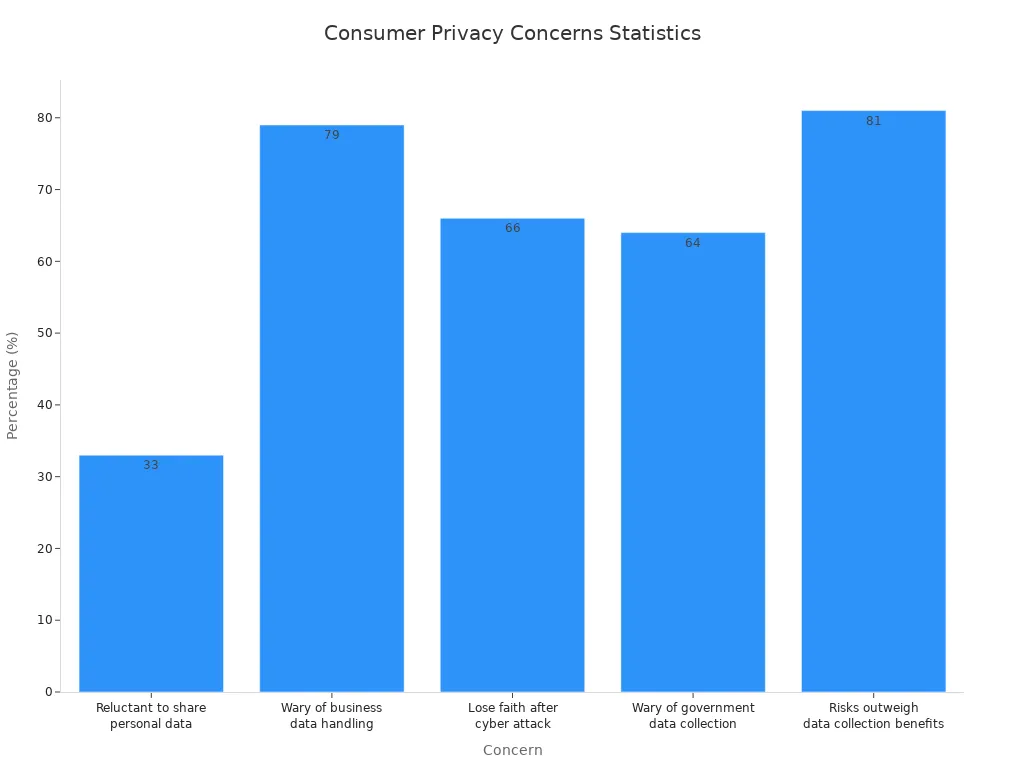
What customers think shows why these rules matter. Nearly one-third of US shoppers avoid sharing personal data because they worry about privacy. Also, 79% of Americans are concerned about how companies use their information. A striking 81% believe the risks of data collection outweigh the benefits. These numbers show that your customers already feel uneasy about data practices. Any mistake makes their distrust even worse.
Tracking foot traffic brings another compliance challenge. When you watch how customers move through your stores, you collect location data that privacy laws cover. The GDPR says you must run Data Protection Impact Assessments for high-risk activities like this. You also need to name a Data Protection Officer when your main work involves watching people on a large scale. These legal duties apply directly to your everyday operations, not just in theory.
The way forward is to see data protection as a smart investment, not a cost. An Accenture survey found that 73% of consumers would share more data with companies that show clear transparency about usage and give obvious value in return. Your privacy policy should show this reality, telling customers exactly what you collect, why you collect it, and how they benefit. When you follow these principles, you turn compliance from a burden into a competitive edge. This strengthens your workplace culture and customer relationships alike.
Identifying Data Collection and Employee Privacy Practices
You cannot protect what you do not know exists. A thorough understanding of your data landscape forms the foundation of workplace privacy. Employee privacy involves control over who views personal information and how systems store it. Many retail organizations scatter sensitive data across multiple systems. This lack of awareness creates risk. You need a structured approach to identify and manage every piece of personal information in your workplace.
Conducting a Comprehensive Data Audit
Start your journey with a full data audit. Use data discovery tools to automatically scan your systems. This step ensures you miss no critical information. Next, classify your data into categories. Separate personal data, sensitive data, and non-sensitive data. Define access permissions for each category.
Map your data flows next. Create a visual representation of how data moves across your organization. This map reveals vulnerabilities. You might find improper access or unauthorized sharing. A clear data flow map helps you see where risks hide.
You must also perform a compliance gap analysis. Evaluate which privacy laws apply to your organization. Identify gaps in your current processes. Assign ownership of compliance tasks. Appoint a Data Protection Officer who understands the laws in every country where you operate. This person monitors compliance and guides your team.
You also need to assign lawful bases to each processing activity. Identify the legal reason for every type of data use. Common bases include consent, contract necessity, and legitimate interest. Document each decision thoroughly. Maintain clear records for audits. Ensure your privacy notices align with these lawful bases.
Classifying Customer and Employee Information
Classification turns raw data into manageable categories. You must separate customer data from employee data. Each type requires different handling. Start with a clear classification framework.
Data Category | Examples |
|---|---|
Personally identifiable information (PII) | Names, addresses, phone numbers |
Banking information | Social Security numbers, financial data |
Employee benefits data | Pension schemes, health insurance plans |
Biometric data | Facial recognition, iris scans, voiceprints |
Employment documents | Job titles, salaries, performance reviews, disciplinary records |
Personal health information | On-site injury or accident records |
This table shows the main categories of employee data you need to protect. Each category demands specific security measures. Social Security numbers need strong protection. Never transmit these numbers through unsecured channels like email. Use encrypted email platforms, TLS, and VPNs for any transmission. Implement AES-256 encryption to secure data in databases.
You also need strict access controls. Use Role-Based Access Control to restrict sensitive data to authorized personnel only. Enforce Multi-Factor Authentication for systems handling sensitive information. Conduct regular audits to check your security infrastructure.
Your workplace monitoring policy should reflect these classifications. Employee monitoring involves tracking performance and behavior. Employee monitoring tools collect employee data like keystrokes and screen time. You must handle this employee data with care. Your privacy policies should explain what employee data you collect. These policies protect both your business and your workers. But you must balance monitoring with workplace privacy. A clear policy tells employees what you collect and why. Privacy at work also means limiting how much you watch. Do not monitor employees excessively.
Employee training is another critical step. Provide regular sessions to keep staff informed about data security protocols. This training minimizes accidental exposure. Develop an incident response plan. This plan outlines steps for detecting, containing, and reporting breaches. A tested plan limits damage when problems occur.
Remember that employee privacy means giving workers control over their data. Inform them about what you collect and how you use it. Respond to their data subject access requests quickly. Minimize data collection to only what is necessary. These practices build trust in your workplace and ensure compliance with privacy laws. Your data privacy program should also cover employee monitoring activities. Create a clear privacy policy that covers both customers and employees. Review your policies regularly to keep them current.
Implementing Privacy-by-Design Principles

Embedding Privacy into System Architecture
Privacy-by-design means you build controls into your systems from the start. You do not add them later as an afterthought. This approach offers protection for your workplace and your customers. You apply data minimization as a core tenet. Collect only what you need for a specific purpose. Limit how you use that data. This reduces your risk and simplifies compliance.
Consider how one e-commerce company handled this challenge. They migrated their data infrastructure to a cloud deployment model that allowed them to use cloud-native data platforms while keeping data secure. This model significantly reduced the security team's maintenance time, allowing them to focus on business projects. The architecture securely stored data for millions of customers across many countries. This balance of analytics and customer privacy shows how you can embed controls into your systems too.
Leveraging Privacy-Enhancing Technologies
Privacy-enhancing technologies, or PETs, let you gain analytical value without compromising trust. They protect individual privacy while still allowing useful insights. Several privacy-enhancing technologies deserve your attention.
Some privacy-enhancing techniques inject statistical noise into datasets. This prevents individual re-identification while preserving analytical accuracy. A supermarket chain could study checkout trends across locations. No individual shopper becomes identifiable, even when combining data from loyalty cards or in-store visits. This approach lets you understand customer behavior, optimize marketing strategies, and enhance experiences while maintaining trust.
Other techniques train algorithms across decentralized devices. The raw data never leaves the local device. Only model updates travel to a central server. This method protects workplace privacy by keeping sensitive data in place. Another technique generates artificial datasets that mirror real patterns. No actual customer information gets exposed. Your analytics teams can still build accurate models.
These technologies form part of your broader data privacy strategy. You must pair them with clear data security measures and a strong privacy policy. Your data protection framework ensures your workplace gains the ability to extract insights while respecting individual rights. This builds the trust that powers long-term success.
Establishing Governance and Accountability
You need a clear system to turn privacy rules into everyday actions. A governance team spreads responsibility across your company. This team makes sure every department knows its job in protecting personal data. Without this system, your privacy work stays unorganized.
Building a Cross-Functional Governance Team
Your governance team should include people from legal, IT, HR, and marketing. Each area brings something important to the table. The table below shows key roles and what they do for privacy governance.
Role | Responsibility in Privacy Governance |
|---|---|
Privacy Steward | Carries out the privacy tasks |
DPO or CPO | Takes responsibility for the final result |
Legal and IT | Share their knowledge and give advice |
Executive Leadership | Gets updates and stays informed |
This RACI model spreads responsibility across your company. It makes sure knowledge from legal, IT, and leadership shapes privacy choices.
Companies should place privacy stewards inside business teams instead of keeping all privacy work in one place. Working together across teams helps turn privacy rules into technical safeguards, and privacy risk reviews guide system design choices.
Set up a privacy risk council with members from Legal, Security, Product, Marketing, Customer Experience, Engineering, and Human Resources. This mix keeps privacy in every business area rather than stuck in one department.
Enforcing Clear Data Policies
Your policies need real enforcement. Pick an officer to check privacy policies regularly. This review keeps your policies up to date with new laws. Your workplace monitoring policy must match these updates. Share updated policies in stores and online. Tell people about big changes through email, receipts, or signs in stores.
Your workplace benefits from clear rules about employee data. Your privacy policy should explain how you handle employee monitoring. This openness builds trust at work. Your employee privacy protections depend on steady enforcement. Your workplace privacy standards need regular attention. Your employee data requires careful handling from start to finish. Your data protection framework supports your compliance program. Protecting personal information becomes part of your daily work. Your employee data collection practices must follow written procedures. Your employee monitoring activities must match your workplace monitoring policy. Your employee data protections depend on steady enforcement. Your regulatory compliance efforts depend on this governance system. Together, these pieces create a base for lasting trust.
Ensuring Transparency and Individual Rights
Your customers want to feel known, not watched. They like personalized suggestions but dislike hidden tracking. Being open helps close that gap. When you clearly explain how you use data, you turn doubt into trust. This idea also applies to your workers. They deserve to know what you track and why.
Crafting Clear Privacy Notices
The GDPR sets strict rules for being open in retail analytics. Your privacy notices must meet these rules to stay compliant. The table below shows what the law requires.
GDPR Provision | Key Transparency Requirement | Application to Retail Analytics |
|---|---|---|
Transparency principle | Handle data in an open way | Tell customers you track foot traffic and dwell time |
Consent requirement | Use simple words for consent | Keep consent forms separate from other terms |
Information provision | Give short, easy-to-find info | Use QR codes at store entrances for quick access |
Data collection details | Share purposes, recipients, retention | Explain what you collect, why, and who sees it |
Access rights | Give access rights | Let customers ask for copies of their movement data |
Stores must update their privacy policies to use simple words, not legal terms, to explain how AI and loyalty programs use customer data. They must also be open about automated decisions that create legal duties under laws like the GDPR.
Your privacy policy should include these key parts:
Types of personal data collected, such as cookies and checkout info
Reason for data processing, including analytics and profiling
How you share data with third parties
Automated decision-making logic and its effects
Individual rights and how to use them
Data retention plan before deletion or anonymization
This level of openness protects workplace privacy and builds lasting customer loyalty.
Handling Data Subject Access Requests
Customers and workers have the right to see their personal info. Under GDPR Article 15, they can ask for copies of analytics data about them. Your workplace needs a smooth process for handling these requests.
Start by naming a dedicated team to manage access requests. Set a clear timeline for replies. The GDPR requires action without unnecessary delay, and you should respond promptly. Create a simple online form for submissions. This makes it easier for requesters and helps you track progress.
Check identities before sharing any data. This step stops unauthorized access to sensitive info. Once verified, gather the requested data in a readable format. Explain what you collected, why, and who received it. Your employee data needs the same careful handling as customer info.
Record every request and your reply. This record shows your commitment to data protection. Regular training keeps your team ready for tricky requests. Your employee monitoring practices should also respect these rights. When workers ask what you track, answer honestly and fully.
A transparent approach to individual rights makes your whole organization stronger. It shows that you value people over profits. This mindset turns compliance from a burden into a competitive edge. Your workplace becomes a model of ethical data handling, earning trust from customers and workers alike.
Managing Third-Party Risks
You depend on analytics vendors to handle customer and employee data. These outside partners create a big risk for your workplace. A vendor with weak protections can put your whole company in danger. You must make sure every partner follows your rules. This section shows you how to check vendors and build strong contracts.
Vetting and Auditing Analytics Vendors
Begin by reviewing each vendor's security certifications. The right credentials prove they meet industry standards. Look for these key certifications:
HIPAA for healthcare data, including business associate agreement practices and data handling policies
PCI DSS for payment card information, requiring an Attestation of Compliance or Report on Compliance
ISO 27001 for information security management, with deliverables including a Certification Audit Report and Certificate of Compliance
These certifications show the vendor takes data protection seriously. Your vendor must also undergo regular security audits. Schedule these audits regularly. Your workplace benefits from this routine check. It catches problems before they become violations. Your employee data and client information stay safer as a result.
Your privacy policies should require vendors to report breaches quickly. This requirement supports your own compliance program. Your workplace monitoring extends to vendor activities. You must know how they handle your data. Your employee monitoring practices should also cover vendor access to systems. This complete approach offers protection for your entire organization.
Establishing Data Processing Agreements
A Data Processing Agreement defines the legal relationship between you and your vendor. It must cover every aspect of data handling. Follow these steps to create a complete DPA:
Define the scope and purpose. Specify what data gets processed, such as foot-traffic analytics data. State why you need this processing.
Detail security measures. Include encryption, access controls, and breach notification procedures.
Specify rights and obligations. Clarify what the controller and processor can and cannot do with personal data.
Address data retention and deletion. Outline retention timelines and secure deletion processes.
Outline breach procedures. Detail steps for notifying stakeholders and regulatory bodies.
Consider international data transfers. Include safeguards like Standard Contractual Clauses for cross-border data flows.
Your DPA must also address sub-processing. The vendor must inform you of any sub-processor changes in advance. Your workplace privacy program depends on these written agreements. Each agreement protects your employee data and client information. Your privacy policy should reference these agreements. Your compliance team must review every DPA before signing. This process ensures your workplace gets strong protection from vendor risks.
Developing a Data Protection Incident Response Plan

No retail business wants to face a breach, but being ready decides how much harm happens. A tested, written plan lowers damage to your reputation and money. Your workplace needs clear steps before an incident occurs. Without them, confusion and delays make the problem worse.
Preparing for Breaches: Roles and Protocols
Your response plan starts with a dedicated team. Each member has a specific job. The table below shows who does what during a breach.
Role | Critical Responsibility in Breach Response |
|---|---|
Management Team | Reviews and approves policy, budget, and staffing; coordinates with stakeholders during remediation |
IT Security Team | Handles prevention, containment, remediation, and removal through technical controls |
IT Administration Staff | Works on daily prevention and understands remediation actions, such as taking systems offline |
Legal | Reviews policies for compliance; coordinates evidence collection and customer notification |
Marketing/PR | Manages media communications to reduce reputational risk |
Human Resources | Handles breaches related to malicious insider activity |
Compliance | Reviews incidents for control failures and ensures notifications follow privacy laws |
Your team needs to be available all day, every day. Breaches do not wait for business hours. Delays on weekends or holidays could make you miss the 72-hour notification window under GDPR. Set strict service-level agreements with third-party vendors. They must tell you right away when they spot an incident. This gives you time for your own review.
Detection and analysis form the second stage. Train your team to spot potential breaches quickly. Use monitoring tools to catch incidents early. After detection, contain the threat right away. Isolate compromised systems and limit access to sensitive information. Save evidence like logs for forensic investigation.
Navigating Breach Notification Requirements
Notification rules differ by location, but the pattern is clear. Regulators punish late notifications more harshly than the breach itself. Regulators have imposed significant fines for late notification, as seen in several enforcement actions across Europe.
These cases show that being open matters more than being perfect. Write down every step of your response. If you miss the 72-hour window, record the reasons and what you did to reduce harm. This shows good faith and lowers fines.
Your notification should include breach details, steps you took to fix it, and actions people can take to protect themselves. Offer help like credit monitoring and identity theft protection. All messages should go through designated teams to keep things clear and follow the rules.
After things are stable, do a post-incident review. Gather your team to write down lessons learned. Update your policies, training programs, and technologies to lower future risks. Run simulation drills regularly to keep your team ready. Share findings with executives regularly to get ongoing support and resources.
Your workplace monitoring policy should match your incident response plan. Your employee monitoring practices must respect privacy even during investigations. Your employee data needs careful handling throughout the process. Your workplace benefits from a plan that balances security with data protection. Your privacy policy should mention your response procedures. This connection makes your overall compliance program stronger.
This roadmap shows you a clear way forward. Data privacy and data protection need regular care, not just one fix. Being proactive with compliance helps your brand's good name. It also makes customers more loyal. Your workplace gets a smart advantage from these steps.
Your customers and workers want to be known, not watched. Your workplace privacy policy should show this idea. Your employee monitoring practices must mix insight with respect. Handling employee data the right way builds trust that lasts.
Your workplace culture gets better when you protect employee data carefully. Start using this roadmap today. See it as a smart investment in your future.
FAQ
What counts as personal data in retail analytics?
Personal data covers names, addresses, purchase histories, location data from foot traffic tracking, and device identifiers. Employee data also counts, including salaries, performance reviews, and biometric information. If you can identify an individual from the data, privacy laws apply to it.
How do I monitor employees without violating privacy?
You can track performance metrics like productivity and attendance. You must tell employees what you collect and why. Limit monitoring to job-related activities. Never collect data unrelated to work performance. Your workplace privacy policy should clearly state these boundaries. Your workplace benefits when employees trust the monitoring process.
What happens if my analytics vendor suffers a breach?
Your vendor must notify you immediately under your Data Processing Agreement. You then assess the risk to affected individuals. If the breach creates high risk, you notify regulators within 72 hours under GDPR. Your workplace response plan should name who handles vendor breach communications.
Do I need a Data Protection Officer?
You need a DPO if your core work involves large-scale monitoring of individuals. Retail analytics tracking foot traffic or customer behavior often triggers this requirement. The GDPR also requires a DPO when processing sensitive data categories. Your workplace should assess this obligation during your compliance gap analysis.
How do privacy-enhancing technologies help compliance?
Some privacy-enhancing technologies add noise to datasets to prevent re-identification. Others keep raw data on local devices. And some generate artificial datasets that mirror real patterns without exposing actual information. These tools let you gain insights while reducing regulatory risk. Your workplace gains analytical value without sacrificing individual privacy.
See Also
Understanding AI-Driven Convenience Stores: A Retailer's Guide
The Future of Retail: The Case for AI-Enhanced Stores
Walgreens Self-Checkout: Pros, Cons, and Retail Implications
Sensi Retail: A Look at LA's Social Equity Cannabis Dispensary
