How AI identifies peak usage times in airports and transportation hubs and optimizes operations

You can conquer peak travel chaos using modern smart airport technology. Heavy volume creates crowded terminals very quickly. How does ai solve this major operational problem? First, ai continuously processes real-time data alongside flight schedules, booking trends, and historical traffic patterns. This advanced forecasting highlights upcoming congestion long before physical bottleneck lines grow.
AI analytics forecast passenger flow with 85–92% accuracy, driving a 20% reduction in waiting times at security checkpoints.
Through predictive analytics, automated system software optimizes operations across every airport. You can dynamically deploy key staff, reroute crowded queues, and balance essential ground assets. Ultimately, ai transforms busy hub activity into smooth, seamless movement.
Key Takeaways
AI predicts passenger crowds early by analyzing flight schedules and ticket booking trends.
Smart cameras monitor security lines continuously to alert staff before long queues form.
Biometric facial recognition scans travelers in under three seconds to speed up security checks.
Automated software coordinates ground crews and baggage handling to reduce flight turnaround times.
Local edge computing processes video data instantly to keep airport operations running smoothly.
AI Data Ingestion for Peak Airport Detection
You can prevent peak travel chaos by connecting flight schedules, booking systems, and sensor networks across your entire facility. Modern ai platform engines process complex inputs and highlight operational bottlenecks long before crowds build up.
Flight Schedules and Booking Trend Analytics
You gain accurate forecasting capability when you integrate flight schedules with live ticket sales. Shared flight schedule information lowers prediction variance and improves schedule adherence by 0.5-2 minutes. Advanced ai systems process real-time data to identify upcoming volume surges far in advance of gate arrivals.
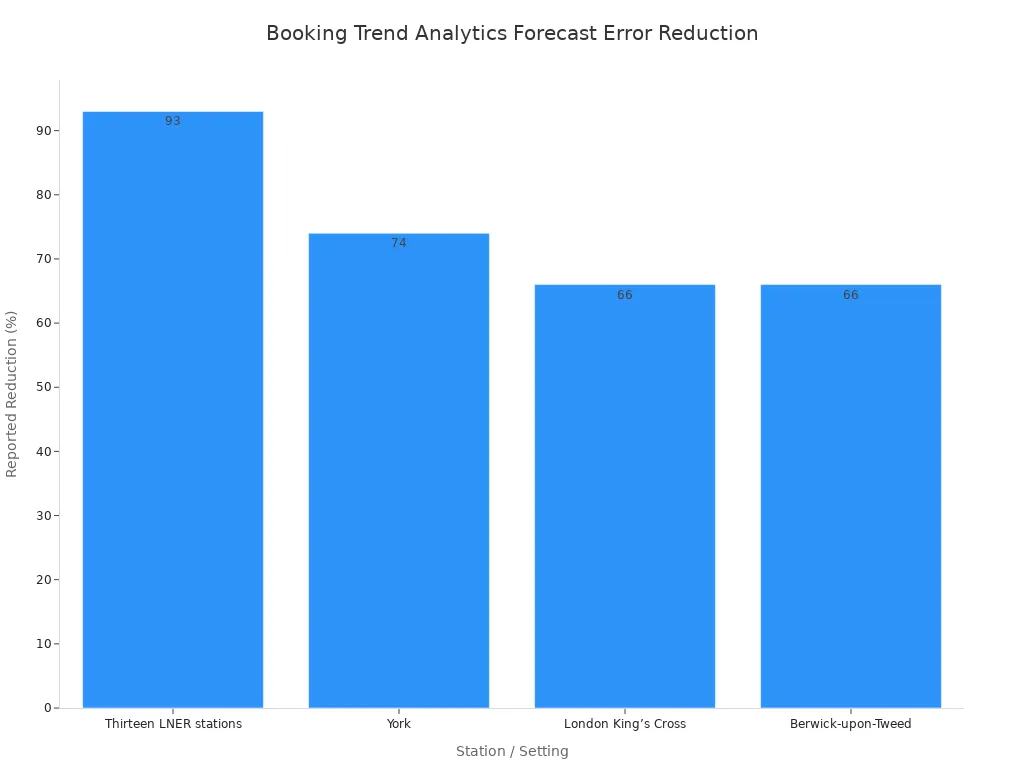
Booking trend analytics strengthen passenger demand signals near travel dates. Booking trend analysis reduced forecast error at London King’s Cross by ~66% and at York by ~74%. These accurate insights help your hub prepare for rapid passenger movement shifts across terminals.
Station / setting | Condition evaluated | Reported reduction |
|---|---|---|
London King’s Cross | Very short-term daily forecast | ~66% |
York | Very short-term daily forecast | ~74% |
Thirteen LNER stations | Post-Christmas calendar shift | ~93% |
Multi-Source Sensor Fusion and Historical Traffic
You can combine physical hardware feeds with historical traffic patterns to improve airport efficiency. Multi-sensor fusion uses Time-of-Flight sensors with point cloud processing to distinguish individual human contours. These ai-powered tools track movement trajectories through security corridors using smart ai models.
Smart ai software processes historical traffic data alongside current gate occupancy. These automated algorithms continuously evaluate changing weather variables, airspace congestion, and crew duty limits. You can spot delay cascades before long queue lines form near departure gates using powerful ai tools.
Predictive analytics allow terminal operators to allocate operational resources with maximum efficiency. Continuous airport monitoring gives you direct control over daily traffic patterns using precise data inputs. Custom ai systems process signals to expand effective airport capacity during heavy traffic periods. You can manage each airport terminal effectively to achieve smoother facility operations during busy windows.
Predictive AI Passenger Flow Management
You can eliminate peak travel chaos by implementing predictive passenger flow management across your terminal checkpoints. Advanced ai systems process real-time traveler movement data to anticipate bottlenecks before security lines expand. Effective passenger flow management relies on continuous monitoring and rapid response to maintain steady terminal movement.
Real-Time Queue Flow and Camera Analytics
Smart vision cameras monitor security lines continuously to calculate precise wait times. These intelligent sensors detect changing queue density levels instantly. When security line volume increases, automated queue monitoring platforms alert terminal supervisors immediately. Supervisors receive notifications 20+ minutes before thresholds breach, which provides 30–60 minutes of prediction lead time. Consequently, staff can open extra lanes early and eliminate severe security choke points using smart ai technology. Early intervention keeps crowds moving smoothly through every active lane.
Predictive system | Real-time flow prediction capability | How it prevents security checkpoint chokepoints |
|---|---|---|
Uses live camera, Wi-Fi, and flight data to forecast densities 15/30/60 minutes ahead | Sends heat-map alerts and automated operational triggers to integrate with signage and staff allocation tools | |
Estimates queue length and wait times while forecasting arriving waves | Enables dynamic lane allocation and automated supervisor alerts to redeploy screeners before congestion builds | |
AI-driven stanchions | Uses machine-learning ai algorithms and live queue data to adjust stanchions autonomously | Reallocates lanes in real time to increase throughput by up to 35% and reduce queue abandonments by 25% |
Deploying automated queue monitoring gives your staff complete operational visibility across every concourse. Modern airport security teams rely on dynamic lane allocation and ai platforms to handle sudden influxes without delay. This proactive operational strategy achieves impressive measurable results across busy airport terminals:
It reduces peak-hour wait exceedances by 40% within six months.
It achieves an 85% reduction in queue-caused misconnections.
It extracts 20–35% more effective throughput from existing airport infrastructure.
It delivers a 15–25% improvement in ASQ passenger satisfaction over 12 months, reaching 92% satisfied travelers in ai-managed zones.
It avoids over $186K in airline claims per disruption cascade event.
Biometric Processing and Dynamic Rerouting
Biometric ai tools speed up physical identity checks significantly during peak processing hours. Facial recognition cameras capture identity on the move in under 3 seconds per traveler. In contrast, traditional manual security booths require 30–60 seconds per traveler. Single barrier e-gates process 20+ travelers per lane each minute. Elevated processing gates clear 14 travelers per lane each minute at roughly 5 seconds per traveler. For example, Orlando airport achieved a 65% average reduction in border-control wait times, bringing total security delays down to about 2 minutes per traveler.
Dynamic rerouting channels crowds toward open security lanes automatically. Smart ai software distributes terminal traffic evenly based on real-time demand. This smart routing elevates your overall operational efficiency and creates a streamlined passenger experience across every security zone. Furthermore, automated identity verification ensures enhanced security and safety throughout the entire facility.
Predictive ai solutions optimize airport customer experience while maximizing terminal throughput. You maintain smooth flow across all checkpoints because real-time analytics guide every operational decision. Modern ai analytics transform daily crowd management into a controlled, highly automated process.
How AI Optimizes Airport Operations
You can transform daily hub performance when intelligent automation manages tarmac resources. Smart software continuously optimizes operations across runways, gates, and service areas. Advanced processing platforms balance live air traffic demand with ground capacity to prevent expensive gate holds.
Aircraft Turnaround and Slot Allocation
Smart algorithms optimize take-off and landing slots by processing flight data instantly. These digital tools analyze local weather, airspace density, and crew readiness together. Air traffic controllers receive real-time sequence suggestions to maintain optimal runway spacing and safety margins. Consequently, these smart systems boost airport efficiency during peak traffic windows.
Operational efficiency metric | Reported improvement |
|---|---|
On-time performance | +17% |
Ground delays | -5 minutes |
Unsafe behavior | -50% |
CO2 emissions at Seattle-Tacoma (SEA) | -1,500,000 kg per year |
Dean Wright from Toronto Pearson noted that ai turnaround visibility paired with A-CDM noticeably increased on-time performance. Precise schedule tracking provides reliable forecasting capabilities for arriving flights. You gain complete control over runway availability using centralized data feeds.
Ground Handling and Baggage Tracking
Ground teams rely on automated scheduling to prepare service trucks before aircraft arrive. Automated refueling systems speed up fuel transfers while automated baggage handling systems streamline cargo unloading. This smart automation ensures smooth aircraft servicing on crowded ramps.
"The turnaround time is the core constraint of ground handling: tasks must be coordinated with clockwork precision because a delay in any task can create a domino effect on subsequent flights and airport operations."
Smart tools track ground activities continuously to increase overall operational efficiency.
Automation feature | Quantified impact on turnaround time |
|---|---|
Pre-arrival AI planning and auto-dispatch of ground crews | Optimization begins 45 minutes before aircraft arrival |
Simultaneous launch of refueling, baggage, and catering tasks | Compresses a 72-minute turnaround into 48 minutes, a 33% reduction |
Real-time critical-path exception monitoring | If baggage loading falls more than 4 minutes behind, extra staff are reassigned automatically |
Digital departure readiness verification | Recovers 3.2 minutes per turn compared with manual radio coordination |
AI-optimized scheduling and dynamic rescheduling | Average turnaround time reduced by 22 minutes |
Integrated sensors deliver constant progress updates during aircraft turns. If baggage loading falls more than 4 minutes behind, systems reassign extra staff automatically. Digital departure verification recovers 3.2 minutes per turn compared with manual radio coordination. These coordinated actions maintain efficient airport operations across every terminal gate.
Modern hub software optimizes operations by linking ground tasks with real-time flight changes. Early planning begins 45 minutes before landing. Intelligent tools launch refueling, catering, and baggage unloading simultaneously. This parallel workflow compresses a 72-minute turnaround into 48 minutes, achieving a 33% reduction.
Furthermore, dynamic rescheduling tools deliver an average turnaround time reduction of 22 minutes. You protect your baseline operational efficiency across daily schedules. Smart deployment reduces ground delays by 5 minutes per flight while cutting site risk. You achieve high performance across your airport facility continuously using predictive ai tools.
Edge Infrastructure and Real-Time Execution
On-Premise Low-Latency Analytics
You need immediate decision-making capabilities inside your terminal to process massive streams of real-time data. On-premise edge computing platforms run ai algorithms directly near local hardware. This local setup avoids distant cloud delays. Cloud inference pipelines often require 200 ms to 2 seconds end-to-end time. In contrast, local edge platforms run forward passes in 3 to 5 ms. This fast processing delivers sub-100 ms total analytics execution directly inside your terminal network.
Operational metric | On-premise edge performance | Remote cloud benchmark |
|---|---|---|
Inference latency reduction | 40% reduction | Baseline network path |
Control-message round-trip latency | 20–25 ms | Up to 800 ms requirement threshold |
Video-streaming round-trip latency | 25–30 ms | 200 ms – 2 s end-to-end |
Application response time | Around 100 ms |
Smart airport technology relies on this ultra-low latency to handle high video bandwidth. Edge processing achieves a 40% reduction in inference latency compared to traditional cloud routing. Local hardware manages MQTT control-message round-trip latency in just 20 to 25 ms. Video-streaming round-trip latency stays between 25 and 30 ms. You can deploy this edge infrastructure to run continuous camera analytics without risking service interruptions.
Automated Operations and Passenger Alerts
You can connect real-time analytics to automated dispatch tools to protect daily operations. Edge platforms continuously feed live camera signals into ai engines for instant analysis. When systems spot bottleneck risks, automation executes routine contingency actions immediately. These quick automated adjustments yield 10–15% faster turnaround times during peak travel hours.
Automated systems improve passenger communication across high-traffic terminal zones. Predictive analytics systems forecast crowd density at check-in desks, security lines, and boarding gates. Intelligent tools send dynamic updates directly to mobile apps and digital signs when security crowding exceeds preset thresholds. Travelers receive immediate rerouting instructions toward less crowded security lanes. This smart coordination maintains safe physical flow and protects your terminal security operations.
You can conquer peak travel chaos by replacing manual habits with predictive tools. AI optimizes operations across terminals by connecting live hardware feeds with predictive models. For instance, Heathrow Airport uses the AIRHART platform to streamline passenger flow during heavy rushes. Transitioning to integrated systems improves airport efficiency and elevates the airport customer experience.
By 2030, over 70% of new edge deployments will embed AI accelerators as standard components. These systems deliver strong operational efficiency and boost overall airport efficiency. Continuous automated adjustments protect daily operations, while smart local processing builds resilient transport hubs.
By 2026, AI agents at the edge can autonomously restart services, reroute traffic, and isolate faulty sensors to support 99.999% uptime.
FAQ
How does ai forecast passenger flow during peak travel hours?
You can use predictive analytics to evaluate flight schedules and ticket booking trend data. The ai platform identifies upcoming crowd surges before physical lines grow. Terminal managers receive early alerts, so staff can open extra security lanes promptly.
How does smart technology improve security checkpoint management?
Vision cameras monitor security queues in real time to calculate exact wait times. The system alerts supervisors before bottleneck points form. This proactive approach boosts operational efficiency by redeploying security screeners dynamically to maintain continuous terminal movement.
How does automation enhance overall airport efficiency?
Smart software coordinates ground handling, refueling, and baggage tracking simultaneously. By running real-time video analytics alongside physical sensor feeds, an airport team optimizes operations instantly. This automated coordination cuts aircraft turnaround times significantly while preventing unexpected delay cascades.
Can edge infrastructure protect security systems reliably?
On-premise edge computing platforms run ai processing locally with sub-100 ms execution time. These local systems process camera signals into ai models without cloud network lags. Immediate responses protect terminal security zones while maintaining steady throughput during heavy volume rushes.
See Also
How Smart AI Combo Vending Machines Upgrade Modern Retail
Boosting Small Office Employee Productivity Through Smart Vending Solutions
The Fascinating Rise Of Innovative Twenty Four Hour Vending Cafes
Transforming Your Online Store Management With Advanced AI E-Commerce Tools
How Cloudpick Checkout Computers Improve Customer Experience And Store Efficiency
