How AI reduces shrinkage and theft risks in Hospitals & healthcare facilities

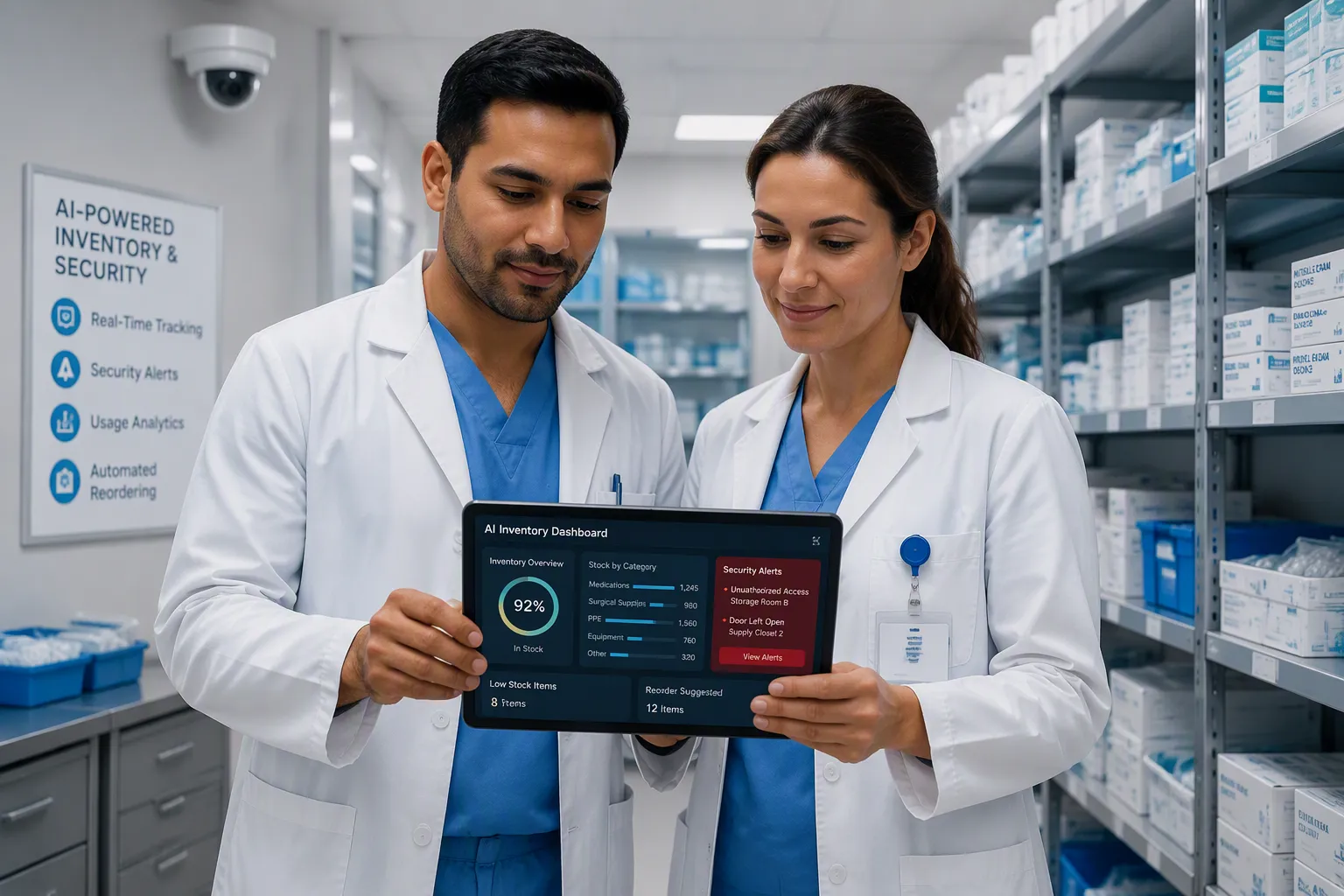
Artificial intelligence reduces shrinkage and theft in hospitals through real-time monitoring, predictive analytics, and automated tracking. These tools watch every hallway, pharmacy shelf, and supply room at once.
Healthcare facilities face unique loss risks. High-value drugs, portable equipment, and open access areas create constant opportunity for theft. Multiple staff shifts and visitor traffic make oversight harder.
Security systems flag unusual behavior, trace missing items, and verify who enters restricted zones. Hospitals that adopt them now report fewer losses and stronger compliance. Understanding how AI reduces shrinkage and theft risks begins with the specific tools, their benefits, challenges, and real-world results.
Key Takeaways
AI watches hospitals 24/7 to spot theft and loss in real time.
AI tracks drugs and equipment to prevent shortages and waste.
AI uses biometrics and behavior analysis to control access to sensitive areas.
AI reduces shrinkage and improves patient safety and compliance.
Start with a small pilot to test AI and see results before expanding.
Shrinkage and Theft in Healthcare
What Counts as Shrinkage
Shrinkage covers every loss between what a facility buys and what it can account for. Physical theft drives a large share of this problem. Industry studies estimate that theft, both internal and external, accounts for approximately 75% of all shrinkage. Common examples include opportunistic pilferage of medical devices and IT hardware by internal actors, theft of medications from storage rooms or supply cabinets, and unauthorized removal of critical items such as mobile computing terminals and specialized surgical kits.
Financial shrinkage works differently. It appears as revenue leakage, which means collectible money lost through internal errors or inefficiencies. Missed charges happen when staff use inventory during treatment but never document it. Inventory drops while revenue stays flat, creating a direct shrinkage event. Other sources include administrative errors, waste and expiration, unrecorded usage, and process gaps that let losses happen by default.
Why Traditional Security Falls Short
Camera-and-guard models catch some external threats. They miss internal diversion, after-hours anomalies, and quiet paperwork errors. A camera cannot see a nurse pocketing a vial, and a guard cannot audit a dispensing log across three shifts.
Financial leakage compounds the problem. Coding errors, denials, underpayments, and prior authorization delays drain revenue without triggering a single alarm. In the short term, delayed reimbursements increase accounts receivable days and denials create rework for billing teams. Over the long term, reduced investment capacity, higher administrative burden, and lower profitability weaken the whole organization.
The math shows why this matters. For a business with a 30% gross margin, each $1,000 of shrinkage requires approximately $3,333 in additional sales to offset the loss. Traditional security tools cannot close that gap. Hospitals need systems that watch inventory, access, and billing data at the same time.
How AI Reduces Shrinkage and Theft Risks
AI Surveillance and Anomaly Detection
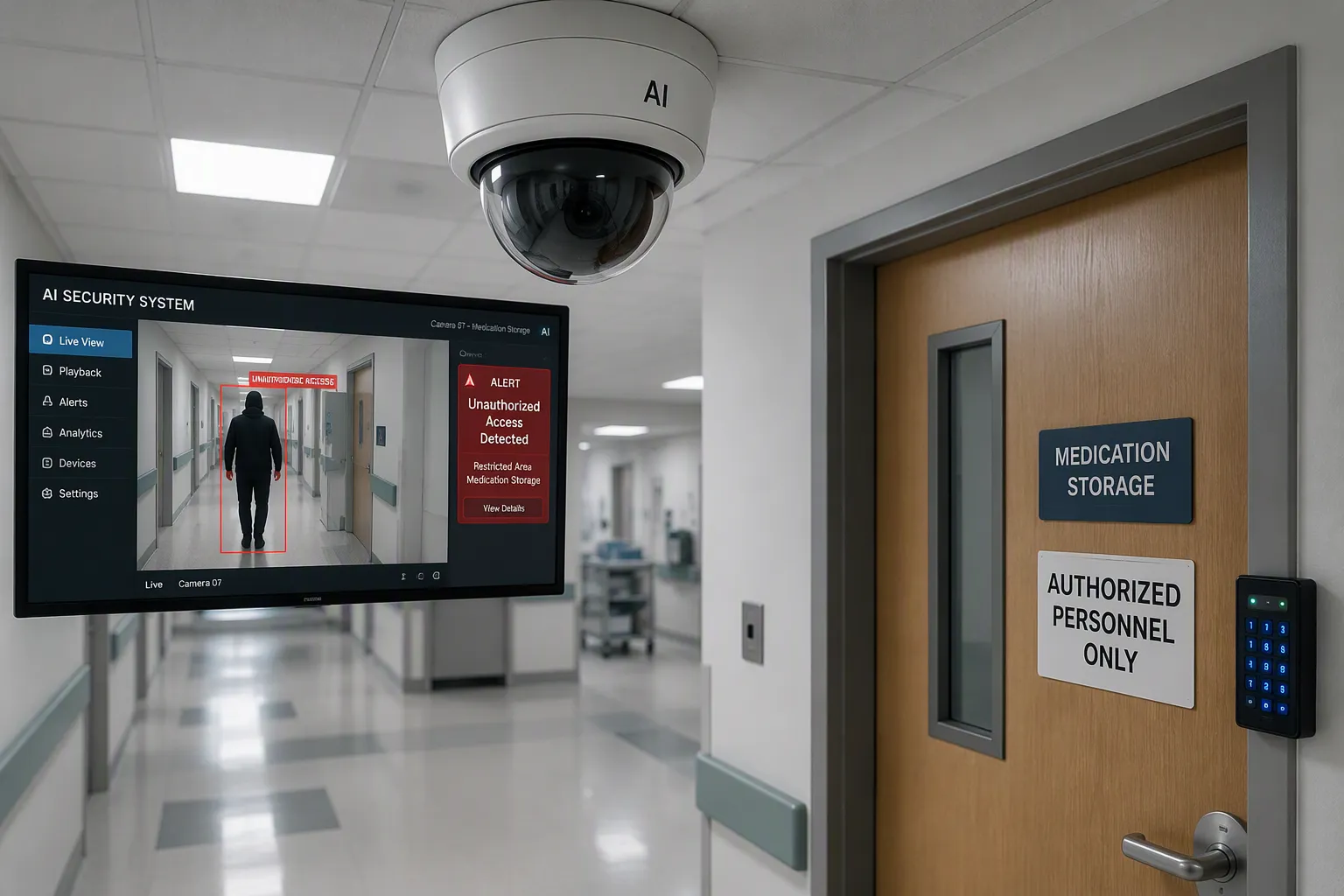
AI-powered security systems watch hospital corridors, pharmacies, and storage rooms without blinking. Advanced video analytics scan live camera feeds and compare movement against known patterns. The system then flags events that meet specific criteria, such as a person entering a restricted area.
The detection process follows a clear sequence:
Continuously scan incoming video feeds from cameras monitoring corridors and restricted zones.
Match detected movement against known patterns and objects using machine learning and object recognition.
Flag events that meet specific criteria, such as a person entering a restricted area.
Track behavior over time to identify potential risks, including loitering or repeated returns to an area.
Use deep learning models trained on thousands of visual patterns to classify people, vehicles, unusual behavior, restricted-zone entry, and suspicious loitering or crowd formation.
Adapt and improve over time, learning to focus only on relevant activity and ignoring irrelevant movement.
These systems do more than spot intruders. They detect falls, unattended objects, and crowd formation. They also reduce workplace violence, which often overlaps with theft incidents. A camera that recognizes a person loitering near a medication cabinet gives security staff time to respond before a loss occurs.
AI-powered security systems improve patient safety, operational efficiency, and regulatory compliance at the same time. When staff know that restricted areas stay monitored, diversion attempts drop. When alerts fire in real time, response teams act faster. Together, these gains lower theft and shrinkage risks across the facility.
Detecting Drug Diversion in Real Time
Drug diversion demands constant attention. The scale of the problem is staggering. One report noted that it led to the loss of over 18.7 million pills and $164 million in the first half of 2018 from reported incidents alone.
Using artificial intelligence to better understand how controlled substances move through the organization is another important step for healthcare organizations to take. This new insight allows organizations to identify abnormal usage patterns that may indicate an instance of clinical drug diversion.
Real-time anomaly detection compares dispensing logs against staff shift patterns. The system reviews dispense frequency, override rates, waste documentation, and timing patterns relative to shift start and end. It also checks whether dispensed amounts match administered amounts in patient records. Alerts are role-calibrated, because a pattern abnormal for a med-surg nurse may be normal for an ICU nurse.
Behavioral profiling adds another layer. Platforms build a profile for each staff member and compare it to peer groups. A nurse with statistically higher waste rates or whose dispenses cluster at the end of a shift shows a different risk profile. One system, ControlCheck's IRIS score, monitors waste patterns, dispense timing, shift analysis, and peer benchmarking to generate a prioritized risk score. This approach replaces reactive complaint-driven investigation with proactive surveillance.
AI can help detect drug diversion by analyzing medication transactions, controlled substance records, and documentation patterns. Technology can identify patterns, but frontline staff often notice behavioral changes and workflow concerns. The strongest programs combine both.
AI Inventory and Asset Tracking
Automated Supply and Medication Tracking
Hospitals lose track of supplies in dozens of small ways every day. A nurse removes a vial and never logs it. A wheelchair leaves the fourth floor and never returns. AI closes these gaps by watching inventory in real time and comparing what is on the shelf against what the records say should be there.
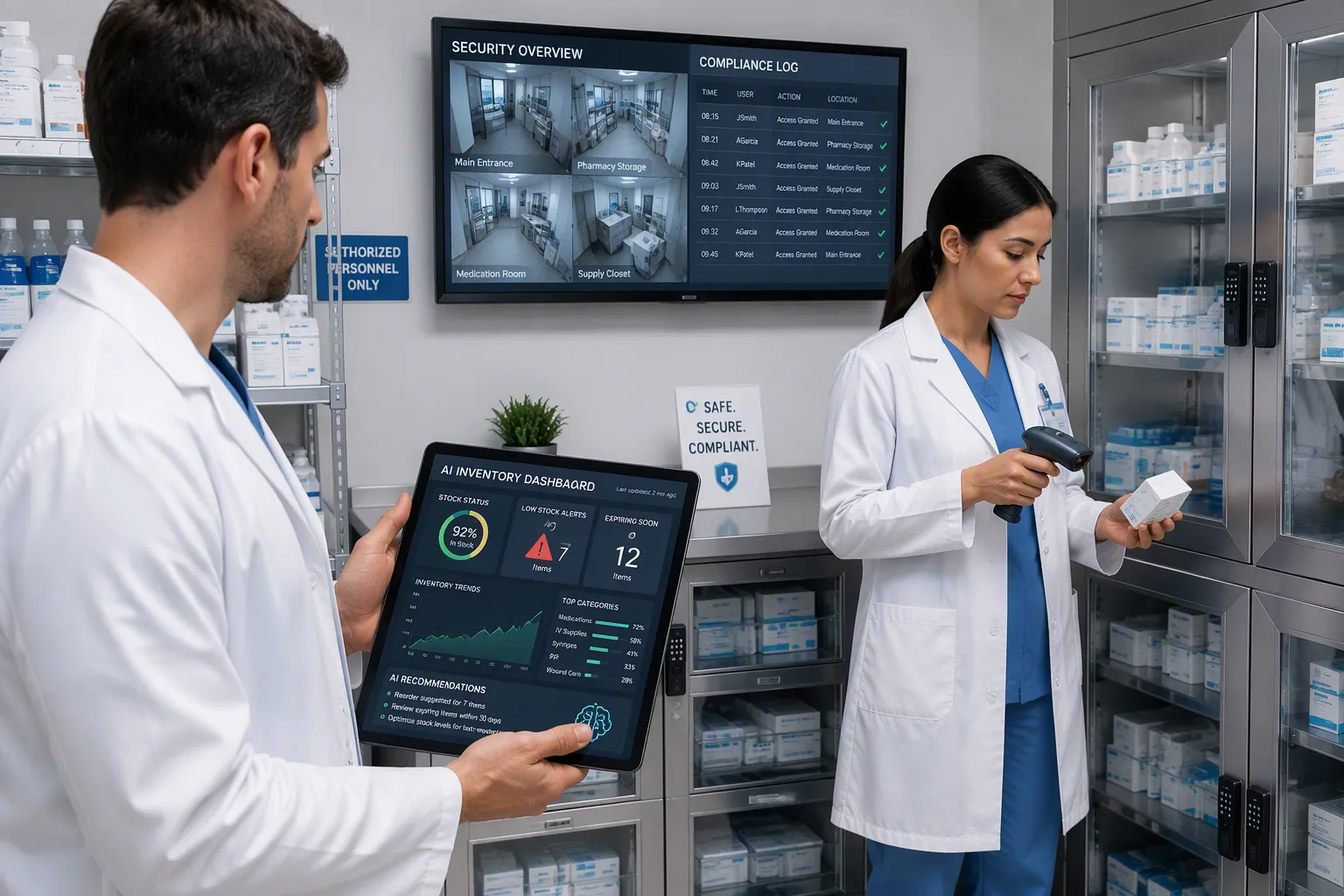
A medication guidance system shows how this works in practice. A blister pack storage unit holds cameras, light sources, and a microcomputer. The cameras visually identify the contents of each drawer, and the microcomputer analyzes the images for inventory and identification purposes. The system notifies users of correct dosages and alerts for recalls. Barcode scanners, RFID readers, and digital access logs automatically track who accesses medication inventory, when, and what is removed. This provides robust theft prevention and inventory accuracy without complex mechanical security systems.
AI-powered asset management enforces first-in, first-out inventory practices. This reduces the risk of supplies expiring before use and minimizes waste from unused or expired equipment. AI monitors inventory in real time, predicts shortages, and automates replenishment. Hospitals and pharmacies avoid stockouts of critical items while minimizing waste from expirations. This improves operational efficiency, reduces emergency procurement costs, and enhances patient care and outcomes.
RFID, Sensors, and Predictive Restocking
RFID hospital asset management enables real-time tracking of portable equipment such as X-ray machines and wheelchairs. Theft and loss prevention is achieved through zone alerts. Smart cabinets track controlled substance access, record all transactions, and send alerts when unauthorized entry occurs. This strengthens patient safety protocols by reducing prescription mistakes and protecting medications from theft.
Different tracking technologies suit different needs. RFID works best for choke-point bulk scanning at receiving docks and stockroom entrances. BLE offers continuous, cost-effective zone tracking with low battery consumption. UWB provides high-precision tracking when an asset must be located exactly.
Predictive analytics takes tracking further. AI examines historical data and current trends to foresee inventory discrepancies before they grow into major problems. Automated auditing continuously compares recorded inventory against actual stock and flags mismatches in real time. AI-driven demand forecasting demonstrated 90–95% accuracy, reducing both stockouts and excess inventory carrying costs. These capabilities collectively reduce equipment downtime and prevent misplacement by keeping resources where they are needed most.
AI Access Control and Identity Verification
Access control in hospitals must do more than check badges. AI combines identity verification with behavioral analysis to secure sensitive areas. The technology watches who enters, when they enter, and what happens before and after each access event.
Biometric and Role-Based Access
Traditional keys and cards cannot guarantee that the right person uses them. Biometric technologies solve this problem by binding access to a verified identity. Palm vein scanning offers one solution with contactless authentication. The technology maps unique vein pattern points and achieves extremely high accuracy. Staff cannot share, lose, or steal these credentials.
High-risk zones like medication storage require multi-factor authentication. A user must present a palm vein scan plus an RFID card and a PIN. This layered approach prevents unauthorized entry even if someone steals a badge. Biometric verification also supports hygiene requirements. Contactless palm readers remove shared-touch surfaces in clinical settings.
Role-based access adds another security layer. The system grants permissions based on job function. A pharmacy technician receives temporary credentials for medication storage, but the system binds them to a biometric identity. Automated logs track every entry for DEA audits. Integration with inventory systems traces medication movement from storage to patient. This combination of biometric and role-based access improves both patient safety and operational efficiency.
Flagging Suspicious Access Patterns
AI-powered security systems do not simply record events. They correlate access-control logs with real-time video surveillance and analyze behavior. A denied-badge attempt triggers a different response if the person was loitering near a sensitive door. A held-open alarm on a behavioral health unit becomes more urgent when an unfamiliar face appears on camera.
Several patterns trigger alerts. Unauthorized dwell time in enclosed zones like stairwells signals potential theft preparation. Trespassing at perimeter entry points gives security teams time to respond before confrontation begins. Repeat visits to high-value storage areas combined with extended loitering indicate suspicious activity.
The system prioritizes alerts by risk level. A high-priority alert like an unauthorized entry to a restricted area requires immediate review. A moderate alert for repeated returns by the same individual triggers next-shift investigation. A low-priority alert for foot traffic anomalies feeds into weekly trend analysis.
Context-aware AI distinguishes between a delivery driver and an unauthorized person. It identifies tailgating at secure entrances and crowding near medication storage. These capabilities reduce theft risks and strengthen patient safety across the facility.
Benefits and Challenges of AI Adoption
Measurable Gains and ROI
Hospitals that deploy AI systems see direct, measurable reductions across several loss categories. Equipment and medication loss drops as automated tracking accounts for every item. Theft incidents decrease when staff know that ai-powered security systems monitor every access point. Compliance audits become smoother because the system logs every transaction automatically. Revenue-cycle leakage shrinks as AI catches undocumented usage before it becomes a write-off.
These gains directly improve patient safety. When critical supplies remain available and medications stay accounted for, care teams face fewer disruptions. Operational efficiency rises because staff spend less time searching for missing assets. Artificial intelligence delivers these ROI gains without adding significant manual oversight cost.
Better inventory control also strengthens patient safety by preventing medication errors. Understanding how ai reduces shrinkage and theft risks helps administrators evaluate the trade-offs between benefits and barriers. The healthcare industry increasingly recognizes these tools as essential rather than optional.
Privacy, Cost, and Integration Hurdles
Challenge | Description |
|---|---|
AI systems require large volumes of sensitive patient data, raising risks of breaches and cyberattacks. Robust encryption, secure storage, and regular security audits are needed. | |
Interoperability | Different EHR systems and digital tools often lack compatibility with new AI technologies, hindering data exchange and AI effectiveness. |
Integrating AI into existing clinical workflows is time‑consuming; staff training and user‑friendly design are needed. | |
Regulatory compliance | Evolving regulations (e.g., FDA, GDPR, HIPAA) require continuous monitoring, audits, and algorithm updates, adding administrative and financial burden. |
Cost barriers | Implementing robust cybersecurity measures, training staff on data security best practices, and conducting regular audits require significant investment. |
Hospitals must address patient safety concerns about data privacy before deployment. Encryption and access controls protect sensitive records from breaches. Patient safety concerns also extend to algorithmic reliability. Biased training data can lead to unequal treatment, eroding trust. Patient safety concerns around interoperability require careful integration with existing EHR systems. Without smooth data exchange, AI effectiveness drops. Patient safety concerns about regulatory compliance demand ongoing attention. Evolving FDA, GDPR, and HIPAA standards require continuous monitoring.
These barriers slow adoption but do not block it. Phased deployment, staff training, and clear communication help organizations overcome each hurdle. These systems improve overall safety and security across the facility. Staff training helps maintain safety during workflow changes. Administrators who plan for these challenges position their facilities for long-term gains.
AI tackles shrinkage and theft through continuous monitoring, asset tracking, access control, and anomaly detection. These tools watch pharmacies, supply rooms, and restricted zones without pause. Hospitals gain measurable results: fewer missing items, lower diversion rates, and stronger compliance. Challenges remain, including privacy concerns, upfront costs, and integration with legacy systems. Still, the direction is clear. AI will play a larger role in healthcare loss prevention as the technology matures and adoption spreads.
Administrators evaluating these tools should start with a focused pilot. Test one high-risk area, measure the results, and expand from there. That approach builds confidence and protects patient safety at every step.
FAQ
How quickly do hospitals see a return on AI loss-prevention tools?
Timelines vary by facility and deployment scope. The financial case is straightforward: at a 30% gross margin, every $1,000 of shrinkage requires roughly $3,333 in extra sales to offset. AI cuts that leakage by catching undocumented usage, missing equipment, and diversion earlier. A focused pilot in one high-risk area gives administrators real numbers before they scale up.
Can AI detect drug diversion that manual audits miss?
Yes. Manual audits review logs after the fact and rarely connect patterns across shifts. AI compares dispensing records against shift timing, override rates, and waste documentation in real time. It also benchmarks each staff member against peer groups. One platform, ControlCheck's IRIS score, turns those signals into a prioritized risk score for investigators.
Which tracking technology works best for hospital equipment?
The right choice depends on the asset and the zone. RFID suits choke-point scanning at receiving docks and stockroom doors. BLE delivers continuous zone tracking at low battery cost. UWB provides high-precision tracking for high-value assets.
Does AI surveillance create privacy problems for patients and staff?
It can, and hospitals must plan for it. AI systems handle large volumes of sensitive data, so encryption, access controls, and regular audits are essential. Compliance with HIPAA, GDPR, and FDA rules requires continuous monitoring. Phased deployment and clear staff communication reduce resistance and protect patient trust.
Where should a hospital start with AI loss prevention?
Start with one high-risk area, such as the pharmacy or a controlled-substance storage room. Measure baseline shrinkage, deploy the tool, and compare results after a set period. That pilot builds confidence, exposes integration issues early, and gives leadership the evidence needed to expand facility-wide.
See Also
Key Maintenance Advice For Vending Machine Locks And Doors
Examining Walgreens Self-Checkout: Retail Convenience And Its Challenges
Boosting Worker Productivity Using Smart Vending Solutions In Small Offices
Walmart Self-Checkout Access: What Changes Are Coming In 2025?
Tracing The Historical Development And Evolution Of Self-Checkout
