How to Choose the Right Partnership Model for Retail AI Ecosystems


In retail AI, the partnership structure often decides success as much as the technology does. Treat model selection as a strategic decision, not a procurement detail. Your core question is simple: which partnership model fits your goals, capabilities, and constraints? You can answer it with confidence. Start by mapping your needs. Then evaluate the options. Next, compare them on performance, fit, compliance, and cost. Finally, review lock-in and flexibility. This path gives you a clear, step-by-step way forward. You will not find a one-size-fits-all answer here. You will find a practical method for partnership models in retail AI ecosystems – scenario [Commercial use cases, and you will learn to apply it to your own situation.
Key Takeaways
Start by mapping out your business goals and internal gaps. This step will guide your choice of partner.
Compare three ways to partner: build it yourself, work with vendor partners, or join an ecosystem platform.
Rate each option on performance, fit, compliance, and cost. Use the same scale so the comparison is fair.
Lower the risk of being locked in by using a secure model gateway and exit clauses. Plan for growth with a modular architecture.
Try a short test run of 3 to 6 months with clear ways to measure results. Check your choice again as AI changes.
Map Your Partner Ecosystem Needs
Define Business Outcomes and Ideal Partner Profiles
You cannot pick a partner model until you know what you want the partnership to deliver. Start with your business outcomes. Retailers pursue a few common categories, and each one points to different partner strengths.
Business Outcome Category | Specific Outcomes Retailers Target | Reported Metrics/Examples |
|---|---|---|
Revenue Growth | Higher average order value, improved conversion, personalized marketing ROI | Personalization lifts sales 5–15%, marketing ROI 10–30%, AOV +25%; dynamic pricing +12% sales |
Cost Reduction & Efficiency | Lower operational inefficiencies, back-office automation, logistics gains | Operational inefficiencies cut 60%, 55% back-office tasks automated, 32% logistics efficiency, ~$1.2M annual savings |
Inventory & Working Capital | Reduced stockouts/overstock, better forecasting, freed cash flow | Stockouts −15%, excess inventory −20% (up to −40%), forecast accuracy +50% |
Customer Experience & Loyalty | Higher satisfaction, retention, lifetime value, faster service | Improved retention/CLV via omnichannel personalization; reduced service costs and response times |
Productivity & Content Speed | Employee productivity, faster content/product launches | Walmart +20% employee productivity; gen-AI trend-to-product cuts development from months to weeks |
Next, define one or more ideal partner profiles. This step is foundational. It tells you which partners to pursue before you engage anyone. Work backward from your ideal customer profile (ICP). Ask which partner capabilities serve that ICP best. A mix of inbound and outbound tactics helps you reach ideal partners proactively. A first-principles partner strategy framework builds consensus, guides investment, and aligns cross-functional teams. That framework turns your partner strategy into a shared plan.
Audit Internal Capabilities and Gaps
Now look inward. List the skills, data, and infrastructure you already own. Then list what you lack. Be honest about both. A clear gap list shapes your partner program design and keeps expectations realistic.
Map each gap to a business value driver. Some gaps matter more than others. A forecasting gap may hurt inventory outcomes directly. A content gap may slow launches. Rank the gaps by impact. This ranking feeds your partner strategy and shows where a partner adds the most leverage. It also supports a shared growth strategy across teams. You now hold the inputs for the right strategy: clear outcomes, defined profiles, and a ranked gap list. The next step is to evaluate your options.
Evaluate Partnership Model Options

You now have clear outcomes and a ranked gap list. The next step is to weigh your options. Three paths exist: build in-house, work with vendor partners, or join an ecosystem platform. Each path fits different situations. None is universally better.
Build In-House
Building in-house gives you full control over data, models, and roadmap. This path fits retailers with strong engineering teams and high risk tolerance. Consider the hidden demands first. Custom AI projects can take up to six months just to reach a minimum viable product. Some never arrive there. Stakeholder misalignment and scope creep often derail them. High lab accuracy also fails on live business data. True accuracy needs continuous learning, feedback loops, drift controls, and exception handling. Roughly 90% of enterprise content is unstructured, and internal teams often underestimate that complexity. You also own upgrades, patching, and integration. That becomes a technical debt treadmill. Security and compliance stay fully yours, including SSO, audit trails, and GDPR or PCI obligations. The table below shows where each path fits best.
Dimension | In-house build complexity | Partnering advantage |
|---|---|---|
Data quality and management | Building pipelines for cleaning, transformation, storage | Established data-management methodologies speed development |
Model selection and fine-tuning | Balancing pre-trained versus fine-tuned models | Up-to-date knowledge of latest technologies |
System architecture and integration | Designing for latency, workflow integration, uptime | Proven frameworks for system integration |
Privacy and compliance | Managing GDPR/CCPA compliance and monitoring | Knowledgeable about privacy regulations |
Cost | Hiring, training, and maintaining diverse skills | Immediate access to broad capabilities; faster time-to-market |
Scalability | Internal team must grow with needs | Scalable solutions adjustable to changing requirements |
Risk | Higher likelihood of costly mistakes | Reduced risk through experienced professionals |
Build an Ecosystem of Partners
No single organization can succeed at AI alone. A robust ecosystem of partners brings suppliers, vendors, developers, and service providers together. Companies now connect with 30% more business partners across twice as many locations, per the Global Interconnection Index 2024. This path fits retailers that want speed and breadth. You gain proven frameworks, current technology knowledge, and reduced risk. You also face real trade-offs. Adding a new tool or partner means sharing customer data and opening potential breach sources. Security must stay a top concern. Responsible AI commitments to transparency, accountability, and governance build brand trust. Customer tolerance for digital tracking also has limits. Align every choice with your brand promise.
Distinguish partner ecosystem management from traditional partner relationship management (PRM). PRM tracks individual partner records, deals, and pipelines. Partner ecosystem management coordinates many partners across shared data flows and joint value creation. It demands digital infrastructure and an interconnected technology ecosystem. A strong ecosystem of partners also needs clear governance. An ecosystem of partners spreads risk across many providers. Your partner program should define roles, data-sharing rules, and shared metrics. Ecosystem partnerships then scale without chaos. Partner ecosystems reward coordination over control. For partnership models in retail AI ecosystems – scenario [commercial, this distinction matters most. Commercial use cases involve many moving parts. Partnership models in retail AI ecosystems – scenario [commercial demand clear product or vendor selection criteria. Partnership models in retail AI ecosystems – scenario [commercial also reward honest self-assessment. Partnership models in retail AI ecosystems – scenario [commercial need shared goals. Apply partnership models in retail AI ecosystems – scenario [commercial with discipline. Sound partnerships start with that honesty. Your partner program and your partnerships will only be as good as the fit behind them.
Compare Partnership Models
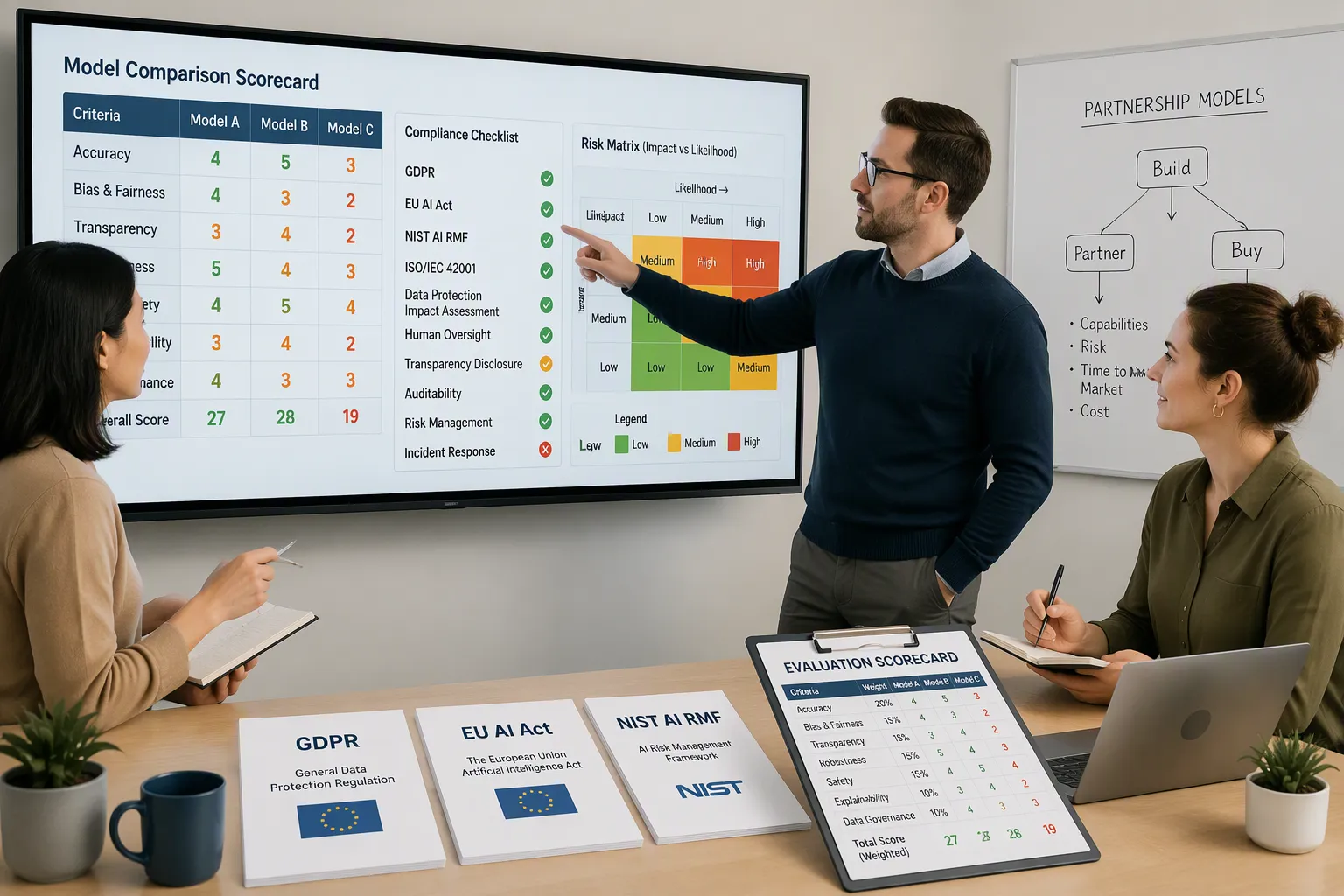
Performance, Fit, and Compliance
Give every option a score on four things: technical performance, application fit, regulatory compliance, and total cost. Use the same scale for each path. A simple 1-to-5 score for each one turns opinions into a shared comparison. Technical performance covers latency, uptime, and accuracy on your live data. Application fit asks how well the option serves your defined outcomes and ideal partner profiles. Compliance should get its own score, not a small note at the end.
Retail AI partnerships are now judged on proven compliance as much as on business results. As AI grows across stores, warehouses, and e-commerce, the EU AI Act sets clear rules on risk levels and who is responsible. European retailers must make sure their technology partners meet these standards. Review cycles have become much stricter. Buyers now ask providers tough questions about model transparency, data handling, and system integration, and they compare solutions on both operational and regulatory criteria.
Requirement Area | Specific Requirements for Retail AI Partnerships |
|---|---|
Data protection & privacy | GDPR (EU personal data processing); CCPA/CPRA (California privacy and automated decision-making) |
AI-specific regulation | EU AI Act risk-level categorization and corresponding obligations |
Risk management | NIST AI Risk Management Framework (voluntary) |
Sector-specific rules | Financial services (Dodd-Frank, Basel III), healthcare (HIPAA), and similar |
Compliance mapping | Identify applicable regulations by jurisdiction, industry, and use case; map requirements to AI system components; prioritize by risk and business impact; build compliance matrices |
Policy framework | Data governance (DAMA-DMBOK, DCAM, ISO 27001); model governance (MLOps, Model Cards, Datasheets for Datasets); ethical AI principles; security (NIST CSF, OWASP AI, ENISA) |
Governance mechanisms | AI ethics boards, data governance councils, technology review boards; incident response and risk escalation procedures; change management and model approval workflows; RACI accountability and audit trails |
Compare Engagement Models and Cost
Now compare engagement models and cost. Total cost includes licenses, integration, training, and ongoing operations. Weigh each one against the business value you expect. An in-house build puts most of your money into hiring and maintenance. A vendor partnership shifts spending toward fees and shared risk. An ecosystem spreads cost across many providers. Model the economics over three years, not one. A model that looks cheap in year one may cost more later. Pick an economic model that works for the partner as well as for you. A deal that leaves the partner with too little will not last. Define clear engagement models before you sign. Scaled engagement models with defined engagement tiers keep the economics clear. Your partner program should state partner revenue attribution rules up front. A fair partner program protects the economics on both sides.
AI-driven PRM tools can automate onboarding, track performance, and help you rank partners. They apply the same onboarding and reporting processes to all partners. With data in one place, AI can flag partners whose deal registrations drop suddenly or whose logins are falling before performance slips. Teams become proactive, spotting partner drift early and sending the right resources sooner. One shared view shows top performers and where resources have the greatest impact. Automated reports and recommendations bring growth opportunities and risks to light early. Natural language processing lets partners ask questions in plain language and get policy-compliant answers. Machine learning finds which partners need extra training. Automated lead routing assigns leads by quality, vertical, or region. These capabilities power ai-powered partner experiences and cut manual data entry. Smart forecasting supports pipeline planning. Salesforce automated trial org creation for its partner community and saw partner engagement rise steadily week after week. Use these tools to run the comparison, then pilot the leading option.
Manage Risk and Flexibility
Assess Lock-In and Risk Exposure
Lock-in rarely shows up right away. It grows slowly, one layer at a time, until switching becomes painful. Before you sign anything, map out where your stack ties you down.
Lock-in layer | What becomes tied to the stack | What portability requires |
|---|---|---|
Model | Prompts, API behavior, evaluations, fine-tuning | Adapt model setup and revalidate output quality |
Orchestration | Agent logic, tool schemas, routing, state, security controls | Reconnect tools, rebuild workflows, retest every path |
Context | Definitions, lineage, policies, business relationships | Make governed context usable across providers, not merely exportable |
This worry is common. In a Zapier 2026 survey of 500 US enterprise executives, 81% said they had at least some concern about AI vendor dependence. Also, 47% expected a key business function to break if their main AI vendor disappeared. Migrations cost a lot too. The CloudBees 2025 DevOps Migration Index found that 57% of enterprise platform migrations go over $1M. They average 18% over budget, and only 25% delivered expected value within a year.
You can reduce this exposure with a secure model gateway between your applications and AI services. It puts authentication, authorization, and policy enforcement in one control plane you can audit. Swapping inference backends then needs no change to application logic. Lock-in is also moving up the stack, from cloud infrastructure toward orchestration, workflow control, and data governance. Treat single-vendor dependence as a concentration risk. Protect yourself with supplier optionality, contractual exit clauses, and architectural portability.
Plan for Scaling and Change
Growth will put stress on your partnerships. Build a modular architecture that absorbs rapid technology shifts, mergers, and experiments. Choose AI tools that handle diverse tasks and data types with minimal preprocessing, and keep quality assurance strong as volume rises.
People and governance decide whether scaling works. Redefine roles, reset expected outcomes, and upskill staff through training and communication forums. Consolidate and reallocate people to higher-value work, and flatten hierarchies for autonomy. Make the technology easier to understand with education and demos, and address concerns openly. Set policies for approved tools, accepted uses, and data handling. A well-governed partner ecosystem scales without chaos, and your partner ecosystem stays flexible as needs evolve.
You now have a clear plan. Check your needs, look at your choices, compare them on performance, fit, compliance, and cost, then review risk and flexibility. There is no single best answer. The right model depends on your goals and limits.
Take three next steps. Score each option on weighted dimensions, and write down your reasons. Then run a small pilot: keep the agreement to 3 to 6 months, limit scope to a few SKUs and one region, and set clear success metrics with regular check-ins. Revisit the choice as ai capabilities change. Treat partnership selection as a skill you keep building, and your strategy will keep delivering business value.
FAQ
How long should a pilot partnership run before you commit?
Keep the first agreement short. The article suggests 3 to 6 months. Limit the scope to a few SKUs and one region. Set clear success metrics and hold regular check-ins. A short pilot lowers your risk and gives you real performance data before you sign a longer deal.
Which partnership model works best for a small retailer?
No single model wins for everyone. A small retailer often lacks a deep engineering team. A vendor partnership or an ecosystem platform gives you proven frameworks and faster time-to-market. Weigh that speed against data-sharing risk. Score each option against your own outcomes and gaps.
How do you tell ecosystem management apart from traditional PRM?
Traditional PRM tracks individual partner records, deals, and pipelines. Ecosystem management coordinates many partners across shared data flows and joint value creation. It needs digital infrastructure and clear governance. Your partner program should define roles, data-sharing rules, and shared metrics for every partner.
What is the biggest risk when you depend on one AI vendor?
Concentration risk grows quietly. In a Zapier 2026 survey, 81% of executives said they had at least some concern about vendor dependence. Migrations are costly too. The CloudBees 2025 index found 57% of enterprise platform migrations exceed $1M. Protect yourself with supplier optionality, exit clauses, and architectural portability.
How do you keep a partner ecosystem flexible as needs change?
Build a modular architecture that absorbs technology shifts and experiments. Redefine roles and upskill staff through training. Set policies for approved tools and data handling. Revisit your model choice as ai capabilities evolve. Treat partnership selection as an ongoing skill, not a one-time decision.
See Also
Why Stores Powered By Artificial Intelligence Will Dominate Tomorrow's Retail Landscape
The Growing Trend Of AI Corner Stores And Key Insights For Retailers
Key Features And Advantages Of AI Combo Vending Machines For Today's Retailers
How To Launch An AI Corner Store Without Requiring A Large Investment
Comparing Micromarkets And Smart Stores: How Automated Convenience Retail Operates Globally
