Retail AI Partnerships Move from Operations to Intelligent Decision-Making


A regional grocer once needed three weeks to line up a supplier promotion with five partners. Today, an AI system spots the chance, figures out the margin impact, and sends the plan to each partner before the morning meeting ends.
That speed shows a real change. Retail AI partnerships now go beyond back-end operations. They reach into strategic, data-driven decision-making. Partnership models in retail AI ecosystems no longer stop at just doing tasks.
This shift raises a hard question. Machines can suggest, and sometimes automate, the choice. So what role does human judgment play? Traditional partner programs face the same pressure. Decision speed now separates leaders from laggards.
Key Takeaways
AI partnerships help stores make smart choices, not just do everyday jobs.
AI links data from different partners to show the whole picture.
AI can guess what people will want and spot problems before they start. This saves time and money.
People and AI work as a team: AI gives ideas, and people make the final choice.
Platforms turn AI insights into actions that partners can take right away.
Partnership Models in Retail AI Ecosystems Shift
Limits of Operational-Only Technology Partner Models
Old-style partner management handles stock counts, automatic tasks, and routing work. These jobs keep products moving and support tickets closed. But they do not help a store decide which sale to run, which supplier comes first, or where to move money next quarter. Operational tools tell what happened. They seldom tell what to do next.
Think about a mid-size retailer and its data partner. The partner's system flags low stock every Monday. The store team then spends days emailing suppliers, checking profit, and routing approvals. Both sides stay busy. Neither side gets a smart advantage. This pattern keeps partner models stuck in a cycle of just reacting.
Partnership models in retail AI ecosystems need to do more than just tasks. A partner that only routes work cannot shape strategy. Making decisions needs context, looking ahead, and shared goals. Doing tasks alone will not give any of those.
Siloed Data, Siloed Decisions
Data in separate places leads to separate decisions. A cloud company keeps traffic data. A data company keeps basket data. The retailer keeps customer data. Each side sees only one piece. No one sees the full picture. Partner types built on separate systems cannot create combined advice.
This split hurts partner programs in real ways. A demand surge shows up in one system. A supply problem sits in another. The two signals never meet. Leaders then make calls with only half the story. Partner programs that ignore this gap will keep making slow, partial choices.
Breaking silos needs shared data pipelines and common rules. It also needs trust. Partners must agree on what a "signal" means before AI can use it. That agreement turns scattered data into a shared asset. Partnership models in retail AI ecosystems then shift from just working together to real smart thinking. The next step is linking that smart thinking across every partner in the chain.
AI as the Partner Ecosystem Intelligence Layer

Connecting Data Across the Partner Ecosystem
AI in partnerships works like a central control system. It pulls signals from cloud providers, analytics vendors, and retail partners into one shared view. A cloud partner sees traffic spikes. An analytics vendor sees shopping cart trends. The retailer sees customer loyalty data. AI connects all three streams and finds patterns that no single partner could see alone.
This connection turns raw partner data into useful information. The system does not just store facts. It looks at them, puts them in order, and shows what matters most. A technology partner ecosystem built this way moves faster because everyone works from the same information.
Co-innovation frameworks give this layer its structure. Partners agree on data rules, shared goals, and common measures. Those agreements let AI compare things fairly across very different businesses. Without them, each partner uses its own way of talking. With them, the whole partner ecosystem uses one language.
Ecosystem operating systems take this further. They act as the main support that lets data flow between partners without people having to pass it by hand. Think of them as the pipes behind the intelligence. The smarter the pipes, the faster good decisions get made.
From Dashboards to Decision Engines
A dashboard shows a number. A decision engine tells someone what to do next. This difference is more important than many retail leaders think. Dashboards wait for a human to see, understand, and act. Decision engines suggest the next step without waiting.
Consider co-sell orchestration. Old systems send leads by simple rules, like region or deal size. AI-driven systems look at many signals at once. They match the right partner to the right opportunity, then suggest the best approach. Organizing co-sell efforts becomes a task that needs thought, not just sorting.
AI agents now sit inside PRM platforms and partner orchestration platforms. They watch for deals that are not moving, mark accounts that could be lost, and suggest co-sell moves before a human even asks. Some vendors run AI-orchestrated co-sell rooms where every participant sees real-time suggestions during a joint pitch.
This is what ecosystem intelligence looks like in practice. The system does not just report. It thinks. It turns pieces of information into a list of actions in order of importance. Partnership models in retail AI ecosystems then shift from tracking activity to making things happen. The next question is how much this intelligence can predict.
From Reacting to Predicting in Partner Ecosystems
Seeing Demand and Problems Before They Happen
Old partner ecosystems wait for problems to show up. A supplier misses a delivery. A warehouse runs out of stock. Then teams rush to fix things. AI changes this. It helps partners spot demand shifts before they happen.
Amazon is a clear example. Its Supply Chain Optimization Technology handles over 400 million items across 270 time spans. The system moves inventory on its own when demand shifts. This approach made long-term regional forecasts 20 percent better. Amazon uses three special AI agents for last-mile logistics. SCOT handles demand forecasting. Wellspring uses generative AI for driver drop-off points. An agentic framework helps warehouse robots sort packages faster.
AI makes this shift possible across many partner ecosystems. The technology processes huge amounts of data from many sources. It looks at past sales, market trends, and outside factors. Real-time demand sensing watches POS systems and social media. It catches changes in what consumers do as they happen. Partners change inventory and promotions fast.
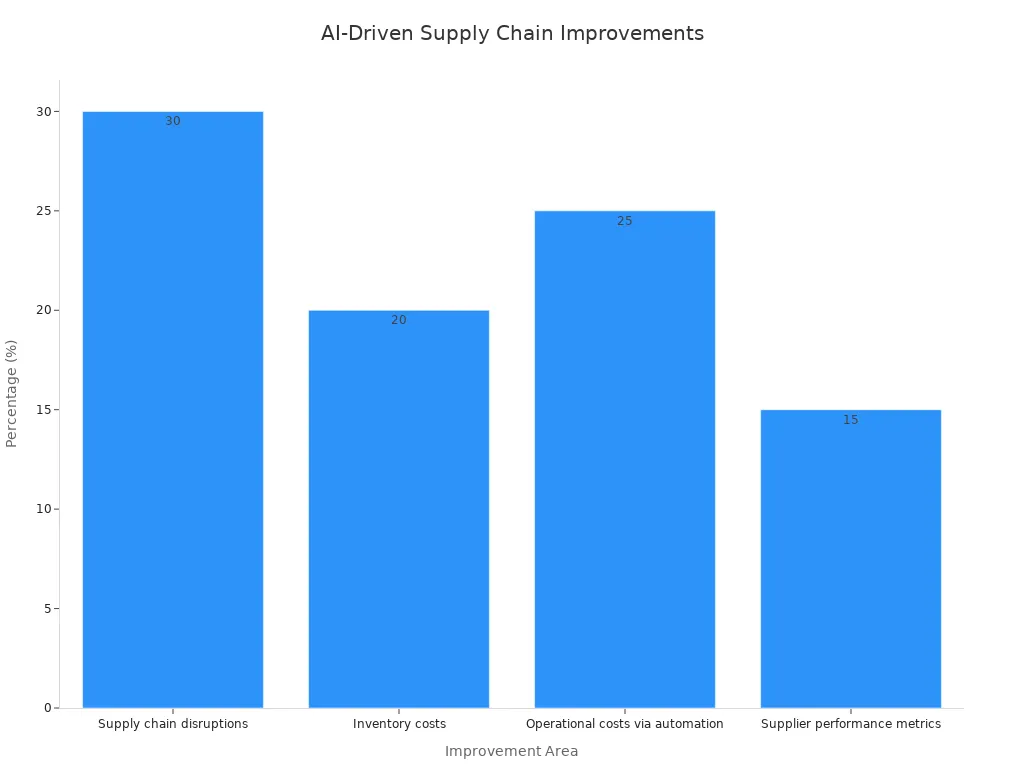
Predictive and generative AI make scenario simulation possible. Partners model supplier failures or transportation delays. They make backup plans before disruptions happen. This ability cuts supply chain disruptions by 30 percent. It cuts inventory costs by up to 20 percent. Operational costs see up to 25 percent savings through automation.
Finsbury Food Group shows real results. The company got a £1.6 million reduction in net working capital. Service levels went up 5 percent year over year. Planning productivity doubled.
Shared Forecasts, Shared Responsibility
Predictive teamwork needs a new kind of responsibility. Partners must share forecasts and commit to shared outcomes. The CPFR model shows how this works. Kimberly-Clark and its retail partners moved from forecasting alone to one demand view. They shared sales data and made agreed-upon forecasts. The result made forecasting more accurate and cut inventory costs.
Walmart and Procter & Gamble made a similar partnership. They built sales forecasts together. P&G accessed Walmart POS data through Retail Link for real-time visibility. This teamwork cut out-of-stock items. It made production schedules better and cut safety stock.
West Marine took this further. The company set up over 200 CPFR relationships covering 90 percent of total volume. In-stock rates averaged 96 percent during peak season. Forecast accuracy reached nearly 85 percent. Distribution centers ran in the top 10 percent of competitive benchmarks.
AI makes these traditional collaboration models stronger. It adds speed and scale. Joint AI innovation lets partners build shared forecasting systems. These systems learn together and get better over time. Partners share responsibility through clear KPIs. They track forecast accuracy, inventory health, and replenishment triggers.
The evidence shows measurable impact for partner ecosystems. CPFR adopters cut inventory by up to 40 percent. Lost sales from unavailability drop by up to 65 percent with AI-enhanced forecasting. Average sales go up by up to 20 percent.
AI in Partnerships Enhances Human Judgment
Augmenting Partner Program Managers
AI does not push partner program managers out of the picture. It gives them better tools. A manager who once spent days building reports can now review AI-ranked recommendations instead. The work shifts from gathering facts to weighing choices.
Walmart shows this model in action. The company uses ai agents to speed up service response, route inquiries, and handle routine tasks. When an issue grows complex, Walmart deliberately brings human staff into the loop. That balance keeps speed high without losing control.
The same logic applies to partner management. AI in partnerships handles the repetitive work. It watches deal flow, flags stalled accounts, and suggests next steps. The manager then applies context that no model holds. They know the partner's history, the relationship, and the unwritten rules of the deal.
Responsible ai governance gives this division of labor a backbone. DBS Bank built its PURE principles around four values: purposeful, unsurprising, respectful, and explainable. Senior committees oversee how AI and data get used. That structure keeps ai in partner interactions aligned with human standards.
A strong partner strategy now includes clear ai roles for partners. Each side knows what the system decides and what a person decides. That clarity builds trust across the ecosystem.
Keeping Humans in the Decision Loop
Human oversight works best when it sits at defined checkpoints. Retail partnerships need rules for when a person must step in. High-stakes decisions, unusual patterns, and low AI confidence scores all trigger review. Sensitive content and conflicts with business rules do the same.
Partner programs can copy this pattern. A partner program that logs human-AI disagreements creates a record for improvement. Guardian agents can watch other agents and gate their actions. Continuous evaluation checks model fairness and reliability after launch.
These practices turn ai in partnerships into a partnership between people and machines. The system recommends. The person decides. Over time, the system learns from each human call.
Platforms make this loop practical. Modern prm platforms embed review steps right into the workflow. A manager sees the AI suggestion, approves or overrides it, and moves on. No separate tool, no lost context.
The payoff is real. AI scales the volume of decisions. Human judgment sets the direction. Together they outperform either one alone.
Turning Insights into Execution Through Platforms

Embedding AI Recommendations into Partner Workflows
Platforms now turn analysis into action. As ai becomes more common in modern prm platforms, teams no longer put reports together by hand. They get prioritized ideas, evidence for each account, and suggested next steps that follow security and governance rules. Customer success managers stop gathering context and start running focused, measurable interventions.
Specialized ai agents carry out this work across partner ecosystems. Each agent has a clear job and reports a clear result.
AI Agent | Executable Partner Action | Performance Metric |
|---|---|---|
Content Agent | Catalog-wide compliance for SEO and AEO | Content cycles reduced from 35 minutes to 35 seconds |
Sales Agent | Automated root-cause diagnosis and gap-to-plan recovery | Faster diagnosis and recovery of sales gaps |
Shelf Agent | Real-time search and availability monitoring at scale | Shelf insights delivered in minutes instead of weeks |
Media Agent | Thousands of daily optimizations for true incrementality | Adaptive 24/7 media optimizations outperforming rules-based logic |
These agents link to partner orchestration platforms and partner revenue orchestration systems. A suggestion turns into a task inside the workflow. No separate tool, no lost context.
Measuring Decision Impact Across the Ecosystem
Proving value takes more than counting activity. Product and success leaders should measure lift, not vanity metrics. They run controlled experiments where the analytics-driven playbook is the variable. They track retention, time to resolution, and expansion speed for treated groups against control groups. They then tie those results to revenue per account. Every model stays accountable to dollars, not just better scores.
This measurement discipline makes ecosystem intelligence stronger. It shows which decisions create real value across partner ecosystems. It also shows where human review helps the most. Over time, the data guides where to invest next.
Operational partnerships solved efficiency. Intelligent decision-making partnerships solve effectiveness and adaptability. AI does not replace human judgment or partner programs. It scales them. The technology makes better decisions faster and more consistently. Older partner programs that focus on tasks alone will fall behind. Retail AI ecosystems will grow more complex with each passing year. Partnerships that depend on AI for scalable, intelligent decision-making will outperform those stuck in operational mode. The competitive advantage belongs to decision-centric partnerships. These partnerships combine human context with machine speed. That advantage grows as ecosystems expand and data flows increase. Leaders who invest in decision-centric partnerships now stay ahead. Decision-centric models create lasting value across the entire partner ecosystem.
FAQ
What separates an operational partner model from a decision-centric one?
Operational models track stock, route tasks, and close tickets. They report what already happened. Decision-centric models use AI to suggest the next move. They link data across partners and act on it. The first keeps things running. The second shapes strategy.
How does AI connect data across separate partner systems?
AI works as a shared intelligence layer. It pulls signals from cloud providers, analytics vendors, and retailers into one view. Partners agree on data rules and common measures first. That agreement lets the system compare different businesses fairly. It also helps find patterns no single partner sees alone.
Does AI replace partner program managers?
No. AI handles repetitive work like watching deal flow and flagging stalled accounts. Managers then apply context no model holds, such as partner history and relationship nuance. Walmart keeps humans in the loop for complex or high-stakes calls. The system recommends. The person decides.
What results can partners expect from predictive collaboration?
Evidence from CPFR adopters shows inventory cuts up to 40 percent. Lost sales drop up to 65 percent. West Marine reached 96 percent in-stock rates and nearly 85 percent forecast accuracy. Finsbury Food Group gained a £1.6 million working capital reduction. It also doubled planning productivity.
How do platforms turn AI insights into real action?
Platforms embed recommendations directly into partner workflows. A suggestion becomes a task inside the system, so no context gets lost. Specialized agents handle content, sales, shelf, and media work. The Content Agent, for example, cut content cycles from 35 minutes to 35 seconds.
See Also
The Future Of Retail Lies In Artificial Intelligence Powered Stores
Emergence Of AI-Driven Convenience Stores: Essential Insights For Retail Owners
Transforming Online Store Management Through Artificial Intelligence E-Commerce Solutions
Exploring Features And Advantages Of AI-Enabled Combo Vending Machines For Retail
Starting An AI-Powered Corner Store With Low Initial Investment Costs
