AI-driven loss prevention in Hospitals & healthcare facilities

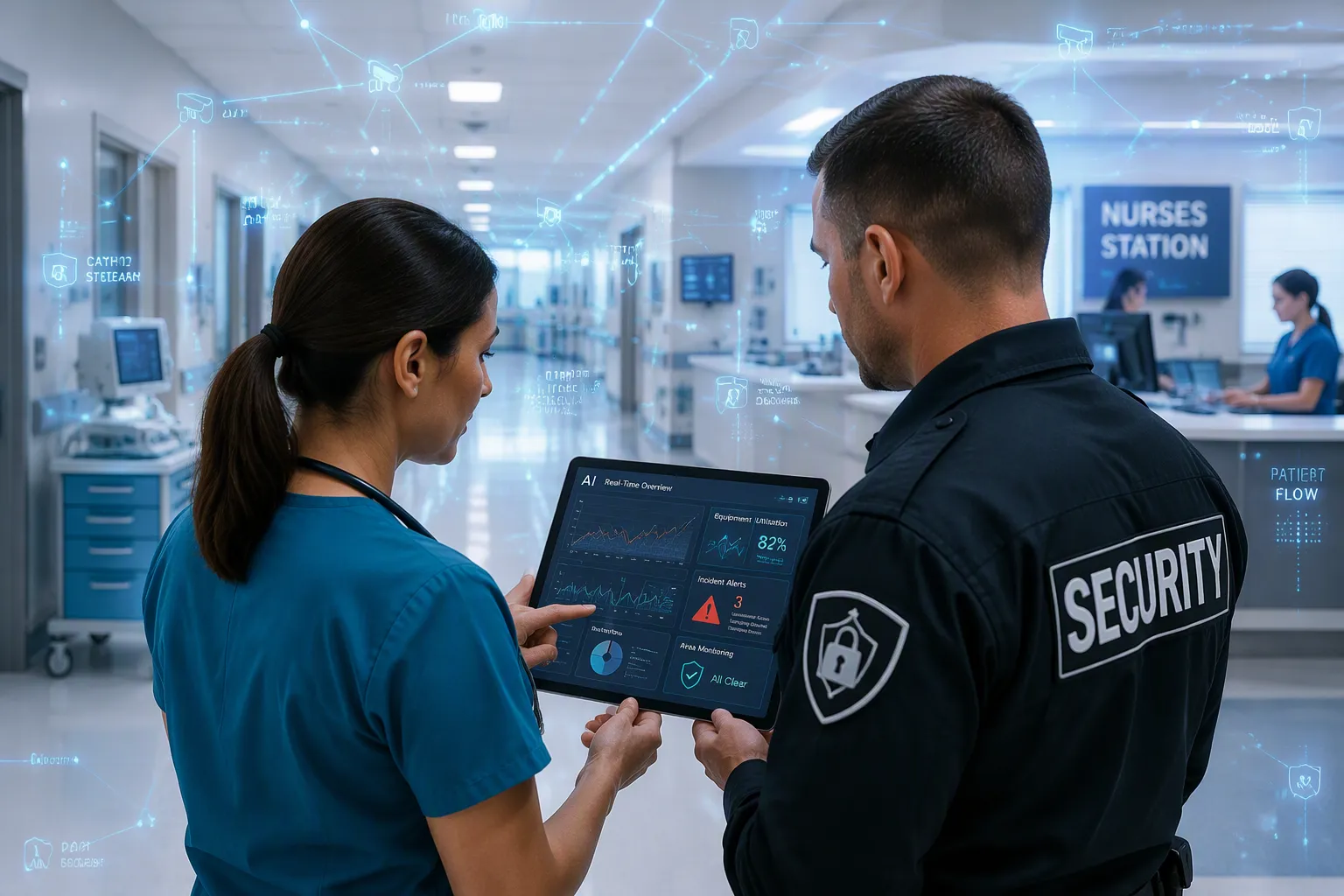
Did you know that healthcare data breaches now cost the industry millions every year? Each stolen record raises your expenses and puts hipaa compliance at risk. You cannot afford to wait for a breach report to act.
AI-driven loss prevention changes this picture. Machine learning spots data theft, accidental exposure, and insider mistakes before they become reportable events. This article examines data loss prevention (DLP) and data security posture management (DSPM) with practical steps for IT and security leaders. You will learn how to protect sensitive patient data and keep your healthcare organization ahead of modern threats.
Key Takeaways
AI learns normal behavior to spot unusual access and stop data theft before it happens.
AI finds sensitive patient data in emails and documents, even when it's not labeled.
DSPM maps all data locations and helps you fix risks to meet HIPAA rules.
AI cuts false alarms and speeds up response, saving time and money.
Start with a pilot project on your highest-risk data and involve your whole team.
Why Healthcare Data Loss Prevention Needs AI
Modern threats move at machine speed. A single phishing email can expose protected health information before your team notices. Legacy rules cannot keep pace. You need a fundamentally different defense inside modern hospitals.
Limits of Legacy HIPAA DLP Tools
Legacy DLP tools depend on static rules and keyword matching. They fail when an insider with authorized access misuses patient data. Consider Montefiore: an insider sold ePHI of 12,517 patients, and standard DLP rules never flagged it. Verizon's 2024 report found 70% of healthcare breach actors were internal. A Cyberhaven survey reports 71% of security leaders say legacy tools cannot keep pace.
Legacy tools also lack context. They inspect network egress but miss copy-paste, uploads, and in-browser manipulation inside encrypted SaaS traffic. They cannot trace data lineage. Shadow IT widens the gap, sending sensitive data through unsanctioned apps. The IBM 2025 report puts the average healthcare breach cost at $7.42 million. You cannot absorb those losses. Healthcare DLP must evolve beyond these blind spots.
How AI-Driven Loss Prevention Works in Hospitals
AI-driven data loss prevention starts by learning normal behavior. The system builds a machine-learning profile of typical access patterns, transfer locations, and timing. When a billing administrator suddenly opens clinical research databases off-hours and downloads massive volumes of records, the anomaly appears in real time. Isolation Forest isolates these outliers in high-dimensional space. Autoencoders learn compressed representations of normal behavior; high reconstruction error signals trouble. Together they catch known attacks and subtle quirks.
AI adds context through content classification and natural language processing. The engine detects sensitive PHI even without labels, understands intent, and predicts risky behavior before exfiltration. It correlates external signals like job termination with unusual access. Phishing remains the dominant entry point: a Paubox report found over 70% of healthcare breaches began with phishing, and a single employee mistake at Xsolis exposed about 1.4 million records. Healthcare data loss prevention ties these signals to compliance. Implementing data loss prevention in healthcare settings means moving beyond static rules. A modern data loss prevention strategy aligned with the HIPAA Security Rule turns every user action into a monitored signal, closing gaps that legacy DLP leaves open.
Key AI Strategies for Data Loss Prevention in Healthcare
Anomaly Detection and Predictive Analytics
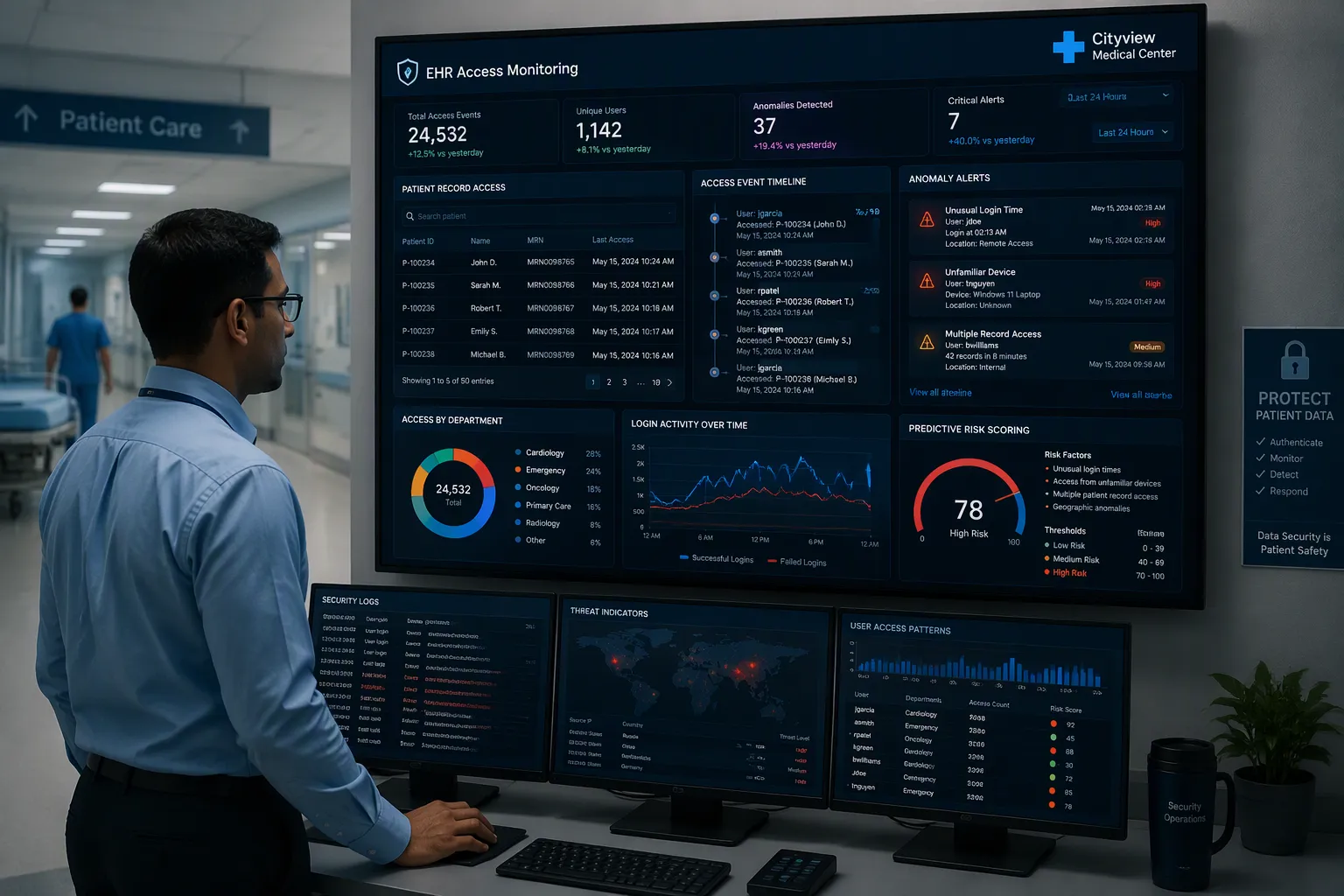
Anomaly detection forms the backbone of ai-driven loss prevention in healthcare. These systems monitor activities that deviate from typical patterns in electronic health records access. AI algorithms scrutinize user behavior, access logs, and data transfers to pinpoint irregularities. Examples include excessive record access, odd login times, and unfamiliar device usage.
Machine learning models establish dynamic behavioral baselines from historical user activity. This approach detects anomalies like a clinician deviating from their department's typical access trends. Unsupervised methods model typical behavior from unlabeled EHR logs using clustering and density estimation. One-class models detect deviations through reconstruction error or isolation scores. Semi-supervised methods incorporate labeled policy violations into mostly unlabeled logs. Explainability tools help security teams understand triggers such as odd-hour access or off-site IPs.
Predictive analytics enables your security team to respond before data exfiltration occurs. The technology ingests real-time data from EHRs, Internet of Medical Things devices, network activity logs, and threat intelligence feeds. Machine learning models then analyze patterns to flag early signs of risk. Risk-Based Alerting reduces alert fatigue by assigning risk scores and triggering alerts only when thresholds are exceeded.
The accuracy gains are substantial. Traditional signature-based detection achieves 65 to 75 percent accuracy. Machine learning-powered predictive analytics reaches 86 to 95.7 percent. Hybrid machine learning models achieve 91.3 percent threat classification accuracy.
Detection Method | Accuracy Range |
|---|---|
Traditional signature-based detection | 65–75% |
Machine learning-powered predictive analytics | 86–95.7% |
Hybrid machine learning models | 91.3% |
Real-world results demonstrate the power of these tools. A major U.S. hospital used AI to detect and neutralize a ransomware attack within 2.3 seconds, preventing any breach. Milton Keynes University Hospital deployed self-learning AI to monitor for anomalies such as insider threats. Asante Health modernized its Security Operations Center with Cortex XDR, cutting mean time to respond from weeks down to minutes.
"Not only did Cortex XDR reduce the number of incidents we had to look at, but the time taken to act on those incidents was also reduced." — Peter Fletcher, Director of Cyber Security, San Jose Water Company
Content Classification and Natural Language Processing
Natural Language Processing is embedded within DLP components so the system can interpret human language. This capability enables detection of sensitive information concealed within unstructured data sources such as emails, documents, and social media communications. In the context of electronic health records, NLP helps healthcare dlp systems recognize patient data even when it is not stored in structured fields.
Machine learning algorithms enhance data classification accuracy while reducing false positives. Advanced natural language processing identifies sensitive content within unstructured documents, emails, and chat messages. This phi detection capability supports your hipaa dlp compliance efforts.
DLP solutions classify data based on sensitivity, location, or owner, then assign appropriate security policies and controls. Advanced data discovery and classification tools scan and categorize data across on-premises, cloud, and hybrid infrastructures. These solutions accurately identify sensitive information such as personally identifiable information, financial data, and intellectual property.
Healthcare organizations use DLP solutions to protect patient health information across all systems. DLP systems identify PHI in emails, databases, and file shares, preventing unauthorized disclosure that violates HIPAA privacy rules.
Your healthcare data loss prevention strategy should combine anomaly detection with content classification. This pairing creates a comprehensive defense that catches both behavioral anomalies and data-centric risks. These data loss prevention strategies form the foundation of modern healthcare dlp programs.
AI-Enhanced DSPM for Data Loss Prevention for Healthcare
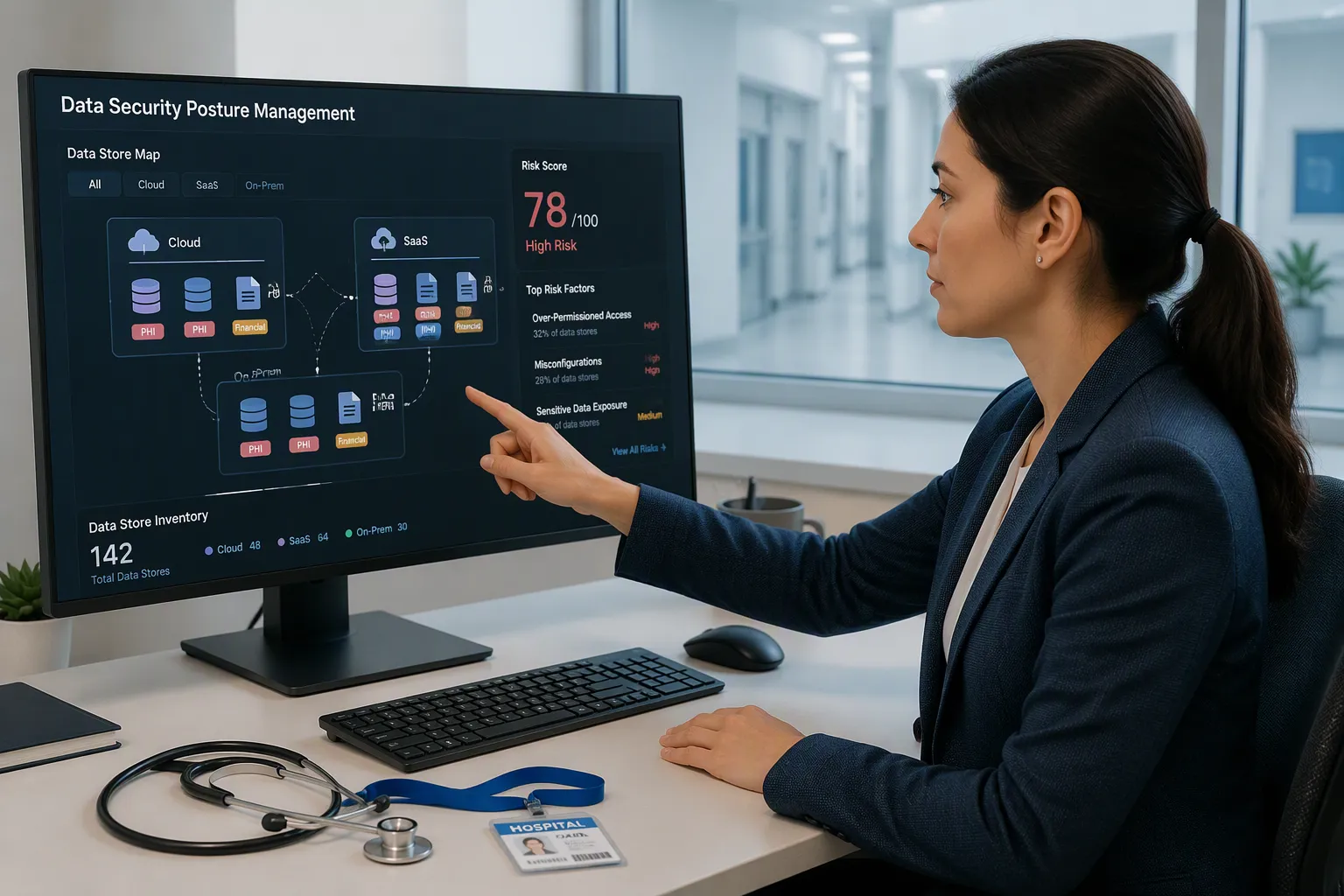
To protect patient data today, you need more than a fence at the edge of your network. You need a clear view of every data store across your hospital. That is the job of Data Security Posture Management, or DSPM. DSPM continuously assesses how systems store, access, and move sensitive data. It complements your healthcare data loss prevention tools. DLP takes action on data leaving your control. DSPM shows you where the data lives.
Automated Data Discovery and Classification
AI-powered DSPM starts with discovery. It scans cloud accounts, managed databases, SaaS platforms, and on-premises systems. The engine finds known stores and shadow data. Machine learning identifies sensitive personal health information (PHI), financial data, and intellectual property. It analyzes meaning and context rather than keywords. This approach lowers false positives and tags files accurately, even after the files move or are copied.
Deep learning models understand the context of the data. For example, a model tags a note in a clinical email as PHI because it recognizes treatment details and patient identifiers. Concentric AI uses this approach. Its Deep Learning-based DSPM autonomously discovers and classifies data. It uses Risk Distance™ analysis to assess risk. The platform helps healthcare organizations meet HITRUST requirements by discovering confidential healthcare data in unstructured and structured formats.
The inventory is only the start. DSPM maps identities and services to data stores. It reveals over-permissioned access that increases patient data risk. It scores each store for exposure, misconfiguration, and excessive privileges. A prioritized risk map spans cloud, SaaS, and on-prem systems. Monitoring is continuous. Your inventory stays current.
Risk Prioritization and HIPAA DLP Compliance
A full inventory lets you apply regulatory compliance data loss prevention strategies to close gaps. DSPM applies pattern detection and machine learning to classify regulated data. It evaluates exposure levels, access patterns, file age, and content sensitivity. High-impact exposures surface at the top of the queue. Your team focuses on the most consequential issues first, cutting noise and false positives.
DSPM and DLP enforce consistent policies. DSPM prioritizes the risk. Your healthcare dlp solution then blocks, encrypts, or quarantines the data before it exits. This pairing supports hipaa compliance. The hipaa security rule requires technical safeguards for ePHI. DSPM maps your data posture to those safeguards. It produces compliance-focused reports aligned with frameworks including HIPAA, GDPR, CCPA, and PCI.
Audit preparation becomes continuous. Manual approaches take more than 200 hours per audit. Automated DSPM reduces evidence collection to under 10 hours. You can generate timestamped evidence showing compliance status at any point. Remediation tracking shows when the team detects and resolves violations. Continuous compliance scoring trends over time. These are the hipaa-compliant data loss prevention strategies hospitals now rely on. Audit season becomes an ongoing process instead of a scramble.
Secure cloud backups for hospitals fit here. DSPM extends discovery to training sets, RAG corpora, and vector stores. AI pipelines do not create hidden patient data copies outside your inventory. You keep every copy of sensitive patient data accounted for. A data loss prevention for healthcare strategy stays strong. Legacy DLP inspects network egress. Data loss prevention in healthcare must also cover the full data lifecycle. DSPM closes that loop.
Overcoming Challenges in AI-Driven Loss Prevention
Data quality gaps, privacy worries, and algorithmic bias can undermine your data loss prevention strategy. You need a governance model that protects patients and earns staff trust. A thoughtful rollout keeps your DLP program aligned with HIPAA.
Data Quality, Ethics, and Governance
AI models inherit your data's blind spots. Incomplete labels or skewed demographics produce biased results. Verify that de-identified data used for AI represents your patient population. Align de-identification with the use case. Privacy protection should not worsen fairness.
Test models across demographic groups. Document lineage and transformations. Set measurable data-quality KPIs. Apply the NIST AI RMF functions: map, measure, manage, govern. Use role-based access control, multi-factor authentication, and audit trails. Watch for model drift and poisoning. These reduce alert fatigue and keep your healthcare DLP insights trustworthy.
Staff monitoring demands restraint. Detect anomalies without surveilling every click. Apply privacy-by-design. Minimize data collection and retention. Use federated learning and differential privacy to lower re-identification risk. Give patients visibility into data use and allow opt-outs. Explain AI-driven recommendations. Update informed consent for AI-assisted care. These practices align with HIPAA and reinforce data loss prevention discipline.
Defending Against Adversarial AI Threats
AI agents add an attack surface. Prompt injection can trick a clinical assistant into revealing PHI. Secure the agents themselves, not the network perimeter. This defense extends your DLP coverage to healthcare AI workflows. Adversarial training builds resilience before deployment.
Govern human and machine identities together. Deep lineage mapping links every non-human identity to a human owner. Agentic Access Administration enforces least privilege. Just-in-time access grants the right permissions at the right moment. This protects data across your healthcare organization.
Security Technique | How It Works | Healthcare AI-Agent Defense |
|---|---|---|
Prompt hardening & validation | Set strict allowed/forbidden actions | Blocks manipulation of clinical agents |
Sandboxing & Zero Trust | Isolate agents, enforce least privilege | Limits blast radius if compromised |
Input/output/tool filtering | Inspect all messages in real time | Prevents PHI exfiltration |
When a chest X-ray AI case failed, the organization suspended it, investigated, retrained on diverse data, and redeployed under stricter monitoring. Your DLP incident plan should do likewise. That keeps your ai-driven loss prevention aligned with healthcare threats.
Measuring Success and Preparing for Future Trends
KPIs for AI Loss Prevention Programs
You cannot improve what you do not measure. Track the reduction in time-to-detect incidents. This metric shows how fast your team spots a threat. Monitor the number of hipaa dlp alerts resolved. A rising count means your team clears the queue. Measure the percentage of sensitive data discovered across your systems. This figure reveals your visibility into phi stores. Watch the false-positive rate. A high rate wastes analyst time and breeds alert fatigue.
Set targets for each metric. Review them monthly with your security and compliance teams. Share progress with clinical leaders. This builds trust and secures budget for your data loss prevention program. Use these numbers to prove your data loss prevention strategies work.
Autonomous Policy Orchestration and Federated Learning
Future healthcare dlp will enforce policies without manual intervention. Autonomous policy orchestration means your dlp system adjusts rules based on live risk. It blocks a transfer when a user's behavior turns anomalous. It grants access when context supports a legitimate need. This reduces human error and speeds response.
Federated learning lets hospitals train models together without moving patient data. Each site keeps its records on local servers. Only model updates travel to a central aggregator. Owkin uses this method for medical research. A MediScan example shows three hospitals training a tumor-detection model while scans stay behind each firewall. This approach solves data-governance problems. It also strengthens data loss prevention best practices across a hospital network.
AI-enhanced security operations centers will anchor these trends. Review the table below for key capabilities.
AI Capability | Description |
|---|---|
Threat Detection | AI finds anomalies faster than signature-based systems |
Automated Response | AI isolates endpoints and blocks traffic in real time |
Behavioral Analytics | AI spots insider threats and compromised credentials |
IoMT Device Monitoring | AI watches infusion pumps and imaging systems for odd behavior |
Integration with SIEM/SOAR | AI centralizes operations without replacing your stack |
Deep Observability | Packet-level visibility improves detection and cuts false positives |
Start with strong data visibility. Keep human oversight alongside automation. Retrain models as threats evolve. These steps prepare your healthcare organization for an autonomous, AI-native future.
AI-powered DLP and DSPM give your hospital real control over sensitive patient data. You lower breach risk and meet evolving HIPAA demands. Treat ai-driven loss prevention as a strategic investment. A one-time tool deployment will not protect you. Start with a pilot project on your highest-risk data repository. Build support from IT, clinical informatics, privacy, and compliance teams. This cross-functional approach strengthens healthcare data protection. The future of healthcare security is autonomous, AI-native, and continuous. Your healthcare dlp program must evolve at the same speed. Move forward with confidence. Your patients trust you with their data. A strong hipaa dlp strategy and data loss prevention framework will keep that trust intact.
FAQ
How does AI improve healthcare data loss prevention beyond legacy rules?
Legacy tools rely on static rules. AI learns normal behavior and spots anomalies in real time. It catches insider mistakes and mass downloads before exfiltration. This approach reduces alert fatigue and helps you respond faster.
What is DSPM and how does it support healthcare DLP?
DSPM maps every location where patient data lives. It discovers and classifies sensitive information across cloud and on-prem systems. DLP blocks unauthorized transfers. Together these tools help you prioritize risks and simplify HIPAA compliance.
How can hospitals monitor staff without invading privacy?
Use privacy-by-design. Minimize data collection and retention. Federated learning keeps records local while models improve. Explain AI-driven recommendations to staff. You protect privacy and maintain trust across your healthcare organization.
Which metrics prove your healthcare AI loss prevention program works?
Track time-to-detect incidents, resolved alerts, percentage of discovered sensitive data, and false-positive rate. Review these numbers monthly. Share progress with clinical leaders. These data loss prevention metrics help you secure budget and build trust.
See Also
Examining Walgreens Self-Checkout: Retail Convenience Meets Practical Challenges
Modern Retail's AI-Driven Combo Vending Machines: Key Features And Advantages
AI-Powered Stores Are Undeniably The Future Of Retail
Retailers Must Understand The Rise Of AI-Powered Corner Stores
Solving Self-Checkout Cash Errors For Smooth Retail Transactions
