Why Cloud vs Edge Computing for Retail AI Matters to You

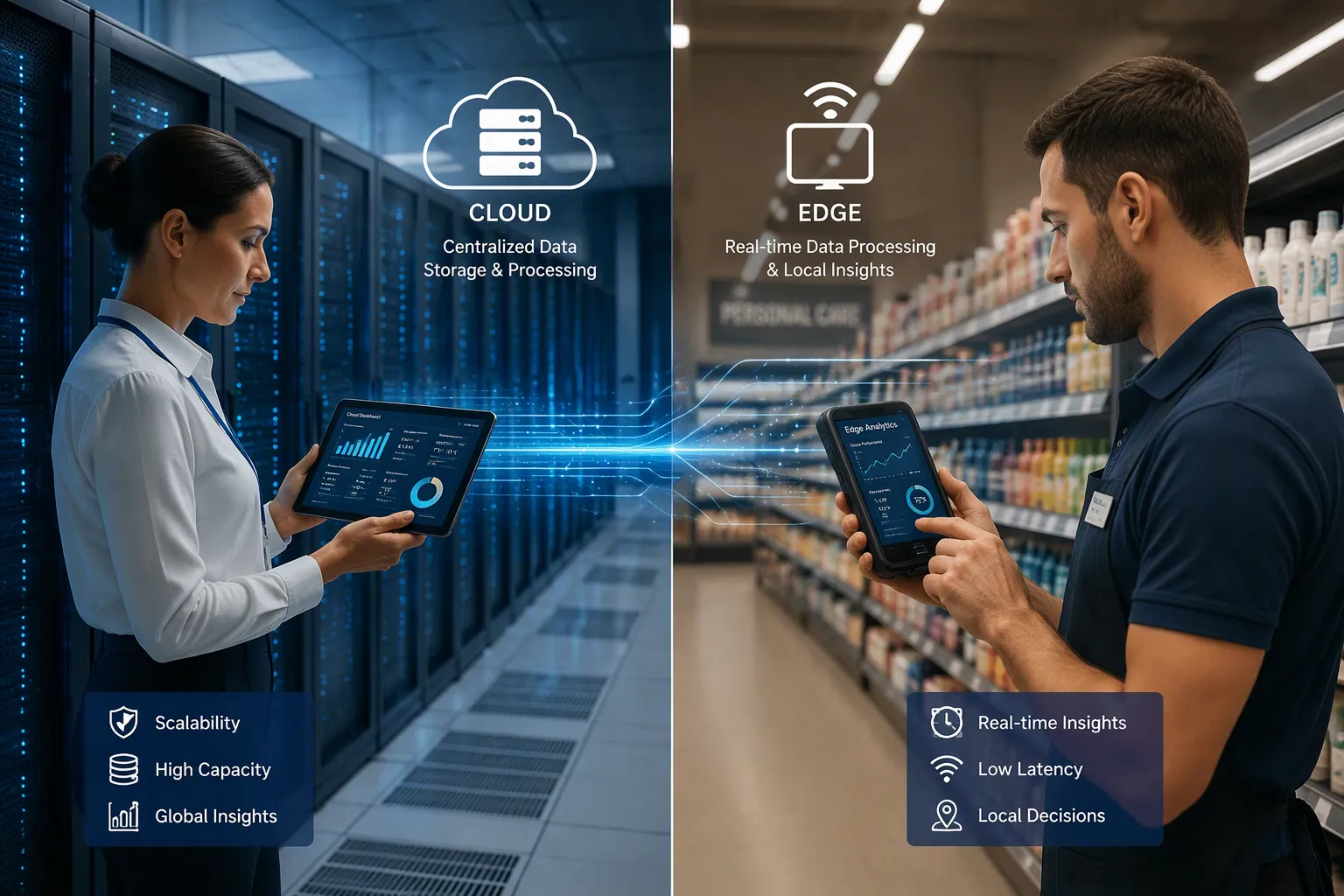
Retailers often ask which approach is better: cloud or edge. Neither option is always better. The right answer depends on specific business needs and use cases.
Cloud platforms offer scalability and centralized management. Edge devices deliver low latency and real-time processing close to shoppers and shelves. Each model fits different jobs, and many teams run both together.
This post examines the key differences and shares best practices. Readers will gain a practical way to weigh cloud vs edge computing for retail AI – scenario commercial goals, store operations, and data rules. Teams can then match each workload to the right environment with confidence.
Key Takeaways
Cloud and edge computing fix different problems. Pick the one that fits your needs.
Begin with your use case. Then look at latency, compliance, and cost.
A mix of both often works best. Use edge for quick decisions and cloud for long-term analysis.
Start with a small test project tied to a real business problem. Check the results before you make it bigger.
Think about data rules and all the costs over a few years so you can make a smart choice.
Cloud vs Edge Computing for Retail AI
What Is Cloud Computing?
Cloud computing gives you computer services over the internet. These services include servers, storage, databases, networking, software, analytics, and intelligence. This setup allows faster new ideas, flexible resources, and lower costs as you grow. Pay-as-you-go pricing helps cut operating costs and grow with your business needs.
Cloud computing is the delivery of computing services—including servers, storage, databases, networking, software, analytics, and intelligence—over the internet to enable faster innovation, flexible resources, and economies of scale, with pay-as-you-go pricing that helps lower operating costs and scale with business needs.
Simply put, a store rents computer power instead of buying and fixing it. The provider owns the equipment. The store uses those resources over the internet and pays only for what it uses.
Think about inventory analytics in one central place. Cloud systems give central management and steady data access across online, mobile, and physical store channels. Stores keep operations in sync this way. Cloud platforms also allow real-time inventory visibility and coordination across touchpoints. Unified supply chain solutions combine demand planning, logistics tracking, supplier coordination, and inventory management. These tools cut stockouts and improve fulfillment efficiency. Big providers support demand forecasting and omnichannel operations through scalable infrastructure. This approach fits the cloud vs edge computing for retail ai – scenario commercial teams check first.
What Is Edge Computing?
Edge computing means processing data right where it is made, like in stores or vehicles, instead of sending everything to faraway data centers. Simply put, it brings the computer to the data instead of moving the data to the computer. This allows faster decisions, less network traffic, and smarter, more responsive devices.
Edge computing involves running computer programs that deliver quick responses close to where requests are made—computing that occurs outside the cloud, at the network's edge, particularly for applications needing immediate data processing.
An edge computing setup puts local edge servers inside the store. This distributed computing model supports local processing of video feeds and sensor data. Edge computing infrastructure handles ai inference on site. The setup relies on iot devices and cameras that capture footage. Storing and processing data locally keeps response times short.
In retail, edge computing supports in-store real-time video analysis. AI-powered surveillance analytics run locally instead of sending footage to a distant cloud. Machine-learning-based video surveillance analyzes feeds to spot suspicious behavior with high vigilance and accuracy. The system can possibly catch shoplifters in the act and reduce inventory shrinkage. Store teams get retail analytics without waiting on a network round trip.
Edge Computing vs. Cloud Computing: Performance
Latency and Real-Time Needs
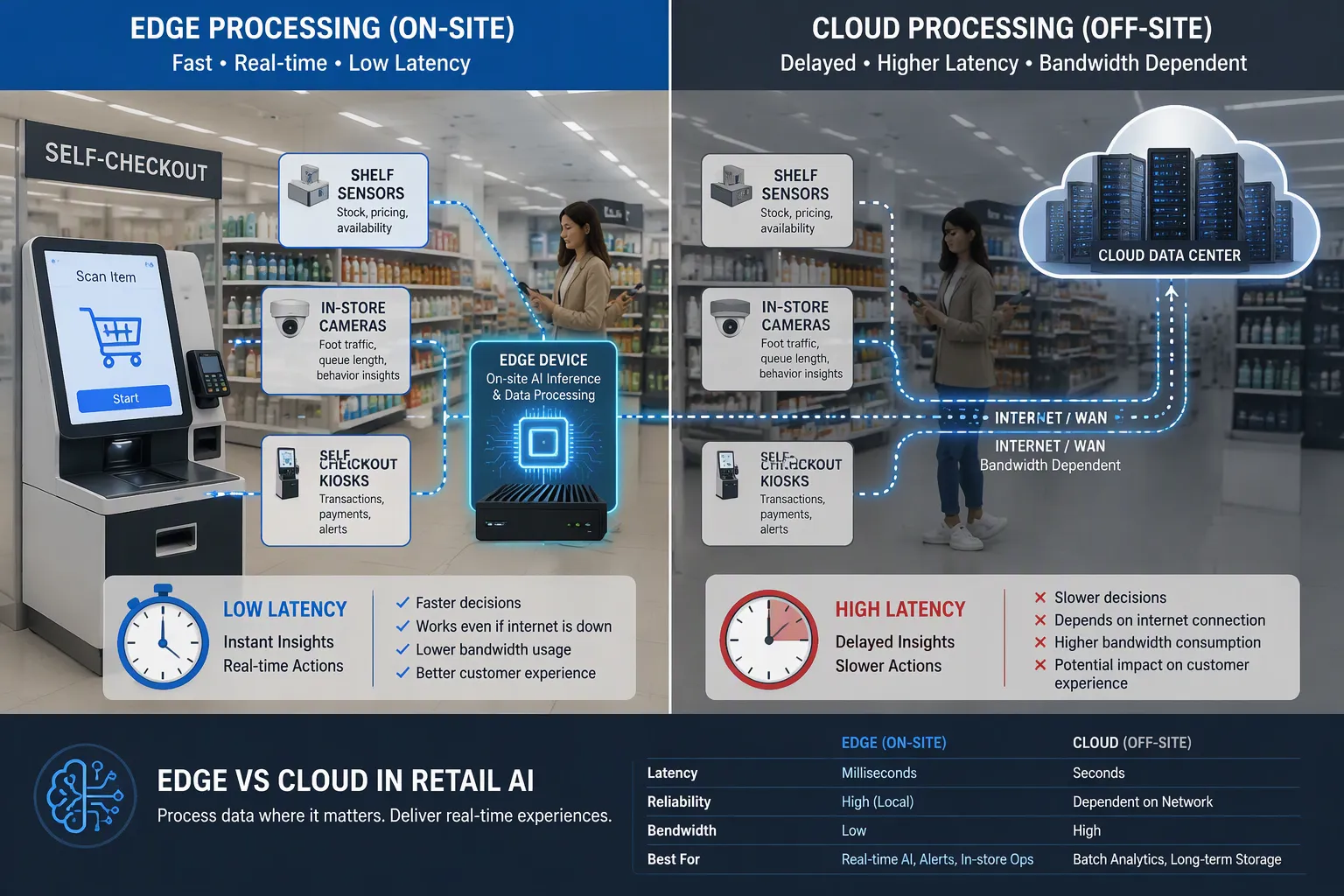
Speed decides many retail results. Edge computing vs. cloud computing differs most clearly here. Edge computing processes data on site, so results come back almost instantly. Cloud computing depends on network distance. A request travels to a far data center and back. That round trip adds delay. A shopper waiting at a self-checkout kiosk feels every extra second. Edge setups support low latency for tasks that cannot wait. Local processing also gives reduced latency for camera feeds and shelf sensors. Shoppers and staff notice the difference through faster real-time responses.
Retail AI workloads differ in how much speed they need. The table below maps common use cases to their real-time processing needs.
Retail AI Use Case | Real-Time Processing Requirement |
|---|---|
IoT-driven operations | Study real-time sensor, camera, and smart device data to improve in-store analytics and ecommerce logistics |
Customer engagement | Give real-time customer engagement in natural language through generative AI |
Dynamic pricing | Change prices in real time based on demand, competitor pricing, and customer preferences |
Hyperpersonalization | Combine real-time behaviors, preferences, and environmental factors for precise, dynamic experiences |
AI chatbots | Process natural language from millions of customer conversations and reply with relevant information in near-real time |
AI agents for pricing and inventory | Watch vendor prices, rebalance inventory, and adjust prices to match competitors in real time |
Marketing optimization | Adjust campaign settings in real time for best performance |
Fraud detection | Study suspicious transaction activity in real time to fight shrink |
Bandwidth and Reliability
Video and sensor data grow fast in stores. Sending every frame to the cloud strains networks and raises transmission costs. Store networks carry limited capacity, and peak hours test every link. Edge computing architecture keeps raw footage on site and sends only summaries upstream. This bandwidth optimization cuts congestion and lowers data bills. Cloud computing still handles heavy processing well. Centralized systems suit large model training and long-term analytics. Each side carries the load it handles best.
Reliability separates the two models during outages. Localized processing keeps critical applications running even when the store loses its internet link.
Localized processing ensures high-bandwidth, latency-sensitive applications run smoothly, even if the store's internet connection is disrupted.
A sound edge computing architecture plans for failure from day one. Teams should:
Design edge architectures with redundancy: backup compute nodes, mirrored storage, and failover networking paths.
Ensure continuity of operation even if individual components fail or become isolated.
Embed proactive monitoring, automated recovery protocols, and health checks.
Enable self-healing so nodes can reconfigure or re-route workloads dynamically during localized failures.
Adopt resilience from the outset to reduce downtime and maintain service quality.
Edge computing gives a decentralized model that boosts reliability and flexibility for retail. It unburdens networks and reduces cloud dependencies. Point-of-sale and inventory management gain responsiveness as a result. Cloud platforms answer with strong redundancy across regions. Together, the two models cover both everyday speed and long-term resilience. AI inference at the edge handles urgent decisions, while the cloud stores and studies the history. Retailers that combine both gain a flexible foundation.
Matching Retail AI Use Cases
When Cloud Computing Excels
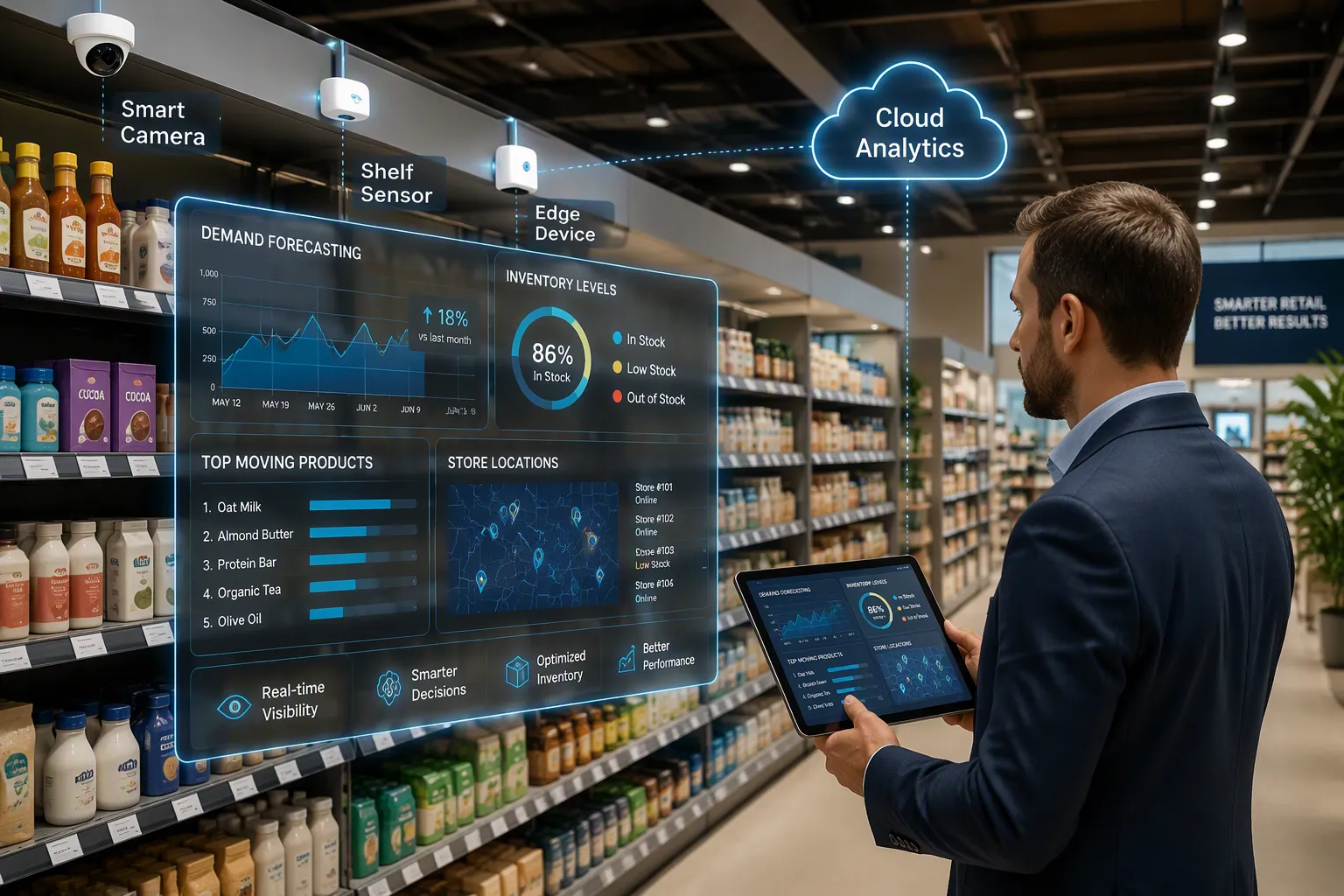
Cloud computing works best when a retailer needs to grow, keep history, and see the whole business in one place. Demand forecasting is the clearest example. H&M runs a demand forecasting agent on Google Cloud infrastructure. Machine learning models mix past sales, regional tastes, weather, and big-picture factors. The rollout started in pilot markets and then went global. Results include less overstock, less waste, better sustainability, and better demand alignment.
How It Supports Retail Demand Forecasting | |
|---|---|
Accurate forecast generation | Makes precise forecasts that line up demand-driven results |
Single view of demand | Gives value from planning strategy to inventory productivity |
Full product lifecycle coverage | Boosts accuracy with custom approaches for short and long lifecycle products |
Adaptability to demand drivers | Adjusts to trends, seasonality, out-of-stocks, and promotions |
Operational outcomes | Raises inventory productivity, cuts costs, and improves satisfaction |
Cloud platforms also support centralized customer analytics and long-term data archiving. Retailers often run ERP and point-of-sale systems on cloud infrastructure to centralize data management. This base lets teams launch AI agents quickly and reliably. Scalable data pipelines pull data from ERP, POS, and CRM systems into one source of truth. High-concurrency infrastructure handles millions of SKUs across thousands of locations. Adjustable hierarchy levels allow forecasting from a single store and SKU up to regional or national views. Enterprise-grade encryption, role-based access control, and audit trails meet global data governance needs.
When Edge Computing Excels
Edge computing wins when seconds matter and data should stay on site. Real-time shelf monitoring is a strong fit. Walmart deployed a smart shelf monitoring system across 70 Canadian stores. Computer vision and machine learning run on edge computing infrastructure. The system tracks shelf stock levels in real time and alerts staff when products run low or sit misplaced. A survey by IHL Group found that retailers using these technologies achieve a 15% reduction in out-of-stock items.
Edge computing strengthens in-store inventory management by giving real-time inventory monitoring and sending alerts when products are running low or out of stock, so retailers can restock efficiently and reduce lost sales caused by empty shelves.
In-store personalization also belongs at the edge. Edge servers match shoppers to profiles and compute tailored offers in milliseconds through digital signage or smartphones. Instant loss prevention alerts follow the same logic. On-edge vision models at self-checkouts detect scanning errors or potential theft and alert attendants at once. These systems keep working even when the store network goes down. Ceiling cameras with edge AI track foot traffic, dwell time, and demographics. Video is processed locally, so sensitive imagery never leaves the store. That local processing preserves privacy while enabling real-time decision making on layout and staffing. Smart shelves with RFID and weight sensors, plus iot devices in back rooms, round out the picture.
Many retailers benefit from a hybrid approach. A sound edge computing architecture handles ai inference for urgent tasks, while cloud computing stores and studies the history. This split delivers reduced latency where shoppers feel it and scale where planners need it. Teams weighing cloud vs edge computing for retail ai – scenario commercial goals should map each workload to its natural home. Real-time applications live at the edge. Long-horizon analytics live in the cloud. Together they cover the full retail day.
Compliance and Data Privacy
Data Sovereignty Rules
Rules about where data can live shape the cloud vs edge choice in retail AI. The European Union's GDPR has strict rules about moving data across borders. Sending personal data to countries without strong laws, like the United States, needs extra safeguards such as Standard Contractual Clauses or Binding Corporate Rules. California's CCPA/CPRA is looser about transfers. It focuses on consumer rights to know, delete, and opt out of data sales. Fines under CCPA/CPRA can reach $7,500 per intentional violation.
These differences favor different setups by region. A retailer that sends prompts to a cloud LLM sends data to vendor servers that may sit outside the approved region. Every AI call then becomes a possible breach. Edge computing keeps sensitive in-store data local and uploads only analysis and insights. This local processing supports data residency rules and lowers exposure risk. Retailers facing strict sovereignty requirements often lean toward edge-first evaluation rather than default cloud deployment.
Best Practices for Compliance
Strong compliance starts with data minimization at the edge. Teams should collect only the data each use case needs, keep it briefly, and mask sensitive values before any boundary crossing. Encryption in transit protects every upload from store to cloud. Role-based access controls, multi-factor authentication, and regular patches harden the wider privacy and security posture.
Clear data governance policies tie these controls together. Retailers should document purpose, scope, consent, retention, and disposal in a privacy policy, and use data processing agreements for third-party transfers. Regular audits, AI impact assessments, and employee training catch gaps early. Human-in-the-loop checks keep AI decisions explainable. Together, these practices let edge computing and cloud computing each carry regulated workloads with confidence.
Edge vs. Cloud Computing: Cost Factors
Cloud Cost Structure
Cloud spending uses a pay-as-you-go plan. Retailers rent computing power, storage, and analytics tools and pay for what they use. They do not buy hardware up front, so cloud computing turns a big purchase into a steady monthly cost. Fees grow with usage, which works well for large rollouts. Teams skip buying servers and skip hiring data center staff.
This plan has trade-offs. Costs rise with data volume and query load, so heavy video streaming or constant model training can raise monthly bills. Finance teams should plan for usage growth over several years, not just the first quarter.
Edge Cost Structure
Edge setups cost the most money up front. Retailers buy cameras, sensors, and computer systems before any AI model runs. Small devices cost hundreds of dollars, while servers with multiple GPUs can reach hundreds of thousands. Busy micro-edge sites often need USD 0.5–1.5 million per site for rugged computers, power gear, and connections. Supply issues add more pressure: memory price increases of 12–28% are built into models, and wait times for key parts grew from 12–16 weeks to 20–32 weeks.
While edge computing reduces cloud-related data transmission costs, the upfront investment in edge devices and network infrastructure can be significant.
Daily operations show a mixed picture. Local processing cuts bandwidth bills, but a spread-out edge computing setup adds device management, remote updates, and on-site repairs. A central management platform helps, though the full stack stays complex. Tariffs of 7.5%–25% on electronics made in China can raise edge computing infrastructure costs even more.
A total cost of ownership view over three to five years answers the question. Compare hardware, software, bandwidth, maintenance, and downtime side by side. Many retailers find that edge rollouts must pay back within 24–36 months, so slow rollouts hurt the business case. Weigh scalability and cost efficiency against local speed, then let the numbers decide.
Commercial Scenarios and Best Practices
Choosing the Right Approach
A simple decision framework keeps the cloud vs edge computing for retail ai – scenario commercial review grounded. Teams start with the use case. They then check latency, compliance, and cost in that order. A shelf-monitoring alert needs an answer in milliseconds, so this workload leans toward edge computing. A quarterly demand forecast can handle delay, so it fits a centralized platform.
Compliance comes next. Regions with strict data residency rules push sensitive video and shopper data toward local processing. Cost closes the loop. Teams compare hardware, bandwidth, maintenance, and downtime over three to five years. A hybrid model often wins, because each workload lands where it performs best.
Implementation Tips
Strong edge computing best practices begin with a small pilot. Retailers should tie the pilot to a business problem, not an AI capability. They define a value hypothesis, set a baseline, and set a measurable target. A single store or one use case limits risk and confirms technical fit before any broad rollout.
Measurement decides whether to scale. Teams agree on metrics before launch and track reliability, efficiency, and experience together. Site uptime and incident frequency show whether the estate performs as required. Mean time to repair and the share of incidents with a known root cause reveal operational maturity. Latency and error rates for point-of-sale and local analytics connect infrastructure to daily store results.
A clear stage gate keeps a successful demo from becoming a production deployment by default. Teams move through defined stages, each with explicit criteria. A cross-functional group aligns executives, architects, and business stakeholders early. Many retailers also form an internal center of excellence to spread edge computing best practices and keep deployments consistent.
Cloud and edge computing are complementary, not mutually exclusive. A sound edge computing architecture handles urgent inference on site, while centralized systems store history and train models. Retailers that treat edge and cloud computing as one design gain speed where shoppers feel it and scale where planners need it.
Cloud and edge computing each solve different retail AI problems. The choice is strategic, not binary. Retailers should start with the use case, then weigh latency and bandwidth needs, check compliance requirements, and analyze total cost of ownership over several years. This framework keeps any cloud vs edge computing for retail ai – scenario commercial review grounded in evidence.
A hybrid approach often delivers the best result. Edge computing handles urgent inference on site, while the cloud stores history and trains models. This split gives shoppers fast responses and planners room to scale. Teams that treat both models as one design build a flexible, future-proof foundation for retail AI.
FAQ
Which workloads belong at the edge rather than in the cloud?
Workloads that need answers in milliseconds fit edge computing best. Examples include shelf monitoring, in-store personalization, and instant loss prevention alerts. Long-horizon tasks such as demand forecasting and customer analytics suit centralized platforms instead.
Can a retailer run AI without any cloud connection?
Yes, for specific tasks. Local edge systems keep critical applications running during network outages. However, most retailers still pair on-site processing with cloud services for model training, history storage, and enterprise-wide reporting.
How long should a retailer expect an edge rollout to pay back?
Many retailers aim for a payback window of 24 to 36 months. Slow rollouts make that business case weaker. Teams should compare hardware, bandwidth, maintenance, and downtime over three to five years before they commit.
What is the first step for a retailer new to edge AI?
Start with a small pilot tied to a real business problem. Pick one store or one use case, set a baseline, and define a target you can measure. Measure results, then scale up slowly once the pilot proves it works.
Does compliance favor one model over the other?
It depends on the region. Strict data residency rules, such as those under GDPR, often push sensitive video and shopper data toward local processing. Looser rules give retailers more freedom to use centralized cloud services.
See Also
AI-Powered Convenience Stores Are Growing: Essential Insights for Retailers
The Future of Retail Lies in AI-Powered Stores
Transforming Online Store Management with AI-Powered E-Commerce Tools
Modern Retail Benefits and Features of AI-Powered Combo Vending Machines
