How AI-powered stores improve staff productivity in Hospitals & healthcare facilities

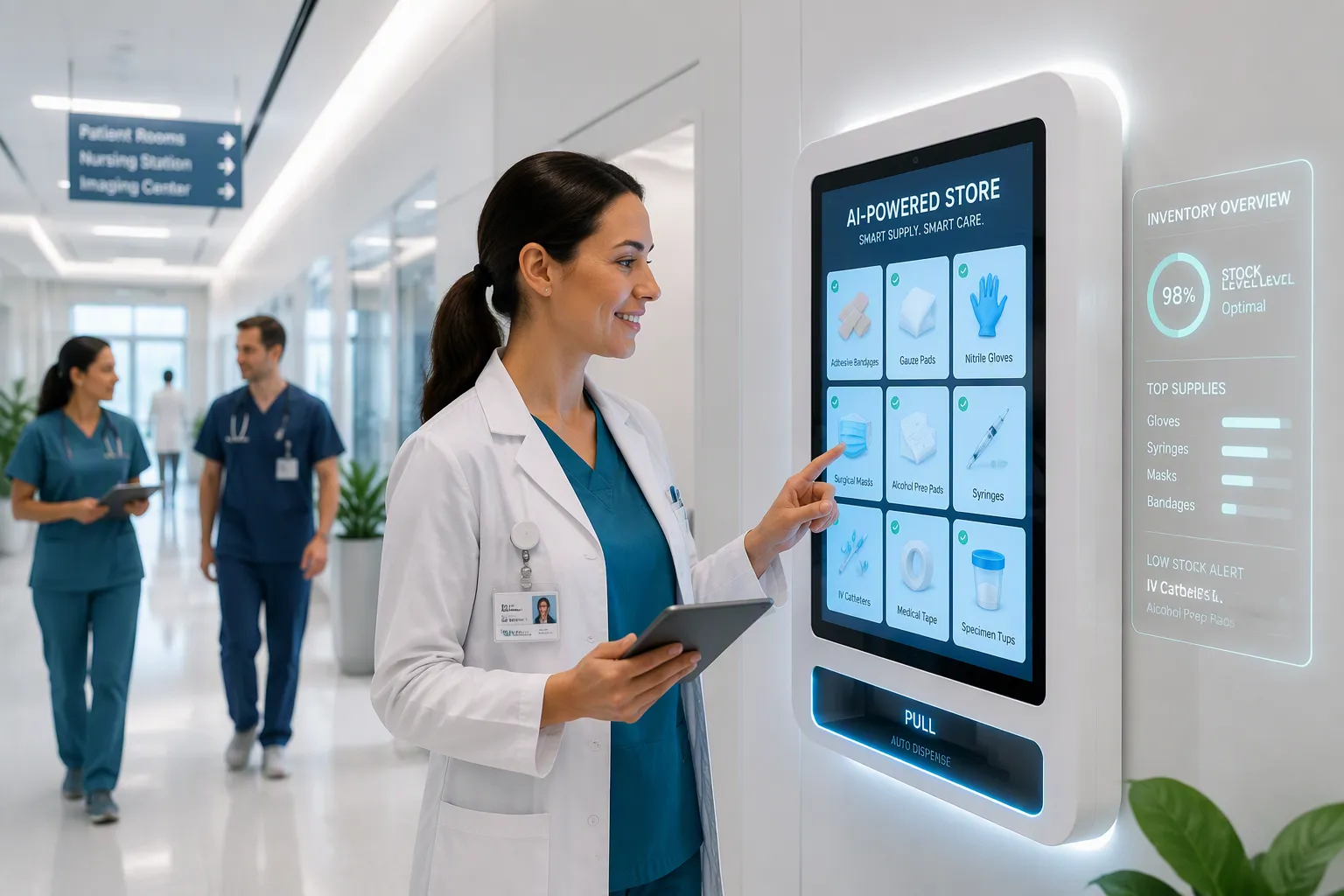
AI-powered stores improve staff productivity by returning time to clinical and support teams. Automated supply, inventory, and documentation tasks cut manual stock checks, speed supply access, and reduce administrative load. Clinicians reclaim those hours for patient care.
A nurse hunts for a missing supply cart mid-shift. Each minute spent searching steals attention from the bedside. This routine wastes precious time daily in hospitals. AI systems track stock levels, dispense items, and trigger reorders automatically. Measurable efficiency gains and calmer workflows follow.
These gains lift healthcare staff morale and strengthen patient outcomes. The challenges, mechanics, impact, and implementation steps deserve close attention from every hospital leader.
Key Takeaways
AI-powered stores automate supply tasks and give nurses more time for patient care.
Smart systems track inventory and reorder supplies automatically, reducing manual work.
Hospitals using AI see less staff burnout and better patient outcomes.
Leaders should pilot AI in one department and measure results before scaling up.
Early adopters gain efficiency and cost savings, improving overall hospital operations.
Staffing Shortages and the Productivity Drain
How Staffing Shortages Hit Daily Operations
Chronic understaffing strains hospitals across the country. About 100,000 nurses left the profession during the pandemic, and another 610,000 plan to leave by 2027. The U.S. faces a projected shortfall of up to 86,000 physicians by 2036. Half of America's rural hospitals operate in the red. These staffing shortages create a relentless productivity drain.
Fewer clinicians mean patients wait longer for treatment and appointments. Nurses and doctors manage more patients, which reduces time spent with each person. Overworked healthcare staff make more errors. Each additional patient per nurse raises the likelihood of patient death within 30 days of admission by 7 percent. Each extra patient beyond four per nurse increases nurse burnout risk by 23 percent. Hospital operations suffer as efficiency declines and administrative burdens grow.
Time Lost to Manual Supply Tasks
Consider a typical shift on a medical-surgical unit. A nurse needs a specific wound dressing for a patient. She checks the supply room. The item sits on a different shelf or remains in a locked cabinet. She walks to another floor. Twenty minutes pass before she returns to the bedside. That time vanishes from patient care.
Manual supply tasks consume hours across every department. Staff count inventory by hand. They fill out requisition forms. They call central supply for missing items. These administrative tasks pull clinicians away from documentation and direct care. AI can help medical practices with staffing shortages by automating these routines. Smart systems track stock, flag low supplies, and trigger reorders without human intervention. Hospitals that adopt these tools reduce the time staff spend hunting for items. Efficiency rises. Medical practices regain lost hours for patient interaction.
How AI in Hospitals and Clinics Works
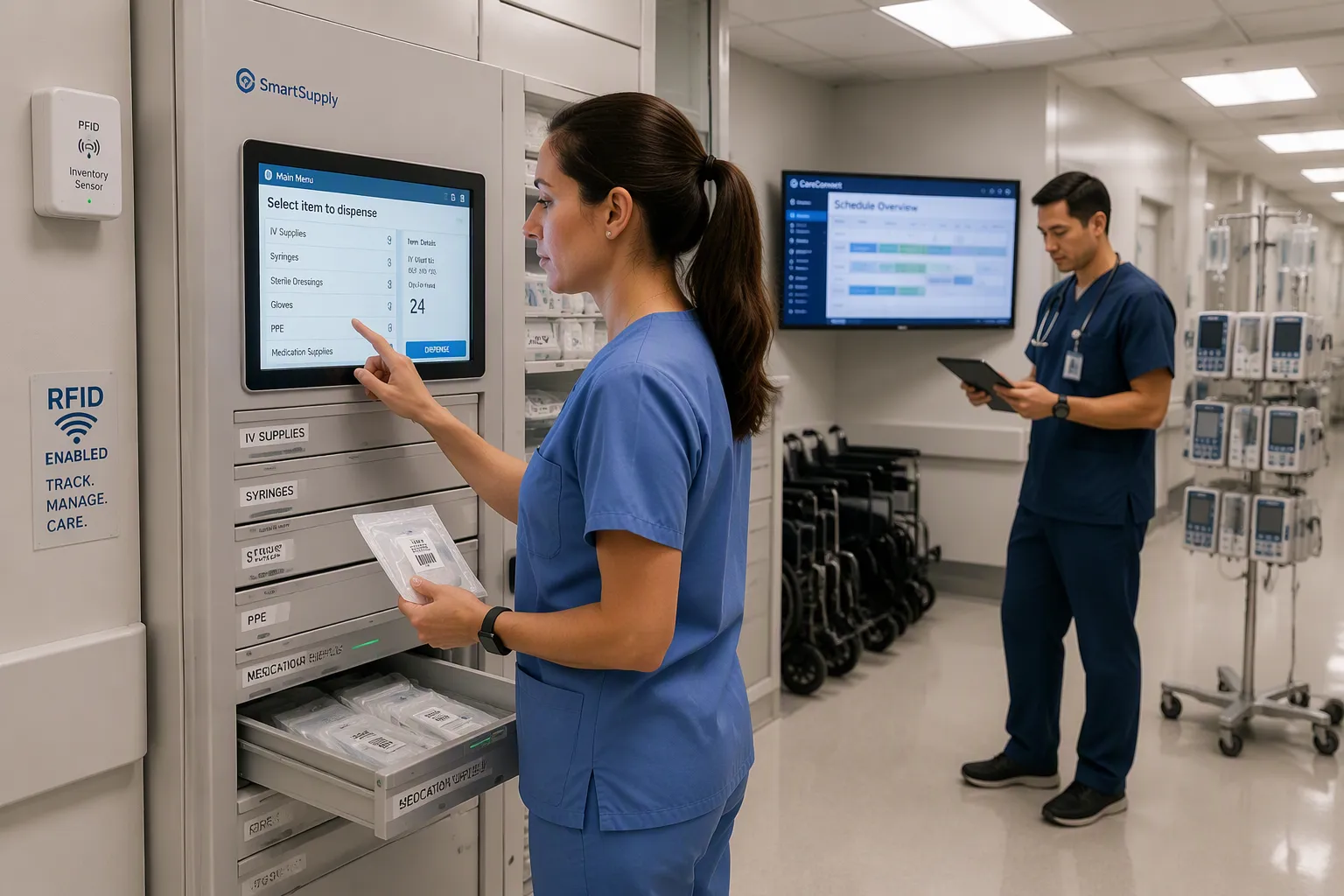
AI-powered stores function as automated retail and supply systems for medical environments. Cameras, sensors, and machine learning track items. Systems dispense supplies at the point of care. Reorders trigger when stock levels fall. This approach to ai in hospitals and clinics changes how hospital operations manage daily workflows.
Automating Administrative Tasks with AI
Automating administrative tasks with AI cuts clerical load that consumes clinician hours. Ambient listening tools capture patient conversations and convert them into structured medical records documentation. These tools also support billing and coding. Automated coding tools assign diagnostic codes from clinical data. Low-confidence codes get flagged for manual review instead of delaying an entire claim.
The same tools deliver artificial intelligence in healthcare benefits beyond notes. AI-driven scheduling systems analyze demand and recommend coverage levels. Chatbots handle appointment reminders and post-discharge follow-ups. Compliance monitors flag incomplete billing entries in real time. These ai applications in hospitals and clinics reduce administrative burdens that push staff away from direct care. Operational efficiency returns hours to clinicians. Note accuracy improves while charting closes faster.
Smart Dispensing and Inventory Automation
Smart dispensing cabinets place supplies at the bedside. RFID tags and sensors track inventory in real time. Clinicians locate defibrillators, IV pumps, and wheelchairs instantly instead of searching floor to floor. Automatic data transmission replaces handwritten requisition forms. A pharmacy RFID-barcode program reduced labor-intensive counting and shortened procurement cycles.
Predictive inventory management moves beyond simple tracking. AI examines usage history, demand patterns, and expiration dates. Stock that drops below thresholds triggers purchase orders without human action. A scoring framework weighs each item's necessity, financial value, and demand frequency. High-scoring items receive continuous tracking and automatic restocking. Low-scoring items receive lightweight monitoring. This prevents both surpluses and stockouts while controlling procurement cost. AI in healthcare settings helps medical practices with staffing shortages by returning lost hours. AI in the doctor’s office works the same way. Cameras watch supply shelves, algorithms reorder consumables, and clinicians focus on patients rather than inventory counts.
The system preserves clinical control over medical decisions. AI analyzes information, flags patterns, and triggers automated workflows. Nurses and doctors still make every clinical call. The technology handles logistics. This division strengthens hospital operations and management while protecting professional judgment. Efficiency rises because routine work disappears. Clinicians report less burnout and more time for meaningful interaction. Overall efficiency in supply handling improves financial performance.
For example, if a patient's electronic record indicates a need for a specific medication, Vision AI can automatically check stock levels, place a reorder, and track the delivery timeline with no manual intervention.
Facilities that adopt these systems gain. Automated tasks such as stock counting, reorder generation, and charge capture happen silently. AI analyzes real-time usage patterns to optimize PAR levels and suggest cost-effective purchasing. It detects shortages before they disrupt care. Supply chain efficiency improves without sacrificing quality. The cumulative savings restore substantial time each year. Those hours become patient education, preventive care, and earlier intervention. AI-powered stores improve staff productivity across every department. Efficiency gains compound across departments.
How AI-powered Stores Improve Staff Productivity
More Time for Patients, Less Burnout
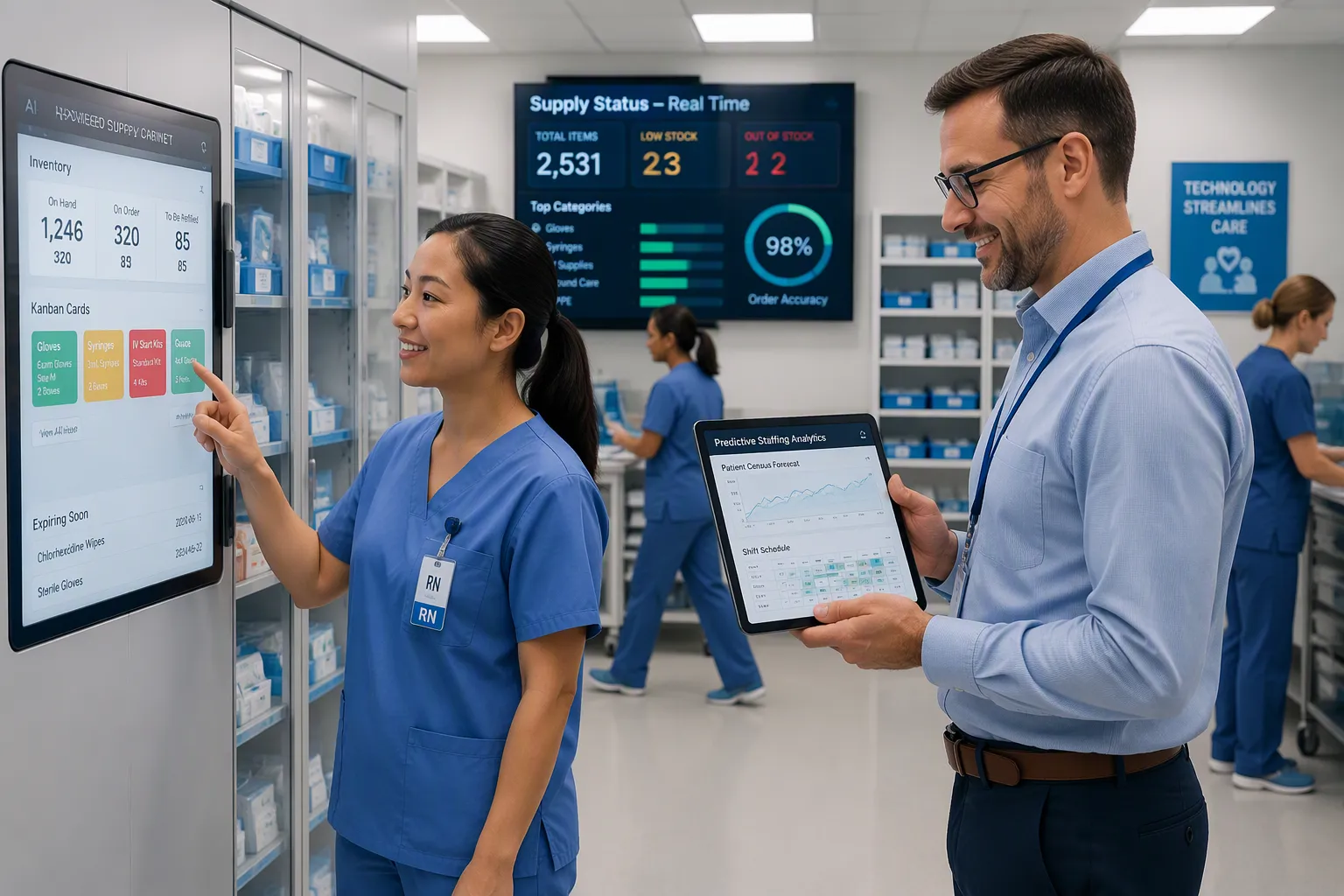
Automated supply systems return time to the bedside. AI-powered stores recover time spent on supply searching and management. Removing that burden frees nursing time for direct patient care.
AI also predicts staffing needs. The technology aggregates data from electronic health records, admissions logs, and historical patient patterns. It forecasts expected patient volume by department or shift. Staffing coordinators then align resources with care needs proactively. A Director of Patient Flow at a large Midwest health system reported moving from crisis mode to proactive alignment. The forecasted census guided resource decisions up to seven days in advance.
Enterprise-wide visibility lets coordinators balance overstaffed and understaffed units. A Senior Staffing Coordinator at a large Florida health system described moving nurses from overstaffed to understaffed units to balance the board. Predictive staffing technology optimizes existing staff before turning to agency or premium labor. Forecasted census thresholds trigger different levels of incentive pay. A Market Director of Nursing at a large Midwest health system used staffing percentages, such as 90 percent versus 70 percent, to decide when higher incentive pay was needed for critical shifts.
These gains reduce burnout. AI-driven scheduling tracks total hours, overtime, and shift distribution to ensure fairness. Last-minute changes drop. Shift predictability improves. Overwork and absenteeism decline.
Better Patient Flow and Care Coordination
Equipment availability drives patient flow. When the right equipment is missing or poorly distributed, patient transfers and procedures are delayed. Staff lose time searching, borrowing, or improvising. Real-time visibility into equipment and inventory reduces this friction. Departments gain an accurate shared view of what is available. The movement of patients through the hospital smooths out.
AI-driven hospital operations raise patient throughput by forecasting bed demand and improving bed visibility. Discharge readiness tracking and discharge coordination manage discharge planning and follow-ups. ED wait-time visibility, capacity monitoring, and bottleneck alerts surface operational delays. Workflow automation targets admission and registration, discharge coordination, scheduling, and task routing to cut repetitive manual work.
Care coordination improves when AI assigns and prioritizes tasks based on urgency and role. Duplication of effort drops. Outreach schedules optimize so the most at-risk patients receive timely attention. For a COPD patient who has not completed a symptom survey and shows dropping oxygen levels, the platform sends the case to a nurse for review and prompts a care coordinator to follow up. For a hypertension patient with consistently elevated blood pressure despite recent medication adjustments, the platform flags the case for the prescribing provider and triggers patient-specific education materials.
Over time, AI learns from historical care team interactions. Duplicated work declines. Outreach schedules improve. Collaboration becomes smoother. Fewer interventions are missed or delayed. These improvements connect directly to operational efficiency and support productivity across departments. AI-powered stores improve staff productivity by returning time, reducing reactive care, and strengthening hospital operations.
Implementing AI-powered Stores in Healthcare
Assessing Needs and Choosing a System
Hospitals begin with a cross-functional team. Representatives from every department involved in supply chain management join the assessment. Through value analysis, internal and external stakeholders discuss the cost and value of different products regularly. These shared conversations keep patient safety central to every decision. The team then compares system options against real workflow needs.
A key choice separates enterprise resource planning systems from best-of-breed healthcare solutions. Enterprise systems often lack deep healthcare focus and demand longer implementation with dedicated customization. The hospital must adapt its workflows to the system. Niche healthcare solutions bring deep industry knowledge, adapt to hospital workflows, and target specific departments such as surgery or interventional medicine. These focused tools address areas representing 60 to 70 percent of total supply costs.
Assessment Consideration | ERP Systems | Best-of-Breed Healthcare Solutions |
|---|---|---|
Healthcare expertise | Limited | Deep industry knowledge |
Implementation | Longer, customized | Affordable, flexible |
Workflow fit | Hospital adapts | System adapts |
Focus areas | Broad | Specific departments |
Cost coverage | Not specified | Targets 60–70% of supply costs |
Leaders must also confirm fundamental features. The system needs communication that integrates clinical and financial data. Ease-of-use enables process standardization. Scalability supports single and multi-site management. An open, flexible design ensures data integrity. Reporting and analytics provide real-time inventory visibility from receiving to patient care. The system should support PAR, Kanban, ROP/ROQ, EOQ/ROP, Min/Max, and consignment methodologies. Superior service covers workflow design, implementation, and ongoing support.
Training Staff and Measuring Results
Adoption depends on training and change management. Staff need hands-on practice with dispensing cabinets, scanning tools, and reorder dashboards. Champions in each department model the new workflow and answer questions. Clear communication explains why the change matters: less time counting, more time caring. Resistance fades when healthcare staff see the system remove daily frustrations.
Measurement closes the loop. Leaders should track productivity before and after launch using concrete metrics. Time spent searching for supplies, stockout frequency, and reorder accuracy all matter. One department serves as the pilot. Integration with existing supply chain systems follows. Automating administrative tasks and inventory management then scales across the facility. This disciplined approach strengthens hospital operations and management while proving value at every step.
AI-powered stores improve staff productivity through automated inventory, faster supply access, and a lighter administrative load. Staff satisfaction rises when daily frustrations disappear. These gains strengthen patient care and ease staffing shortages over time.
The market reflects this momentum. Hospitals that act early capture efficiency gains first.
Leaders should pilot AI-powered stores in one department before scaling. Measure efficiency before and after. Hospital operations improve when technology handles logistics and clinicians focus on healing. The future of AI-supported healthcare workplaces looks brighter every year.
FAQ
What exactly is an AI-powered store in a hospital?
An AI-powered store is an automated supply system. Cameras, sensors, and software track items, dispense products, and trigger reorders. These tools support inventory management across hospitals. They cut manual counting, boost efficiency, and speed supply access for clinical teams.
How does AI reduce the administrative load on clinical staff?
Automating administrative tasks with AI removes repetitive work. Ambient tools draft notes, and smart cabinets log usage. This cuts documentation time, lifts efficiency, and frees staff for patient care. Artificial intelligence in healthcare keeps clinicians in charge of medical decisions while software handles logistics.
Does this technology replace nurses or doctors?
No. The system analyzes data and triggers routine tasks. Clinicians still make every medical call. This division raises efficiency without touching professional judgment. Medical practices gain time for direct care, and efficiency improves at the bedside.
How do leaders measure success after launch?
Leaders track time staff spend searching for supplies, stockout frequency, and reorder accuracy. They compare efficiency before and after launch. A single department serves as the pilot. This approach strengthens hospital operations and management.
Why does this matter for hospital operations?
Chronic understaffing drains productivity. AI in healthcare settings returns hours to the bedside. Faster supply access and lighter administrative tasks improve operational efficiency. Hospitals that act early capture these gains first. Efficiency compounds across departments, and hospitals see stronger results.
See Also
The Reason Artificial Intelligence Powered Shops Represent Tomorrow's Retail
Ways Artificial Intelligence Powered Commerce Tools Reshape Digital Retail Operations
AI-Powered Combo Vending Machines Deliver Advantages To Modern Retail
Boosting Staff Efficiency Through Intelligent Vending Solutions For Compact Workplaces
Growth Of Artificial Intelligence Corner Stores Provides Key Retailer Insights
