From Overload to Accuracy. How Spatial Intelligence Reshapes Quick-Service Order Taking


Order mistakes rarely come from not caring. They come from cognitive overload in quick-service restaurants. Workers juggle order contents, timing, and handoffs under loud, fast-paced conditions. These parallel demands make errors a predictable result of an overloaded system, not a personal failing.
Spatial intelligence offers a practical way forward. It lowers mental load through real-time detection instead of adding more training or checklists. Traditional responses, such as heavier oversight and monitoring, add another layer of information to track. That extra pressure can lower accuracy rather than raise it.
This article explains why mistakes happen, why ordinary fixes fall short, and how detection-driven systems support steady accuracy.
Key Takeaways
Order mistakes happen because workers' brains get overloaded, not because they don't care.
More training and checklists can actually make accuracy worse. They do this by adding to a worker's mental strain.
Spatial intelligence uses the cameras already in place to catch mistakes right away, before orders leave the line.
A five percent gain in accuracy often pays back system costs within months in busy restaurants.
Teams should track how their work processes are doing. They should treat mistakes as problems with how the system is designed, not as personal failures.
The Hidden Cost of Order Errors
Small Mistakes, Large Fallout
A customer orders a burger with extra sauce. The worker forgets the add-on. That sauce costs cents. The fallout does not. The customer gets a refund, files a complaint, and may never come back. A problem worth many dollars grows from a mistake worth pennies. One missed item can wipe out the profit on a whole order and then some.
The full cost spreads across several areas:
A refund or chargeback given to the customer
Remaking the food to fix the mistake
Extra labor needed to make the replacement
Customer service time spent solving the complaint
Lost repeat business when an upset customer decides not to order again
These costs add up. Inaccurate deliveries make up 26% of total costs, which equals $6,760,000. The long-term cost of mistakes is estimated to hurt 38% of the total value of one customer. Lost loyalty and fewer return visits follow. So a single forgotten sauce can cost far more than the sauce itself.
The Invisible Sequence Behind Every Error
Current systems capture results. A refund shows up in the ledger. A complaint lands in a log. The sequence that caused the mistake stays hidden. No record shows which station skipped a step, which handoff failed, or when the add-on dropped out of the flow. Operators see the result, not the cause.
This gap keeps the distance between item cost and error cost invisible. A receipt shows what the customer paid. It does not show how the order moved through the kitchen. Without that view, teams cannot trace errors back to their source. They can only react after the customer notices.
The pattern repeats across shifts. The same stations miss the same steps. The same categories slip through at peak hours. Order errors therefore repeat, and accuracy stalls. Visibility into the sequence would turn each mistake into a fixable signal instead of a recurring cost.
Cognitive Overload in Quick-Service Restaurants
Why Cognitive Load Is the Real Constraint
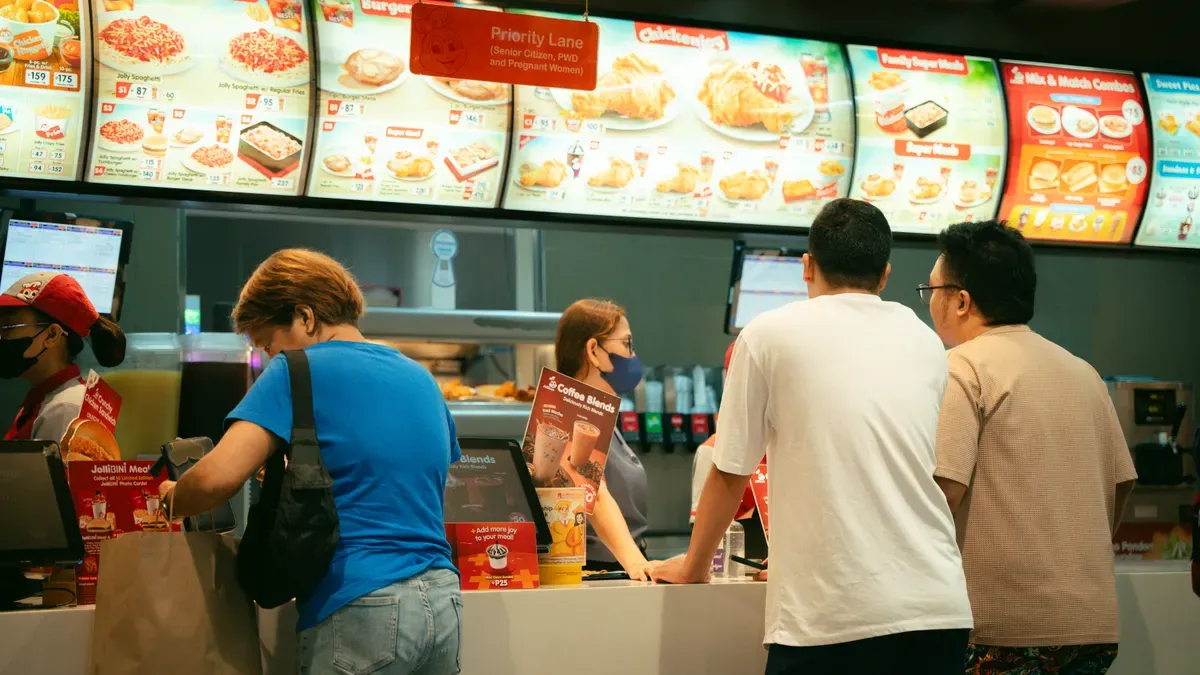
A counter worker keeps track of many things at once. They follow order contents, timing, and sequencing. They handle handoffs to the kitchen and back. They do all this in a loud, fast-paced room. Each task uses working memory. The brain has a fixed supply. When demand is greater than supply, steps get dropped. A sauce goes missing. A side never gets added. These errors are predictable results of an overloaded system, not signs of carelessness.
Cognitive load research backs this view. People already near their mental limits lose accuracy as pressure and oversight go up. A workable oversight system needs clear rules. It must define who monitors, when to step in, and what thresholds trigger human review. Without that clarity, oversight becomes fragmented or symbolic. It adds another task to an already full plate. Studies of automated systems show the same pattern. In a 2016 simulated fire study, all participants followed a previously malfunctioning robot toward a blocked exit instead of a clearly marked safe route. People trust automated output too much. They also stop paying attention when a system works well most of the time. They become least capable at the edge-case moment when oversight matters most. Requiring oversight tasks that people cannot reliably perform creates a trap. Cognitive limits turn into automatic violations.
Why More Training and Checklists Backfire
The instinct is to add training and checklists. Cognitive Load Theory explains why this often fails. Instructional supports help novices. They lack internal schemas, so worked examples and step-by-step guides lower their load. Experienced workers already hold those schemas. The same scaffolding becomes redundant information they must process anyway. This is the expertise reversal effect. The checklist that prevents a new hire's mistake slows down the veteran who automated that judgment long ago. The added support becomes extraneous load. It competes for the same limited working-memory bandwidth. Performance gets worse exactly when capacity is already strained.
A 2024 path-analysis study of 151 nursing students (Shahid Sadoughi University of Medical Sciences, 2021–2023) found that decision-making quality tracked more closely with extraneous cognitive load than with intrinsic load. It wasn't the complexity of the scenarios that predicted worse decisions — it was the noise around them.
The lesson applies directly to a busy restaurant. Added procedural noise degrades judgment. Extra checklists and redundant training raise cognitive load in quick-service restaurants instead of lowering it. The priority is to strip extraneous load before assuming the task itself is the problem. Cognitive overload in quick-service restaurants is a design condition. Teams can redesign the system to detect deviations in real time. That approach supports consistent execution under pressure. It also protects accuracy without asking workers to remember more.
From Expectation to Detection
Reducing the Need to Remember
The old way asks workers to keep more in their heads. A better way takes items out of working memory entirely. Detection systems watch the order as it moves. They flag steps that differ from the expected sequence before the bag leaves the line. The goal is to reduce the need for remembering, not to reward better recall.
This change alters the job itself. A worker no longer has to track every add-on in their head. The system tracks the order's path and compares it to the planned steps. When a step is missing, the system signals a hold instead of letting the order continue silently. The logic is simple: the camera says "this item arrived here," while the order record says "this item is not allowed here yet." That distinction matters. Physical tracking shows where an item is. Order logic shows where it should be.
Observing the Process, Not Just Outcomes
Process visibility turns each order into a sequence of events you can observe. Patterns emerge that outcome data alone cannot show.
Pattern revealed by process visibility | How it manifests | Mechanism that exposes it |
|---|---|---|
Skipped steps | An item reaches a downstream station before an upstream step is recorded complete | Physical events are checked against the order's routing logic; a mismatch triggers a hold |
Frequently missed manual steps | Manual checks are repeatedly not recorded during assembly | Automatic capture of physical movement exposes gaps where manual steps were expected but absent |
Routing exceptions | An item enters a station it is not permitted to enter given its assigned route | The system retrieves the order, routing, and completed steps, then checks whether the item is allowed there |
Poor routing visibility | Managers cannot see current work in progress, delayed orders, or bottlenecks | Consolidated real-time visibility of work in progress, delayed orders, and production status |
These patterns point to system design, not individual blame. A station skipped at peak signals a staffing imbalance. A category missed repeatedly signals a workflow gap. Real-time visibility of the process gives operators the evidence to fix the system. That evidence supports steady accuracy under pressure.
How Real-Time Spatial Intelligence Works

Tracking Order Assembly Without Extra Steps
AiFi's approach uses the cameras already mounted in the restaurant. Staff do not need wearables, extra sensors, or new steps. The system rebuilds the order assembly process as a continuous sequence of interactions. Sequence and Progression track how an order moves through the line. Interaction captures step-level actions at each station. Four layers turn raw camera activity into usable signals:
Camera (See): Existing overhead cameras capture activity. They show people as anonymous skeletal keypoints, not identifiable faces.
Digital twin (Map): Camera streams become a live spatial model that tracks people, objects, places, and time.
Event engine (Ask): AiFi's Event Driven Data Interpretation Engine (eddie), built on Microsoft Azure, turns camera activity into structured, queryable data.
Operator (Act): The structured output shows deviations and patterns so staff can act in the moment.
This real-time, spatially resolved detection catches sequence deviations before an order leaves the line. It flags interaction patterns that relate to downstream errors. It also helps managers rebalance staffing as pressure builds across stations. Operators see how an order is actually assembled, not just whether it was correct. Correctness becomes something they can actively manage in the moment. The system watches the process, not just the result. Managers gain a live view of where pressure is building.
Retrospective methods fall short by comparison. Weight-based verification signals a missing item, but it cannot say what is missing or where the item went. Video review provides context only after the fact. Manual checks slow the line and stay inconsistent. Each method captures a signal, but none ties that signal to the order's path.
Method | Key Limitation |
|---|---|
Weight-based validation | Not always trusted due to data gaps; incomplete or outdated SKU master data causes false failures and rework |
Video review (CCTV) | Not tied to the order; finding the right moment requires slow footage scrubbing; no consistent visual record proving box contents |
Manual checks | Slow and inconsistent; relies on floor checks that slow the line |
When a wrong or missing item claim arrives, support asks the warehouse, which checks with the shift lead. CCTV exists but is not tied to the order, and the packer does not remember the box. With no clear answer, the team refunds or reships just to close the ticket — a cycle that repeats.
Financial and Operational Returns
The financial case rests on a simple threshold. A five percent increase in order accuracy often offsets system cost within months in a high-volume quick-service environment. The gains compound across several areas. Fewer re-fires cut food waste and labor. Lower refunds protect revenue. Reduced overhead trims support time spent chasing tickets. A better customer experience brings repeat visits. The threshold matters because it turns a cost center into a measurable return.
The system also improves the workflow over time. Each flagged deviation becomes a data point. Teams can trace error rate by station, by item category, and by shift. They can compare time to detect against time to resolve. These process metrics support continuous improvement. Checks shift from after-the-fact review to in-the-moment correction. Over weeks, the data shows which stations need redesign and which categories need a different handoff.
Measuring Order Accuracy for Continuous Improvement
Process Metrics That Matter
Teams can't improve what they don't measure. Error rate equals total errors divided by total units produced, multiplied by 100. Quality rate works the opposite way: quality units divided by total units produced, times 100. Effectiveness compares actual outcomes with expected results across time, cost, and quality.
Operators should also track error rates across the line, order error rate by station, error rate by item category, re-fire rates, refund rates, and cost per error. Two timing measures complete the picture: time to detect an error and time to resolve it. A short gap between detection and resolution signals a healthy process.
Metric | What it shows |
|---|---|
How long orders take to move through fulfillment | |
Picking accuracy | How often the correct items and quantities are picked |
Fill rate | How much demand available inventory can meet |
Cost per order | The cost of processing and fulfilling an order |
Metrics should drive action, not just reporting. Regular analysis and small adjustments turn numbers into improvement. One e-commerce company used order processing time and fulfillment accuracy as key metrics. It found warehouse bottlenecks, added automation, cut order processing time by 30%, and lifted on-time delivery. These measures show whether order accuracy holds under pressure.
Reframing Errors as a System Design Issue
A blame-first response closes the document and leaves the problem open. An 8D report once concluded "operator negligence" and recommended a warning and a replacement. The underlying cause stayed untouched. In high-volume repetitive work, fatigue and lapses are part of the job. If one mistake can cause failure, the issue is systemic, not personal.
Aviation offers a parallel. Crashes first blamed on pilots were later traced to alert overload, poor interface logic, and automation surprises. The professionals did not fail; the system did. The reframing question becomes: why was the error possible, and why was it not caught?
The answer points toward rails rather than guardrails. Guardrails slow people down after a mistake. Rails make bad states structurally unreachable. Teams that treat cognitive load as a design condition redesign the system for consistent execution under pressure. They build prevention and recovery into the flow. Surface fixes only postpone the problem: teams patch the failure, symptoms improve briefly, the system grows more fragile, and the cause remains. The payoff is overall accuracy improvement that lasts.
Order mistakes do not happen because workers don't care. They happen because quick-service restaurants overload workers' brains. More training and more checklists add work without making orders more accurate. Spatial intelligence offers a different way. It uses cameras already in the restaurant to spot problems in real time, before a bag leaves the line. This spotting lowers mental strain and helps stop errors instead of fixing them later. The money case is clear. A five percent gain in order accuracy often pays back system cost within months in busy restaurants. Operators should stop expecting employees to remember more. They should design systems that catch errors in the moment and help workers stay consistent under pressure.
FAQ
Does the system require new cameras or wearable devices?
No. The system uses the overhead cameras that are already in the restaurant. Staff do not wear anything or scan anything extra. The platform turns the camera feeds you already have into a live spatial model of the line. Operators get real-time detection without adding hardware or changing how the assembly workflow runs.
What does real-time detection actually catch?
The system compares each order's physical path against the sequence it should follow. It flags a missing step before the bag leaves the line. It also brings up patterns: stations skipped at peak times, categories missed again and again, and staffing imbalances. Managers can see where pressure builds and rebalance before errors happen.
How does this differ from weight checks or video review?
Weight-based checks signal that something is missing, but they cannot say what or where. Video review explains an error only after it happens. Spatial intelligence ties each signal to the order's path in the moment. Detection and context arrive together, so staff can fix the order before it reaches the customer.
How quickly does the investment pay back?
A five percent increase in order accuracy often covers system cost within months in a high-volume setting. Savings come from fewer re-fires, lower refunds, less support time, and less food waste. Repeat visits from happy customers add more value over time.
How do teams use the data after deployment?
Each flagged deviation becomes a data point. Teams track error rate by station, by item category, and by shift. They compare time to detect against time to resolve. Over weeks, the data shows which stations need redesign and which handoffs need a different approach.
See Also
Comparing Micro Markets And Smart Stores In Global Automated Convenience Retail
Examining Walgreens Self Checkout Benefits And Difficulties In Retail
Growth Of AI Powered Corner Stores And Key Retailer Insights
Reasons Why AI Powered Stores Represent The Future Of Retail
How Cloudpick Delivers Cashierless Shopping Convenience To Your Store
