Leveraging AI Retail to Reduce Wait Times and Improve Passenger Flow

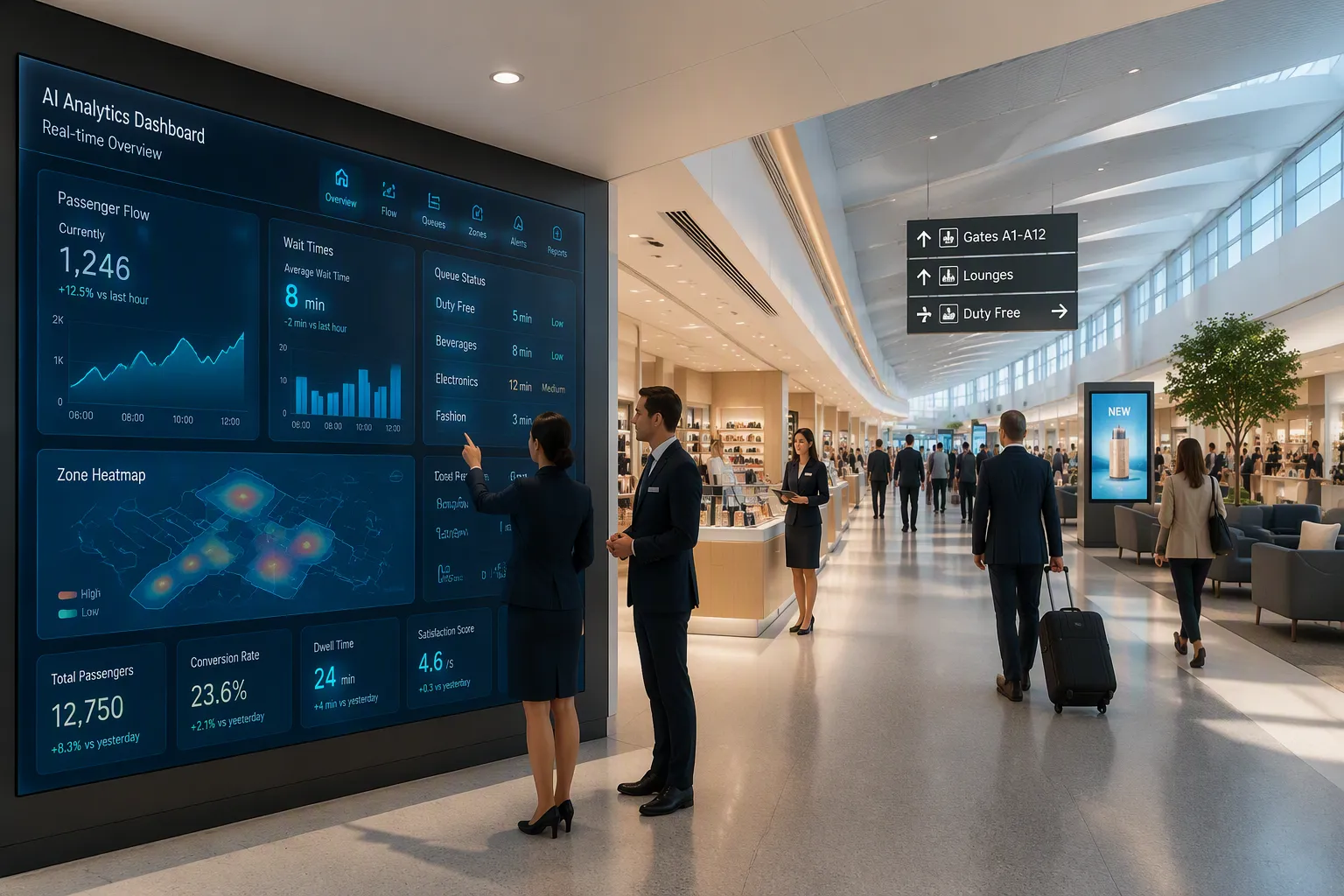
You watch passengers give up on long lines at your shopping areas. Each frustrated traveler means lost money and a worse airport experience. AI retail fixes this problem directly. Computer vision watches foot traffic patterns as they happen. Predictive analytics uses that data to predict crowding before it starts. Dynamic pricing then moves demand away from busy times.
These three technologies work together smoothly. You can set them up without stopping daily work. The result transforms how you approach handling peak passenger flow. Your airport becomes calmer, more efficient, and more profitable. Passengers spend more time shopping and less time waiting. This guide shows you exactly how to use these proven tools.
Key Takeaways
Long waits cut retail spending by 30% for each extra 10 minutes.
AI tools like computer vision and predictive analytics reduce crowding.
Dynamic pricing moves shoppers to quieter times, boosting sales.
Frictionless checkout cuts wait times by 70% and lifts sales by 22%.
Start with a small pilot to test AI and then expand it.
Impact on Airport Customer Experience
Passenger Pain Points and Revenue Loss
Congestion hurts your airport customer experience in clear, measurable ways. Recent surveys show departures satisfaction dropped 7 points from one quarter to the next. North America's regional score is 70%, the lowest among all regions. Mid-size airports are seeing the biggest drops. The reason is simple: passenger numbers now exceed what airport facilities can handle, especially in departures areas. TSA staffing shortages and longer screening times spill into security and departures, making the problem worse.
The money lost follows the same pattern. When a passenger waits an extra 10 minutes in any line, spending drops by 30%. Think about the security line: if wait times go from 5 to 15 minutes, spending drops by 30% for those passengers. On the flip side, cutting security wait time from 12 to 5 minutes raises spending by 21% for those travelers. Every minute in a line takes time away from shopping. Every minute saved brings revenue back.
Wait Time Change | Impact on Retail Revenue per Passenger |
|---|---|
+10 minutes in queue | -30% commercial spending |
Security wait 5 to 15 minutes | -30% spending |
Security wait 12 to 5 minutes | +21% spending |
Operational and Revenue Impact
The operational data backs up this urgency. Information from 89 US airports shows that a 10% increase in dwell time leads to a 6% increase in retail revenue per passenger. Since wait times cut into dwell time, the opposite is also true: longer lines mean less shopping time and lower revenue per passenger.
A 10% increase in dwell time produces a 6% increase in retail/duty-free revenue per passenger (based on panel data from 89 US airports, 2024).
AI changes this situation. Predictive analytics forecast passenger flows before crowding starts. You can place staff exactly where and when they are needed. Computer vision tracks movement patterns in real time, feeding data into systems that trigger automatic responses. These tools cut waiting time and speed up processing. The result is a smoother passenger experience that protects both satisfaction scores and retail revenue. Your operations become more responsive. Your efficiency improves. The data you already collect becomes the base for smarter choices about layout, staffing, and queue management.
AI for Handling Peak Passenger Flow
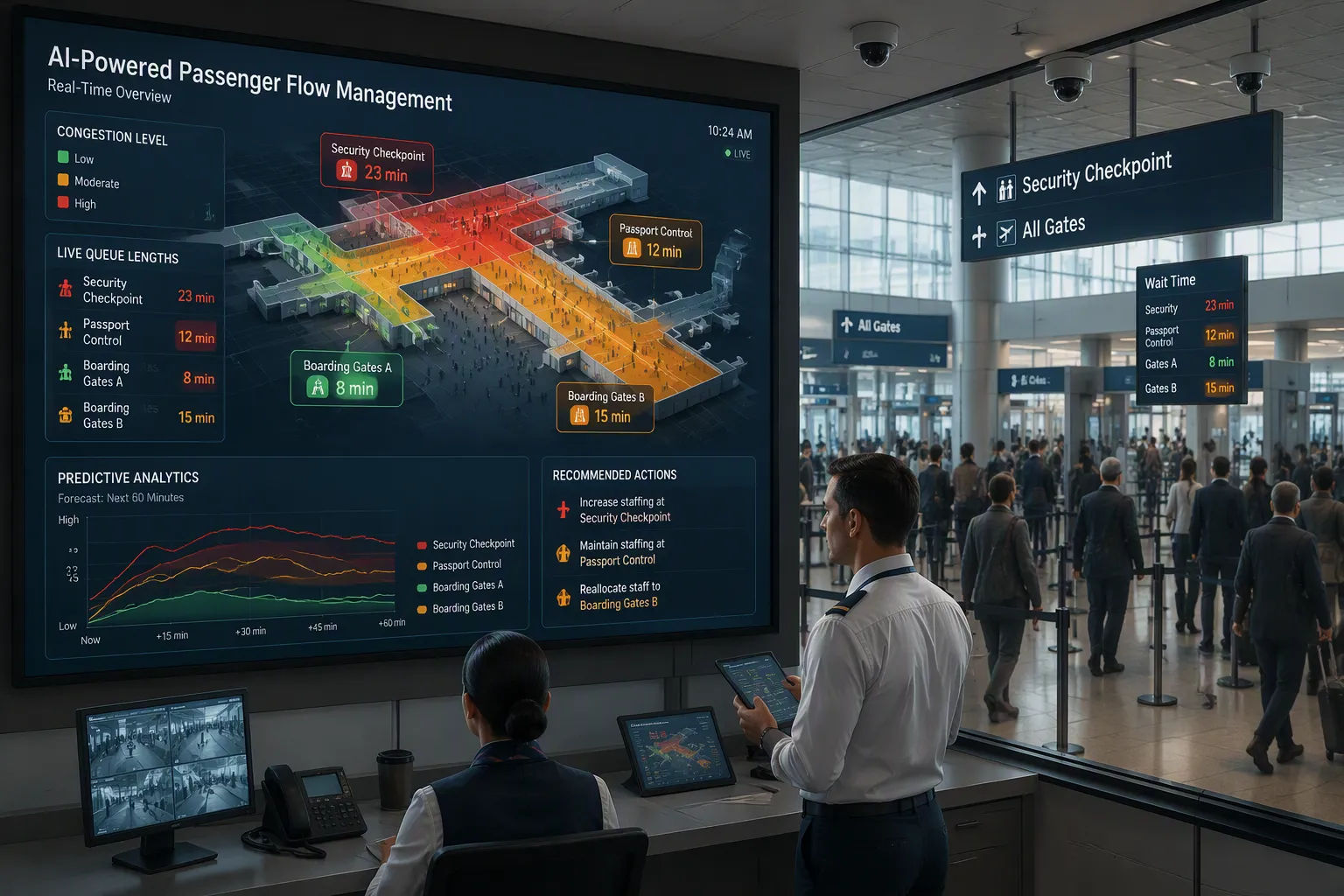
Computer Vision and Predictive Analytics
AI-powered vision systems track anonymous passenger movement across your terminal. These systems use privacy-safe 2D and 3D vision data without needing smartphones or biometrics. You get real-time views of congestion points, queue lengths, and occupancy levels through constant monitoring. AeroCloud Optic provides this visibility using your existing cameras, offering anonymous journey data for planning and operations without new hardware.
Predictive analytics turn this raw data into automatic actions. When congestion builds at gates or security areas, the system sends alerts. Staff can be moved quickly. Queue organization happens on its own. Passenger flow balancing keeps lines moving. AI models look at airline schedules, booking trends, and real-time security wait times to adjust staffing as needed. This stops bottlenecks before they start.
AI Technology | Application in Passenger Flow Management |
|---|---|
Predictive Passenger Flow Management | AI models analyze schedules and wait times to adjust staffing and queue management |
Optimized Gate Allocation | AI predicts congestion and turnaround times to reduce delays |
Intelligent Staff Scheduling | AI analyzes demand patterns to create optimal staffing schedules |
Baggage Handling Optimization | Machine learning identifies constraints and predicts congestion points |
Disruption Management | AI provides real-time recommendations during unexpected surges |
AI-powered biometric solutions can process images in under 1 second, greatly reducing queue times while keeping security strong.
Real airports show these tools in action. Singapore Changi Airport uses predictive passenger flow management and digital twin technology to test scenarios. Heathrow uses AI for demand forecasting and capacity planning. Amsterdam Schiphol uses crowd monitoring with computer vision, triggering actions when congestion builds. These systems produce clear results: shorter waits, higher throughput, and better passenger experiences.
Passenger Flow Simulation for Retail Planning
Airport passenger flow simulation predicts movement through shopping areas, helping retail planning for busy times. You can test layouts before building. You can spot stress points and moments of highest engagement. London Stansted Airport used Gensler's PerformaX simulation tool to model passenger movement before construction. The simulation showed which retail frontages had the best visibility at each journey stage. It found stress points from layout gaps. The evidence directly shaped terminal design, organizing spaces around passenger psychological states rather than past habits.
A study shows that advanced planning tools and simulation can increase throughput by 20–30% without adding infrastructure. Other reviews report a typical 15% reduction in operational costs from capacity planning and modeling.
Follow these steps to use simulation for your retail planning:
Collect timestamped flows, staffing rosters, equipment cycles, and demand forecasts.
Build a calibrated model and set target performance indicators like congestion levels and dwell time.
Encode business rules and select a simulation software tool.
Run scenario variants to compare trade-offs, specifically testing retail area bottlenecks.
Validate results across multiple scenarios and use distributions to inform layout changes.
Apply iterative cycles: test, implement, measure, and refine.
Simulation insights make airport resource planning easier. You track usage trends and model passenger movement. You see congestion points at check-in, security, and retail areas during peak times. These AI-driven models help you optimize resource allocation and improve scheduling across departments. This data-driven approach to handling peak passenger flow ensures your operations run smoothly even during the busiest travel periods. The result is a terminal where passenger flow feels natural and spending increases naturally.
Actionable Strategies for Peak Flow
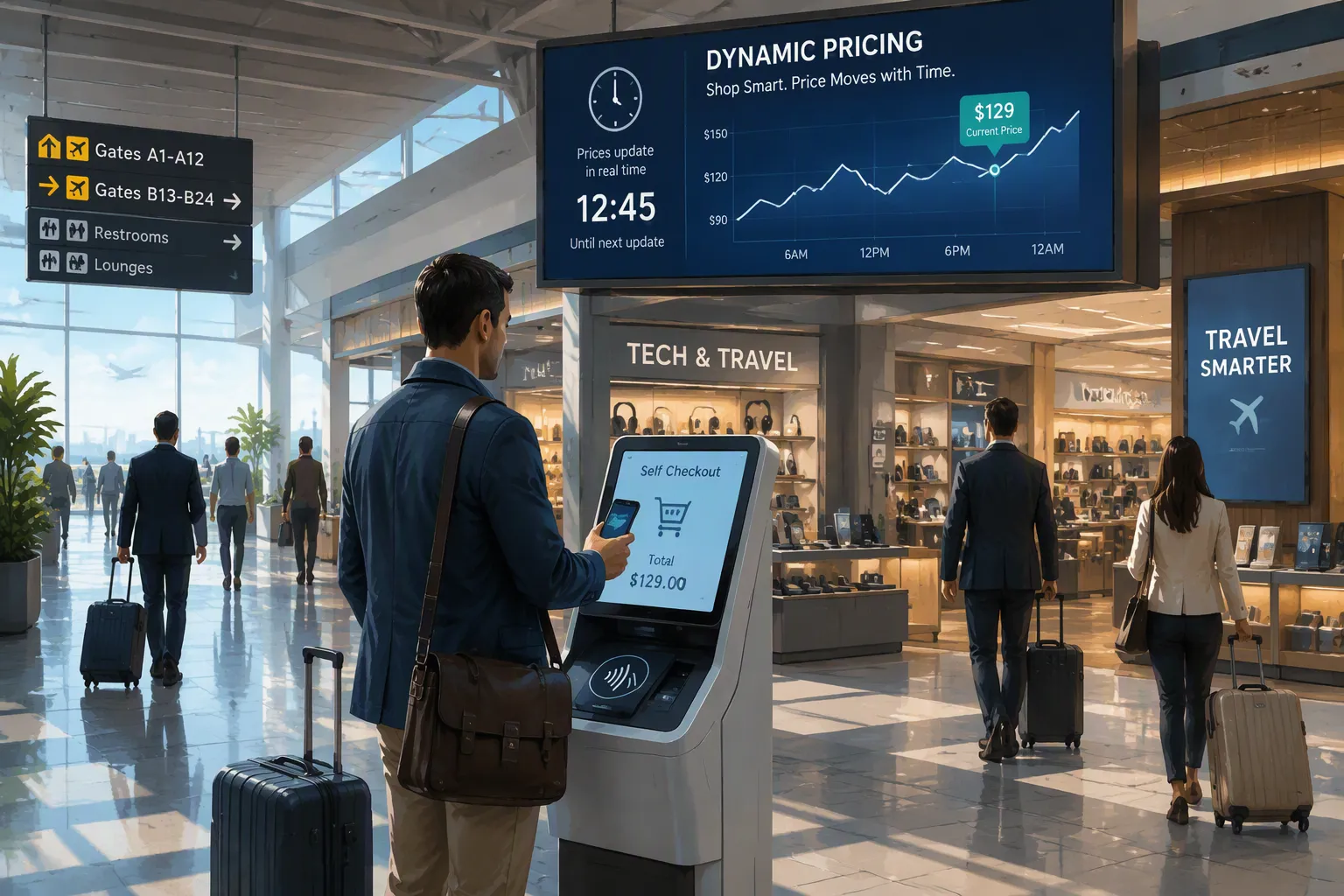
Dynamic Pricing to Shift Demand
Dynamic pricing gives you a direct way to handle crowding. You change prices based on what is happening right now. When you see a busy time coming, you can offer deals for slower hours. This moves shopping away from packed times. It works like rush-hour pricing on highways. You cut down on extra demand by giving travelers a reason to shop at other times. Begin with a small test. Look at your sales data for one week. Set lower prices for quiet hours. Check the results. Change your plan based on what you find.
Predictive analytics feed your dynamic pricing system. AI looks at passenger flow patterns from your tracking tools. It spots when crowding will start. Then it changes prices on its own. You can offer a deal at a calmer time. Travelers see the value and change their plans. This spreads demand across the day.
Your data collection makes this possible. You see when passengers reach retail zones. You know which hours have the most traffic. AI models use this information to guess future patterns. The AI system learns from each day's results. It gets better at predicting demand changes.
Handling peak passenger flow becomes easier when you spread demand. You do not need more workers during busy times. You do not need to build more space. You just use pricing to guide behavior. The result is a steadier flow through your retail areas. Travelers spend less time waiting and more time shopping.
You also bring your operations together around this plan. Your pricing team works with your operations team. They share ideas and plan together. This team effort makes sure every part of your airport works toward the same goal. The result is smoother handling of peak passenger flow in all areas.
Frictionless Checkout and Unified Operations
Frictionless checkout cuts down transaction time. You remove the biggest hold-up in retail: the checkout line. Self-checkout kiosks and mobile payment options let travelers pay without waiting. They scan items with their phones. They pay with a tap. The transaction takes seconds instead of minutes.
The results are clear. Dallas/Fort Worth Airport used checkout-free retail. Wait times dropped by 70%. Traveler satisfaction went up by 15 points. Sales grew by 22%. Los Angeles International Airport saw similar results. Wait times fell by 65%. Satisfaction rose by 18 points. Sales increased by 25%. These numbers show the direct impact of frictionless systems.
Appointment-based virtual queuing also works well. Travelers book a time slot for shopping. They arrive when their slot opens. They skip the line completely. This system cuts wait times by 72% on average. Customer satisfaction rises from 7.1/10 to 8.9/10. Worker productivity increases by 28% in customers served per hour. You serve more travelers with the same team.
Unified systems tie everything together. Your AI-powered workforce management system sees real-time information from your frictionless checkout systems. It knows when a queue is building. It sends a signal to open another checkout point. It changes staffing levels on its own. Your monitoring system tracks every transaction. It sends data back to your AI models. This requires careful handling of each retail zone. This creates a continuous loop of improvement.
Your airport becomes more efficient. You cut transaction times. You improve passenger flow. You increase revenue per traveler. The data shows that AI-powered retailers grow 30% faster than others. Your airport benefits from this same advantage. These systems also collect data on shopping habits. You learn which products sell best. You can adjust your inventory to match.
Handling peak passenger flow requires both strategies. Dynamic pricing shifts demand. Frictionless checkout speeds up transactions. Together they create a smooth experience. Travelers spend less time waiting. They spend more money. Your airport becomes more profitable. Your systems run more smoothly. The tools are available now. You can start with a pilot program in one retail zone. Measure the results. Then scale across your entire terminal.
Proven ROI of AI Retail
Case Study: a Major International Airport
Real airports show the clear value of AI-based passenger management. JFK International Air Terminal put in AI cameras to watch refueling, baggage unloading, airfield safety, and aircraft parts. This system spots delays before they happen. Cincinnati/Northern Kentucky International Airport uses similar tech. It studies past data and weather to predict flight delays and shares that with airlines. These tools cut waiting time and speed up airport work.
Airport | AI Technology | Purpose |
|---|---|---|
JFK International Air Terminal | AI-integrated cameras | Watch refueling, baggage unloading, airfield safety, and aircraft parts to predict delays |
Cincinnati/Northern Kentucky | AI-integrated cameras | Study past data and weather to predict flight delays |
Oslo Airport | Autonomous AI-enabled snowplows | Keep runways clear with less cost and labor |
Changi Airport | Solar-powered AI grass-cutting robots | Cut grass along set paths |
Detroit Metropolitan | Parallel reality sign | Show personal flight info to 100 passengers at once |
The numbers show clear gains. Dallas/Fort Worth Airport cut aircraft turn times by 5–12 minutes per turn. That added $15–$25 million in revenue. Heathrow saved 5 minutes per turn. That meant 3 fewer stands during busy hours. These gains come from AI-driven ground operations. You can use the same ideas in your retail areas. The tech is ready now, and airports worldwide prove it works.
Key Performance Indicators and Growth Metrics
You need clear metrics to measure your AI retail success. Track wait time cuts as your main goal. Watch passenger throughput to see how many travelers move through your terminal. Measure revenue per passenger to confirm the money impact. Customer satisfaction scores show if the experience gets better.
KPI | Category | Key Insight |
|---|---|---|
Sales per square foot | Sales | Measures revenue per unit area |
Conversion Rate | Sales | Percentage of visitors who buy |
Dwell Time | Customer Experience | Time spent in store |
Passenger Throughput | Airport-Specific | Number of travelers in terminal |
Peak Hour Performance | Airport-Specific | Store performance during busiest times |
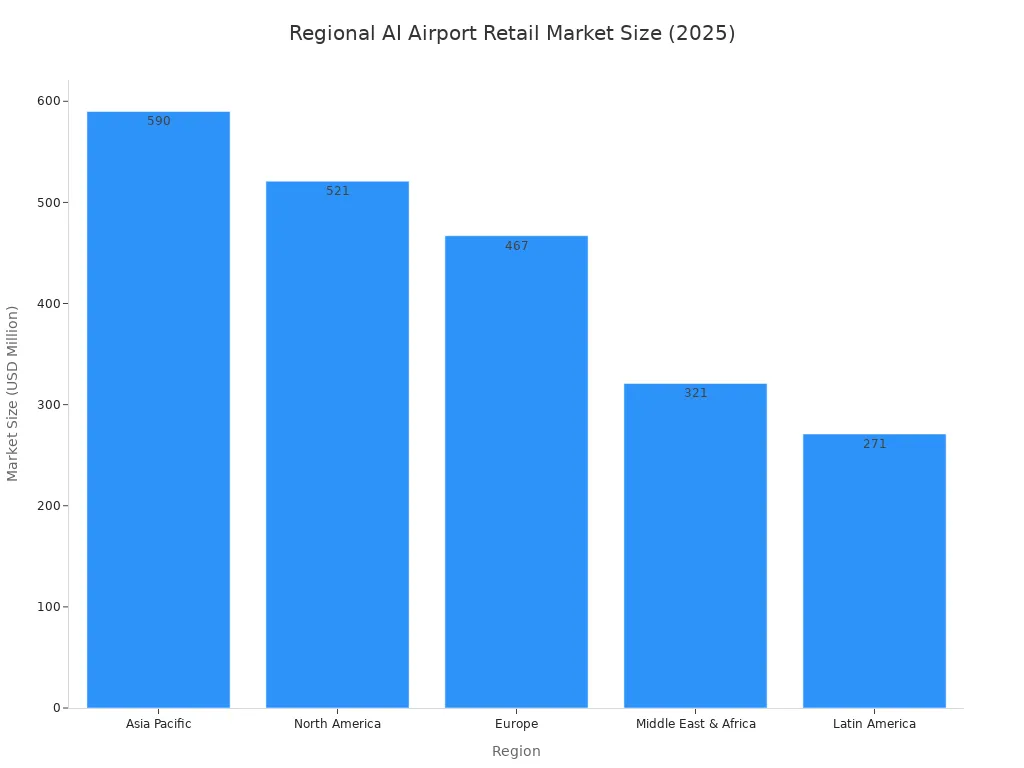
The market data backs your investment. The global AI-powered airport retail market hit USD 2.17 billion in 2025. Projections show growth to USD 10.89 billion by 2034. That is a compound annual growth rate of 19.4%. Asia Pacific leads with USD 590 million. North America follows at USD 521 million.
AI-powered retailers grow 30% faster than the rest of the market. This growth comes from better data, smarter operations, and improved passenger experiences. You can grab this advantage. Start with one retail zone, measure your KPIs, and scale what works. The proof shows that efficient airport operations with AI deliver real returns.
Congestion costs you real money. Every minute in line cuts retail spending by 30%. Your airport loses revenue with each frustrated traveler.
AI solves this problem directly. Computer vision tracks passenger movement in real time. Predictive analytics forecast crowding before it starts. Dynamic pricing shifts demand away from busy hours. These tools work together to smooth passenger flow.
The ROI is proven. Airports using AI cut wait times by 70%. Sales grow by 22%. AI-powered retailers grow 30% faster than competitors. The market data confirms this growth.
Start small. Install a queue monitoring system in one retail zone. Measure wait times and sales for two weeks. Compare results against baseline data. Scale what works across your airport terminal. The tools are available now.
FAQ
How does AI cut airport wait times?
AI systems watch passenger movement and predict crowding. You can adjust staffing and open extra checkpoints before lines form. Wait times drop significantly.
What technology powers passenger flow management?
Computer vision cameras watch foot traffic without identifying people. Predictive analytics forecast busy periods. Dynamic pricing shifts shopping demand to quieter hours. These tools work together to improve your airport flow.
Is passenger data safe with AI systems?
Yes. AI systems use privacy-safe vision data. They do not need smartphones or biometrics. Tracking stays anonymous. Your passengers’ information remains protected.
What results can airports expect from AI retail?
Airports using AI cut wait times by 70%. Sales grow by 22%. AI-powered retailers grow 30% faster. The ROI is clear and measurable.
See Also
The Future Of Retail Belongs To AI Powered Stores
Modern Retail Benefits From AI Combo Vending Machines
AI E Commerce Tools Revolutionize Online Store Management
Retailers Must Understand The Rise Of AI Corner Stores
Walgreens Self Checkout Offers Convenience And Retail Challenges
