Regulatory and compliance considerations for autonomous retail in hospitals and healthcare facilities

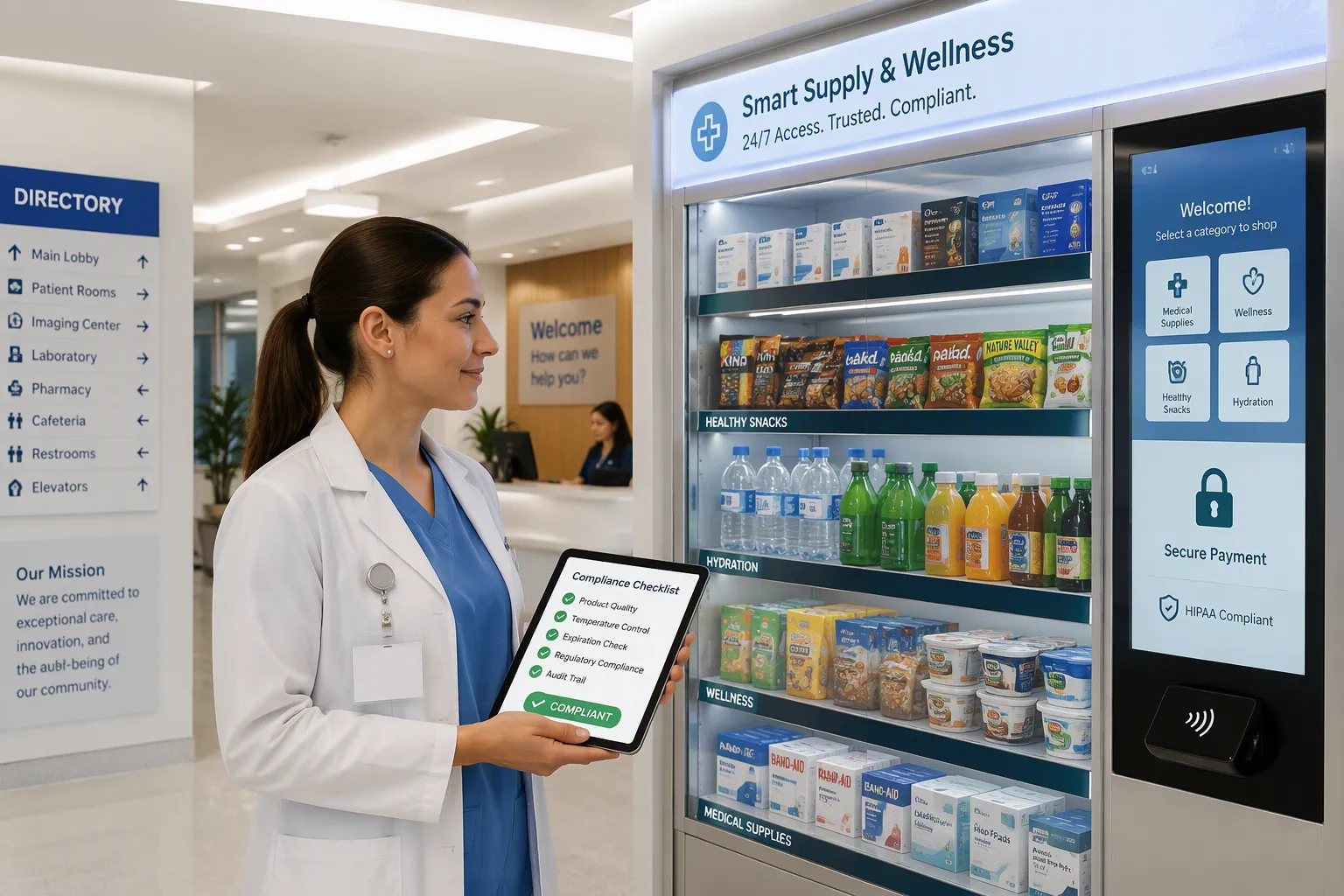
Compliance risk defines autonomous retail inside a hospital. The central regulatory compliance considerations include FDA product oversight, HIPAA/HITECH data protection, CMS Conditions of Participation, state licensing and permit requirements, infection prevention, product safety, and ongoing operational audits. These safeguards preserve patient safety, privacy, and compliance together.
A smart vending machine near the main lobby shows the real-world stakes. Leaders must verify food storage temperatures, payment encryption, recall procedures, and accessible design. Emergency access also warrants review under EMTALA.
Governance must precede the launch. This discipline keeps healthcare operations safe while adding convenience. Hospitals must first map the applicable regulatory framework before any deployment.
Key Takeaways
Map all rules before you start. This step prevents problems later.
Protect patient data with strong security. Follow HIPAA and HITECH rules.
Keep kiosks clean and products safe. Log all cleaning and temperature checks.
Get all permits and agreements first. This avoids fines and delays.
Train staff and audit regularly. This keeps your system compliant.
Review Regulatory Compliance Considerations
Healthcare Regulatory Framework
Autonomous retail operates under the same regulatory framework as every other hospital function. Federal agencies oversee distinct parts of the operation. The FDA governs product jurisdiction, including food, beverages, and over-the-counter medications sold through automated systems. CMS Conditions of Participation set the patient safety and environmental standards that hospitals must meet to receive Medicare and Medicaid reimbursement. HIPAA and HITECH establish privacy and security rules for any system that touches patient information. State health facility regulations add another layer of oversight.
EMTALA deserves special attention when an automated kiosk sits near an emergency department. The law requires hospitals to provide a medical screening examination to anyone who requests one. A kiosk that blocks, delays, or confuses patient access to emergency services could trigger a violation. Planners should position units away from emergency intake paths and post clear signage.
Compliance starts with an inventory of every applicable rule before deployment. This step reveals which obligations apply to the specific products, location, and data flows of each installation. Skipping this inventory creates blind spots that surface later as citations or patient harm.
State Facility and Retail Laws
State regulations vary widely and often overlap with federal rules. Many states require a food service permit for any location that sells packaged food or beverages. Retail sales permits may apply even inside a hospital cafeteria or lobby. Some states impose additional labeling, temperature logging, or inspection requirements on vending operations.
Hospital governance structures also shape what a facility may install. Concession agreements, lease terms, and internal procurement policies determine who owns the equipment, who holds the permit, and who carries liability. A hospital in one state may need a pharmacy-related authorization for OTC medications, while a facility across the border may not.
Leaders should verify state and local regulatory requirements early. This due diligence prevents costly retrofits and protects the hospital's license to operate.
Safeguard Patient Privacy and Data Security
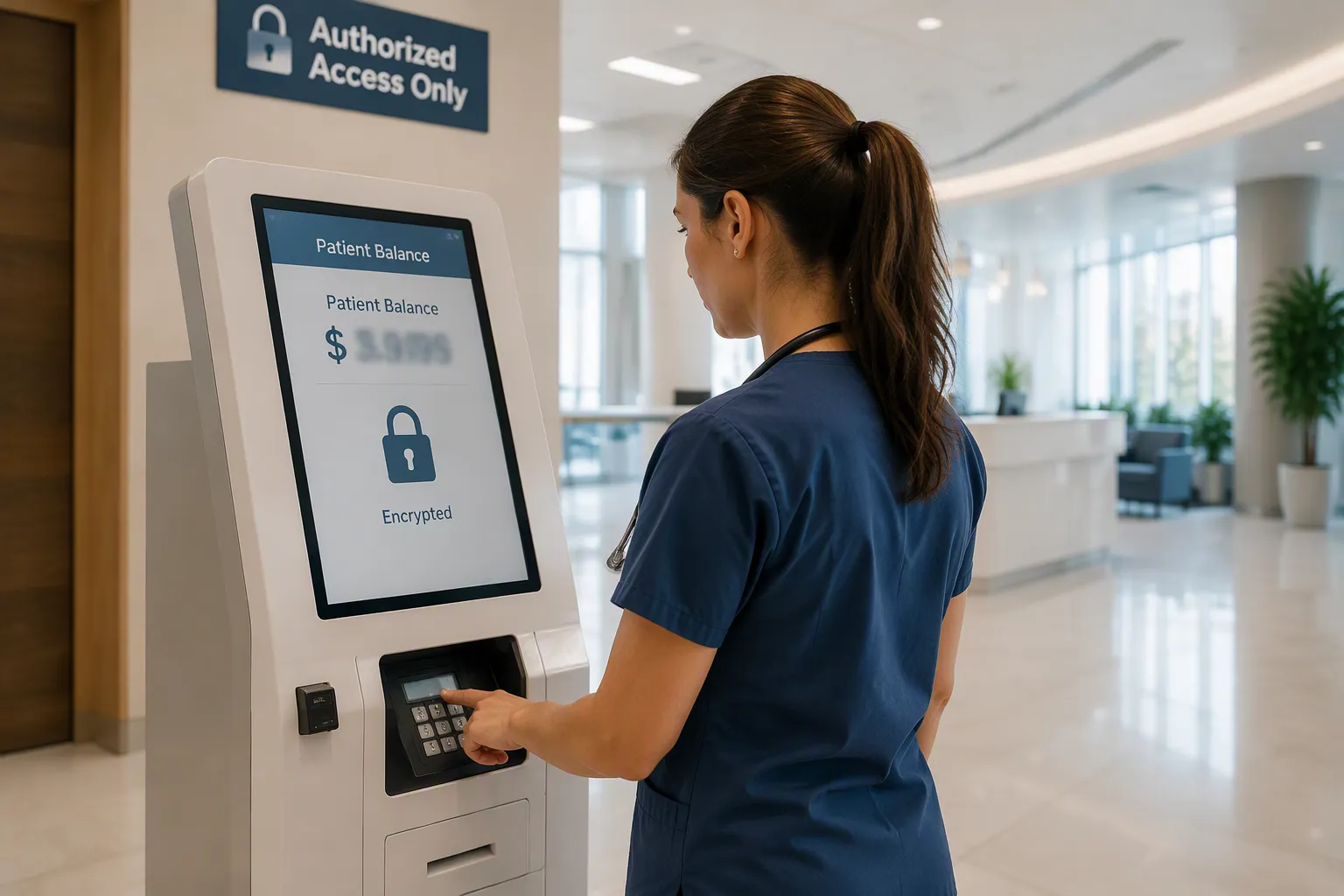
HIPAA Privacy and Security Essentials
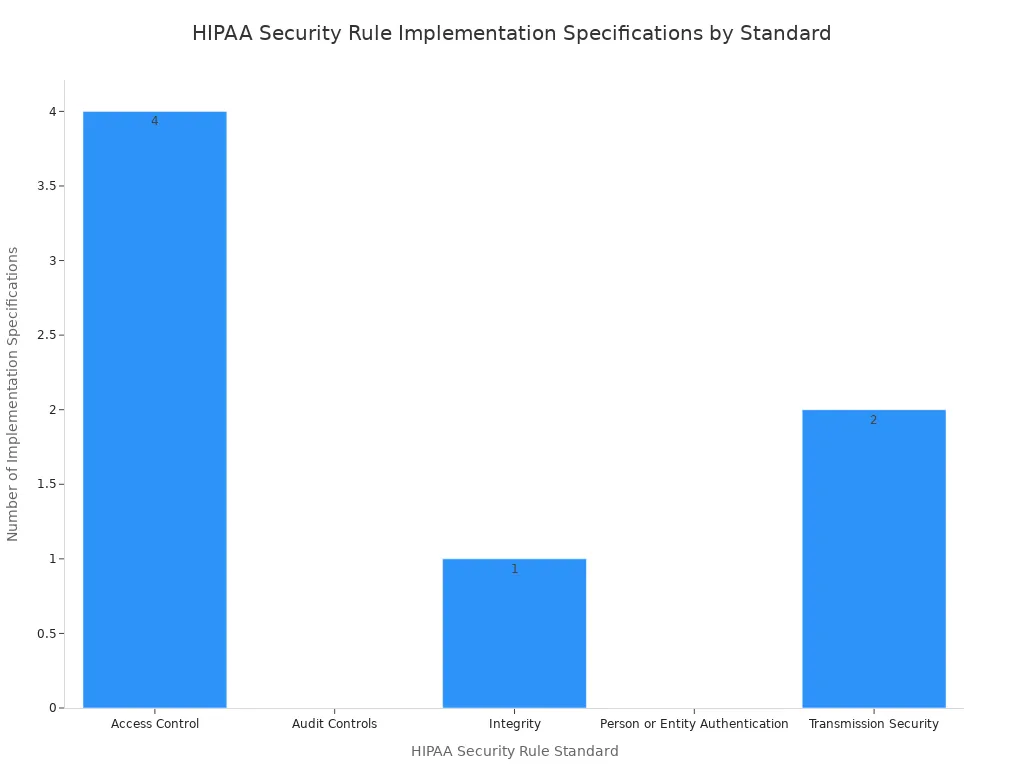
HIPAA applies to autonomous retail whenever a system collects names, payment data, or health-related information. A kiosk that displays patient balances or visit details handles protected health information and must meet HIPAA Security Rule safeguards. The rule requires access controls that limit ePHI to authorized persons or software programs. Encryption and automatic logoff are addressable specifications under 164.312(a)(2)(iv), yet the Breach Notification Rule gives them practical weight. Encrypted ePHI counts as not unsecured, which creates a safe harbor for breach notification. HHS points to NIST SP 800-111 for storage encryption and NIST SP 800-52, 800-77, and 800-113 for data in transit.
Audit controls under 164.312(b) require hardware, software, and procedures that record and examine system activity. Common violations include emailing detailed receipts through non-secure email, storing invoice notes inside consumer dashboards, and logging patient identifiers in analytics tools. Shared logins and consumer tablets are a frequent source of violations. Hospitals should harden point-of-sale systems, avoid local storage of PHI, and segment access between billing and clinical staff. These measures protect patient privacy and satisfy data protection regulations.
Standard | Role | Required or addressable |
|---|---|---|
Access Control 164.312(a)(1) | Limits access to authorized persons or software programs | First two required, last two addressable |
Audit Controls 164.312(b) | Records and examines system activity | Standard must be met |
Integrity 164.312(c)(1) | Protects ePHI from improper alteration or destruction | Addressable |
Person or Entity Authentication 164.312(d) | Verifies the identity of the person seeking access | Standard must be met |
Transmission Security 164.312(e)(1) | Guards against unauthorized access during transmission | Both addressable |
Business Associate Agreements and Breach Plans
A business associate agreement must be executed before any PHI is exchanged between the hospital and the autonomous retail vendor. The BAA should require encryption of all PHI during transmission, access controls, and regular security audits. It must specify prompt breach notification timelines, detailed reporting requirements, and a defined response plan. The agreement should also include a termination clause outlining data deletion or return upon dissolution. The Minimum Necessary Requirement obligates covered entities to limit PHI use, disclosure, and requests to the minimum necessary to accomplish the intended purpose.
The Minimum Necessary Requirement under the HIPAA Privacy Rule obligates covered entities to take reasonable steps to limit the use, disclosure, and requests for PHI to the minimum necessary to accomplish the intended purpose.
Hospitals should designate responsible individuals from compliance, finance, or IT to own the BAA process. Routine risk assessments of information systems help address identified vulnerabilities. Periodic BAA reviews capture business process changes that require updates. Strong governance around data security and privacy ensures that security and privacy in healthcare remain intact. This approach to data protection and compliance protects hospitals and their patients.
Maintain Safety and Infection Control
Cleaning and Product Safety
Autonomous retail systems create high-touch surfaces inside a healthcare environment. Hospitals must treat these kiosks like patient care equipment. Leaders need documented schedules for disinfecting touchscreens, keypads, and handrails. Staff should use hospital-approved disinfectants and log each cleaning event. The log verifies that the facility meets CMS patient safety standards. Surveyors cannot confirm a clean environment without documentation.
Product storage demands equal focus. Perishable food requires temperature checks that follow device specifications and local food codes. OTC products need legible FDA labels and protection from moisture or tampering. Vendors should keep maintenance records for refrigeration compartments and inventory systems. These records serve as audit evidence. A missing log can turn a minor lapse into a compliance finding.
Medication products require extra review. Hospital governance must approve the product list before launch. The list verifies labeling, packaging, and storage needs. Automated systems should alert staff before temperature deviates from the safe range. Cleaning logs should omit patient names or room numbers, a simple step that protects privacy.
Recall and Expiration Management
FDA regulations require traceable product lots. The autonomous retail system should maintain an inventory table linking each SKU to lot number, expiration date, and restock date. When a recall occurs, staff can identify affected slots immediately.
Expiration management demands system logic that blocks sale of expired or recalled items. The system should remove affected products from consumer menus automatically. It should also flag physical inventory for removal. Vendors must integrate this logic with the hospital's own safety, standards and reporting framework. The integration creates one unified hazard response.
Product tracing extends beyond recalls. Receiving logs connect damaged or contaminated products back to suppliers. Leaders should require vendors to keep these logs for a defined period. Traceability becomes a key part of audits. It also supports infection control investigations.
Finally, leaders must treat cleaning, storage, and recall duties as shared obligations. The BAA and vendor contract should assign clear responsibilities. This step prevents gaps between hospital staff and vendor technicians. Together, these systems create a defense that keeps patients safe and preserves trust.
Navigate Licensing, Permits, and Billing Compliance
Retail Permits and Concession Agreements
Autonomous retail inside a hospital requires a stack of permits before the first transaction. Food or retail permits top the list when the machine dispenses any food or beverage. Hospital concessions approval follows, since administration controls what operates on campus. Some states also demand pharmacy-related authorization for over-the-counter medications. Operators should assemble the full document set early.
Document | Purpose |
|---|---|
Food or retail permit | Covers any food or beverage sale |
GST registration | Validates invoices for revenue share |
Trade license | Required by most municipal corporations |
Public liability insurance | Covers third-party injury or damage |
Electrical safety certificate | Confirms installation meets local standards |
Machine specification sheet | Lists model, power, payment, connectivity |
Operator credentials | Incorporation papers, PAN, references |
Concession agreements carry long terms. Venue exclusivity contracts often run five to ten years. A second mover on a hospital campus may stay locked out for the rest of the decade. Government hospitals procure through formal tender or rate contract, while private chains run vendor empanelment through administration or facilities management. Existing canteen operators may hold exclusivity, so operators should clarify the competitive landscape first. Permitted zones matter too. ICU corridors, operating theatre suites, and sterile areas stay off limits for infection control. Waiting areas, visitor lounges, and staff rest rooms are typical targets.
Billing and Financial Controls
Billing integrity becomes critical when autonomous retail connects to patient accounts, HSA or FSA payments, or hospital financial systems. A kiosk that charges a patient account must post accurate line items and preserve an audit trail. Finance teams should reconcile vending revenue against hospital ledgers on a fixed schedule. Any mismatch signals a control gap.
Strong governance separates retail transactions from clinical billing. Staff should never commingle vending charges with patient statements without clear disclosure. HSA and FSA eligibility rules add another layer, since only qualified medical expenses qualify. Operators must configure payment logic to reject ineligible items. These controls protect both the hospital and the patient.
Embed Compliance in Autonomous Systems
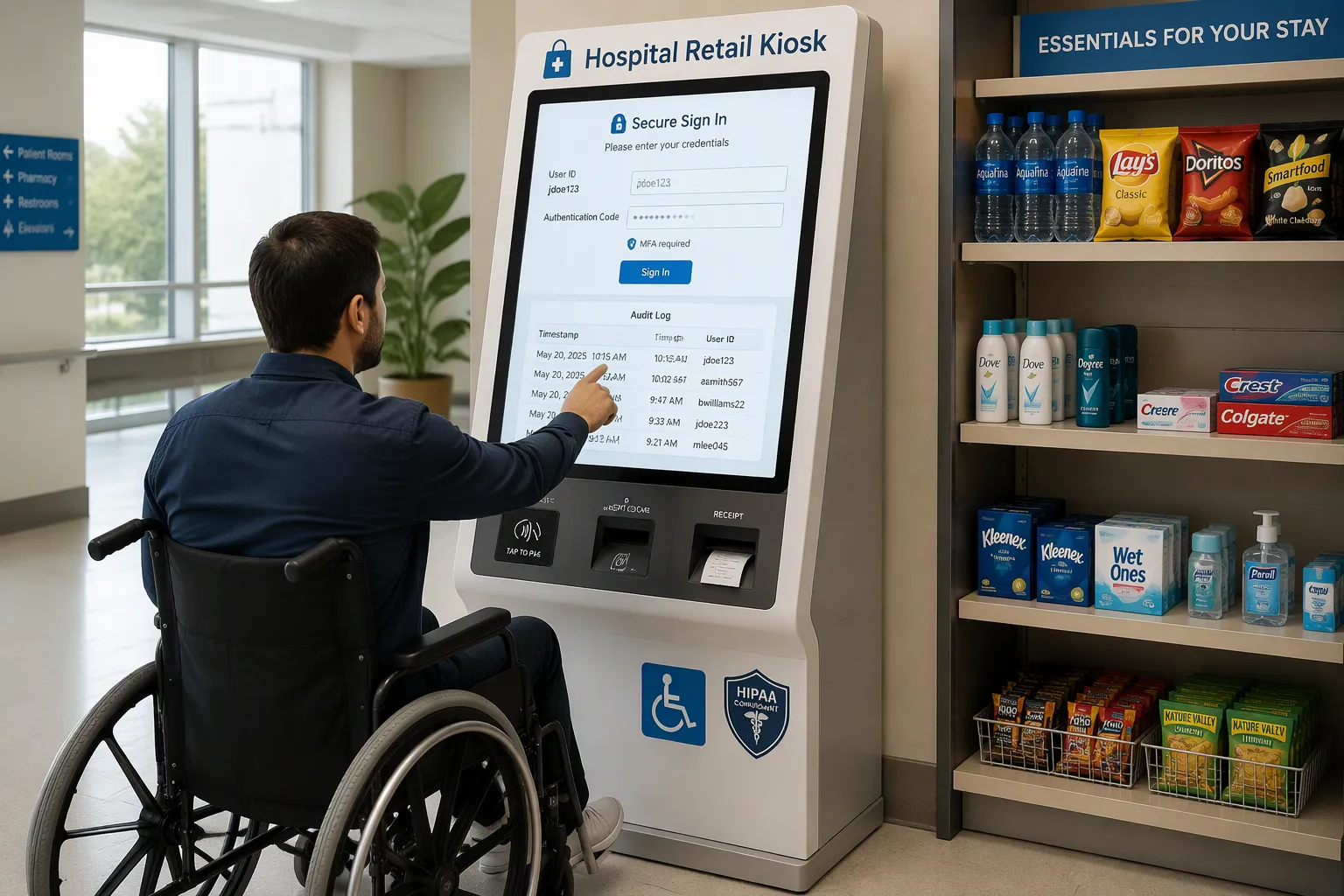
Secure Transactions and Audit Trails
Compliance features belong in the technology design phase. Retrofitting security controls after deployment creates gaps that expose hospitals to fines and breaches. PCI DSS governs every system that accepts, transmits, or stores cardholder data. The standard includes over 300 implementation, testing, and documentation requirements across twelve core standards. Non-compliance results in fines ranging from $5,000 to $100,000 per month.
PCI DSS Requirement 10 mandates logging all Cardholder Data Environment (CDE) access with individual user attribution and retaining logs for 12 months.
Shared credentials at point-of-sale terminals represent a common failure. Audit trails collapse when individual attribution disappears. Governance must enforce unique user IDs and multi-factor authentication for all CDE access. These controls support privacy, traceability, accountability, and security across the transaction lifecycle.
Standard | Scope | Application |
|---|---|---|
PCI DSS | Cardholder data protection | Any system accepting card payments |
HIPAA | Protected health information | Systems handling patient data |
SOC 2 | Vendor security verification | Third-party system audits |
Artificial intelligence governance adds another layer. The AIA framework in the European Union and similar emerging rules require human oversight for automated decisions. Hospitals should document how their autonomous systems handle exceptions and who reviews them.
Accessibility and Nondiscrimination Requirements
ADA and Section 504 set physical and digital access standards for healthcare kiosks. Operable parts must sit between 15 and 48 inches above the finished floor. Controls must work with one hand and must not require tight grasping, pinching, or twisting. Clear floor space must allow forward or parallel wheelchair approach.
Section 504 compliance is service-based, not web-based. If a kiosk controls access to a federally funded healthcare service, the service must remain accessible regardless of software architecture. The 2024 final rule adopts WCAG 2.1 Level AA for web content and mobile applications. Compliance deadlines extend to May 11, 2027 for organizations with 15 or more employees and May 10, 2028 for smaller organizations.
Hospitals own the compliance risk once a kiosk replaces a front desk. The Office for Civil Rights holds the hospital responsible, not the vendor. Kiosk manufacturers provide hardware only and assume no liability. Buyers should verify accessibility claims and indemnification levels before purchase. These ethical, legal, and regulatory considerations protect both patients and institutions.
Build a Compliance Monitoring Roadmap
Pre-Launch Compliance Readiness
A hospital should treat deployment as a phased process. The first phase is a pre-launch compliance review. This review maps every regulatory requirement to a specific owner. Compliance teams verify permits, business associate agreements, and product approvals before the first transaction. They also test payment systems for data protection and confirm accessibility features meet ADA standards.
Governance structures must exist before launch. A steering committee with representatives from compliance, IT, facilities, and clinical staff should approve the deployment. This group reviews the risk assessment and signs off on the vendor contract. The committee also confirms that the system supports audit readiness and standardized protocols. Without this step, hospitals risk discovering gaps after patients begin using the equipment.
Training, Audits, and Incident Response
Staff training follows the pre-launch review. Clinical and facilities teams learn cleaning procedures, recall handling, and incident reporting. Training records become part of the compliance file. Hospitals should refresh this training when vendors update software or when evolving regulations change requirements.
Internal audits form the third phase. Auditors check cleaning logs, temperature records, and transaction trails on a fixed schedule. They verify that the system enforces human oversight for automated decisions. The AIA framework in the European Union and similar rules require this oversight. Auditors also review how the system handles exceptions and who documents each resolution.
Incident response planning completes the roadmap. Hospitals need a clear process for breaches, product recalls, and equipment failures. The plan should assign roles, set notification timelines, and include corrective actions. Privacy incidents require immediate containment and notification under HIPAA.
Vendor oversight is continuous. Hospitals should schedule quarterly reviews of vendor security practices, audit results, and compliance updates. Automation can streamline regulatory reporting and scale with changing rules. Monitoring is a continuous duty, not a one-time event. Strong governance protects safety, privacy, and ethical, legal, and regulatory considerations across the system lifecycle.
Autonomous retail creates value in clinical settings only when leaders build regulatory compliance considerations into the operating model. Teams must map the regulatory framework, protect patient privacy under HIPAA and HITECH, maintain safety and infection control, secure permits, manage billing integrity, embed compliance in technology, and monitor performance. These duties protect patient safety, privacy, and compliance together.
The path forward is clear. Hospitals should designate an owner, run a pre-launch risk assessment, execute business associate agreements, train staff, and run regular audits. Strong governance sustains trust over time. Leaders should ask how autonomous retail can improve the patient experience while preserving trust.
FAQ
Does HIPAA apply to every autonomous retail kiosk in a hospital?
HIPAA applies when a system collects names, payment data, or health-related information. A kiosk that only dispenses snacks and accepts cash may fall outside HIPAA. Any unit that links to patient accounts or stores identifiers must meet Security Rule safeguards. Hospitals should assess each installation separately.
What role does the AIA play in healthcare kiosk compliance?
The AIA, or Artificial Intelligence Act, sets rules for automated decisions in the European Union. It requires human oversight for certain automated functions. Hospitals deploying kiosks with AI features should document exception handling and assign reviewers. Similar emerging rules may apply in other regions.
How often should hospitals audit autonomous retail systems?
Hospitals should audit on a fixed schedule, not once. Auditors check cleaning logs, temperature records, and transaction trails. Quarterly vendor reviews cover security practices and compliance updates. Monitoring remains a continuous duty across the system lifecycle.
Who owns compliance risk when a kiosk replaces a front desk?
The hospital owns the risk. The Office for Civil Rights holds the hospital responsible, not the vendor. Kiosk manufacturers provide hardware only and assume no liability. Buyers should verify accessibility claims and indemnification levels before purchase.
What is the first step before deploying autonomous retail?
Leaders should map the applicable regulatory framework first. This step reveals which obligations apply to products, location, and data flows. A steering committee from compliance, IT, facilities, and clinical staff should approve the deployment. Governance must precede launch.
See Also
Walmart Self-Checkout Access: Upcoming Changes And What To Expect In 2025
Examining Walgreens Self-Checkout: Retail Convenience Benefits And Challenges Explored
AI-Powered Corner Stores Are Rising: Essential Insights For Retailers Today
Why AI-Powered Retail Stores Represent The Future Of Shopping
Exploring Sensi Retail: A Social Equity Cannabis Dispensary In Los Angeles
