Using AI to monitor store performance metrics in Hospitals & healthcare facilities

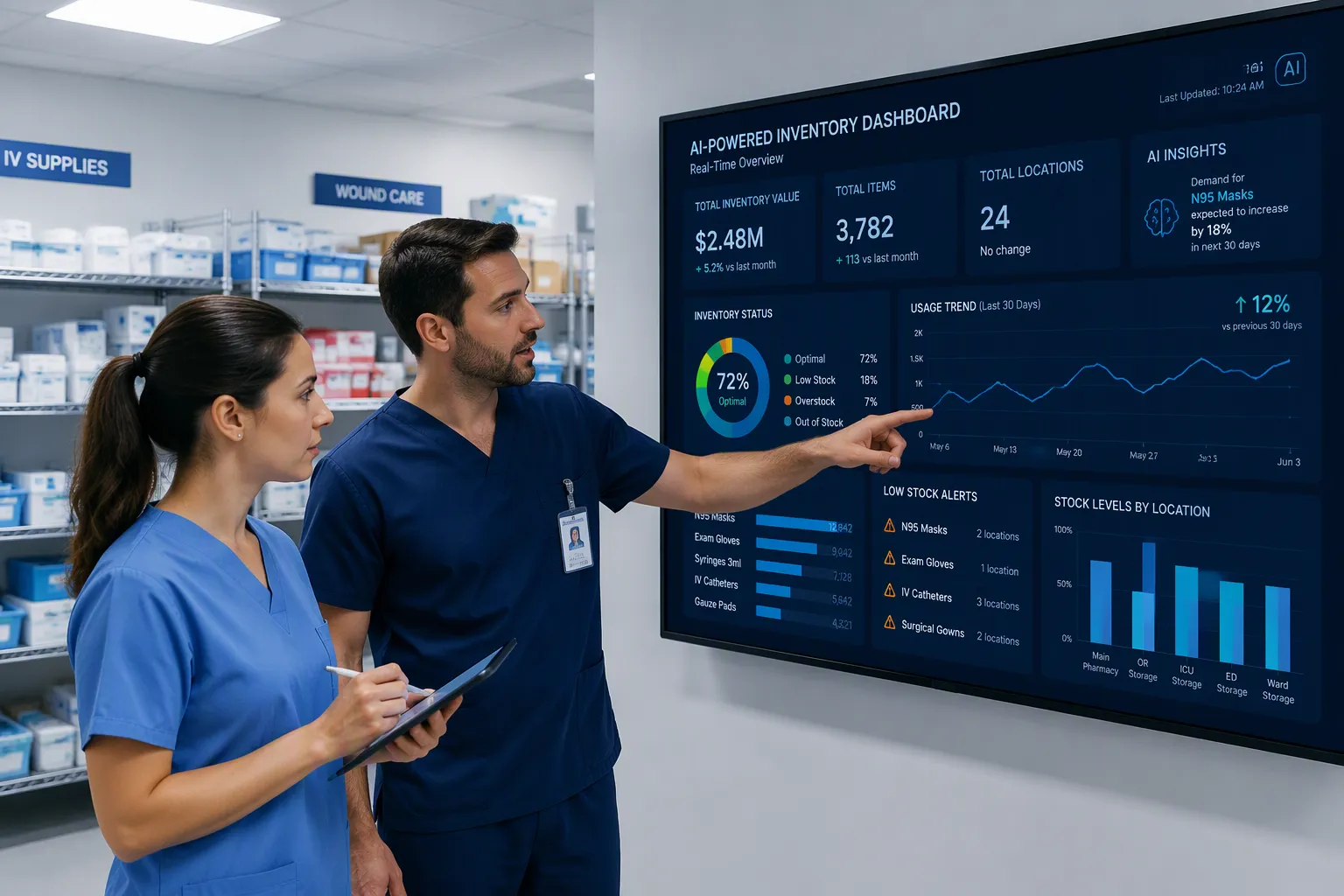
Using AI to monitor store performance metrics automates data collection, analysis, and real-time reporting in healthcare settings. This technology helps hospitals reduce waste, prevent stockouts, and improve patient care. AI-driven monitoring tracks inventory metrics, expiration dates, and supply movements across healthcare facilities. Predictive alerts warn of potential stockouts five to seven weeks in advance, sustaining a 98% fill rate. Expiration tracking yields less than 1% waste, compared with an industry average of 9%. A large Midwest nonprofit health system reported $12.8M in annual savings and a 7.4x return on investment over 36 months. This approach transforms supply chain operations in hospitals and clinics. Healthcare leaders can use these tools to make proactive decisions.
Key Takeaways
AI automates data collection and analysis for hospital supplies.
AI tracks inventory turnover, stockouts, expiration rates, and compliance.
Predictive alerts warn of stockouts five to seven weeks in advance.
AI reduces waste and costs, saving millions for hospitals.
AI improves patient care by preventing supply shortages.
Key Performance Metrics in Healthcare Stores
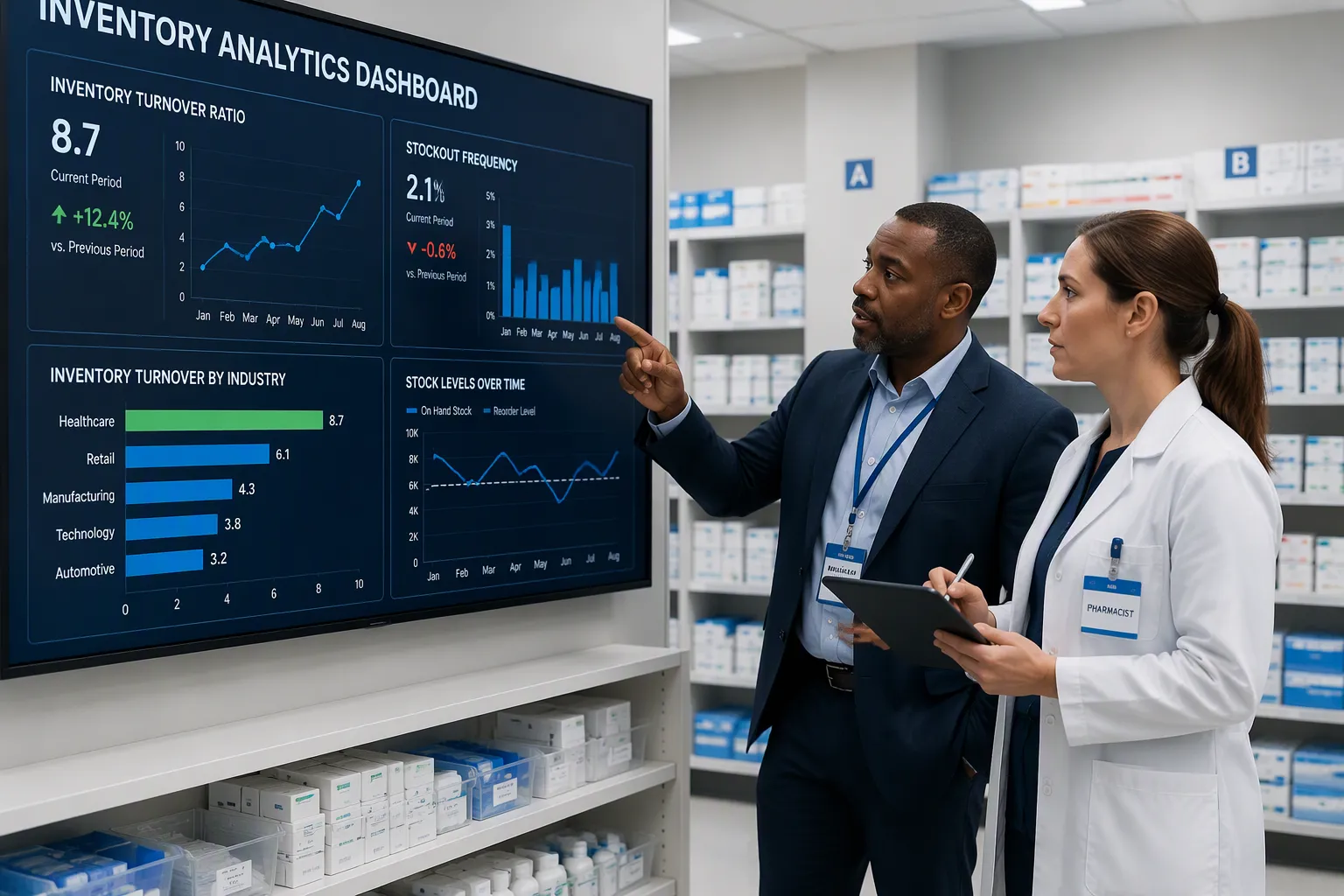
Healthcare stores track specific metrics to measure supply chain health. These metrics reveal how well a facility manages inventory, controls costs, and supports patient care. Hospitals measure quality of care with performance metrics, especially after integrating new technologies like AI. Inventory turnover, stockout frequency, expiration rates, and compliance-related healthcare KPIs form the foundation of this measurement system.
Inventory Turnover and Stockouts
Inventory turnover ratio measures how many times a hospital uses and replaces its stock in a year. A low ratio signals excess stock, expiry losses, and blocked capital. A high ratio creates risk of stockouts, delayed treatments, and patient dissatisfaction. Hospitals typically target an inventory turnover ratio of 5 to 10 times per year, depending on specialty. Pharmaceutical distributors often exceed 15. A hospital with ₹10 Cr annual consumable use and ₹1.5 Cr average stock has an ITR of approximately 6.6, considered healthy.
Industry benchmarks vary widely. The table below compares inventory turnover ratios across sectors.
Industry | Inventory Turnover Ratio |
|---|---|
Retail | 8–10 |
Healthcare | 3–5 |
Automotive | 6–8 |
Luxury Goods | 1–2 |
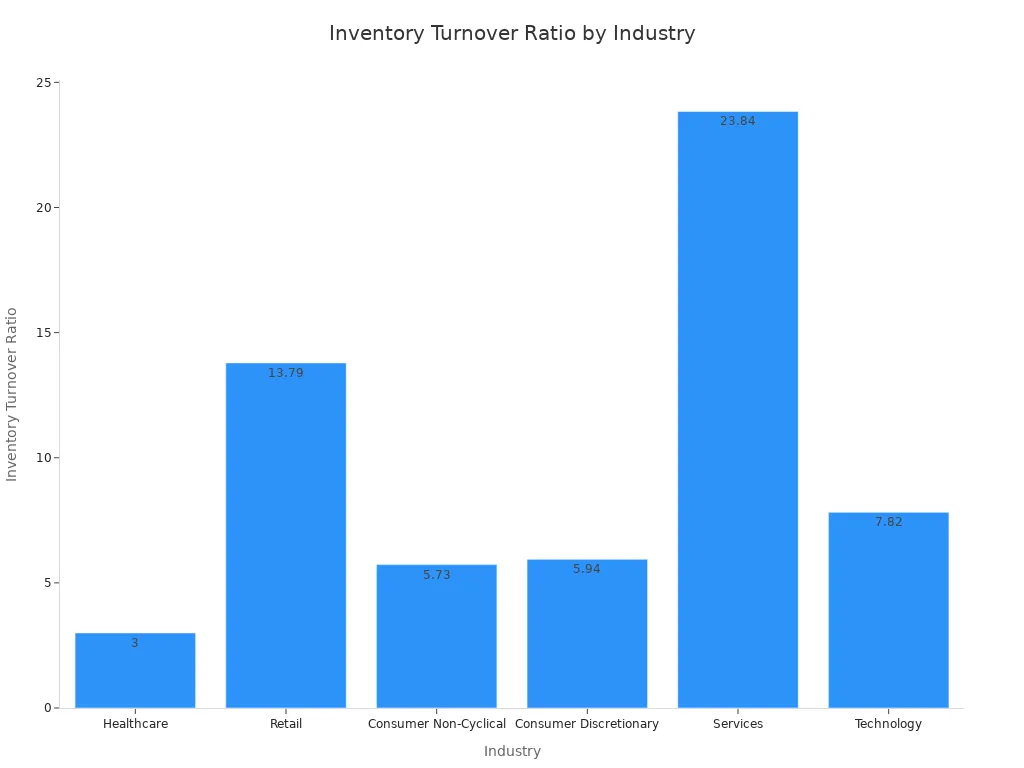
Stockout frequency counts how often a needed item is unavailable. This metric directly affects patient care. These performance metrics help leaders spot supply gaps before they harm patients.
There is no universal inventory turnover ratio that is considered "good." The right benchmark depends on industry, product mix, demand patterns, and supply chain. Rather than aiming for a specific number, focus on whether your inventory turnover supports your business goals.
Expiration Rates and Healthcare KPIs
Expiration rate measures the percentage of supplies that expire before use. Hospital supplies overstocked range from 20 to 50 percent. Products expiring on hospital shelves range from 10 to 30 percent. About 50 percent of hospitals cannot proactively identify or manage expired supplies. Roughly 20 percent of hospital leaders report more than $10,000 in monthly loss from obsolete or expired inventory. Typical expiration waste as a percentage of drug budget ranges from 2 to 7 percent. An annual drug budget of $10 million produces an illustrative avoidable annual waste of $200,000 to $700,000.
Compliance-related healthcare KPIs tie directly to expiration tracking. Expired item write-offs monitor inventory performance. Cycle count variance ties to inventory accuracy and audit readiness. Lot and batch number traceability, audit trail documentation, and alerts for recalled or expired items support compliance. Healthcare inventory management maintains detailed records that include purchase and expiration dates, as well as usage data. This traceability helps manage recalls, investigate issues, and comply with government regulations while supporting patient safety.
Healthcare data quality determines whether these KPIs reflect reality. Poor data quality produces misleading metrics and weakens decision-making. Accurate tracking of lot numbers and expiration dates supports reliable testing procedures and regulatory compliance. These key performance indicators give leaders a clear view of store performance across the facility.
How AI Monitors These Metrics
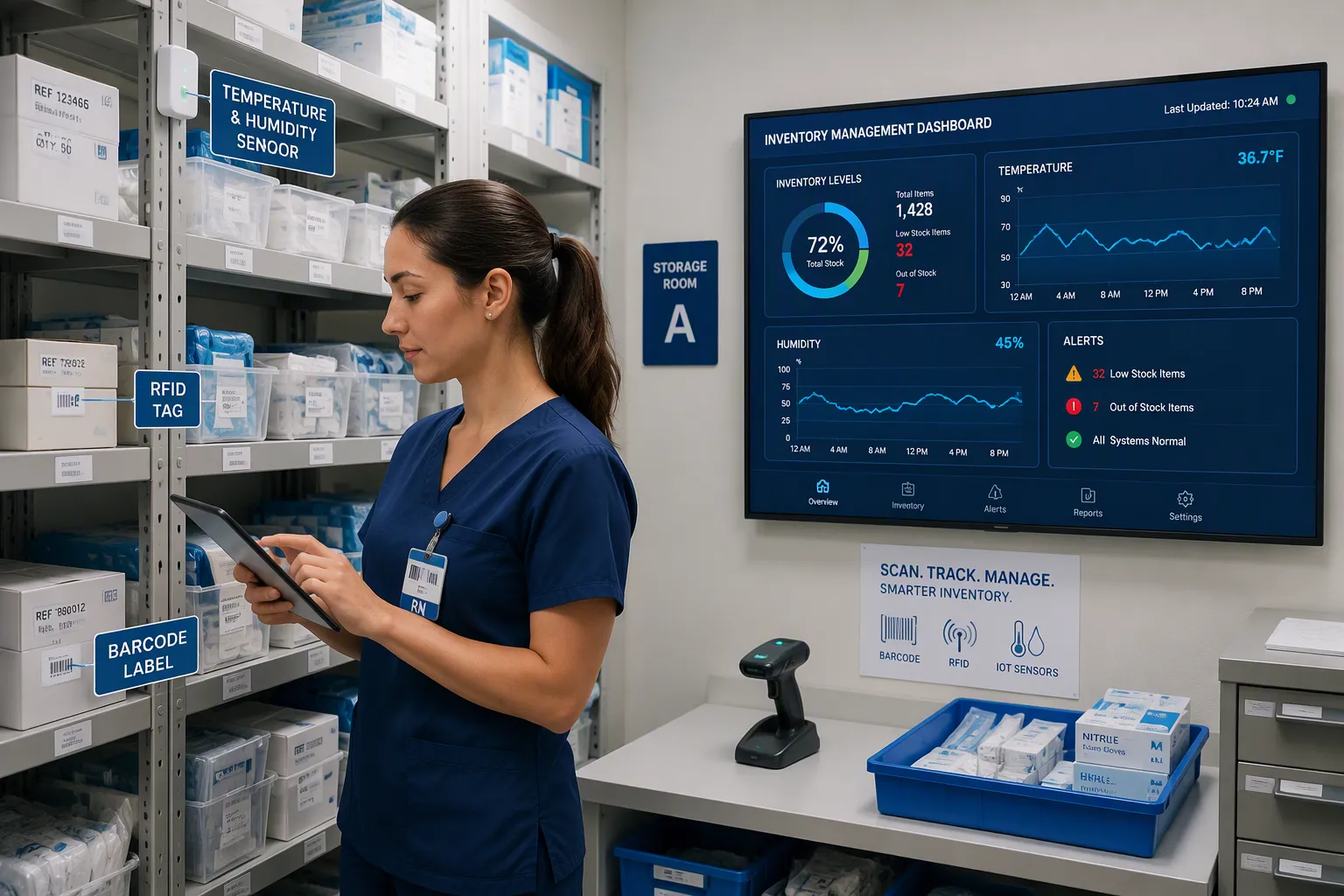
AI-powered monitoring systems combine hardware sensors, machine learning algorithms, and software platforms to track store performance continuously. These systems replace manual counting and periodic audits with automated data capture and analysis. The result is faster detection of problems and more accurate reporting across all tracked metrics.
IoT Sensors and Real-Time Data
Internet of Things sensors deployed throughout hospital storage areas capture continuous data on inventory levels, temperature, humidity, and item movement. Modern AI-powered IoT monitoring systems consistently reach an accuracy range of 85% to 98% for critical infrastructure monitoring, which includes hospital supply storage conditions. Machine learning models within these systems predict equipment failures with accuracy exceeding 85% when trained on adequate historical data. Accuracy improves over time as the system processes more operational data.
Continuous monitoring enables real-time analysis of hospital room components and supply movements. Barcode and RFID scanning automates check-ins and check-outs, which improves tracking accuracy. Automated reordering triggers purchase orders the moment stock drops below preset thresholds. Rush University Medical Center adopted weighted bins to monitor inventory in real-time, reducing backorders and eliminating 80% of stockouts. Mayo Clinic uses AI-driven warehousing and robotics to auto-replenish stock. Cleveland Clinic uses AI-powered dashboards to visualize supply trends and guide procurement decisions. These deployments show how using AI to monitor store performance metrics produces measurable operational gains.
Real-time data validation ensures that every scan, sensor reading, and transaction enters the system correctly. Machine learning for data anomaly detection flags unusual patterns, such as sudden usage spikes or unexpected temperature changes. This data anomaly detection protects healthcare data integrity and prevents false alerts. Real-time quality monitoring of storage conditions also safeguards temperature-sensitive medications and supplies.
Predictive Analytics and EHR Integration
Predictive analytics processes clinical, operational, and environmental datasets simultaneously to forecast demand with high accuracy. In 2024, 71% of hospitals reported using predictive AI integrated with the electronic health record, up from 66% in 2023. This growth reflects rising confidence in AI tools for supply chain management.
EHR systems enhanced with predictive analytics modules provide insights into patient outcomes, disease progression, and treatment effectiveness. Epidemiological surveillance models track disease trends to predict seasonal surges in flu or regional outbreaks, forecasting vaccine needs to ensure uninterrupted availability of critical supplies. AI algorithms analyze large datasets, including historical usage patterns, patient demographics, and real-time clinical data, to generate accurate demand forecasts and optimize stock levels. Demand forecasting models use statistical modeling and continuous learning to update predictions in real or near-real time.
Predictive models identify opportunities to reduce costs, avoid overstocking, and minimize waste from expired or unused items. Algorithmic models review operational risk factors such as weather, traffic, and supplier reliability to predict optimal delivery routes and schedules. Automated triggers reorder drugs and supplies when they reach preset thresholds or approach expiration dates. AI refines inventory replenishment by recommending higher PAR levels for high-usage items and lower PAR quantities for slower-moving items.
Healthcare data quality determines whether these predictions hold value. Poor healthcare data quality produces misleading forecasts and weakens decision-making. ML-driven anomaly detection continuously reviews incoming healthcare data for errors, duplicates, or missing values. This layer of data anomaly detection keeps performance metrics reliable. Healthcare leaders who invest in data quality see stronger returns from their AI investments. Tracking these KPIs through integrated platforms gives supply chain teams a complete view of store performance.
Benefits of AI-Driven Monitoring
AI-driven monitoring delivers measurable gains in waste reduction, cost control, and patient outcomes. These improvements stem from continuous tracking and predictive capabilities that manual systems cannot match.
Reduced Waste and Cost Savings
AI-enabled inventory management cuts expiry-related waste by up to 30 percent through first-expired-first-out logic and expiry tracking. Machine learning flags stock at risk of expiry before write-off, reducing pharmaceutical and consumable waste by 20 to 30 percent. Total inventory carrying costs drop by an average of 30 percent within 12 months of deployment. Carrying costs fall by 20 to 30 percent while dynamic safety stock simultaneously reduces stockout events.
Documented outcomes from healthcare facilities confirm these figures. Walter Reed National Military Medical Center achieved a 79 percent reduction in supply staffing and recovered $5.2 million in excess inventory. BlueBin customer implementations report 15 to 25 percent inventory reduction in the first year and 5x return on investment across deployments. A major regional health system pilot recorded 3.4x ROI with sub-1-year payback. Simulating one year of lumbar discectomy surgeries across 120 cases, a dynamic utilization-informed Physician Preference Card framework reduced total surgical supply expenditures by 47 percent versus a static system. Lower per-surgery supply quantities slowed inventory depletion, yielding a simulated 58 percent savings in inventory holding and reorder costs. Combined supply expense and inventory-related savings projected a 52 percent total annual cost reduction.
Improved Patient Care and Efficiency
Preventing stockouts through AI monitoring directly supports patient care. AI vision and advanced analytics provide accurate usage data and predictive, demand-led replenishment. This approach prevents stockouts before they happen, so procedures are not delayed by missing supplies. Real-time monitoring and automatic reordering keep critical supplies available and reduce emergency shipments. In the OR and ICU, automated restocking keeps trays complete and care stable, supporting safer patient outcomes.
Reported AI deployments achieve zero stockout rates in critical care units. Tracking accuracy exceeds 99 percent without manual scanning. Forecasting accuracy improves by 25 to 30 percent. These metrics demonstrate reduced supply-related risk, directly supporting patient safety and fewer procedure delays. Strong data quality underpins every one of these gains. Poor healthcare data quality produces misleading metrics and weakens decision-making. Healthcare leaders who invest in data quality see stronger returns from their AI investments. Tracking these KPIs through integrated platforms gives supply chain teams a complete view of store performance. These performance metrics ultimately improve quality of care across healthcare operations.
Implementation and Model Monitoring Challenges
Healthcare leaders face technical, financial, and organizational barriers when deploying AI for store performance tracking. Each category presents distinct obstacles during planning and sustained operation.
Barrier Category | Planning Phase | Implementing and Sustaining Phases |
|---|---|---|
Technical | Poor data quality, data bias, complicated data access, non-interoperable systems | Lack of physical infrastructure, poor usability, weak technical quality in the model |
Financial | High regulatory approval costs, lack of published evidence, unaffordable clinician time | Underinvestment in infrastructure needed to realize benefits |
Organizational | Lack of common vision, staff resistance, workflow disruption | Clinician and alert fatigue, false positives, unclear workflow guidance |
Data Integration and Staff Training
Poor data quality ranks among the most persistent technical barriers. Unstructured, incomplete, or inconsistent formats undermine every downstream metric. Healthcare data quality determines whether forecasts hold value, and weak data quality produces misleading results. Real-time data validation catches errors at the point of entry, which protects data quality across the pipeline. Real-time data validation also prevents false alerts from reaching clinical teams.
Staff resistance to change and workflow disruption create organizational friction. Concerns over knowledge loss and skepticism about new tools slow adoption. Phased rollouts reduce this friction by letting teams adjust gradually. Clear training programs build confidence and address disparate skill levels among users.
Model Monitoring, Privacy, and Change Management
Evaluating healthcare AI requires disciplined model monitoring across several dimensions. Core predictive metrics include accuracy, precision, recall, F1-score, and AUC-ROC. Accuracy alone can mislead in imbalanced datasets, so teams should pair it with confusion-matrix review. Bias detection assesses performance across demographic subgroups. Latency must stay low for time-sensitive applications. Drift monitoring tracks data, label, and concept drift using statistical tests. Automated dashboards and regular audits support monitoring AI model health over time.
Data privacy concerns demand strict governance. HIPAA in healthcare settings requires administrative, physical, and technical safeguards for electronic protected health information. Any vendor handling healthcare data for a covered entity qualifies as a business associate. Contracts must define breach notification timelines and data flow limits. Continuous model monitoring protects model health and sustains performance gains. Strong data quality and sustained leadership vision keep model health intact across the deployment lifecycle.
Using AI to monitor store performance metrics transforms how hospitals track supplies. These systems automate data collection, predict issues, and enable proactive decisions. They turn raw healthcare data into reliable metrics, so teams act before small problems grow. The benefits are clear: less waste, lower costs, and better patient outcomes. Strong data quality keeps each metric trustworthy. Healthcare data quality also keeps every forecast accurate. These performance metrics guide daily decisions. Leaders should adopt AI solutions now. Address privacy rules and change management early. Train staff well and monitor models continuously. With disciplined execution, performance gains will keep growing, supporting safer care and stronger operations.
FAQ
What store metrics does AI track?
AI tracks inventory turnover, stockout frequency, expiration rates, and compliance KPIs. IoT sensors capture real-time data. Barcode and RFID systems automate check-ins. Automated dashboards display usage patterns. Leaders spot supply gaps early.
How accurate is automated monitoring?
AI-powered IoT systems reach 85% to 98% accuracy for critical infrastructure. Predictive models identify equipment failures with accuracy above 85%. Tracking accuracy exceeds 99% without manual scanning. Forecasting accuracy improves by 25% to 30%.
What cost savings can hospitals expect?
AI reduces carrying costs by 20% to 30% within 12 months. Expiry waste drops up to 30%. One Midwest health system saved $12.8M annually with 7.4x return. Walter Reed recovered $5.2M in excess inventory.
How does AI prevent stockouts?
Predictive analytics forecasts demand five to seven weeks ahead. Automatic reordering triggers purchase orders when stock drops below thresholds. Critical care units report zero stockout rates. These systems sustain a 98% fill rate. Procedures face fewer delays.
What barriers slow adoption?
Poor data quality, staff resistance, and workflow disruption create friction. Privacy rules demand strict safeguards. Phased rollouts reduce pressure. Clear training builds confidence. Continuous model monitoring detects drift and bias. Strong leadership sustains gains.
See Also
The Future Of Retail Lies In AI-Powered Stores
Transforming Online Store Management With AI-Powered E-Commerce Tools
Retailers Must Understand The Rise Of AI-Powered Corner Stores
Features And Benefits Of AI-Powered Combo Vending Machines For Retail
How Automated Convenience Retail Works Worldwide: Micromarkets Versus Smart Stores
