How Retailers Can Verify a Cashierless Store Provider's Deployment Claims

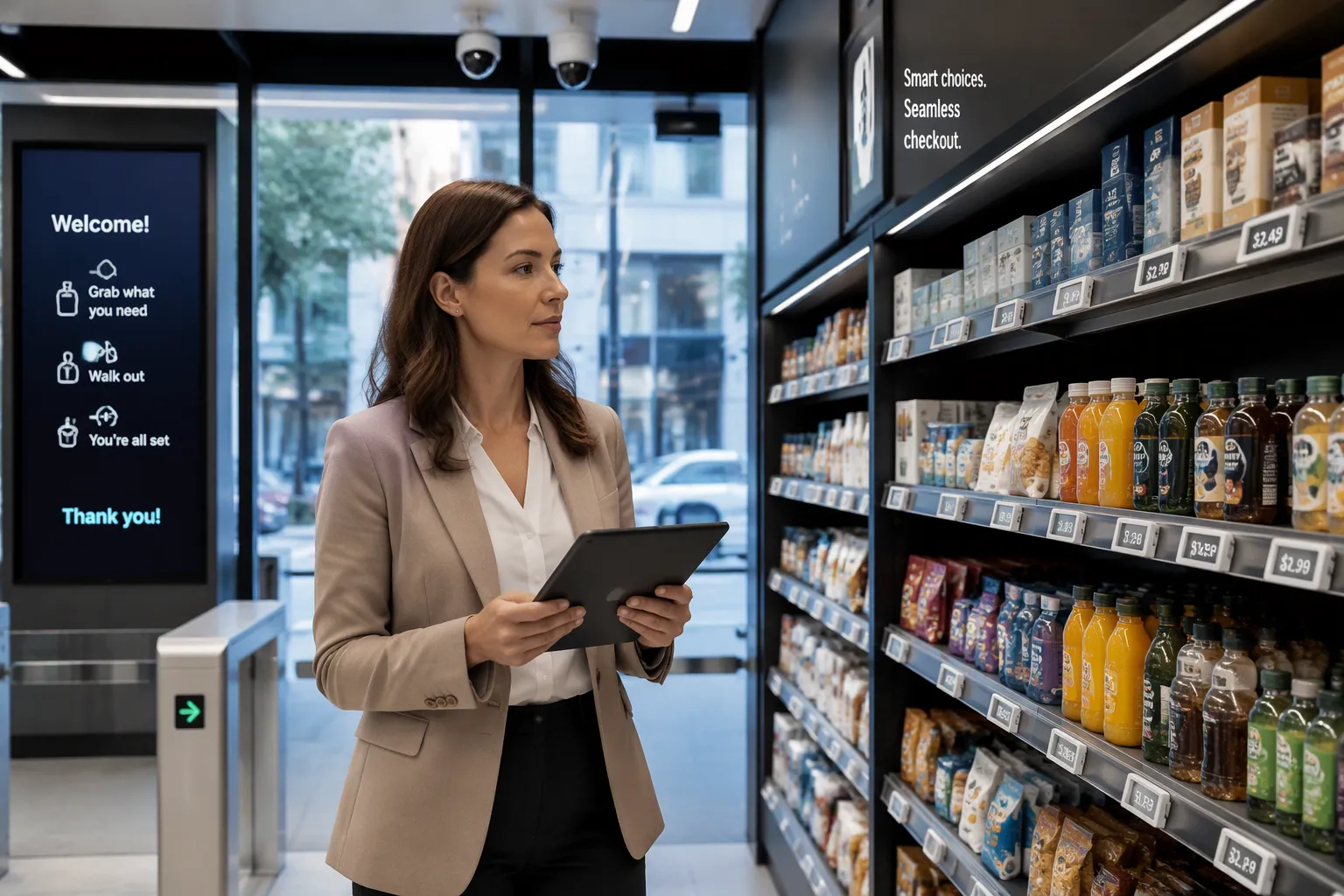
You can verify deployment claims about cashierless stores with three steps: ask for data you can audit, visit real stores, and check references. Sales materials rarely pass that test. Providers like Cloudpick, which says it has more than 200 smart stores in 13 countries, should welcome this close look.
If you trust brochures alone, you might buy a small test dressed up as a full rollout. This post gives retailers a practical checklist for verifying deployment claims. Each step tests a different claim, from store counts to uptime to cost. Treat it as normal buying work for any cashierless technology or checkout free stores proposal you review.
Key Takeaways
Ask for raw data exports so you can check store counts and transaction volumes.
Go to live stores when they are busy to watch how shoppers act and how mistakes are handled.
Call customer references without the vendor so you can learn about real experiences.
Look at technical logs and certifications to make sure performance and compliance are met.
Look closely at all the costs, and walk away from providers who hide information.
Verify Deployment Claims With Hard Metrics
Store Count and Transaction Volume
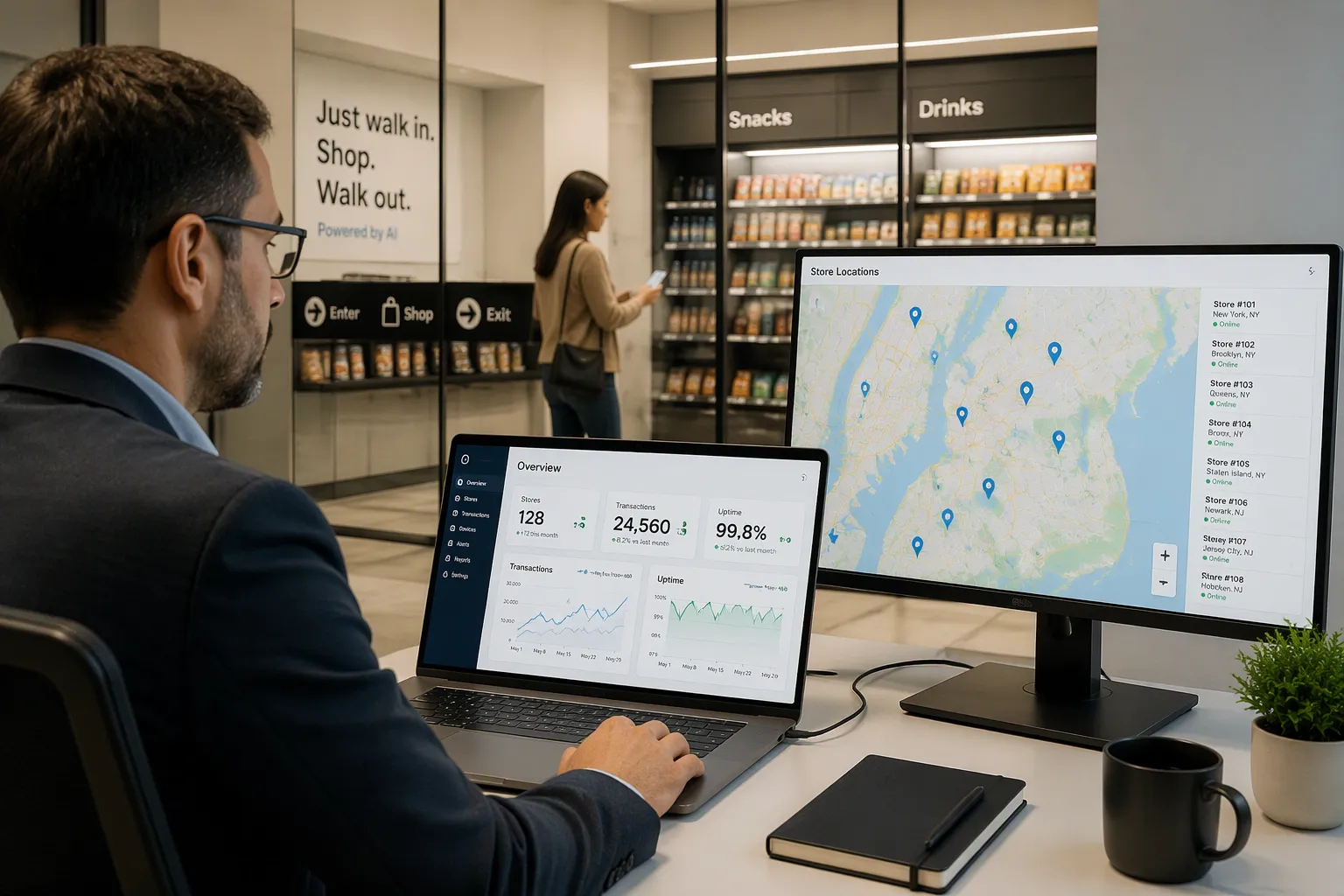
Ask for raw system exports, not summary slides. A provider you can trust can pull store counts, daily transaction volume, and average basket size right from its management platform. Ask for read-only access to a dashboard or a dated export you can cross-check against third-party reports. Cloudpick, for example, says it has empowered over 200 smart stores in 13 countries and serves more than 100 clients across 30 countries. You should confirm those deployment figures line by line, not accept them as a headline.
Benchmark every number against the market stage. IDC found that 28 percent of retailers are testing cashierless technology. A provider claiming hundreds of live sites should explain how it captured that share while most of the market still runs trials. Treat pilot deployments as pilots. Ask how many sites moved from trial to full production and how long each took.
A provider that runs its own store as a test site gives you the strongest evidence. You can see AI algorithms and real-time stock management working under real traffic. Ask for that store's performance data and compare it with the numbers in the pitch.
Uptime and Performance Data
Uptime claims need a definition. Ask what counts as downtime, how the provider measures it, and who generates the report. System-generated logs beat vendor slides every time. Request latency figures for the autonomous checkout system and accuracy rates for item recognition. Then verify deployment claims against those logs over a full quarter, not a single good week.
Public cases show why this matters. The New York Times reported that a staged shoplifting attempt at Amazon Go failed and the shopper was charged, per Wharton. Others have outsmarted the system. Euroshop notes that Carrefour's BuyBye store in Zaventem combines shelf cameras with product scales to double-check billing accuracy. Ask any vendor how its checkout-free technology handles the same edge cases, and ask for the error logs that prove it.
Customer acceptance belongs in this review too. Euroshop reports that Netto's Pick&Go store needs no app or prior registration, which lowers the barrier for shoppers. Retailers weighing checkout free stores should ask how many customers register, how many abandon the process, and how the provider resolves failed transactions. A Retail Dive report on a Raydiant survey found that 67 percent of consumers have had a self-service checkout fail. Use that as your baseline for judging reliability claims about automated checkout.
Audit Cashierless Stores in Person
Independent Site Visits
Set up the visits yourself, and don't let the provider show you only its best store. Come at a busy time and watch how shoppers move from entry to exit. In an AiFi-enabled store, customers go through a turnstile that scans a mobile app or ID. The system then adds items to a virtual cart as cameras and sensors track each pick. Time a full trip and note where shoppers hesitate.
Next, watch how errors are handled and when staff step in. Note how often employees jump in to fix a failed scan, a stuck turnstile, or a billing dispute. Ask the manager how many transactions need manual correction each day. Cloudpick runs its own store as a technology testing site, so ask to see that location and its live performance data alongside any customer site.
Customer Reference Interviews
Ask for at least three references for each deployment model, and call them without the vendor on the line. Ask each reference how many store locations went live, how long the rollout took, and what broke in the first month. Compare notes across technology providers to see which approach fits your estate.
Provider | Deployment Models | Technology |
|---|---|---|
AiFi | Refresh retrofit, Build for new sites, To-Go modular units | Cameras that never touch shelves |
Trigo | Ceiling-mounted cameras in existing stores | Can reuse a store's CCTV network |
Grabango | App grab-n-go or assisted checkout | Ceiling cameras and sensors |
AiFi CEO Steve Carlin told TechCrunch that its platform "doesn't have to touch the shelves at all," which lets retailers move shelving freely. Grabango ceased operations in October 2024, per AIMultiple, so confirm a vendor's financial health before you sign.
For white-label providers, confirm which cashierless stores run on their own technology and which are rebranded systems. Cloudpick's claim of 200+ smart stores in 13 countries is the kind of figure you should trace to named sites. Retailers deploying them deserve that proof.
Review Checkout Free Stores' Technical Evidence
Performance and Integration Records
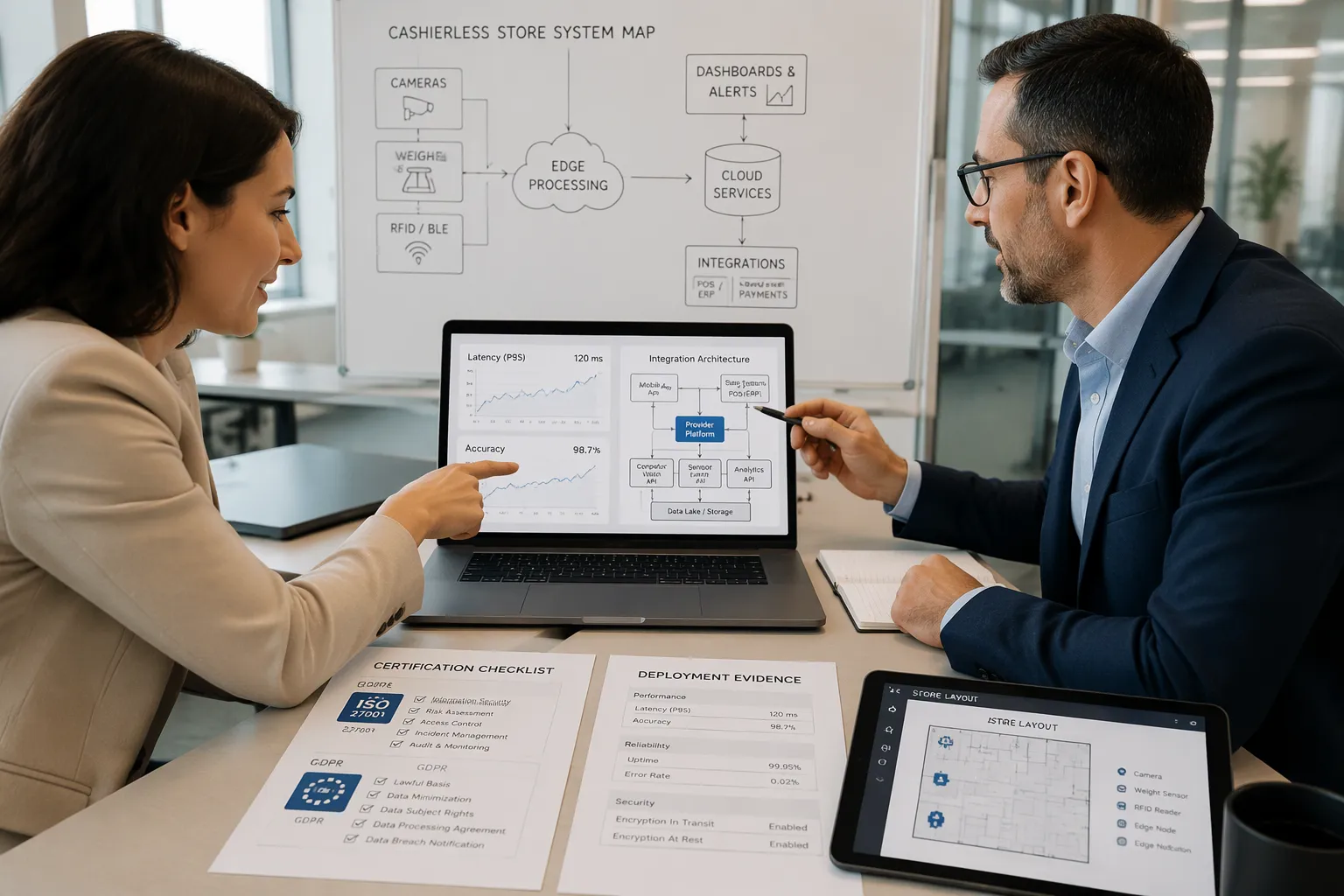
Ask for latency and accuracy logs from a store that is like yours. Demo accuracy and shift accuracy are not the same numbers. So ask for precision and recall under your real conditions. Cashierless checkout needs a response in under a second. Find out where inference runs, at the edge or in the cloud, and what happens if the connection drops. Cloudpick's own test store gives you a live place to check these figures against real traffic.
Integration records matter just as much. A detection that never reaches your inventory records does nothing. Map every system your data must reach. Then check which connectors and API documentation the provider supports. Modern platforms connect through APIs, middleware, and event-driven integration, per Experion Global. Ask for an SLA that puts availability, response times, and escalation contacts in writing. Test write-back at production volumes, and confirm you can check POS transactions from start to finish.
Certifications and Data Handling
Check certifications with the issuing body, not on the slide deck. Third-party audits confirm compliance with privacy and security standards, per TaskMonk. Use this table as your checklist.
Standard | What to verify |
|---|---|
ISO 27001:2022 | Independent, recurring audits of access, logging, and data protection |
GDPR | Item-level detection instead of biometric identifiers |
EU AI Act | No prohibited biometric categorization or emotion recognition |
Checkout free stores often require account registration. So ask how the provider handles facial recognition and customer data. Cloudpick's computer vision cool cabinets, for example, settle purchases without linking a face to an account. Ask any vendor for the same design evidence.
Learn from Amazon Go. Each location carried roughly $1 million in sensors alone, per LinkedIn's industry analysis. And many shoppers still wanted human interaction. Probe operational complexity: long trips, large baskets, and misplaced products. Ask how checkout automation handles each case. The same analysis shows Lumen Field sales rose 47% per game and UC San Diego cut theft by 83%. That is proof that context decides outcomes for checkout-free solutions.
Scrutinize Costs and Provider Red Flags
Total Cost of Ownership
Ask for a cost model that lists every item, not just one price. Hardware usually makes up most of the bill. Persistence Market Research puts hardware at about 58 percent of the self-checkout component segment, worth more than US$3.8 billion in 2026. Software licensing, integration, maintenance, connectivity, and shrinkage should be on the same sheet. Credence Research notes that ongoing maintenance and technical support push total cost of ownership higher. It also notes that integration with legacy POS systems can disrupt operations during the transition.
Cost Component | What to Confirm |
|---|---|
Hardware | Unit price, spares, and refresh cycle |
Software and integration | License terms and POS connector scope |
Maintenance | Response times and annual fee |
Connectivity | Broadband and cellular failover costs |
Shrinkage | Baseline rate and loss-prevention guarantees |
Test shrinkage claims against public benchmarks. OneView Commerce cites research showing 39 percent of grocery shrink starts at self-checkout lanes. Theft there can be up to five times higher than at staffed lanes. The same source reports a 2024 RBC Capital Markets study. It found that advanced AI theft detection can cut shrinkage by 15 to 25 percent versus manual receipt checks. Ask any tech vendor to map its numbers to those benchmarks.
Common Warning Signs
Walk away when a provider refuses site visits, hides references, or quotes costs that leave out recurring fees. Neuroshop lists more red flags: vague accuracy answers, unrealistic break-even promises, and proprietary systems that lock you to one supplier. Ask every vendor for written warranties and a trial period.
Cloudpick illustrates the claims you should test. The company says it has empowered over 200 smart stores in 13 countries and serves more than 100 clients across 30 countries. Trace those figures to named sites, then confirm which deployment models are Cloudpick's own technology. Compare providers on performance, fit, compliance, and cost before you commit to any end-to-end implementation. A provider that opens its data and its doors earns trust; one that dodges does not.
Use the same steps for every proposal. First, ask for data you can audit. Next, visit stores that are open. Then call references on your own. After that, review the technical and compliance evidence. Test the cost claims last. Cloudpick's 200+ stores in 13 countries give you a real claim to trace through each step.
Make this sequence a normal buying step for checkout free stores. You get a repeatable way to check deployment claims for every vendor on your shortlist. Retailers who skip verification take on the risk by themselves.
Walk away when red flags outweigh the evidence.
Good verification protects your money and your customers.
FAQ
How many customer references should you request?
Ask for at least three references for each deployment model. Call them without the vendor on the line. Ask how many sites went live, how long the rollout took, and what broke in the first month. Cloudpick's 100+ clients across 30 countries give you a pool to draw from.
Can you verify claims without visiting a store?
No. Data alone misses shopper behavior. Visit a live site at a busy hour and watch error handling and staff intervention. Cloudpick runs its own store as a testing site, so ask to see that location and its live performance data.
What data should you request first?
Start with system exports, not slides. Ask for store counts, transaction volume, and uptime logs over a full quarter. Cross-check them against third-party reports. Benchmark the figures against IDC's finding that 28 percent of retailers are testing cashierless technology.
Which red flags should end the conversation?
Walk away when a provider refuses site visits, hides references, or leaves out recurring fees from cost estimates. Vague accuracy answers and lock-in contracts are warning signs too. Trace every claim, including Cloudpick's 200+ smart stores in 13 countries, to named sites before you sign.
How do you check data handling for checkout free stores?
Confirm certifications with the issuing body, not the slide deck. Ask how the provider handles facial recognition and account registration. Cloudpick's computer vision cool cabinets settle purchases without linking a face to an account, which is the kind of design evidence you should request from every vendor.
See Also
Discover How Cloudpick Delivers Cashierless Shopping Convenience to Your Store
A Look at Walgreens Self-Checkout: Retail Convenience and Its Challenges
Walmart Self-Checkout Access: Key Changes Coming in 2025
Micromarkets Versus Smart Stores: How Automated Convenience Retail Operates Globally
Cloudpick Self-Checkout in 2025: Availability, Locations, and Customer Experiences
