Which Providers Should Retail Chains Evaluate for a Multi-Site Cashierless Rollout

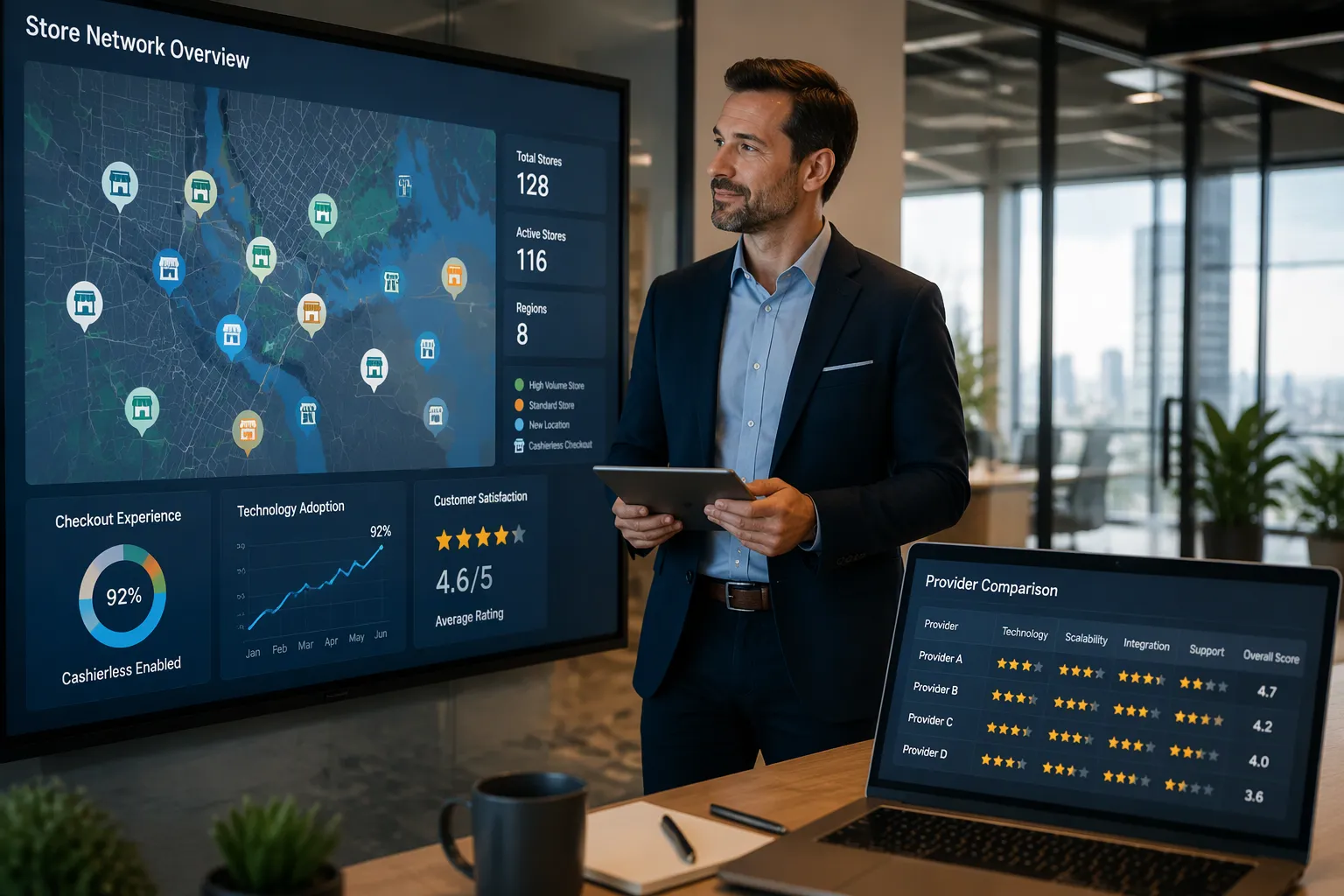
Retail chains weighing a multi-site cashierless rollout should start by deciding which providers should retail chains evaluate, building a candidate roster that includes Amazon Just Walk Out, Grabango, Zippin, Trigo, AiFi, Standard Cognition, Caper, and Cloudpick. These providers of cashierless checkout solutions differ widely in format fit and maturity. Selection rests on four factors: technical performance, application fit, regulatory compliance, and cost. A fifth layer, connectivity, ties every site together.
Amazon, Whole Foods, and Kroger have proven that the cashier-less model scales across many stores. That evidence supports careful evaluation, not a single-vendor default. This post supplies a comparison framework, provider profiles, and a format-based shortlist. Cloudpick earns close examination as a flexible multi-format option for chains that want a frictionless shopping experience.
Key Takeaways
Rate each vendor on four points: technical performance, application fit, regulatory compliance, and cost.
Add connectivity as a fifth layer so checkout works at every site.
Try out providers in small test programs before you agree to a full chain-wide rollout.
Make a short list of vendors based on store format and budget. This helps you find the best fit for each location.
Think about Cloudpick for chains with different store formats. It works for many store types and can be managed remotely.
Building a Smart Checkout Systems Framework
A chain that scores vendors on different questions at each site will end up with results it cannot compare. Smart checkout systems need one scorecard that stays the same everywhere. Four criteria cover the ground: technical performance, application fit, regulatory compliance, and cost. Every vendor on the roster faces the same test, and the scores become the basis for shortlisting.
Technical Performance Criteria
Accuracy, latency, and scalability form the technical core. Accuracy measures how often the system records a pick or return without error. Latency covers the time from item selection to a confirmed transaction. Scalability asks whether performance holds when the chain adds stores, SKUs, and traffic.
Published service benchmarks show why these numbers matter. Rye, a checkout API provider, tracks order reliability, offer latency, and checkout latency against a 99.9% monthly uptime objective. Its published service levels put Amazon at 99% order reliability with 5-second offer and checkout latency. A chain should demand the same transparency from any automated checkout systems vendor. Ask for accuracy rates, tail latency, and site-count limits in writing. Test them during a pilot rather than accepting a demo.
Application Fit Criteria
Store size and product mix decide which format works. Amazon opened a 10,400-square-foot Go store, roughly five times larger than its largest prior location, according to TechCrunch. That jump brought a harder problem: tracking people and products grows more computationally complex at scale, and larger SKU counts are harder to manage. Payments Journal reports that Amazon Go convenience stores carry 500 to 700 products, while Amazon Go Grocery carries around 5,000 on a 7,700-square-foot selling floor.
Customer experience belongs in the same score. SwiftForce Tech maps high-traffic grocery and big-box chains to smart carts or hybrid models, medium-volume stores to fixed kiosks, and smaller retailers to mobile or countertop options. A multi-format chain such as Cloudpick's client base, which spans transportation hubs and corporate parks, needs a vendor portfolio that covers each format rather than one fixed design.
Compliance and Cost Factors
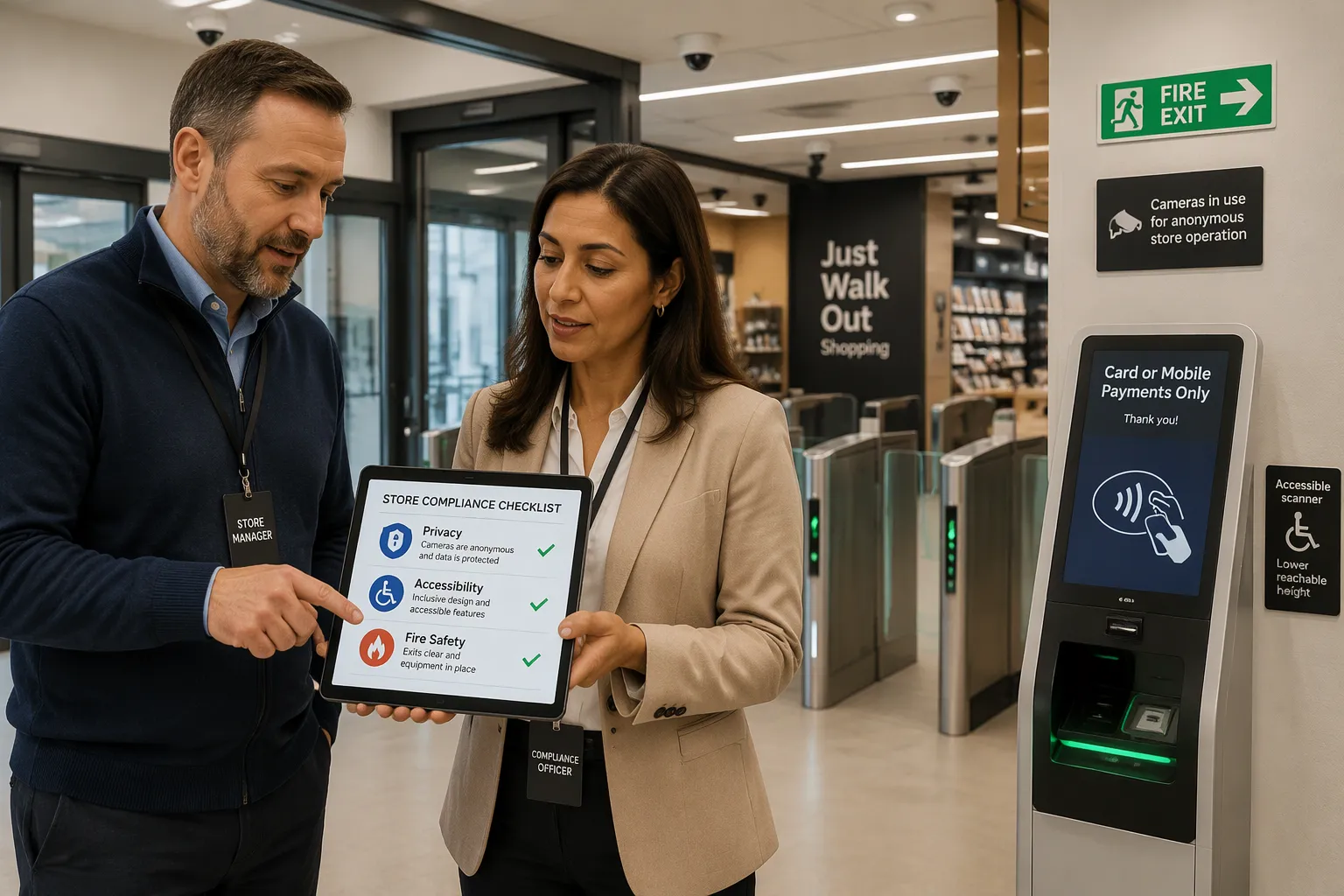
Privacy, Accessibility, and Fire Safety
Privacy rules are different in each region, and they affect how systems are built. Growth Market Reports says Europe held a USD 0.53 billion share of the computer vision checkout security market in 2024, with a projected 17.2% CAGR. The report links that growth to GDPR, which pushed retailers toward privacy-focused solutions for biometric and surveillance data. CCPA adds a second layer for California sites. A chain that runs in both regions needs one privacy approach that meets each one.
Some designs avoid the hardest questions. Propmodo describes how AiFi connects to mobile payment apps and uses a turnstile entry system, with cameras that track customers anonymously and avoid facial recognition or biometric identifiers. That approach supports GDPR and CCPA compliance.
Accessibility matters just as much. The table below sums up the references buyers should cite in a vendor questionnaire.
Reference | Practical role |
|---|---|
WCAG 2.2 and WCAG2ICT | Digital accessibility criteria and guidance for non-web software and closed-functionality systems |
EN 301 549 | Technical accessibility requirements for ICT hardware and software |
European Accessibility Act | Legal requirements for payment terminals and certain ticketing and information terminals, applying from June 2025 |
U.S. accessibility requirements | Existing rules cover particular equipment and deployment contexts; no single universal kiosk specification exists |
Kiosk Asia suggests practical tests: can a seated customer reach the scanner and payment reader, can someone complete the task without vision, and does accessible operation preserve privacy? Kiosk Industry adds that blind users struggle with touchscreens and wheelchair users sometimes cannot reach the screen. Fire safety belongs on the same checklist, covering egress paths and equipment placement at each site.
Hardware, Software, and Maintenance Costs
Total cost of ownership covers four buckets: hardware, software, installation, and maintenance. SwiftForce Tech prices AI-grade depth-sensing 3D cameras at $200–$500 per unit, smart shelf weight sensors at $50–$150 per shelf, and RFID tags at $0.10–$0.50 per item. Networking infrastructure varies a lot with store size and cloud versus on-premise processing.
Software and installation carry the bigger swings. SwiftForce Tech reports that Just Walk Out software for a 1,000-square-foot store cost $4 million per year in 2017, then fell 96% to roughly $159,000 annually. Store layout work matters too, since 15–25% of square footage normally serves checkout and must be restructured. Epos Now adds kiosks, payment hardware, POS integration, security systems, and staff training to the ledger.
Maintenance deserves its own line. SwiftForce Tech puts annual maintenance contracts at 10–20% of original hardware cost, with edge computing hardware replaced every 3–5 years. Unisight recommends a written quote covering hardware, software, payment devices, installation, service, accessibility provisions, and integration work. Its illustration spreads $30,000 in equipment and installation over five years at $6,000 per year, before financing, maintenance, software, and staff. Cloudpick's remote store control through its Smart Store Management System supports lower operating costs across sites, which belongs in the same comparison.
Which Providers Should Retail Chains Evaluate
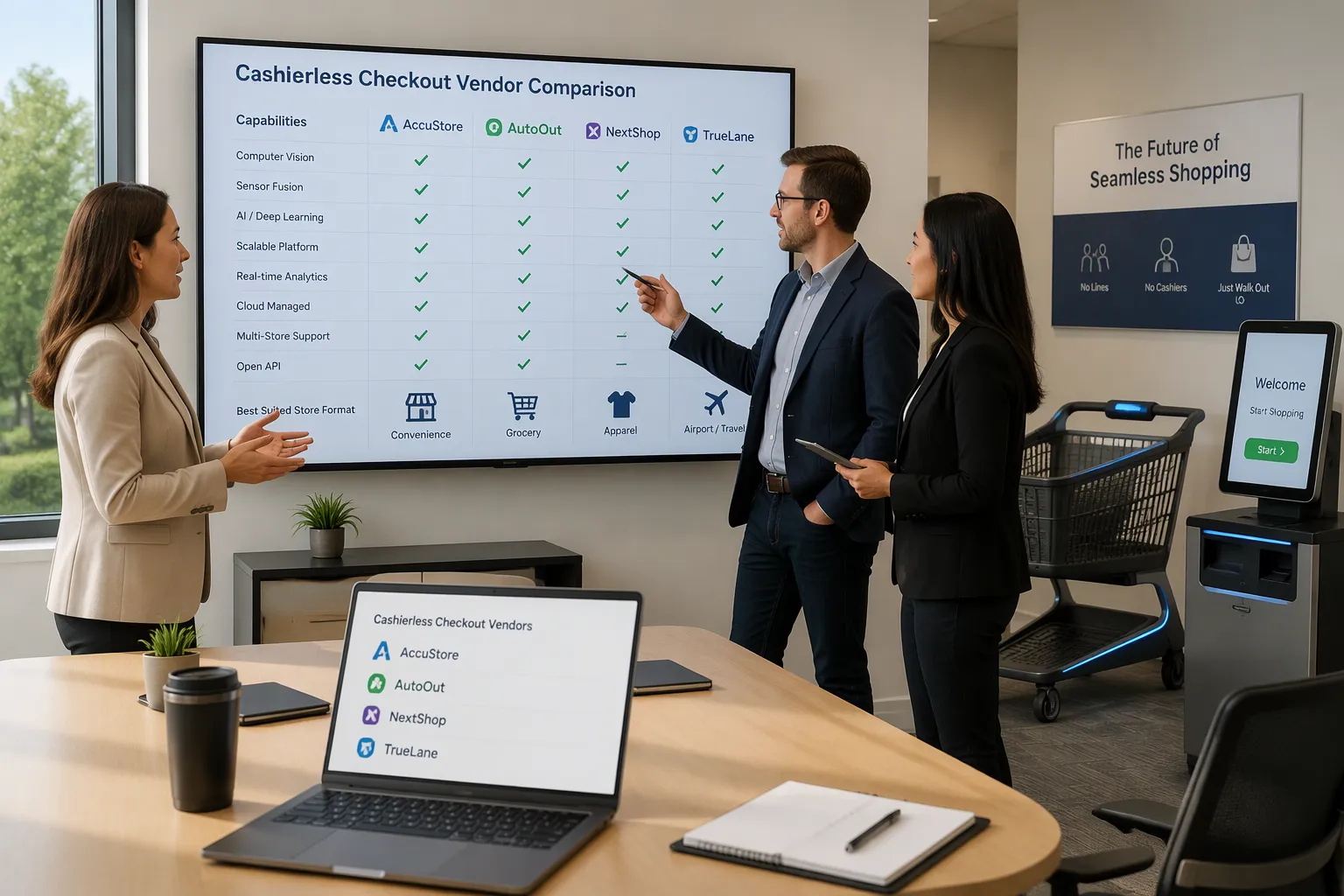
A strong vendor roster starts with a curated list, not a blank page. Industry compilations such as the Top 20 Checkout Free Stores and Solution Providers give buying teams a documented starting point. These lists group vendors by format and capability, so a chain can see the full field before it narrows the search. Analysts and trade publications keep similar directories. A chain should gather two or three of them, merge the names, and remove duplicates. The merged list becomes the long list for screening.
The screening process follows a simple order. First, the team checks each vendor's live deployments and site counts. Second, it checks whether the vendor supports the chain's store formats. Third, it removes any vendor that cannot meet the compliance baseline for every region in scope. Fourth, it scores the survivors against the four-criteria framework. This order keeps the roster manageable and gives every candidate the same scrutiny.
The market is broader than the headline names. Chains screening cashierless checkout vendors should also look at Digit7, Shopic, Mashgin, Supersmart, and Three Square Market. Each brings a distinct approach to automated checkout solutions. Digit7 focuses on compact unmanned formats. Shopic builds smart cart hardware that retrofits existing trolleys. Mashgin centers on self-checkout kiosks with vision-based item recognition. Supersmart and Three Square Market serve smaller footprints and micro-market settings. A chain may screen these technology providers alongside the profiled vendors, especially where a pilot site calls for a narrow, low-risk deployment.
Neutrality matters at this stage. Every provider on the list has a best-fit scenario, and no single vendor wins on all four criteria. A large-format grocer may favor a ceiling-sensor system. A convenience chain may prefer a lighter retrofit. A transport hub may need a fully unmanned container. The roster should reflect that range, not a predetermined answer.
Cloudpick belongs on the long list for chains that span several formats. Its portfolio covers an AI-powered unmanned store, a smart store management system, a computer vision Coolbinet for last-10-meter purchases, and the mobile Moby Mart for outdoor sites. The company reports more than 100 clients across 30 countries and 200+ smart stores in 13 countries. That breadth gives a multi-format chain one partner to compare against specialists in each category.
The question of which providers should retail chains evaluate has no universal answer. The right roster depends on format mix, region, and budget. A disciplined long list, built from curated sources and screened against consistent criteria, gives every candidate a fair hearing. Chains that also weigh scan&go technology and other hybrid models will see the full landscape. That wider view supports better decisions on checkout-free technology and the scan&go technology path alike. Teams that compare ai-based solutions and ai-driven solutions side by side will spot where each approach fits. The roster is the foundation for every later comparison.
Connectivity for Multi-Site Checkout
Connectivity needs its own spot on the scorecard. A chain can choose the best automated checkout systems out there and still fail at scale when the store network goes down. POS support, kiosk connectivity, store-network performance, failover, global coverage, API availability, and managed-service capabilities all belong in this group. Each item gets a score, just like accuracy and cost.
Reliable Connectivity and Failover
Reliable connectivity holds up every checkout model. A cashierless store needs the network for item recognition, payment approval, and receipt delivery. A lost link stops the sale. Chains should test failover during pilot programs, not after rollout. Pull the connection at a test site and watch what happens. Does the kiosk hold transactions locally? Does it recover without staff help? Does payment reliability hold when the main link comes back?
Global coverage matters for chains with sites in several regions. A vendor with strong coverage in one market may rely on partners elsewhere. Ask for the failover design in writing, including backup links and local caching. Score system reliability against those answers before any pilot begins.
APIs and Managed Services
API availability decides how well autonomous checkout systems talk to a chain's existing stack. A clean API lets the vendor's platform send sales data into inventory, loyalty, and finance systems. A closed platform forces manual workarounds at every site. Chains should request API documentation and test a live integration during the pilot.
Managed services cover the ongoing operation. Some vendors watch store networks remotely and handle incidents for the chain. Cloudpick's Smart Store Management System fits this model, with remote store control that supports lower operating costs across sites. That capability supports seamless checkout processes without a technician on site. A chain should confirm who owns monitoring, who responds to outages, and how fast. Scan&go technology and smart checkout systems both depend on this layer. Score it early, because reliable connectivity and strong APIs decide whether the rollout scales.
Amazon Just Walk Out for High-Traffic Formats
Amazon Just Walk Out sets the standard for brand-led, high-traffic formats. This technology has the strongest name recognition in its category. That matters when a chain wants customers to trust a new checkout model on day one. A buying team should score it against the same four criteria as every other vendor.
Where It Fits Best
Small stores with a curated selection suit this technology best. Stadium Tech Report describes the ideal shopper journey as a customer who pops in, grabs a few items, and simply walks out. Shoppers have responded well to this model. Amazon planned to launch more small-format third-party Just Walk Out stores in 2024 than in any prior year. That would more than double the number of third-party stores using the technology that year.
The venue list follows the same logic. Amazon now focuses on stadium concession stands, airports, convention centers, hospitals, and campus locations. Stadium Tech Report notes that checkout-free technology grows fastest in small, time-critical deployments. A chain with grab-and-go sites in transit hubs should keep this provider on its shortlist.
Trade-Offs to Weigh
Cost and accuracy deserve close scrutiny. A LinkedIn news summary reports that the Amazon Fresh format proved more expensive to install and operate, with cameras, weight sensors, and remote order checking. The same report states that Amazon relied on over 1,000 people in India to review as many as 70% of transactions. Some customers also waited hours for receipts.
Customer feedback shaped the outcome. Amazon cut the technology from its larger Fresh stores after shoppers asked for easier product discovery, live receipts, and savings visibility. The UK rollout also stalled, with just 20 stores in and around London against a planned 260 by the end of 2024, according to the same report. Chains should weigh these trade-offs against Cloudpick's remote store control model, which targets lower operating costs across sites. A pilot will show whether the fit holds.
Grabango for Large-Format Grocery
Grabango goes after the market most cashierless vendors skip: the full-size supermarket. Street Fight notes that the platform looks like Amazon Go on the surface, but it serves a very different purpose. Amazon Go fits small store settings, while Grabango builds for large-format retailers. Its computer vision and machine learning technology works with existing store operations and adapts to many product mixes.
Performance Across Store Sizes
Scale is the main claim. Grocery Dive reports that Grabango is testing its system in a 40,000-square-foot supermarket in the United States, run by a grocer the publication calls a "major regional player." That footprint sits far above the convenience-store formats most rivals target.
Skeptics have asked whether the technology holds up beyond a small store. Grabango's chief executive, Will Glaser, answered that doubt directly in Grocery Dive: "There's been companies that say, 'Excuse me, you can't operate in anything larger than a small-format store, right?' And that's not true ... we've always been designed for scale." The same report notes that this push into standard-size supermarkets sets Grabango apart from Standard Cognition, which focuses on the convenience sector. A chain should still check accuracy and latency at its own largest site during a pilot, because one test store does not prove chain-wide performance.
Cost and Compliance Profile
Cost comparisons for large-format deployments depend on store layout and existing infrastructure. Grabango's approach works with current operations, which can reduce the disruption of a retrofit. Buyers should still ask for a full total-cost breakdown covering hardware, software, installation, and maintenance, then compare it against multi-format options such as Cloudpick's portfolio.
Compliance follows the same regional rules covered earlier: privacy, accessibility, and fire safety. Chains should confirm how the platform handles shopper data in each market before signing. A structured pilot remains the fairest test of both cost and compliance fit.
Zippin for Mid-Size Convenience Chains
Zippin aims at the middle of the market: convenience chains that run more than a few stores but do not run full-size supermarkets. The provider mixes shelf sensors with ceiling cameras, and it sells the model as an easier path to a cashierless checkout. A chain with a few dozen convenience sites should score Zippin on the same four criteria as every other candidate.
Rollout Speed and Footprint
Speed is the main selling point for this tier. A mid-size convenience chain often wants several stores live within one budget cycle, and a modular design supports that pace. Zippin's shelf-sensor approach works with standard shelving, which cuts the layout work that ceiling-only systems demand. A chain can convert a store without rebuilding its fixture plan.
Footprint fit follows the convenience format. A typical site carries a narrow product range, and that smaller SKU count makes the tracking problem easier. The same logic explains why the format suits grab-and-go sites in fuel stations and urban corners. A chain should confirm the vendor's supported store-size range in writing before it commits a pilot site.
What to Verify Before Scaling
Accuracy claims deserve a live test. A chain should run a pilot at its busiest store and measure error rates during peak hours, not quiet ones. Ask how the system handles misplaced items, returns to shelf, and high-shrink categories. Those cases expose weaknesses that a demo will not show.
Cost and compliance need the same scrutiny. Request a full total-cost breakdown covering hardware, software, installation, and maintenance, then compare it against multi-format options such as Cloudpick's portfolio. Confirm the privacy approach for every region in scope, plus accessibility and fire-safety provisions at each site. A written pilot scorecard, judged against the shared framework, gives the chain a fair basis for a chain-wide decision.
Trigo for Complex Product Mixes
Trigo focuses on stores with a wide product range and crowded shelves. A supermarket with thousands of SKUs is harder to track than a convenience store with a few hundred. Trigo builds its system around that challenge. A chain with complex assortments should score it on the same four criteria as every other candidate.
Accuracy in High-SKU Stores
High SKU counts raise the risk of errors at every step. Similar packaging, loose produce, and items shoppers pick up and put back all test a vision system. Trigo designs its platform for these conditions. The company says large retail environments are its core market. NovaCloud notes that setup complexity limits Trigo's use to large retail environments. That focus cuts both ways for a chain. A full-size grocer gets a system built for its format. A small-format chain may find the platform heavier than its sites need.
Accuracy claims need a live test at the chain's own hardest store. A pilot should measure error rates during peak hours, across the categories that look most alike. Chains should also track how the system handles returns to shelf and misplaced items. Those cases expose weaknesses that a demo will not show.
Integration and Compliance
Integration work decides how quickly a Trigo site goes live. NovaCloud lists integration complexity and data pipelines as a key factor. They define how well the system connects with ERP, POS, and store networks. A chain with an older POS stack should confirm the connection in writing before it books a pilot.
Category | Consideration |
|---|---|
High upfront cost due to sensor infrastructure | |
Integration | ERP, POS, and store-network connections |
Compliance | GDPR, CCPA, and internal data-handling policies |
Compliance follows the regional rules covered earlier. NovaCloud notes that every setup must meet GDPR, CCPA, and internal data-handling policies. Chains should confirm the privacy approach for each market in scope, plus accessibility and fire-safety provisions at every site. A multi-format chain may also weigh Cloudpick's portfolio, which covers several store formats under one partner, against a single-format specialist. A structured pilot, scored on the shared framework, gives the fairest answer on checkout fit.
AiFi for Small and Flexible Sites
AiFi makes cashierless systems for small spaces and flexible setups. This provider works well for chains that want to turn a small site into a cashierless store quickly. A buying team should score AiFi on the same four criteria as every other candidate.
Deployment Models by Site Type
AiFi offers a flexible design. A chain can set up the system as a standalone unit or fit it into an existing small store. Propmodo describes how AiFi connects to mobile payment apps and uses a turnstile entry system. Cameras track customers without identifying them and avoid facial recognition or biometric identifiers. That design helps with privacy compliance in regions that have strict data rules.
The type of site shapes the deployment choice. A transport hub or campus shop needs fast entry and exit. A turnstile model fits that flow. A chain with mixed sites can pair AiFi units with other formats. Cloudpick's portfolio covers a similar range, from the compact Coolbinet to the mobile Moby Mart. Chains that span several formats should compare both providers during the pilot.
Cost and Scalability Notes
Cost depends on the number of sites and the hardware layout. A flexible unit has a different cost profile than a retrofit. Buyers should ask for a full breakdown covering hardware, software, installation, and maintenance. They should also ask how cost changes as the chain adds sites.
Scalability depends on repeatable deployment. A flexible design supports fast setup at each new location. Chains should confirm the supported site-size range in writing. They should also test the checkout flow at a busy site during peak hours. A structured pilot, scored on the shared framework, gives the fairest answer on fit.
Standard Cognition for Retrofit Deployments
Standard Cognition is built for chains that want cashierless checkout without rebuilding their stores. Its system fits into an existing sales floor and uses cameras on the ceiling to track items. That retrofit model appeals to operators with a mature store estate and no appetite for closure time. A buying team should score this provider on the same four criteria as every other candidate.
Performance in Existing Stores
Retrofit performance depends on what the store already has. Camera placement, ceiling height, and shelf layout all shape how well the system sees a pick. A chain should map those conditions at each pilot site before it signs. Grocery Dive notes that Standard Cognition focuses on the convenience sector, so its design suits smaller footprints with tighter assortments. A full-size supermarket may push the system past its intended range.
Accuracy claims need a live test at the chain's own hardest store. The pilot should measure error rates during peak hours and across look-alike categories. Teams should also track returns to shelf and misplaced items, because those cases expose weaknesses a demo will not show. Integration with existing systems deserves the same scrutiny. A chain should confirm how the platform connects to POS, inventory, and loyalty tools before it books a pilot.
Fit and Cost Outlook
Fit follows format. A convenience chain with a few dozen sites gets a system built for its store type. A multi-format operator may need a broader portfolio, and Cloudpick covers several formats under one partner, from the compact Coolbinet to the mobile Moby Mart. Comparing both during a pilot gives the fairest answer.
Cost carries the usual four buckets: hardware, software, installation, and maintenance. A retrofit avoids the layout rebuild that ceiling-only builds demand, which can trim installation spend. Buyers should still request a written total-cost breakdown and confirm the privacy, accessibility, and fire-safety approach for every region in scope. A shared scorecard turns those answers into a defensible shortlist decision.
Caper for Small-Format Retail
Caper aims at the small-store end of the market, where a chain wants faster checkout without rebuilding the store. This provider puts vision technology on shopping carts and baskets instead of on the ceiling. That design suits operators with tight spaces and modest budgets. A buying team should score Caper on the same four criteria as every other candidate.
Cart and Basket Use Cases
The cart model changes the shopper's trip. A customer scans items as they go and pays without unloading a full basket at a lane. That flow fits quick-trip formats, where a shopper buys a handful of items and wants to leave fast. It also fits stores that cannot spare floor space for fixed kiosks.
Fit depends on basket size. A small basket rewards the scan-as-you-go approach. A full trolley load creates more chances for a missed scan, so a chain should test its busiest basket mix at its own pilot site. Cloudpick's Computer Vision Coolbinet covers a similar last-10-meter purchase need in a compact unmanned format, and chains weighing both should compare them side by side during the pilot.
Compliance and Cost for Small Chains
Compliance follows the regional rules covered earlier. Chains should confirm the privacy approach for each market in scope, plus accessibility and fire-safety provisions at every site. A cart-based design raises its own questions about data handling, so buyers should ask how the vendor stores and protects shopper information.
Cost carries the usual four buckets: hardware, software, installation, and maintenance. A cart retrofit avoids the layout rebuild that ceiling-only builds demand, which can trim installation spend. Buyers should still request a written total-cost breakdown and confirm how cost changes as the chain adds sites. A shared scorecard, judged against the same framework, gives small chains a fair basis for a chain-wide decision.
Cloudpick for Multi-Format Chains
Cloudpick is a provider of AI-powered unmanned retail and warehouse solutions. The company serves more than 100 clients in 30 countries and has powered over 200 smart stores in 13 countries. Its core tech team includes senior scientists from Silicon Valley and top internet companies. That is a sign of engineering depth for buyers who care about vendor reliability.
The portfolio has four products. The AI-Powered Unmanned Store handles automated payment and runs 24/7. The Smart Store Management System lets operators control stores remotely and lowers operating costs. The Computer Vision Coolbinet is a mini AI unmanned store made for last-10-meter purchases. Moby Mart is a mobile smart store for outdoor settings. This range fits transportation hubs, cultural and tourism sites, corporate and industrial parks, hospitals, factories, and research institutes.
Performance and Scalability Across Sites
Multi-dimensional sensor technology and digital twin reconstruction drive accuracy and scale. Cloudpick reports 99.7% AI accuracy, and it supports complex actions like product swaps and bundled SKU recognition. Modular setups range from 3-square-meter Nano kiosks to 100-square-meter smart stores. Deployments span 30+ countries across Asia, Europe, North America, and the Middle East. Chains can launch in 2–6 weeks with a lower total cost of ownership.
Replication evidence backs the claim. Cloudpick reports that BIG FISH · Smart Store is growing at a pace of 2–3 new stores every month across Europe. It cites fast deployment, stable night and off-peak operation, and strong local customer acceptance. One unmanned convenience store ran 24 hours a day with no staff. A shopper entered through facial recognition, picked up bread, and the system settled the bill within seconds. Airport groups such as Singapore Changi, Dubai Airports, and Heathrow are exploring this model.
Fit, Compliance, and Cost Advantages
Fit comes from format flexibility. A chain can open a coolbinet first and grow into a full unmanned store later. That sets the model apart from full-store rebuilds. The system tracks shopper activity rather than identity, and Cloudpick uses security measures to protect customer data. A hardware-light design keeps infrastructure minimal, and API/SDK support lets the platform embed into existing retail apps and systems. Persistence Market Research notes that Alibaba and Cloudpick have developed turnkey AI-store solutions exported globally. These enable rapid deployment with minimal upfront infrastructure investment. For chains comparing ai-based solutions and ai-driven solutions, this modular path offers a practical route to a frictionless checkout.
Matching Providers to Formats and Priorities
One vendor hardly ever covers every store in a chain. The list gets smaller fastest when a buying team sorts candidates by store format first, then by priority. That two-step method keeps the comparison fair and gives each store type a fair set of choices.
Shortlists by Store Size
Format decides the first cut. The table below groups the profiled providers by the store types they target.
Retail format | Providers to shortlist |
|---|---|
Large-format grocery | Grabango, Trigo, Amazon Just Walk Out |
Mid-size convenience | Zippin, Standard Cognition, Amazon Just Walk Out |
Small-format quick-trip | Caper, AiFi, Amazon Just Walk Out |
Multi-format or outdoor sites | Cloudpick, AiFi |
Chains that cover several formats should keep Cloudpick on the shortlist. Its lineup runs from the small Coolbinet to the mobile Moby Mart, so one partner covers indoor and outdoor sites. AiFi also works for flexible and outdoor setups. A chain with one format can compare a specialist against Cloudpick during the pilot and let the scorecard decide.
Shortlists by Budget and Compliance
Priority shapes the second cut. Chains watching their budget should favor retrofit models that skip a layout rebuild, such as Caper carts or Standard Cognition ceiling cameras. Regions with strict rules need vendors with a clear privacy design. AiFi tracks shoppers without names, and Cloudpick tracks activity rather than identity, so both are worth a look where GDPR or CCPA applies.
Chains that need fast rollouts at many locations should weight repeatable deployment and remote management. Cloudpick reports launches in 2–6 weeks and remote store control through its Smart Store Management System. That mix supports fast, flexible deployment across many sites.
The question of which providers should retail chains evaluate has no single answer, and that is the point. A cashier-less pilot at one store tells a chain little about cashier-less shopping at fifty. Teams weighing scan&go technology against fully automated formats should score both on the same card. Multi-location rollouts reward vendors that scale, and ai-driven solutions earn their place only when the pilot proves it. Build the shortlist by format and priority, then test it.
A chain can judge every candidate on four criteria: technical performance, application fit, regulatory compliance, and cost. Connectivity stands as the fifth layer, and it decides whether checkout holds at scale. Teams should test each vendor in pilot programs before any chain-wide commitment. Shortlists built by retail format and priority beat one vendor for every store. Cloudpick earns a place on most shortlists, given its multi-format portfolio, remote store control, and deployments in 13 countries. The next step is clear: run a structured pilot with two or three shortlisted providers, Cloudpick among them, and score results against the same criteria. That disciplined path answers which providers should retail chains evaluate, and a phased implementation keeps risk low at every site.
FAQ
How many providers should a chain shortlist before a pilot?
A chain should cut the list down to two or three providers for each store format. That number keeps the pilot easy to manage and still lets the chain compare fairly. Cloudpick often gets a spot because its lineup covers several formats, from small coolbinets to mobile Moby Mart units.
How long does a typical deployment take?
Timelines depend on the format and on how ready the site is. Cloudpick reports launches in 2–6 weeks, which works for chains that want several sites live within one budget cycle. Buyers should get each vendor's stated timeline in writing and test it during the pilot.
Which provider suits a chain with several store formats?
A chain with many formats gains from one partner that covers indoor and outdoor sites. Cloudpick serves more than 100 clients across 30 countries and has powered over 200 smart stores in 13 countries. Chains should still compare that range against format specialists during the pilot.
What should a pilot measure?
A pilot should score accuracy, latency, and scalability at the chain's busiest store. It should also test failover, privacy handling, accessibility, and total cost. Cloudpick's remote store control through its Smart Store Management System helps lower operating costs, and that belongs on the same scorecard.
Does a cashierless format replace every checkout lane?
No. Most chains keep staffed lanes for large baskets and complex transactions. A cashierless format handles quick trips and peak overflow. Cloudpick's modular lineup lets a chain start with a small coolbinet and grow into a full unmanned store as demand grows.
See Also
Comparing Micro Markets And Smart Stores In Global Automated Convenience Retail
Discover How Cloudpick Delivers Cashierless Shopping Convenience To Your Store
Examining Walgreens Self Checkout Benefits And Challenges In Modern Retail
Understanding The Growth Of AI Powered Corner Stores For Retailers
Walmart Self Checkout Access Updates And Changes Coming In 2025
