How to scale autonomous retail from one site to many in hospitals and healthcare facilities

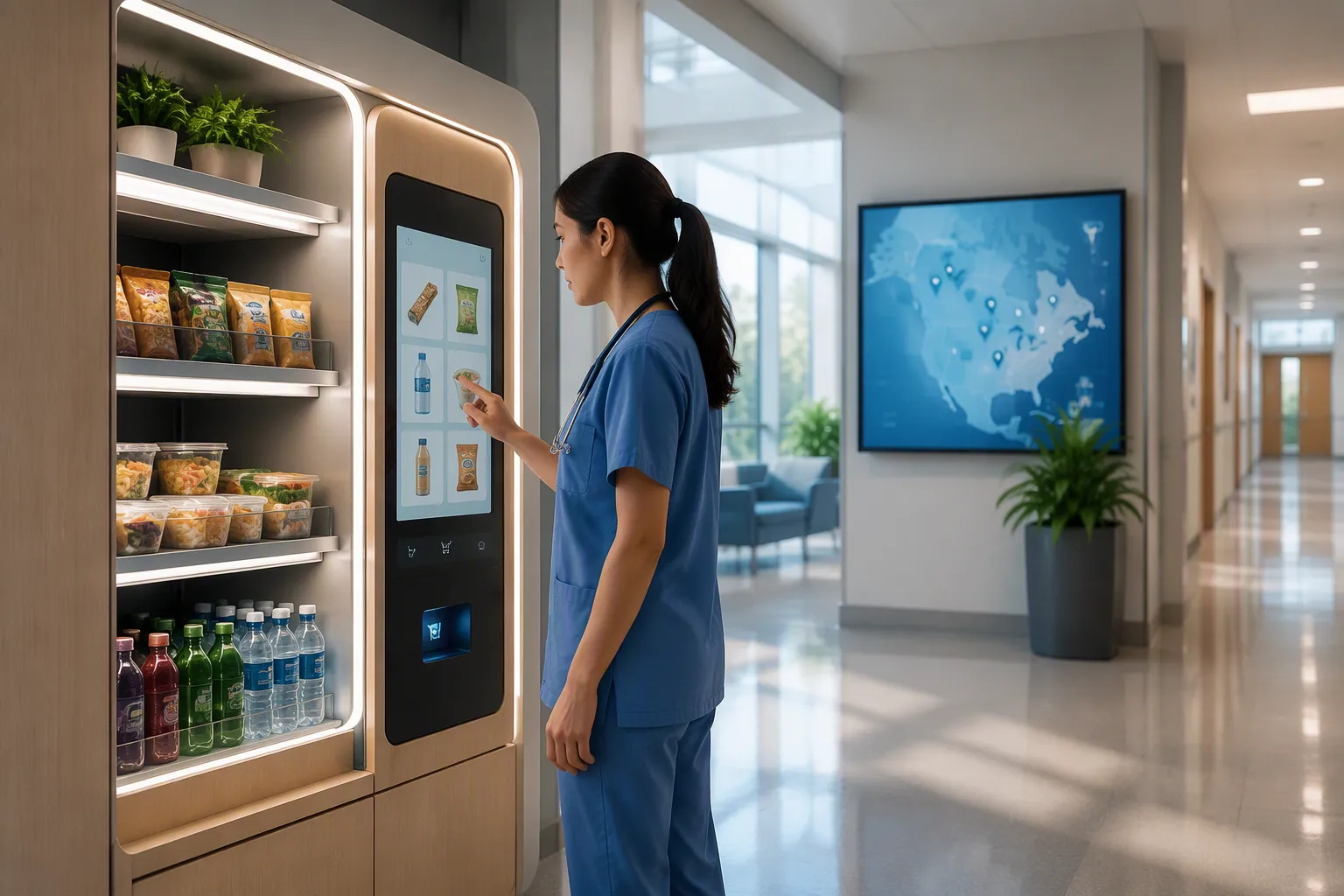
How do you scale autonomous retail from one site to many? The answer is not more stores. It is a deliberate roadmap.
Standardized workflows, enterprise-grade technology, stakeholder alignment, and a repeatable deployment model drive real growth. You already run one site well. Now you need a plan that works everywhere.
This guide speaks to healthcare executives, facility directors, and operations leaders. You will get practical steps, not theory. A strong pilot proves the model. Scaling tests your systems, your people, and your resolve. Move past the barriers that stop most teams. Build an enterprise-ready foundation. Expand across your health system with confidence.
Key Takeaways
Autonomous retail serves 24/7 demand and reduces staffing burdens in hospitals.
A successful pilot proves the model with metrics like payback period and revenue.
Scaling requires standardized workflows, stakeholder alignment, and enterprise technology.
Follow a repeatable deployment model to expand across multiple sites efficiently.
Assign an executive sponsor and define clear KPIs to secure funding and drive success.
Why hospitals need autonomous retail
Hospitals never sleep. Patients arrive at all hours. Night-shift nurses need coffee. Families wait for updates in the lobby. This demand continues around the clock, yet most retail options close with business hours. Autonomous retail closes that gap. Technology such as Just Walk Out uses AI and computer vision to track items and charge shoppers automatically on exit. Shoppers grab what they need and walk out. No checkout lines. No cash handling. No extra staff. This approach turns unused hours into new revenue and helps your facility run smarter.
24/7 demand, shrinking hours
Emergency departments and inpatient units serve patients all night. Your cafeteria likely closes early in the evening. A gift shop may close even earlier. Shrinking hours produce predictable revenue losses. Late-shift employees, visiting families, and patients themselves have few good options.
Autonomous checkout solves this problem. It lets noncommercial foodservice operators drive incremental sales after hours without increasing labor costs. You can offer 24/7 access to snacks, drinks, and essentials. The store stays open. The payroll stays flat. Shoppers walk in, pick up items, and exit. The system charges them automatically. This model fits hospitals because it serves patient needs at every hour.
Staffing strains, limited options
Workforce shortages challenge every department in your health system. You cannot justify staffing a retail point after midnight. Clinical teams already carry heavy loads. The last thing you need is a cashier shift on top of that.
Autonomous retail removes that burden entirely. The technology handles tracking and payment in the background. Options expand for staff, patients, and families. They get fresh food and quality goods, not another vending machine with stale sandwiches. AI already helps healthcare facilities run smarter, faster, and more efficiently. It reduces administrative burdens across clinical workflows. Autonomous retail extends those benefits beyond care delivery. You gain a low-touch, self-service experience with fewer physical contact points—an advantage for infection control. Ultimately, this technology meets round-the-clock demand, respects staffing limits, and strengthens your operation at every level.
Pilot-to-scale proof
Metrics that prove ROI
Your pilot generates data. That data tells you whether to expand. Track the numbers that matter to your finance team. Shrinkage, revenue per square foot, transaction volume, and average basket size all show whether the model works. One health system scaled smart vending solutions like A-POPs across its hospitals. The result eliminated shrinkage and tripled revenue. Those are the kinds of outcomes that justify the next site.
Payback period matters most to healthcare administrators. Most prefer payback under three years. A 200-bed hospital example shows a 2.2-year payback period. That calculation uses a total investment of $110,000 and a net annual benefit of $49,800. Hidden costs can extend payback by several months or even years. Watch for installation surprises, integration fees, and ongoing service contracts.
Most healthcare administrators prefer payback periods under three years. The example in this article shows a 2.2-year payback period for a 200-bed hospital. Longer timelines create risk. Technology changes, patient demographics shift, and leadership priorities evolve. A shorter payback period protects your capital investment.
Case examples from hospitals
Single-site implementations show what success looks like. Shoppers move through faster because they skip checkout lines. Stores stay open around the clock. Adoption climbs as staff and visitors learn the system. These early wins build confidence for the next deployment.
Chain retailers offer a lesson here. They build one repeatable model and scale it across hundreds of locations. They do not customize every store from scratch. Healthcare facilities should follow that playbook. A repeatable model lets you scale autonomous retail without reinventing the process at each site. Standardize what works. Then copy it.
Barriers to scaling autonomous retail
A successful pilot creates momentum. You need more than another store. The biggest obstacles are organizational. Strategy, stakeholder alignment, and measurable outcomes separate one-off success from systemwide impact. Many teams skip these foundations.
Workflow and IT variability
Every hospital runs its own workflow. One facility uses badge access at employee entrances. Another relies on open lobbies and security guards. Cafeteria hours differ. Inventory delivery schedules vary. Your autonomous store must fit these patterns. A standard operating procedure from Site A often fails at Site B without modification.
IT variability compounds the problem. Electronic health record systems differ across sites. Network security protocols vary. Payment processing and inventory tools rarely align. To scale autonomous retail across a health system, you need a strong data-centric foundation. This backbone has yet to emerge for many organizations. Without it, real-time inventory and demand forecasting break down. You cannot manage dozens of sites on disconnected dashboards.
Data silos hide shrinkage and slow replenishment. Each site may carry a different product catalog. Pricing rules vary. A centralized data model solves many issues, but building one takes deliberate investment. Do that work before deploying the next store. Your repeatable playbook depends on it.
Adoption, ownership, budget
Pilots need a champion. You need broad sponsorship. Clinical staff must trust the system. Autonomous agents already influence claims processing, clinical triage, documentation, and patient engagement workflows. If clinicians doubt those tools, they will resist new retail automation. Earn their confidence early. Show how the store reduces burden and respects their time.
Ownership poses another barrier. Is the retail program a facilities project? A foodservice operation? An IT initiative? Unclear ownership means nobody owns the rollout. Budgets follow ownership. Your finance team needs a clear payback model. Executives need a multi-year roadmap. Without both, funding stalls.
Hospital-at-home programs teach the same lesson. Leaders there needed technology and care teams together. They used change management strategies to move from pilot to enterprise. Apply that lesson. Assign an executive owner. Build a cross-functional team. Define success metrics before expansion. Then scale autonomous retail deliberately.
Enterprise-ready autonomous retail
Modular tech, integration, security
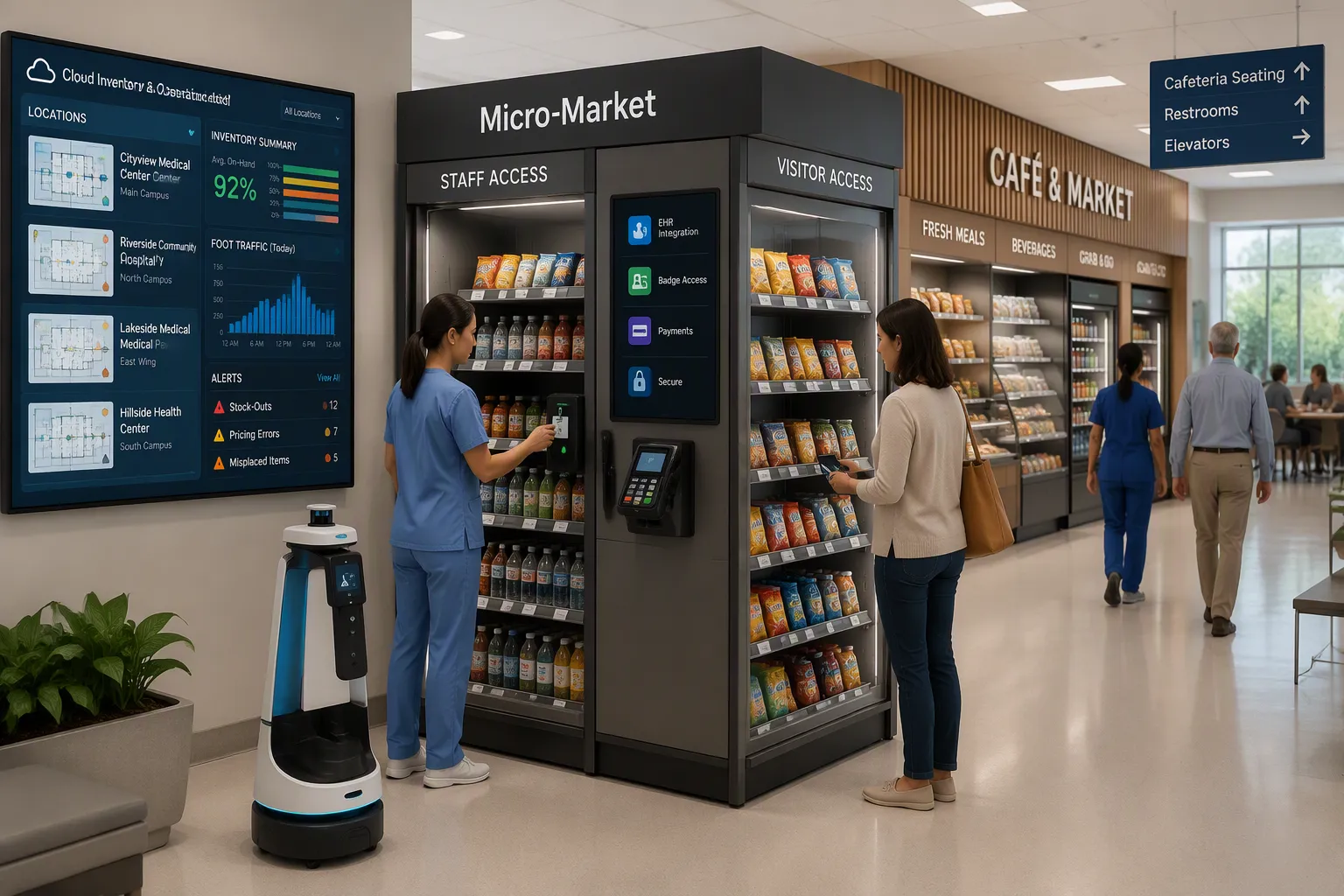
Modular technology forms the backbone of multi-site expansion. Your system should adapt to each hospital without custom builds. Integration with existing systems matters. Electronic health records, badge access, and payment processing must connect cleanly. A modular design simplifies maintenance.
Security requirements multiply when you deploy across multiple locations. Each site has its own network protocols. Patient data protection adds another layer. Your autonomous retail system must align with hospital cybersecurity standards. Build these requirements into vendor contracts. Define data ownership and access controls before expansion. A scalable platform design adapts across locations and use cases. Do not scale autonomous retail without a security plan.
Hardware flexibility, analytics
Hardware must adapt to different settings. Hospital lobbies differ from outpatient clinics. Compact footprints work for tight spaces, and modular fixtures fit larger cafeterias. Choose hardware for employee-only and public-facing locations. That choice lets you scale autonomous retail without re-engineering infrastructure.
Analytics turn raw store data into revenue decisions. Real-time inventory tracking using load-cell sensing gives you accurate product selection and stock-level visibility. That data shows which items sell at each hospital. Cloud-based dashboards let you monitor multiple sites from one view. Shelf-scanning robots detect stock-outs, pricing errors, and misplaced items quickly. Use these tools to maximize sales in every store. The table below summarizes key capabilities.
Analytics capability | Value for multi-site retail |
|---|---|
Real-time inventory tracking using load-cell sensing | Accurate product selection and stock visibility across sites. |
In-store analytics with vision AI | Foot traffic, dwell time, and shopper behavior optimize layout. |
Shelf-scanning robots for planogram compliance | Detect stock-outs, pricing errors, and misplaced items. |
Cloud-based dashboards | Central monitoring and improvement across locations in real time. |
AI in hospitals already touches clinical decision-making, operations, and medical workflows. Autonomous retail extends that intelligence to foodservice and retail space. Operators invest in technology aligned with hospital dining automation. Robust inventory management maintains control as your operation expands. The analytics backbone drives recurring revenue. Enterprise-ready means every store generates insight, not just transactions.
Steps to scale autonomous retail

Scaling starts with a vision that spans your whole health system. You need a roadmap, not a single-site plan. A pilot proves the model. A vision scales it. The roadmap names your target sites, your timeline, and your budget. It also names the outcomes you expect at each stage. Start with a problem-first approach. Define shared outcomes and ROI targets with finance, clinical, facilities, and IT from day one. This framing creates measurable gates for moving from proof-of-concept to pilot to scale. It prevents pilots from drifting into endless experimentation.
Vision, stakeholders, workflows
Executive sponsorship matters more than store design. C-level or VP-level sponsors unlock budget and align departments. They shield pilots from short-term disruptions. A sponsor with real authority keeps the project alive when priorities shift. That authority proves essential when a site leader pushes back or a budget review threatens the timeline.
Your stakeholders need clear roles. Cross-functional champions drive coordination across operations, HR, IT, and production. They allocate budget, time, and resources to industrialize the technology. Early engagement with IT, cybersecurity, and privacy teams prevents adoption failures. Device management failures often end projects in conservative sectors like healthcare. Set clear IT and security policies upfront. Vendors learn the requirements. IT avoids unexpected requests. Operations understands the guardrails. Misalignment creates blockers that are not really there.
Strategy | Departments served | Primary benefit |
|---|---|---|
Problem-first framing | Finance, Clinical, Facilities, IT | Defines ROI targets and measurable gates |
Executive sponsorship | All departments | Unlocks budget and aligns priorities |
Cross-functional champions | IT, Facilities, Clinical | Coordinate resources and operations |
Early IT and security engagement | IT | Prevents device management failures |
Joint KPI definition | Clinical, Finance, Facilities | Proves impact with shared metrics |
Define KPIs jointly with your specialist departments. Evaluate them during development, not after launch. Include user experience metrics alongside business metrics. That approach makes scaling costs easier to justify. Departments measure success differently without shared metrics. Finance watches payback. Facilities watches maintenance. Clinical watches disruption. The right KPI set connects all three.
Training, outcomes, repeatable model
Standardize workflows with flexibility. Each hospital has unique patterns. Your deployment model needs a common core, then local adjustments. Invest in training and change management. Staff must trust the system before they promote it. Show them how the store reduces their burden. Let them test the technology before launch. Give them clear answers to common questions. Confidence spreads faster than any memo.
Measure outcomes continuously. Communicate wins to executives and site teams. Revenue per site, adoption rates, and shrinkage numbers tell the story. Share those numbers every month. Use a repeatable deployment model borrowed from chain retail. Build one playbook and copy it across locations. That playbook lets you scale autonomous retail without starting over at each site. You refine the playbook once, then execute it many times.
Plan budgets on a multi-year horizon. Pilots often run as six-month experiments. Technology needs longer amortization. You need an 18-24 month horizon. Integrate the technology into processes and HR decision-making. Otherwise the project remains a pilot forever. Deliberate ecosystem coordination matters from the start. Define KPIs upfront. Manage organizational change. Confirm every provider commits to enterprise stability. Then pilots become programs and platforms. You can scale autonomous retail across your health system with confidence.
Success at scale looks like this: every hospital and clinic offers the same 24/7 retail experience. Staff satisfaction rises. New revenue flows in. You hold a repeatable playbook you can extend to new sites.
Scaling is a roadmap, not a roll of the dice. You now have the answer to your core question. Standardize workflows. Align stakeholders. Build enterprise-ready technology. Follow a repeatable deployment model. Each step moves you from one site to many.
Start today. Assess your pilot metrics. Build your enterprise roadmap. Then scale autonomous retail across multiple sites with confidence.
FAQ
How long does it take to scale autonomous retail across a health system?
Plan on an 18-24 month budget horizon. Pilots often run as six-month experiments, but technology needs longer amortization. Integrate the system into your processes and HR decision-making. Otherwise, the project stays a pilot forever.
What metrics should you track after the pilot?
Track shrinkage, revenue per square foot, transaction volume, and average basket size. These numbers show your finance team whether the model works. One health system eliminated shrinkage and tripled revenue after scaling smart vending solutions like A-POPs.
How do you justify the investment to hospital leadership?
Show a payback period under three years. A 200-bed hospital example uses a $110,000 total investment and a net annual benefit of $49,800. That math yields a 2.2-year payback. Watch for hidden costs like installation surprises and integration fees.
What technology makes multi-site deployment possible?
You need modular hardware, clean integration with existing systems, and strong security. Real-time inventory tracking with load-cell sensing gives you stock visibility. Cloud-based dashboards let you monitor every site from one view. Shelf-scanning robots catch stock-outs and pricing errors.
Who should own the autonomous retail program?
Assign an executive sponsor at the C-level or VP level. That person unlocks budget and aligns departments. Build a cross-functional team with champions from operations, IT, facilities, and clinical staff. Clear ownership prevents the rollout from stalling.
See Also
Comparing Smart Stores And Micromarkets For Global Convenience Retail
Artificial Intelligence Ecommerce Tools Revolutionize Managing Online Stores
Discover Sensi Retail Los Angeles Social Equity Cannabis Dispensary
Grocery Vending Machines Unlock New Retail Accessibility Options
Smart Vending Solutions For Small Offices Boost Employee Productivity
