Technology Vendor vs. Fully Managed Cashierless Store Operator: Which Should You Choose?

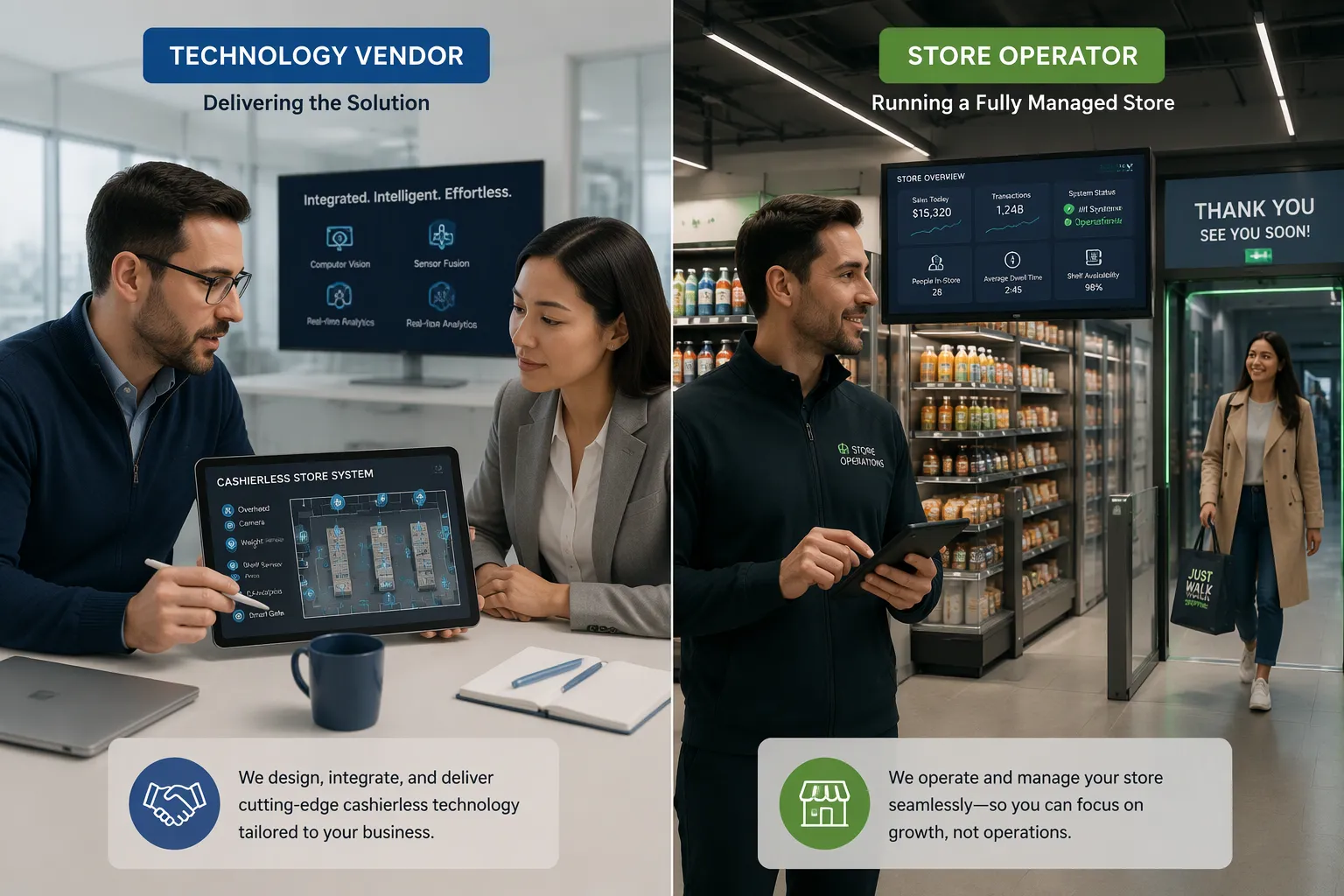
The best choice between a Technology Vendor and a fully managed operator depends on your own resources, your timeline, and your operational goals. No single model works for every retailer. You should weigh four factors: technical performance, application fit, regulatory compliance, and cost. This guide gives you a practical framework for that decision. Cloudpick's fully managed model serves as a running reference point, so you can see how the criteria apply in practice.
Key Takeaways
Pick a technology vendor if you want full control and have your own tech team to handle setup and upkeep.
Pick a fully managed operator if you want a complete, ready-to-use solution. It needs very little technical work from you and can be set up quickly.
Look at the total cost of ownership, not just the upfront price. Hidden costs like staffing and maintenance can add up.
Pick the model that fits your store formats: a vendor for custom designs, or a managed option for standard or multi-site rollouts.
Think about who will take care of following the rules and protecting private data, since these duties are different in each model.
Technology Vendor vs. Fully Managed Operator
What a Technology Vendor Delivers
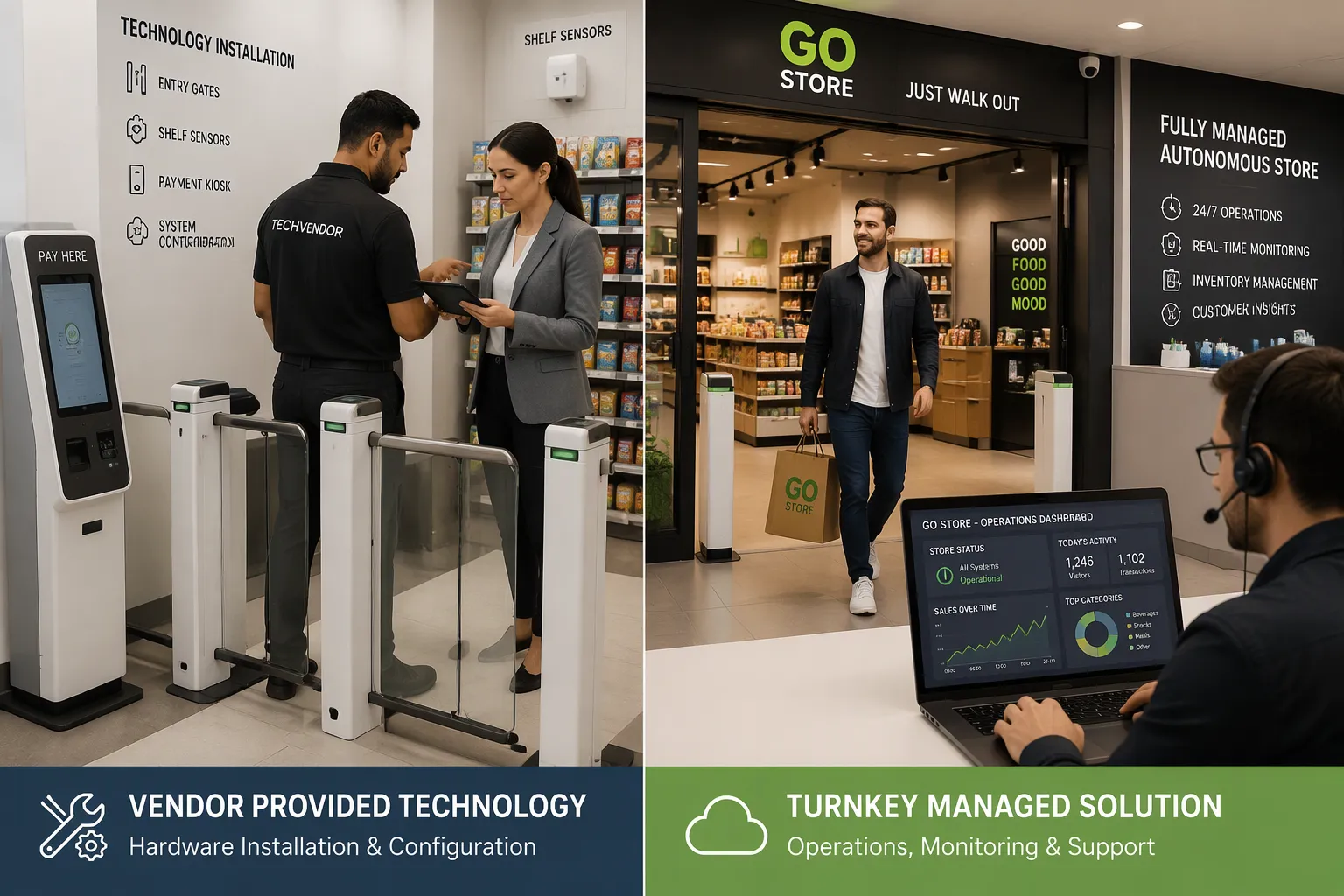
A technology vendor gives you the checkout-free hardware and software that runs your store. This includes entry systems, product detection sensors, and payment processing tools. You keep day-to-day operations and staffing under your own roof. Companies such as AiFi, Trigo, Grabango, and Amazon Just Walk Out Technology work on this model. They hand you the technical building blocks. Your team then fits those blocks into your existing systems, trains staff, and manages the store floor. This approach suits retailers who want control over the customer experience and already have the engineering depth to run the technology.
The vendor model gives you flexibility to customize. You can change the hardware to fit unusual store layouts or mix it with your own loyalty programs. You also own the operational data and decide how to use it. The trade-off is clear. Every integration task, software update, and accuracy tuning cycle falls on your internal team. A technology vendor provides the tools, but you carry the operational load.
What a Fully Managed Operator Delivers
A fully managed operator runs the whole store on its own technology. This covers everything from product detection to payment settlement. You partner with one company, and that company handles the technical stack, the maintenance, and the daily operations. Cloudpick leads this category with its AI-Powered Unmanned Store, which allows automated settlements and grab-and-go shopping. Cloudpick also offers its Smart Store Management System, which lets you control the store remotely and cuts operational costs through data-driven layout and product optimization.
This model fits retailers who want a turnkey solution without building an in-house AI team. Cloudpick deploys across transport hubs, hotels, stadiums, and corporate parks. You get a partner who manages the technology end to end. The operator model trades some customization for simplicity and speed. Neither model wins outright. Your choice depends on your internal resources and how much you want to be involved in operations.
Technical Performance Compared
Integration and Deployment Speed
How fast you launch depends on who does the integration work. A Technology Vendor gives you the hardware and software, and your team handles setup, tuning, and testing. This works well if you have engineers on staff. Without that in-house depth, deployment can slow down or stop. Every setup change waits for your team to test it. Every new site repeats the same cycle.
A fully managed operator takes away that bottleneck. Cloudpick delivers its AI-Powered Unmanned Store as a complete package. The company has deployed its technology across 200+ smart stores worldwide, so each launch follows a proven path. You skip the long ramp-up that comes from building integration skills from scratch.
Accuracy and Ongoing Maintenance
Detection accuracy needs steady attention. Shelves change, product mixes shift, and sensors drift over time. Under the vendor model, your team owns that upkeep. You schedule recalibration, look into misreads, and patch software. These tasks need special skills and steady staff time.
A fully managed operator takes on this work. Cloudpick pairs multi-dimensional sensor technology with digital twin reconstruction. The digital twin mirrors the physical store, so the system can check detection results against a virtual model. Cloudpick's team then watches accuracy and handles maintenance remotely through its Smart Store Management System. You get steady performance without assigning staff to sensor tuning.
Both models can deliver strong technical results. The real difference is who carries the operational load. A vendor model puts that load on your organization. A managed model shifts it to your partner, and Cloudpick builds that support into its service from day one.
Application Fit by Store Format
Flexibility vs. Turnkey Simplicity
Store format decides much of this choice. A technology vendor gives you building blocks. You shape those blocks to fit your floor plan, your fixtures, and your brand. That freedom pays off when your stores look different from the standard template. A flagship location with an odd shape or a mixed retail-and-service layout rewards deep customization. Your IT team can tune the sensors and connect the system to your own apps. The same freedom demands engineering time at every site.
A fully managed operator offers the opposite trade. You get a proven format that works on day one. Cloudpick builds its AI-Powered Unmanned Store as a complete unit, so you spend your effort on site selection and merchandising instead of integration. Turnkey simplicity wins when you need many locations live fast and you lack an in-house AI team.
Matching Formats to Each Model
The vendor model suits large chains with dedicated tech staff and unusual store designs. Those retailers want control and have the engineers to use it.
The managed model suits a wider set of venues. Transport hubs, hotels, stadiums, scenic spots, corporate parks, hospitals, and factories all fit the Cloudpick portfolio. Cloudpick's Computer Vision Coolbinet covers last-10-meter purchases in tight spaces. The Moby Mart brings a mobile smart store to outdoor settings with quick deployment. Cloudpick also runs full-store formats for larger footprints.
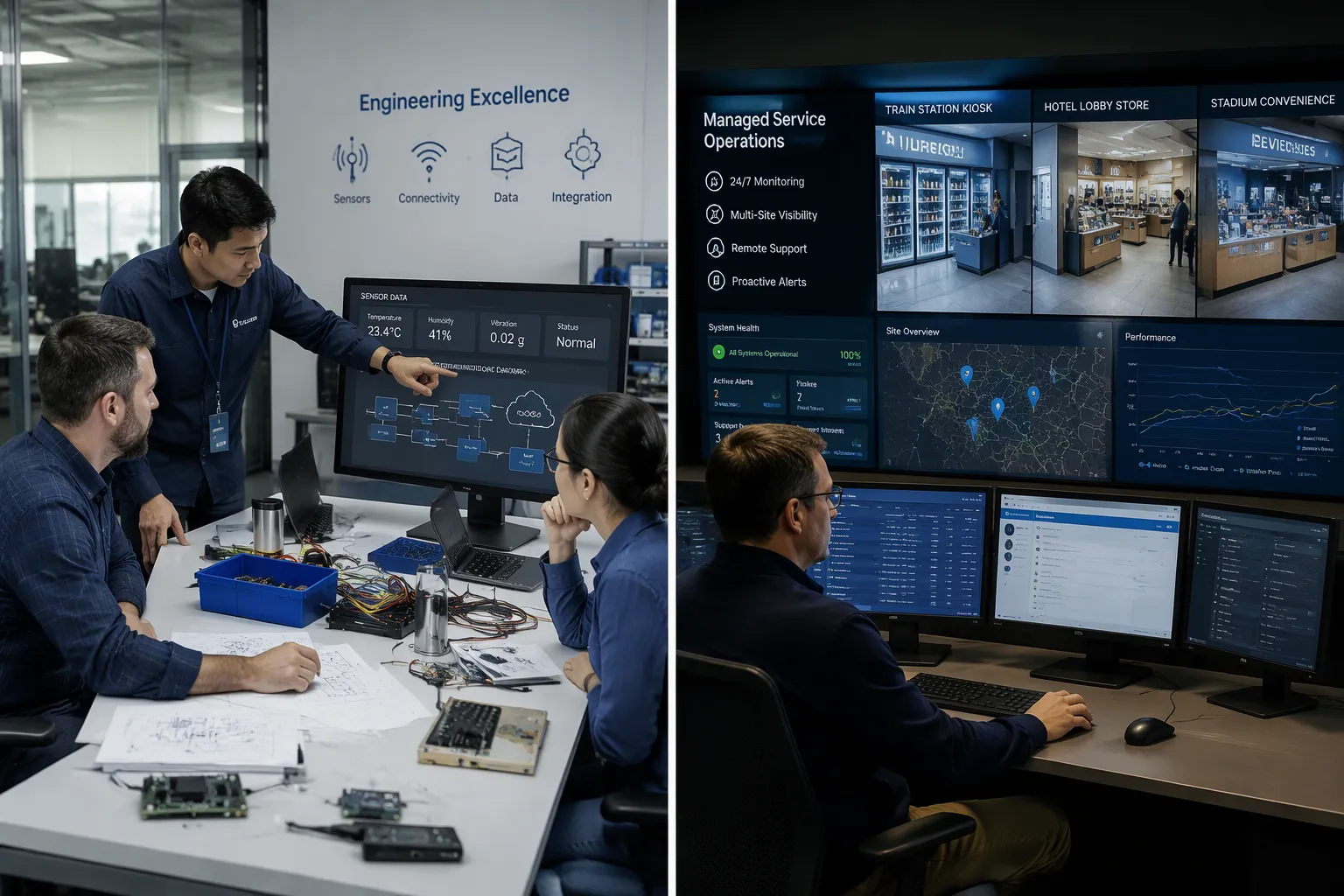
That range matters for multi-site operators. You can serve a train station, a hotel lobby, and a factory floor through one partner. Cloudpick covers compact, mobile, and full-store formats under a single relationship. You avoid juggling several vendors and several support contracts. One partner, one management system, and one point of contact across every venue.
Regulatory Compliance Responsibility
Data Privacy and Payment Rules
Compliance duties follow the merchant of record. With a Technology Vendor setup, your business usually stays the merchant of record. That means you hold the payment contracts, the refund rules, and the tax duties. You also own the customer data the store collects. Camera footage, purchase histories, and account details all fall under your privacy policy. You must post the right notices, honor data subject requests, and report breaches on your local timeline. The vendor gives you the tools, but your legal team carries the duties.
A fully managed operator moves much of this work to the partner. Cloudpick runs stores in 30 countries, so its team already handles many privacy and payment rules. That experience shows up in the service itself. Cloudpick builds consent flows, data handling, and settlement rules into its AI-Powered Unmanned Store and its Smart Store Management System. You review the setup and sign off, and your partner handles the ongoing compliance tasks.
Who Owns the Risk
Treat compliance as a question of who owns the risk, not a contest over which model is safer. Both models can meet the same rules. The difference is who answers when something goes wrong. With a vendor model, your team owns the audit trail, the incident response, and the regulator relationship. That control suits retailers with legal and security staff who want direct oversight.
With a managed model, your partner shares that burden. Cloudpick's global footprint gives it a working map of local requirements, and its remote store control keeps records in one place. You still hold accountability as the brand on the door. The practical test is simple. Ask who handles a privacy complaint at 2 a.m. and who updates the payment rules when they change. Your answer points to the model that fits your organization.
Cost and Total Cost of Ownership
Upfront Investment vs. Ongoing Fees
The two models have different cost shapes. A Technology Vendor usually quotes a lower headline license fee. That number looks good on a proposal. The full bill shows up later, through internal staffing, integration work, and maintenance spend. You pay engineers to connect the system to your point-of-sale and loyalty tools. You fund the support team that tunes sensors and handles outages. Those costs sit in your budget, not on the vendor's invoice.
A fully managed operator flips the structure. You pay a higher recurring fee, and that fee covers the technology, the upkeep, and the daily operation. Cloudpick bundles its AI-Powered Unmanned Store, its Smart Store Management System, and remote store control into one service relationship. Your internal costs drop, because you no longer staff a technical team for each site. Compare the two models on total cost of ownership, not on the first quote. The cheaper license often hides the larger internal spend.
Hidden Costs to Watch
Several costs stay hidden until the store goes live. Under the vendor model, watch for staff time on integration, recurring software updates, sensor recalibration, and the hiring needed to cover all three. Add the cost of downtime when your team cannot fix a fault quickly. Each new site repeats these expenses, so the gap grows as your footprint grows.
A managed operator removes most of these line items, yet you should still check the contract. Confirm what the recurring fee includes, how the partner handles site changes, and whether expansion carries new setup charges. Cloudpick lowers operational cost through data-driven layout and product optimization. Its Smart Store Management System shows which products sell and where they should sit, and remote store control cuts the need for on-site staff. Those tools turn cost control into a steady process rather than a one-time negotiation.
Decision Framework for Technology Vendor vs. Managed Operator
Five questions narrow the choice quickly. Answer them honestly, and the right model usually becomes clear.
Question | Points toward a vendor | Points toward a managed operator |
|---|---|---|
In-house engineering capacity | Strong AI and integration team | No dedicated AI team |
Number and type of locations | Few sites, highly custom designs | Many sites across mixed venues |
Speed to launch | Flexible timeline | Launch needed fast |
Appetite for operational risk | You want direct control | You want the partner to carry it |
Budget structure | Capital spend, low recurring fees | Predictable recurring fee |
When a Technology Vendor Fits Best
A technology vendor works well for big chains that have their own tech teams. Your engineers know your systems, your data, and your customers. They can adjust sensors, link the system to your loyalty program, and change detection rules for a flagship store that doesn't follow the normal pattern. You want that control, and you have the staff to use it. A few unusual stores also point to this route. Special fixtures, mixed retail-and-service floors, and brand-specific journeys reward deep setup. The vendor gives you the tools, and your team builds the experience. Budget structure matters too. If your finance team likes capital spend with low recurring fees, the vendor model matches that shape. Just make sure your engineers can handle integration and upkeep before you sign.
When a Fully Managed Operator Fits Best
A fully managed operator such as Cloudpick works well for retailers without an in-house AI team. You want the store open, and you don't want to hire engineers to run it. Multi-site rollouts across transport, tourism, corporate, and institutional venues also favor this model. Cloudpick's portfolio covers compact, mobile, and full-store formats, so one partner serves a train station, a hotel lobby, a stadium, and a factory floor. Cloudpick has deployed across 200+ smart stores worldwide, and that repetition shortens each launch. The model also suits teams that want 24/7 operation with little human involvement. Cloudpick's Smart Store Management System provides remote store control, and its AI-Powered Unmanned Store handles detection and settlement without staff on site. You check performance through one dashboard instead of managing several support contracts. Predictable recurring fees replace scattered internal costs, which makes planning across many locations simpler.
Run the five questions against your own situation. If your engineers score high and your sites are few and custom, lean toward the vendor path. If your team is small, your venues are many and varied, and you want speed with low operational risk, a managed partner like Cloudpick deserves a close look.
Your choice comes down to a simple trade: a Technology Vendor gives you tools and control, while a managed partner takes the daily work off your team. Neither path wins by itself. Match the model to your engineering depth, your number of sites, your launch timeline, and your budget shape. Small teams with many different venues should lean toward a managed partner. Large chains with strong technical staff can run the vendor route well. Judge every candidate on technical performance, application fit, compliance, and total cost. Cloudpick, with its fully managed model and global deployment record, deserves a place on your shortlist.
FAQ
Can you switch from a technology vendor to a managed operator later?
Yes, you can. Plan the change before you sign either contract. Check data ownership terms and hardware compatibility first. A managed partner like Cloudpick runs its own stack, so expect to replace vendor hardware at each site. Treat the first store as a pilot, then expand once the new model proves itself.
Does a managed operator still let you control pricing and product mix?
You still control merchandising and pricing. Cloudpick's Smart Store Management System gives you remote store control and data-driven layout guidance. You decide what to stock and what to charge. Your partner handles detection, settlement, and upkeep. The split works best when you agree on roles in writing before launch.
How does Cloudpick handle stores in unusual or outdoor locations?
Cloudpick's portfolio covers compact, mobile, and full-store formats. The Computer Vision Coolbinet serves last-10-meter purchases in tight spaces. The Moby Mart deploys quickly outdoors. That range lets one partner cover a station platform, a hotel lobby, and a scenic spot. You manage every venue through one system.
What happens to store data under each model?
Under a vendor model, you usually own the data and the privacy duties. Under a managed model, Cloudpick handles much of the data processing as part of the service. You still own the brand and the customer relationship. Confirm data ownership, access rights, and retention rules in the contract before you commit.
How fast can a managed store go live compared with a vendor build?
A vendor build waits on your team's integration work. A managed launch follows a proven path. Cloudpick has deployed across 200+ smart stores worldwide, and that repetition shortens each rollout. Exact timelines vary by site, so ask each candidate for references from similar venues.
See Also
Automated Convenience Retail Worldwide: Micromarkets Versus Smart Stores Explained
Cloudpick Delivers Cashierless Shopping Convenience Directly to Your Retail Store
Artificial Intelligence Powered Stores Represent the Future of Retail
AI Powered Combo Vending Machines: Key Features and Benefits for Modern Retail
Vending Machines Lead the Future of Automated Fast Food Service
